
الموارد
استكشف مجموعة واسعة من الموارد القيمة حول تعليم المواطنة العالمية لتعميق فهمك وتعزيز البحث والمناصرة والتعليم والتعلم.
تم العثور على 190 نتيجة
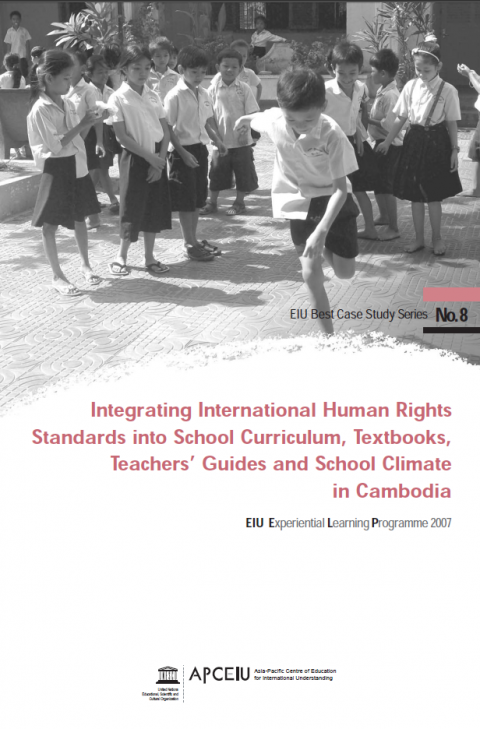 EIU Best Practice Series No.8: Integrating international human rights standards into school curriculum, textbooks, teachers' guides and school climate in Cambodia سنة النشر: 2007 المؤلف: Seungmi Lee | Hyewon Jung المؤلف المؤسسي: APCEIU It goes without saying that the aftermath of the war brings various challenges such as poverty, displacement, disability, destroyed culture, etc. and it is of critical importance that it should be well-remedied to preclude its recurrence. In this regard, value education and human rights education are considered crucial and to my mind, so is the educational role that religion can play. Although religions have harmonized the impaired society, but generally they have not been appreciated by their ignorant disciples or followers. Thus, value education is considered to be able to play a crucial role. It is in this context that human rihts education is gaining currency in Cambodia in recent years and has been implemented gradually.
  Two concepts, one goal: education for international understanding and education for sustainable development سنة النشر: 2007 المؤلف المؤسسي: APCEIU | UNESCO Bangkok EIU and ESD are not dogmas but evolving concepts that can contribute to social learning and transformation. EIU and ESD share many common issues, supporting each other’s scope of work and focus. This series of information sheets has been prepared to highlight key complementary areas and synergies.
  EIU Best Practice Series No. 5: Peace and human rights education through education for sustainable development: lessons from four case studies in the Philippines سنة النشر: 2007 المؤلف المؤسسي: APCEIU The four case studies showed that EIU through peace and human rights education in the context of education for sustainable development can build a critical mass of Filipinos who will reject wars and promote social security. Education can play a role to direct the children, youth, and adults toward peace building and better understanding of cultural differences. It should also be noted that when institutions adopt a peace culture, establishing local and international organizations and putting up resources for various peace-building initiatives become possible. Educational intervention can effect changes in the minds of men and build a lasting and substantive foundation for peace based on justice and respect for human rights.
 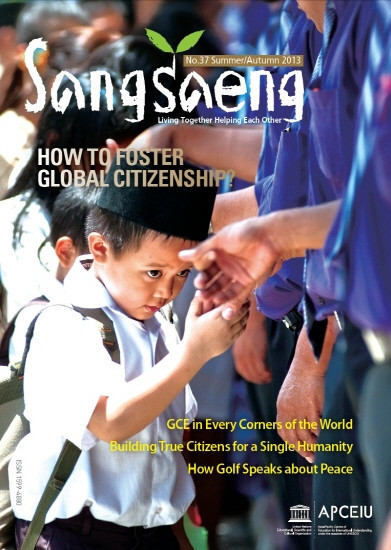 Building a global community out of the ashes of poverty (SangSaeng no. 37 summer autumn 2013) سنة النشر: 2013 المؤلف المؤسسي: APCEIU SangSaeng No. 37- How to Foster Global Citizenship? has been published. In order to help our readers better grasp the concept of global citizenship and provide useful information and new ideas, this issue deals with various aspects of global citizenship education.3 Director’s Message4 Special ColumnBuilding True Citizens for a Single Humanity8 Focus: How to Foster Global Citizenship?8 Eliminating World Challenges through Global Citizenship Education 13 Developing Global Citizens with a Global Perspective18 Living in a New World Starts with Education23 GCE in Every Corners of the World28 Best Practices28 Hands-on Hand Print for Environmental Sustainability32 Bhutan Teachers Learn New Models of Education35 Comic Relief: Song of the City36 Special ReportPaving the Way Together for Global Citizenship Education40 InterviewBuilding a Global Community out of the Ashes of Poverty42 LetterCapturing Moments of Living in Harmony44 Peace in My MemoryHow Golf Speaks about Peace47 Understanding the Asia-Pacific RegionDiscovering Locks beyond the Function of Opening and Closing50 APCEIU in Action
 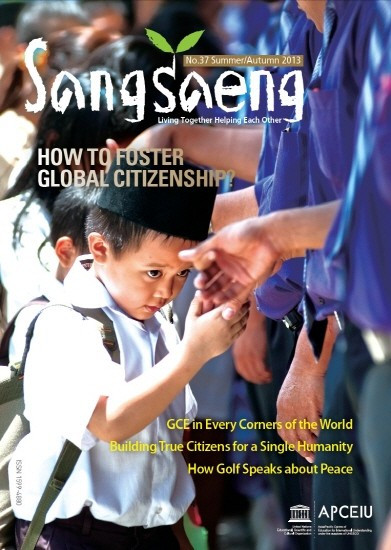 Paving the way together for global citizenship education (SangSaeng no. 37 summer autumn 2013) سنة النشر: 2013 المؤلف المؤسسي: APCEIU SangSaeng No. 37- How to Foster Global Citizenship? has been published. In order to help our readers better grasp the concept of global citizenship and provide useful information and new ideas, this issue deals with various aspects of global citizenship education.3 Director’s Message4 Special ColumnBuilding True Citizens for a Single Humanity8 Focus: How to Foster Global Citizenship?8 Eliminating World Challenges through Global Citizenship Education 13 Developing Global Citizens with a Global Perspective18 Living in a New World Starts with Education23 GCE in Every Corners of the World28 Best Practices28 Hands-on Hand Print for Environmental Sustainability32 Bhutan Teachers Learn New Models of Education35 Comic Relief: Song of the City36 Special ReportPaving the Way Together for Global Citizenship Education40 InterviewBuilding a Global Community out of the Ashes of Poverty42 LetterCapturing Moments of Living in Harmony44 Peace in My MemoryHow Golf Speaks about Peace47 Understanding the Asia-Pacific RegionDiscovering Locks beyond the Function of Opening and Closing50 APCEIU in Action
  Final Report: 18th Asia-Pacific Training Workshop on EIU سنة النشر: 2018 المؤلف المؤسسي: APCEIU This report is the summary of the 18th Asia-Pacific Workshop on EIU (APTW) held in the Republic of Korea from 20 to 28 July 2018. Designed as TOT (Training of Trainers), the Workshop has invited 31 teacher educators/trainers from the Asia-Pacific region, strengthening their capacities to carry out Global Citizenship Education in their respective institutions and countries.
 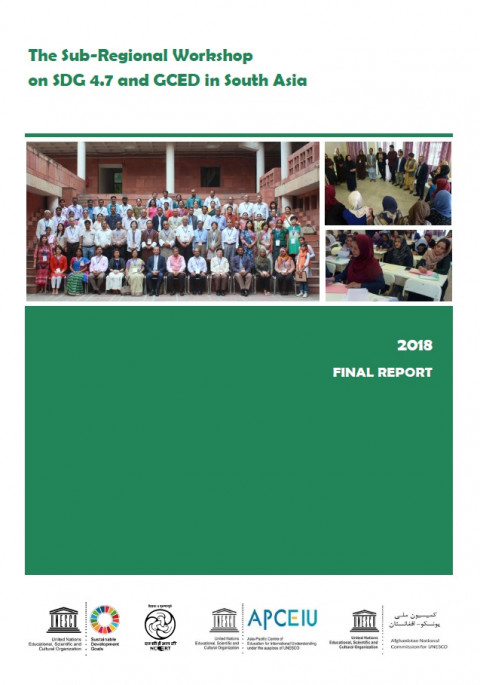 Final Report: 2018 Sub-regional Workshop on SDG 4.7 and GCED سنة النشر: 2018 المؤلف المؤسسي: APCEIU This report is the summary of the Sub-regional Workshop on SDG 4.7 and GCED in South Asia. Implemented by two occasions, the Workshop has offered the platform for the key educators from the South Asian region to discuss GCED in the regional context of achieving SDG 4.7. The report provides the overview of the two workshops held in India and Afghanistan in 2018.
  Global Citizenship Education: A Guide for Trainers سنة النشر: 2018 المؤلف المؤسسي: APCEIU APCEIU has published Global Citizenship Education: A Guide for Trainers in order to aid trainers to conduct introductory workshops for educators on Global Citizenship Education (GCED). Designed as a training manual for trainers, the Guide offers overview of GCED, including backgrounds and core concepts as well as pedagogical principles, but also provides guidelines on the workshop design and facilitation. Consisting of five chapters, the Guide first introduces the rise of GCED within the latest shift in education and global development agendas. Under this framework, the next chapter explores the meanings of a ‘global citizen’ and ‘global citizenship,’ and introduces key concepts and principles of GCED. The next two chapters deal with how to teach GCED, presenting topic areas and themes as well as pedagogies and strategies. The Guide concludes with the last chapter that summarizes and integrates the contents learned in previous chapters by sharing case studies as examples and providing guidelines on how to design GCED activities.The Guide is available in English and French. <Contents> Chapter 1- Why GCED Now?Chapter 2- What is GCED?Chapter 3- GCED: What to Teach?Chapter 4- How to Teach GCED?Chapter 5- Preparing for ActionAnnex: Global Education AgendasUNESCO’s Topics and Learning ObjectivesGCED Resources & Reference Materials
 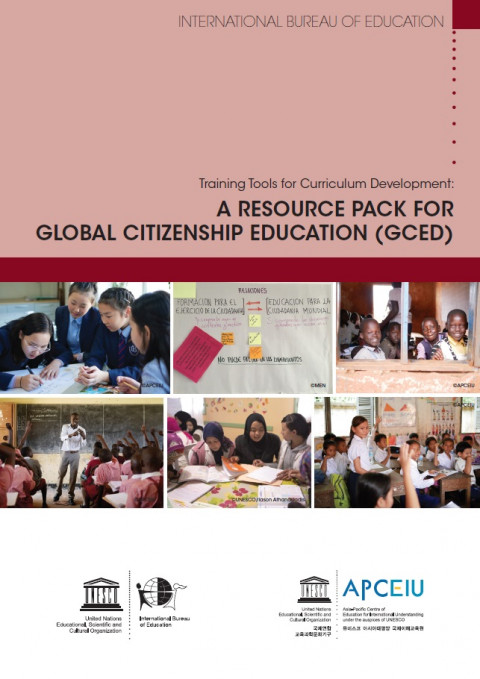 Training Tools for Curriculum Development: A Resource Pack for Global Citizenship Education (GCED) سنة النشر: 2018 المؤلف المؤسسي: UNESCO International Bureau of Education (IBE) | APCEIU The overarching objective of ‘A Resource Pack for Global Citizenship Education (GCED)’ is to share a broader understanding of GCED theory and practice, in order to support its effective development and implementation at the policy, school and classroom levels. The Resource Pack provides comprehensive guidance for national policymakers, curriculum specialists and developers, teacher educators, teachers, school leaders and district level administrators.The key topics covered are:Module 1: IntroductionModule 2: National PoliciesModule 3: CurriculumModule 4: Teaching, Learning and AssessmentModule 5: Teaching and Learning ResourcesModule 6: Whole School ApproachModule 7: Teacher Education and Professional Development
  Europe and North America Regional GCED Network Meeting: Final Report (21-22 November 2018, Lisbon, Portugal) سنة النشر: 2018 المؤلف المؤسسي: APCEIU This meeting report is for the meeting, held on 21-22 November 2018 in Lisbon, Portugal, which aimed to strengthen global action on Global Citizenship Education. The event was jointly organized by the Asia-Pacific Centre of Education for International Understanding (APCEIU) under the auspices of UNESCO, the UNESCO Venice Office and ANGEL project partners GENE.The meeting brought together over 50 GCED-related stakeholders, including those from academia, nongovernmental organizations (NGOs), intergovernmental organizations, ministries, and the National Commissions for UNESCO. The meeting featured a range of presentations and reflections from partners and provided a platform to discuss action to strengthen GCED networking strategies within and beyond the region. It also offered participants the opportunity to share experiences, insights and knowledge with one another, and encouraged them to explore areas of collaboration in the future.