
الموارد
استكشف مجموعة واسعة من الموارد القيمة حول تعليم المواطنة العالمية لتعميق فهمك وتعزيز البحث والمناصرة والتعليم والتعلم.
تم العثور على 9 نتيجة
 The Articulation of Organizational Levels During Interactions of International Students: Current Situation in Various Regions of Quebec (Canada) سنة النشر: 2020 المؤلف: Jorge Frozzini المؤلف المؤسسي: Alterstice This introduction to the thematic issue presents the state of interactions between international students (IS) and the social agents who rub shoulders with them in various regions of Quebec (Canada) as well as in a locality in Bulgaria. They also propose a theoretical framework that focuses on the articulation of three organizational levels affecting the interactions of IS and therefore their resocialization. This framework also pays particular attention to the management technologies that come into play from the first moments when IEs show their desire to study elsewhere until the moment they leave or settle in the new environment. Intercultural encounters in a context where there is an increase in the presence of IEs are thus influenced by the subtleties of the shaping of social relations, which are favored by the articulations of these organizational levels and the coordination made possible by the management technologies in question. a place to ensure control and follow-up (surveillance) with IEs. L’articulation des niveaux organisationnels lors des interactions des étudiants internationaux: État de la situation dans diverses régions du Québec (Canada) سنة النشر: 2020 المؤلف: Jorge Frozzini المؤلف المؤسسي: Alterstice Cette introduction au numéro thématique présente l’état des interactions entre les étudiants internationaux (ÉI) et les agents sociaux qui les côtoient dans diverses régions du Québec (Canada) ainsi que dans une localité en Bulgarie. Nous proposons aussi un cadre théorique qui porte sur l’articulation de trois niveaux organisationnels affectant les interactions des ÉI et donc leur resocialisation. Ce cadre porte aussi une attention particulière aux technologies de gestion qui interviennent depuis les premiers moments où les ÉI manifestent leur volonté d’aller étudier ailleurs jusqu’au moment de leur départ ou de leur établissement dans le nouvel environnement. Les rencontres interculturelles dans un contexte où il y a une augmentation de la présence des ÉI sont ainsi influencées par les subtilités de la mise en forme des relations sociales, que favorisent les articulations de ces niveaux organisationnels et la coordination permise par les technologies de gestion en place pour assurer un contrôle et un suivi (surveillance) auprès des ÉI.
  Interculturality of Disability Situations: From Designation to Recognition سنة النشر: 2021 المؤلف: Geneviève Piérart | Mélissa Arneton المؤلف المؤسسي: Alterstice Alterstice has been offering, for ten years, a unique space for scientific production responding to socially acute questions related to the consideration of inter-individual, social, and societal diversity. This thematic issue is linked to the creation in 2017 of a thematic axis within the International Association for Intercultural Research (ARIC). This network has enabled researchers to organize symposia questioning disability, intersectionality, and how the work carried out in more mainstream currents take into account or not the intercultural dimension to study the paradigm shift of disability. Fifteen years after the launch of the International Convention on the Rights of Persons with Disabilities (CRPD) marks a societal desire to renew living together at the international level as well as at the national level for the countries that have ratified it, as revealed by the work scientific studies carried out from an intercultural perspective. After an introduction to the notions of disability and interculturality, which also refer to designation processes, which may or may not be crossed and compared in scientific analysis. From a multidisciplinary perspective, different angles relating to the diversity of representations of disability and the issues it raises in situations of contact between cultures are discussed. Interculturalité des situations de handicap: De la désignation à la reconnaissance سنة النشر: 2021 المؤلف: Geneviève Piérart | Mélissa Arneton المؤلف المؤسسي: Alterstice Alterstice propose depuis dix ans un espace unique de production scientifique répondant à des questions socialement aiguës liées à la prise en compte de la diversité interindividuelle, sociale et sociétale. Ce numéro thématique est lié à la création en 2017 d'un axe thématique au sein de l'Association internationale pour la recherche interculturelle (ARIC). Ce réseau a permis aux chercheurs d'organiser des colloques questionnant le handicap, l'intersectionnalité, et comment les travaux menés dans des courants plus mainstream prennent en compte ou non la dimension interculturelle pour étudier le changement de paradigme du handicap. Quinze ans après le lancement de la Convention Internationale des Droits des Personnes Handicapées (CDPH) marque une volonté sociétale de renouveler le vivre ensemble au niveau international comme au niveau national pour les pays qui l'ont ratifiée, comme le révèle la travaux d'études scientifiques menées dans une perspective interculturelle. Après une introduction aux notions de handicap et d'interculturalité, qui renvoient également à des processus de désignation, qui peuvent ou non être croisés et comparés dans l'analyse scientifique. Dans une perspective pluridisciplinaire, différents angles relatifs à la diversité des représentations du handicap et aux enjeux qu'il soulève dans les situations de contact entre cultures sont abordés.
  The Genesis of the Category of “LGBT Refugee” Within the United Nations High Commissioner for Refugees سنة النشر: 2021 المؤلف: Ahmed Hamila المؤلف المؤسسي: Alterstice The international protection system is governed by the Geneva Convention of 1951, supplemented by the New York Protocol of 1967. These international conventions list five grounds for granting refugee status: persecution based on race, religion, nationality, membership of a certain social group, and political opinions. These international instruments do not explicitly recognize persecution based on sexual orientation and gender identity as grounds for granting refugee status. However, over the past three decades, the Office of the United Nations High Commissioner for Refugees (UNHCR) has come to recognize such persecution as grounds for granting international protection. In this article, I focus on the genesis of the "LGBT refugee" category within the UNHCR in the early 2000s. The essay argue that the emergence of this new category of refugees is part of two parallel dynamics, which both led to the development of the UNHCR Guidelines, which explicitly recognize persecution based on sexual orientation as a ground for granting refugee status. On the one hand, it is in the context of greater attention paid to refugee women, and in particular to gender-related persecutions, that persecutions related to sexual orientation are for the first time discussed. On the other hand, the category of “LGBT refugee” also appears in the context of the interpretation of the notion of “belonging to a certain social group”. La genèse de la catégorie de « réfugié LGBT » au sein du Haut-Commissariat des Nations Unies pour les réfugiés سنة النشر: 2021 المؤلف: Ahmed Hamila المؤلف المؤسسي: Alterstice Le système de protection international est régi par la Convention de Genève de 1951, complétée par le Protocole de New York de 1967. Ces conventions internationales énumèrent cinq motifs d’octroi du statut de réfugié : les persécutions du fait de la race, de la religion, de la nationalité, de l’appartenance à un certain groupe social et des opinions politiques. Ces instruments internationaux ne reconnaissent pas explicitement les persécutions du fait de l’orientation sexuelle et de l’identité de genre en tant que motifs d’octroi du statut de réfugié. Cependant, au cours des trois dernières décennies, le Haut-Commissariat des Nations Unies pour les réfugiés (HCR) a été amené à reconnaître ces persécutions en tant que motifs d’octroi de la protection internationale. Dans cet article, je m’intéresse à la genèse de la catégorie de « réfugié LGBT » au sein du HCR au début des années 2000. Je soutiens que l’émergence de cette nouvelle catégorie de réfugiés s’inscrit dans deux dynamiques parallèles, qui ont toutes les deux débouché sur l’élaboration des Principes directeurs du HCR, qui reconnaissent explicitement les persécutions du fait de l’orientation sexuelle en tant que motif d’octroi du statut de réfugié. D’une part, c’est dans le contexte d’une plus grande attention portée aux femmes réfugiées, et notamment aux persécutions liées au genre, qu’il est pour la première fois question des persécutions liées à l’orientation sexuelle. D’autre part, la catégorie de « réfugié LGBT » apparaît aussi dans le contexte de l’interprétation de la notion d’« appartenance à un certain groupe social ».
  “Racism, Sexism, Homophobia, Which Card do You Want?” The Post-Migration Experience of Northern LGBTQ People Global and Global South سنة النشر: 2021 المؤلف: Barbara Andrade de Sousa | Line Chamberland المؤلف المؤسسي: Alterstice This article examines the life stories of seven LGBTQ immigrants, from the Global North and South, who live in Montreal. The research on immigration has long been carried out according to a framework heteronormative, which sets aside a whole series of questions relating to the impact of sexual orientation and non-normative gender identity on the migratory experience. Societies impose distinct constraints on LGBTQ people. Once settled in the host society, these subjects can experience more sexual possibilities. However, their origin can become a marker that places them inside a relationship of power with the majority group. This article aims to shed light on how LGBTQ immigrants construct their life stories in a context where their experience is crossed by the interweaving of several aspects of identities such as sexual orientation, gender identity, ethnicity, and religion, to name a few. The intersectional approach makes it possible to identify the systems of binding powers which participants face daily. The thematic analysis gave us allowed to listen to individuals to know the categories of power and the systems of oppression they talk about — the goal being to position respondents as knowledgeable subjects, not mere study objects. Analysis of the interviews shows that LGBTQ individuals who express a diverse combination of identities face specific challenges linked to the migratory route. « Racisme, sexisme, homophobie, quelle carte tu veux ? » L’expérience post-migratoire des personnes LGBTQ du Nord global et du Sud global سنة النشر: 2021 المؤلف: Barbara Andrade de Sousa | Line Chamberland المؤلف المؤسسي: Alterstice Cet article examine l’histoire de vie de sept immigrants ou immigrantes LGBTQ, originaires du Nord et du Sud global, qui habitent à Montréal. Les recherches sur l’immigration ont longtemps été réalisées selon un cadrage hétéronormatif, ce qui met à l’écart toute une série de questions relatives à l’impact de l’orientation sexuelle et de l’identité de genre non normative sur l’expérience migratoire. Les sociétés imposent des contraintes distinctes vis-à-vis des personnes LGBTQ. Une fois installées dans la société d’accueil, ces sujets peuvent expérimenter plus de possibilités sur le plan sexuel ; néanmoins leur origine peut devenir un marqueur qui les place à l’intérieur d’un rapport de pouvoir avec le groupe majoritaire. Notre article vise à mettre en lumière la manière dont les immigrants LGBTQ construisent leurs histoires de vie dans un contexte où leur vécu est traversé par l’imbrication de plusieurs aspects identitaires comme l’orientation sexuelle, l’identité de genre, l’ethnicité et la religion, pour n’en nommer que quelques-uns. L’approche intersectionnelle rend possible l’identification des systèmes de pouvoirs contraignants auxquels les participants font face quotidiennement. L’analyse thématique nous a permis d’être à l’écoute des individus afin de connaître les catégories de pouvoir et les systèmes d’oppression dont ils parlent — le but étant de positionner les répondants comme des sujets connaissants, et non de simples objets d’étude. L’analyse des entrevues montre que les individus LGBTQ qui expriment une combinaison variée d’identités affrontent des défis spécifiques liés au parcours migratoire.
 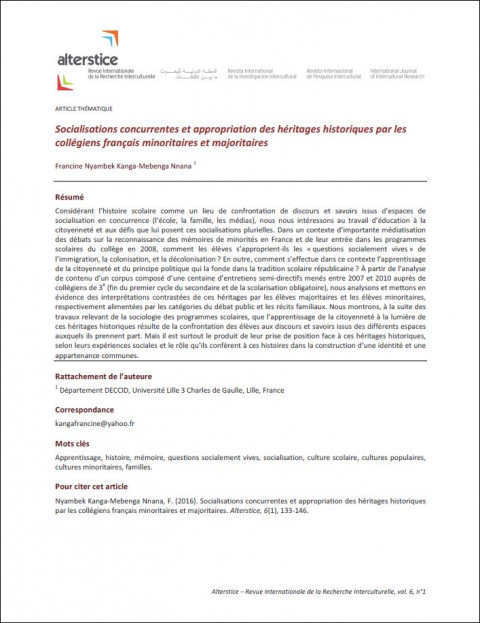 Socialisations concurrentes et appropriation des héritages historiques par les collégiens français minoritaires et majoritaires سنة النشر: 2016 المؤلف: Francine Nyambek Kanga-Mebenga Nnana المؤلف المؤسسي: Alterstice Considérant l’histoire scolaire comme un lieu de confrontation de discours et savoirs issus d’espaces de socialisation en concurrence (l’école, la famille, les médias), nous nous intéressons au travail d’éducation à la citoyenneté et aux défis que lui posent ces socialisations plurielles. Dans un contexte d’importante médiatisation des débats sur la reconnaissance des mémoires de minorités en France et de leur entrée dans les programmes scolaires du collège en 2008, comment les élèves s’approprient-ils les « questions socialement vives » de l’immigration, la colonisation, et la décolonisation ? En outre, comment s’effectue dans ce contexte l’apprentissage de la citoyenneté et du principe politique qui la fonde dans la tradition scolaire républicaine ? À partir de l’analyse de contenu d’un corpus composé d’une centaine d’entretiens semi-directifs menés entre 2007 et 2010 auprès de collégiens de 3e (fin du premier cycle du secondaire et de la scolarisation obligatoire), nous analysons et mettons en évidence des interprétations contrastées de ces héritages par les élèves majoritaires et les élèves minoritaires, respectivement alimentées par les catégories du débat public et les récits familiaux. Nous montrons, à la suite des travaux relevant de la sociologie des programmes scolaires, que l’apprentissage de la citoyenneté à la lumière de ces héritages historiques résulte de la confrontation des élèves aux discours et savoirs issus des différents espaces auxquels ils prennent part. Mais il est surtout le produit de leur prise de position face à ces héritages historiques, selon leurs expériences sociales et le rôle qu’ils confèrent à ces histoires dans la construction d’une identité et une appartenance communes.