
الموارد
استكشف مجموعة واسعة من الموارد القيمة حول تعليم المواطنة العالمية لتعميق فهمك وتعزيز البحث والمناصرة والتعليم والتعلم.
تم العثور على 20 نتيجة
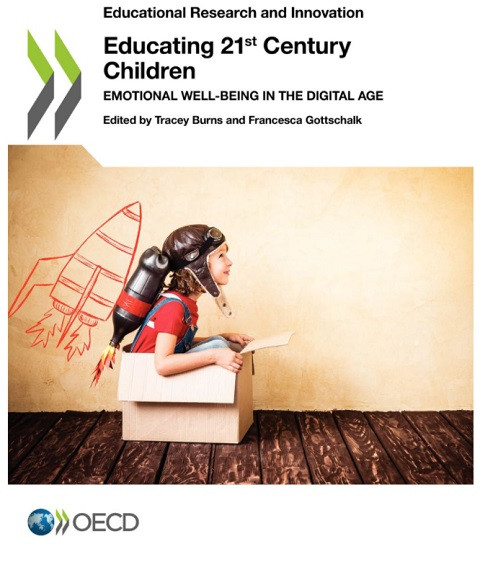 Education 21st Century Children: Emotional Well-being in the Digital Age (Educational Research and Innovation) سنة النشر: 2019 المؤلف المؤسسي: Organisation for Economic Co-operation and Development (OECD) This report examines modern childhood, looking specifically at the intersection between emotional well-being and new technologies. It explores how parenting and friendships have changed in the digital age. It examines children as digital citizens, and how best to take advantage of online opportunities while minimising the risks. The volume ends with a look at how to foster digital literacy and resilience, highlighting the role of partnerships, policy and protection.
 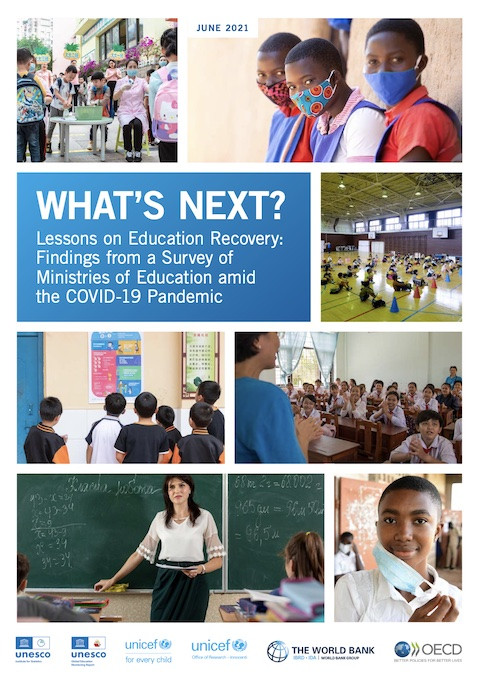 What’s Next? Lessons on Education Recovery: Findings From a Survey of Ministries of Education Amid the COVID-19 Pandemic سنة النشر: 2021 المؤلف المؤسسي: UNESCO | United Nations Children's Fund (UNICEF) | World Bank | Organisation for Economic Co-operation and Development (OECD) United Nations Educational, Scientific and Cultural Organization (UNESCO), the United Nations Children’s Fund (UNICEF), the World Bank and the Organisation for Economic Co-operation and Development (OECD) have collaborated in the third round of the Survey on National Education Responses to COVID-19 School Closures, administered by the UNESCO Institute for Statistics (UIS) and OECD to Ministry of Education officials. The questions covered four levels of education: preprimary, primary, lower secondary and upper secondary. While the first two rounds of the survey were implemented during the periods May–June and July–October 2020, respectively, the third round was implemented during the period February–June 2021. In total, 143 countries responded to the questionnaire. Thirty-one countries submitted responses to the OECD (“OECD survey”) and 112 countries responded to the UIS (“UIS survey”). Seven countries responded to both surveys. In these instances, the more complete set responses were used in analysis.
 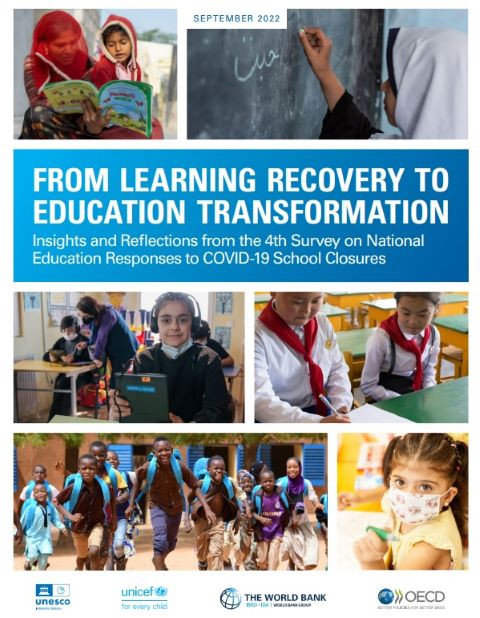 From Learning Recovery to Education Transformation: Insights and Reflections from the 4th Survey on National Education Responses to COVID-19 School Closures سنة النشر: 2022 المؤلف المؤسسي: UNESCO | UNESCO Institute for Statistics (UIS) | United Nations Children's Fund (UNICEF) | World Bank | Organisation for Economic Co-operation and Development (OECD) From Learning Recovery to Education Transformation, a new joint report by UNESCO, UNESCO Institute for Statistics (UIS), UNICEF, The World Bank and The OECD, presents findings from the fourth round of the Survey on National Education Responses to COVID-19 School Closures, administered between April–July 2022 with responses from Ministries of Education in 93 countries. It explores how countries are progressing in the RAPID actions to recover learning: Reach every child and keep them in school; Assess learning levels regularly; Prioritize teaching the fundamentals; Increase the efficiency of instruction; and Develop psychosocial health and wellbeing.
 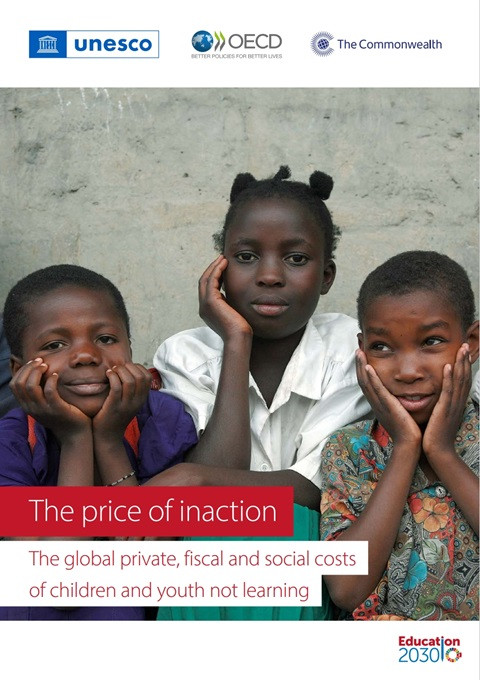 The Price of Inaction: The Global Private, Fiscal and Social Costs of Children and Youth Not Learning سنة النشر: 2024 المؤلف: Giorgio Brunello | Lorenzo Rocco | Matthias Eck المؤلف المؤسسي: UNESCO | Organisation for Economic Co-operation and Development (OECD) | Commonwealth Secretariat Despite efforts by countries, the number of out-of-school children remains significant, with 128 million boys and 122 million girls excluded from schooling. Educational skills deficits are also immense – 57 per cent of the world’s children have not gained basic skill levels. UNESCO, OECD and the Commonwealth Secretariat have developed the first global report to illustrate the monetary costs to economies around the world of leaving children and youth behind in education. Using available evidence, the report calculates the costs, globally and by region, of children and youth that are not in school or gaining basic skills. Calculations are also provided for twenty selected countries in which there are gender disparities in education at either girls’ or boys’ expense. If governments were to increase efforts so that every child was in school and achieving basic skills, the future world GDP would raise by more than US$6.5 trillion annually, not to mention eliminating the social costs of failure. This publication offers the evidence and insights that show that for economic development to accelerate, so must prioritizations and investments in education and gender-transformative action.
 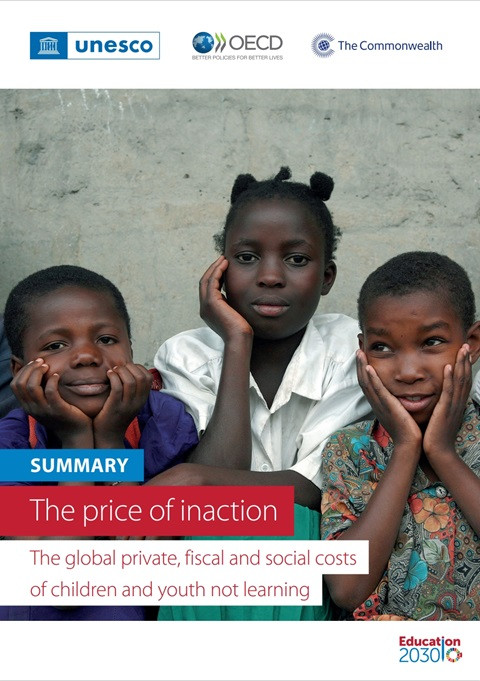 [Summary] The Price of Inaction: The Global Private, Fiscal and Social Costs of Children and Youth Not Learning سنة النشر: 2024 المؤلف المؤسسي: UNESCO | Organisation for Economic Co-operation and Development (OECD) | Commonwealth Secretariat Education is a fundamental human right for all. The United Nations Sustainable Development Goal (SDG) 4 on education has received considerable attention since its adoption in 2015. But more than halfway through the implementation period, achieving the ambitious agenda of inclusive and equitable quality education for all by 2030 remains a significant challenge for countries around the globe. As this report shows, the US$10 trillion social cost of failing to educate all the world’s children is just too high. This is the summary of The Price of Inaction: The Global Private, Fiscal and Social Costs of Children and Youth Not Learning. [Resumen] El precio de la inacción: el costo global privado, fiscal y social de que los niños, niñas y jóvenes no aprendan سنة النشر: 2024 المؤلف المؤسسي: UNESCO | Organisation for Economic Co-operation and Development (OECD) | Commonwealth Secretariat La educación es un derecho humano fundamental para todas y todos. El Objetivo de Desarrollo Sostenible (ODS) 4 de las Naciones Unidas sobre educación ha recibido una atención considerable desde su adopción en 2015. Sin embargo, a más de la mitad del periodo de implementación, la consecución de la ambiciosa agenda de una educación de calidad inclusiva y equitativa para todos en 2030 sigue siendo un desafío considerable para los países del mundo entero. Como muestra este estudio, el costo social de 10 billones de dólares de no educar a todas las niñas y todos los niños del mundo es demasiado elevado. [Résumé] Le prix de l’inaction : les coûts privés, fiscaux et sociaux à l’échelle mondiale des enfants et des jeunes qui n’apprennent pas سنة النشر: 2024 المؤلف المؤسسي: UNESCO | Organisation for Economic Co-operation and Development (OECD) | Commonwealth Secretariat L'éducation est un droit humain fondamental pour tous. L'objectif de développement durable (ODD) 4 des Nations Unies sur l'éducation a suscité une attention considérable depuis son adoption en 2015. Cependant, à plus de la moitié de la période de mise en œuvre, atteindre l'ambitieux objectif d'une éducation de qualité, inclusive et équitable pour tous d'ici 2030 reste un défi majeur pour les pays du monde entier. Comme le montre ce rapport, le coût social de 10 000 milliards de dollars américains lié à l'échec de l'éducation de tous les enfants dans le monde est tout simplement trop élevé.
  The Effects of AI on the Working Lives of Women سنة النشر: 2022 المؤلف: Clementine Collett | Gina Neff | Livia Gouvea Gomes المؤلف المؤسسي: UNESCO | Inter-American Development Bank | Organisation for Economic Co-operation and Development (OECD) The use of AI technologies will affect women’s opportunities for work, and their position, status and treatment in the workplace. Around the globe, women in the labour force earn less than men, spend more time undertaking unpaid child- and elder-care jobs, hold fewer senior positions, participate less in science, technology, engineering and mathematics (STEM) fields, and tend to hold more precarious jobs overall. In harnessing AI, governments, institutions and companies must narrow gender gaps rather than perpetuate or exacerbate them. This report, by the IDB, OECD and UNESCO, outlines current knowledge of the impact that AI systems have on women’s opportunities for work, and their position, treatment and status in the workforce. It does so by exploring how AI is used within and outside the workplace, and how it could be used in the future. It looks at the potential impact of new and emerging AI technologies on the skills that employers will require, on how women look for and are hired for jobs, and on how jobs are structured through automated monitoring and oversight. The report maps the opportunities and challenges that AI presents for the working lives of women and highlights the complexities that varying national and regional contexts present for understanding the impact of AI on the work of women. The report also notes that current research does not offer a complete or definite picture of how AI impacts the working lives of women and calls for further research and analysis in this area. Los efectos de la IA en la vida laboral de las mujeres سنة النشر: 2022 المؤلف: Clementine Collett | Gina Neff | Livia Gouvea Gomes المؤلف المؤسسي: UNESCO | Inter-American Development Bank | Organisation for Economic Co-operation and Development (OECD) El uso de tecnologías de IA afectará las oportunidades de las mujeres en el trabajo y su posición, status y tratamiento en el ámbito laboral. Alrededor del mundo, en la fuerza laboral las mujeres ganan menos que los varones, dedican más tiempo a trabajo no remunerado cuidando a niños y ancianos, tienen menos puestos sénior, participan menos en los campos de ciencia, tecnología, ingeniería y matemáticas (STEM por sus siglas en inglés) y tienden, en general, a tener trabajos más precarios. Al utilizar la IA, los gobiernos, las instituciones y las empresas deberán achicar las brechas de género y no perpetuarlas o exacerbarlas. Este informe del BID, la OCDE y UNESCO resume el conocimiento actual respecto del impacto que tienen los sistemas de IA sobre las oportunidades laborales de las mujeres, y sobre su posición, tratamiento y estatus en la fuerza laboral. En esta línea, el informe explora cómo se usa la IA dentro y fuera del ámbito laboral y cómo podría ser usada en el futuro. Mira el impacto potencial de las tecnologías de IA nuevas y emergentes sobre las habilidades que requerirán los empleadores, la manera en que las mujeres buscan empleo y son contratadas y cómo se estructuran los empleos a través del monitoreo y la supervisión automatizados. El informe presenta un mapa de las oportunidades y los desafíos que presenta la IA para la vida laboral de las mujeres y pone de manifiesto las complejidades que los diversos contextos nacionales y regionales presentan para comprender el impacto de la IA sobre el trabajo de las mujeres. El informe también toma nota de que la investigación actual no ofrece una mirada completa o definitiva respecto de cómo impacta la IA sobre la vida laboral de las mujeres e insta a la realización de más investigación y análisis en este campo. Les effets de l’IA sur la vie professionnelle des femmes سنة النشر: 2022 المؤلف: Clementine Collett | Gina Neff | Livia Gouvea Gomes المؤلف المؤسسي: UNESCO | Inter-American Development Bank | Organisation for Economic Co-operation and Development (OECD) L'utilisation des technologies d'IA aura une incidence sur les opportunités de travail des femmes, ainsi que sur leur position, leur statut et leur traite,ent sur le lieu de travail. Partout dans le monde, les femmes dans la population active gagnent moins que les hommes, passent plus de temps à s'occuper des enfants et des personnes âgées sans être rémunérées, occupent moins de postes à responsabilités, sont moins présentes dans les domaines des sciences, de la technologie, de l'ingénierie et des mathématiques(STEM) et ont tendance à occuper des emplois plus précaires dans l'ensemble. En exploitant l'IA, les gouvernements, les institutions et les entreprises doivent réduire les inégalités femmes-hommes plutôt que les perpétuer ou de les exacerber. Ce rapport, rédigé par la BID, l'OCDE et l'UNESCO, présente les connaissances actuelles sur position, leur traitement et leur statut dans la population active. Pour ce faire, il explore à l'avenir. Il examine l'impact potentiel des technologies d'IA nouvelles et naissantes sur les cométences dont les employeurs auront besoin, sur la manière dont les femmes structurés grâce à un contrôle et une surveillance automatisée. Le rapport dresse la liste des opportunités et des défis que l'IA présente pour la vie professionnelle des femmes et souligne les complexités que présentent les différents contextes nationaux et régionaux pour comprendre l'impact de l'IA sur le travail des femmes. Le rapport note également que les recherches actuelles ne permettent pas de dresser un tableau complet ou précis de l'impact de l'IA sur la vie professionnelle des femmes et appelle à poursuivre les recherches et les analyses dans ce domaine.