
الموارد
استكشف مجموعة واسعة من الموارد القيمة حول تعليم المواطنة العالمية لتعميق فهمك وتعزيز البحث والمناصرة والتعليم والتعلم.
تم العثور على 792 نتيجة
 Global Citizenship Education for the Rule of Law: Doing the Right Thing سنة النشر: 2018 المؤلف المؤسسي: UNESCO | UN. Office on Drugs and Crime (UNODC) UNESCO and UNODC have established a partnership to promote the rule of law and a culture of lawfulness through education. Combining their resources and expertise, they are seeking to build the capacities of educators, teachers and policy-makers to plan and undertake educational activities that empower learners to take constructive and ethically responsible decisions in their daily lives that support justice, human rights and strong institutions to defend them.
  Proposal for a Global Action Programme on Education for Sustainable Development as Follow-up to the United Nations Decade of Education for Sustainable Development (DESD) after 2014 سنة النشر: 2013 المؤلف المؤسسي: UNESCO The present document contains the proposal for a Global Action Programme on Education for Sustainable Development (ESD) and the comments and observations of the Executive Board thereon.
  United Nations Decade on Education for Sustainable Development (2005-2014): Education for Sustainable Development سنة النشر: 2005 المؤلف المؤسسي: UNESCO The Declaration of the International Conference on Ecology and Development, held in Rio de Janeiro in 1992, begins with the following words: "People are the main concern for sustainable development. They have the right to a healthy and productive life in harmony with nature. "The Declaration adopted at the World Summit on Sustainable Development, held in Johannesburg in 2002, reflected the commitment of world leaders to "create a humane, equitable and attentive to civil society, recognizing that each member of this society has its own human dignity". Education is the foundation of sustainable development, as discussed in chapter 36 of the Program-21 of the summit that was held in Rio de Janeiro in 1992. This idea was reiterated at the Johannesburg summit. The implementation plan foresees a link between the Millennium Development Goals for universal primary education for both boys and girls, with special attention paid to girls, and the Dakar Plan of Action on Education for All. The creation of a gender-sensitive educational system at all levels and in all types of education - formal, informal and informal - to reach those who are not involved in the educational process is an essential component of education for sustainable development. Education is considered a tool to address such important issues as rural development, health, the prevention of the spread of HIV / AIDS, the environment, as well as broader ethical and legal issues (for example, human values and human rights).There is no universal model of education for sustainable development. Despite the countries' agreement on the overall concept, the approaches to education in each country will differ due to local characteristics and priorities. Each country should define its priorities and actions, as well as goals, accents and processes, based on environmental, social, economic conditions and appropriate ways of solving the problem. Education for sustainable development is equally critical for both developed and developing countries.
  Promouvoir l’education a la citoyennete mondiale en afrique de l’ouest : Atelier international de renforcement de capacités des pays de la CEDEAO 07 – 09 Juillet 2015, Dakar, Sénégal سنة النشر: 2015 المؤلف المؤسسي: Организация Объединенных Наций по вопросам образования, науки и культуры (UNESCO) Ce rapport est le fruitde l’atelier international de renforcement de capacités organisé par l’UNESCO dans l’objectif de renforcer les capacités des pays membres de la Communauté économique des États de l'Afrique de l'Ouest (CEDEAO) pour la promotion de l’Education à la citoyenneté mondiale aux niveaux nationaux et régionaux. Autonomiser des citoyens du mon de actifs et construire un sens d’appartenance à une humanité commune ne font pas uniquement partie du mandat de l’UNESCO mais sont aussi des problèmes prioritaires pour l’Afrique de l’Ouest. Ce rapport d’atelier fournit des ressources, stratégies et feuilles de routes pour l’avancée et une meilleure intégration de l’ECM dans les politiques et les programmes éducatifs en Afrique de l’Ouest. Les feuilles de route ont été proposées par les Etats membres eux-mêmes et leur mise en œuvre dépendra de la disponibilité des ressources et des partenariats potentiels.
 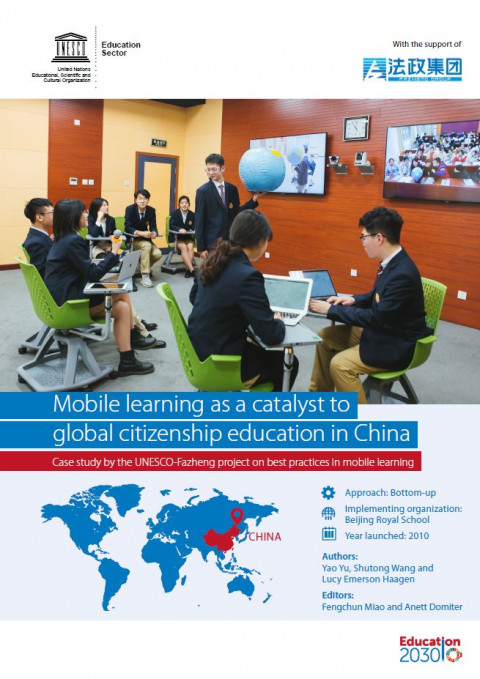 Mobile Learning as a Catalyst to Global Citizenship Education in China: Case Study by the UNESCO-Fazheng Project on Best Practices in Mobile Learning سنة النشر: 2019 المؤلف: Yao Yu | Shutong Wang | Lucy Emerson Haagen المؤلف المؤسسي: UNESCO The Beijing Royal School was one of the pioneer schools in China in incorporating mobile learning into pedagogical transformation. Its mobile learning programme started in 2010. Stemming from the school’s orientation towards global citizenship education, the Beijing Royal School recognizes mobile learning as both driver and enabler for supporting the development of students’ cognitive, socio-emotionaland behavioural dimensions, organized around knowledge acquisition, understanding and respect for difference and diversity, and responsible engagement with global issues. It takes advantage of a variety of mobile apps to support students’ multilingual education, and uses open educational resources (OER) to support multicultural education, taking advantage of the up-to-date worldwide data and information available on the web. It also engages with students from other countries in projects and courses that help the students to widen their understanding of diverse cultures and social contexts. Overall, this case study illustrates how to use mobile technologies to support the implementation of a well-defined and clearly structured educational vision by embedding the use of mobile technologies in students’ daily learning lives.
 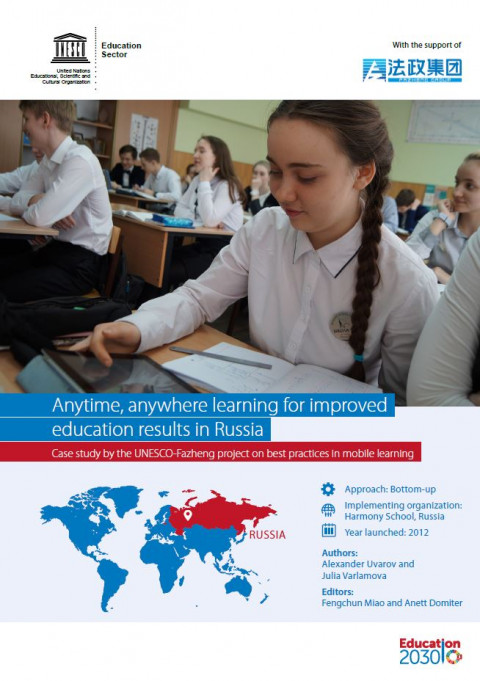 Anytime, Anywhere Learning for Improved Education Results in Russia: Case Study by the UNESCO-Fazheng Project on Best Practices in Mobile Learning سنة النشر: 2019 المؤلف: Alexander Uvarov | Julia Varlamova المؤلف المؤسسي: UNESCO The Harmony School in Izhevsk is a regular municipal school located in one of the city districts of the capital city of the Udmurt Republic in Russia. Students come to Harmony school from different cultural and social environments, with various physical and mental abilities, and the school is eager to create the best conditions for learning and developing for each of them. In 2012, Harmony School took a part in the School of Digital Age project supported by the federal Skolkovo project and the Russian branch of Microsoft. The mobile technologies in the school are implemented as a tool for anytime and anywhere learning to differentiate and individualize learning to improve education results.According to the school vision, mobile learning technologies should provide all students and teachers anytime and anywhere access to a variety of teaching and learning materials and digital instruments and students who are unable to attend classes should be able to continue their systematic studies. The mobile learning model should enable every student to experience independent learning activities in the digital educational environment and improve their educational results with new methods and organizational forms of teaching and learning. To implement this vision, the new school-wide teaching and learning practices including online/blended learning, mobile learning in the classroom and outside-classroom learning have been developed and used actively. The new in-school teachers’ professional development model has become a crucially important element for the project’s success.
  Measuring Global Citizenship Education: A Collection of Practice and Tools سنة النشر: 2017 المؤلف المؤسسي: Center for Universal Education at Brookings | UNESCO | UN Global Education First Initiative - Youth Advocacy Group (YAG) The idea of global citizenship has existed for several millennia. In ancient Greece, Diogenes declared himself a citizen of the world,1 while the Mahaupanishads of ancient India spoke of the world as one family.2 Today, education for global citizenship is recognized in many countries as a strategy for helping children and youth prosper in their personal and professional lives and contribute to building a better world.This toolkit is intended to shed light on one aspect of operationalizing global citizenship education (GCED): how it can be measured. This toolkit is the result of the collective efforts of the Global Citizenship Education Working Group (GCED-WG), a collegium of 90 organizations and experts co-convened by the United Nations Educational, Scientific, and Cultural Organization (UNESCO), the Center for Universal Education (CUE) at the Brookings Institution, and the United Nations Secretary General’s Global Education First Initiative’s Youth Advocacy Group (GEFI-YAG). To gather the measurement tools in this collection, the working group surveyed GCED programs and initiatives that target youth (ages 15–24).3 For the purposes of this project, GCED was defined as any educational effort that aims to provide the skills, knowledge, and experiences and to encourage the behaviors, attitudes, and values that allow young persons to be agents of long-term, positive changes in their own lives and in the lives of people in their immediate and larger communities (with the community including the environment).This toolkit begins with a brief review of opinions on why GCED is important and the variety of definitions of GCED. We follow the report with a catalog of 50 profiles of assessment efforts, each describing practices and tools to measure GCED at the classroom, local, and national levels. Note that the survey does not represent an exhaustive list but may be regarded as a living document that will grow as the field of GCED itself grows around the world.Broadly speaking, the assessment efforts in this survey may be categorized across achieving three goals: (1) fostering the values/attitudes of being an agent of positive change; (2) building knowledge of where, why, and how to take action toward positive change; and (3) developing self-efficacy for taking effective actions toward positive change.Today, global challenges such as climate change, migration, and conflict will require people to do more than just think about solutions. They will require effective action, by both individuals and communities. Education for global citizenship is one means to help young people develop the knowledge, skills, behaviors, attitudes, and values to engage in effective individual and collective action at their local levels, with an eye toward a long-term, better future at the global level. We offer this toolkit to provide guidance for educators, policymakers, non-governmental organizations, civil society, and researchers, and to inform this conversation.
  UNESCO's Contribution to the Prevention of Violant Extremism سنة النشر: 2016 المؤلف المؤسسي: UNESCO This document provides a summary of recent efforts by UNESCO to step up its action to prevent violent extremism, in the context of the United Nations Secretary-General’s Plan of Action on Violent Extremism, launched in January 2016. Building on its mandate and existing activities, UNESCO has adopted an intersectoral approach, paying particular attention to the needs of young people particularly at risk of radicalization.
 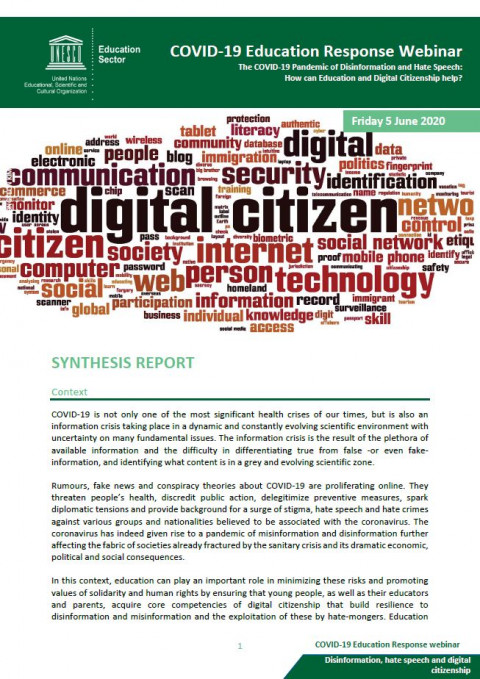 The COVID-19 Pandemic of Disinformation and Hate Speech: How can Education and Digital Citizenship Help? ; Synthesis Report سنة النشر: 2020 المؤلف المؤسسي: UNESCO COVID-19 is not only one of the most significant health crises of our times, but is also an information crisis taking place in a dynamic and constantly evolving scientific environment with uncertainty on many fundamental issues. The information crisis is the result of the plethora of available information and the difficulty in differentiating true from false -or even fake- information, and identifying what content is in a grey and evolving scientific zone.In this context, education can play an important role in minimizing these risks and promoting values of solidarity and human rights by ensuring that young people, as well as their educators and parents, acquire core competencies of digital citizenship that build resilience to disinformation and misinformation and the exploitation of these by hate-mongers. Education can also help young people engage in the online environment in a safe, sensitive, critical, ethical and accountable way as well as encourage them to play a role in pioneering educational initiatives that contribute to promoting digital citizenship.
 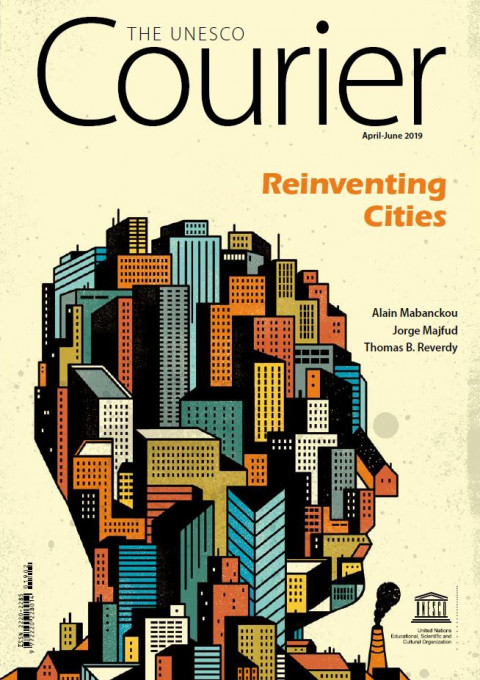 Reinventing Cities (The UNESCO Courier no. 2, April-June 2019) سنة النشر: 2019 المؤلف: Alain Mabanckou | Jorge Majfud | Thomas B. Reverdy المؤلف المؤسسي: UNESCO Cities have always been centres of power, attractiveness and prosperity. But the renetic urbanization of recent decades is jeopardizing their historical function as elting pots that integrate and absorb newcomers. As they become more populated, they become dehumanized. Violence, inequality, discrimination – the larger the cities, the more these ills overwhelm them.Nevertheless, even as they are dehumanized, cities are reinventing themselves. From street smarts as a survival strategy in Kinshasa (Democratic Republic of the Congo) to major national projects for the rehabilitation of single-industry cities in Russia; from the personal initiative of a gallery owner who revitalized the small town of Erriadh (Tunisia) to the mobilization of the masses against the authoritarian ppropriation of public spaces in Warsaw (Poland); and from solidarity movements with migrants in London (United Kingdom) to synergies that revive the heart of Havana (Cuba) – creative forces are emerging and organizing themselves to give urban life new meanings and new perspectives. We may believe these are “tiny resistances” – to use the expression of the French writer Thomas B. Reverdy – but they make all the difference.Two other writers share their views with our readers in this issue. Our Guest, the French-Congolese author Alain Mabanckou, talks about “mobile Africas” and the courage to write, while highlighting contradictory moments in colonial history. The Uruguayan-American writer Jorge Majfud condemns the racist attitude towards migrants in the Ideas section, which also provides an analysis of migration policies in the United States.In the Current Affairs section – on the occasion of World Africa Day, 25 May – we publish an interview with Tshilidzi Marwala (South Africa), on the emergence of artificial intelligence (AI) on the continent. To mark the International Day for Biological Diversity, 22 May, we visit Gran Pajatén, Peru, with Roldán Rojas Paredes – the man who initiated its inscription on UNESCO’s World Network of Biosphere Reserves.We also go to Sharjah (United Arab Emirates), which launches its World Book Capital programme in April 2019. Finally, with Zoom, we travel to India, Mexico, Myanmar and Uganda, to visit places without electricity. An illuminating trip around the world!