
الموارد
استكشف مجموعة واسعة من الموارد القيمة حول تعليم المواطنة العالمية لتعميق فهمك وتعزيز البحث والمناصرة والتعليم والتعلم.
تم العثور على 792 نتيجة
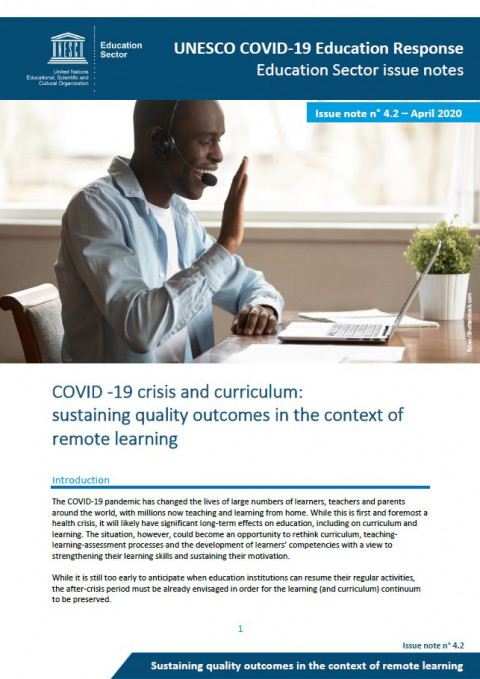 COVID-19 Crisis and Curriculum: Sustaining Quality Outcomes in the Context of Remote Learning (Issue Note no. 4.2 – April 2020) سنة النشر: 2020 المؤلف المؤسسي: UNESCO The COVID-19 pandemic has changed the lives of large numbers of learners, teachers and parents around the world, with millions now teaching and learning from home. While this is first and foremost a health crisis, it will likely have significant long-term effects on education, including on curriculum and learning. The situation, however, could become an opportunity to rethink curriculum, teaching-learning-assessment processes and the development of learners’ competencies with a view to strengthening their learning skills and sustaining their motivation.This crisis will likely provide an opportunity for schools to strengthen their ties with families, and for teachers to communicate and cooperate better with parents in the interest of learners. In the same vein, the crisis means teachers and parents may become more involved in decisions regarding curriculum appropriateness. This can support the development of a learner-centred, participative and inclusive learning paradigm that takes into account the interests of learners, as well as their environments and aspirations.
 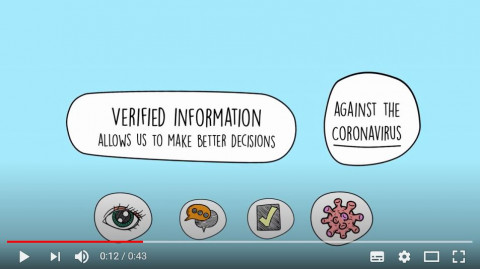 How to Stop Misinformation in Times of Coronavirus? سنة النشر: 2020 المؤلف المؤسسي: United Nations Development Programme (UNDP) | UNESCO Learn how to identify unverified content you receive on your cell phone and avoid spreading information on social media that has not been checked by credible sources. Caring for reliable information is everyone's responsibility, and helps us make better decisions.Learn more about this campaign by UNESCO and UNDP at:https://en.unesco.org/news/disinformation-silent-weapon-times-pandemic
  Framework for Reopening Schools; April, 2020 سنة النشر: 2020 المؤلف المؤسسي: UNESCO | United Nations Children's Fund (UNICEF) | World Bank | World Food Programme By late April, nationwide school closures were still disrupting the learning of more than 73 per cent of students, or more than 1.2 billion children and youth. When deciding whether to reopen schools, authorities should look at the benefits and risks across education, public health and socio-economic factors, in the local context, using the best available evidence. The best interest of every child should be paramount.The guidelines aim to inform the decision-making process regarding school reopening, support national preparations and guide the implementation process, as part of overall public health and education planning processes. It is designed to be a flexible tool that can be adapted to each context and updated as the situation changes. The guidelines outline six key priorities to assess the readiness of those schools and inform planning.
 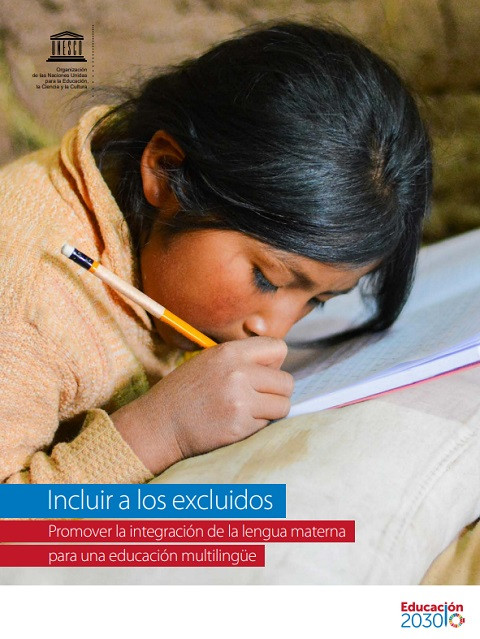 Including the Excluded: Promoting the Integration of the Mother Tongue for a Multilingual Education سنة النشر: 2020 المؤلف المؤسسي: UNESCO This publication presents the advantages of including the mother tongue and promoting multilingual education, as well as guidelines for achieving it.
 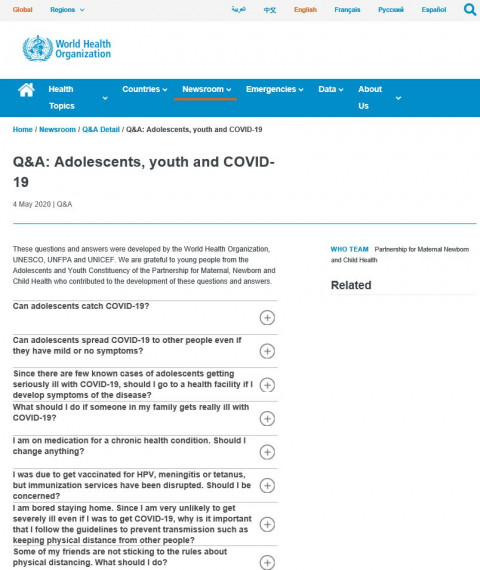 Q&A: Adolescents, Youth and COVID-19 سنة النشر: 2020 المؤلف المؤسسي: World Health Organization (WHO) | UNESCO | United Nations Population Fund (UNFPA) | United Nations Children's Fund (UNICEF) As part of UNESCO’s work in promoting better health and well-being for all children and young people, it has contributed to the development of a practical guide in a ‘questions and answers’ (Q&A) format on children and adolescents and COVID-19. This work was led by the World Health Organization, in collaboration with the Adolescents and Youth Constituency of the Partnership for Maternal, Newborn and Child Health, UNESCO, UNFPA, and UNICEF.The Q&A provide children and adolescents with accurate, non-judgmental information and advice around COVID-19, including how to help stop the spread of the virus, what to do if they develop symptoms of the disease, and how to best manage their health and well-being during the confinement period and after. It considers children and young people as critical actors in the response to COVID-19, not as passive beneficiaries.
  UNESCO's work on education for peace and non-violence: building peace through education سنة النشر: 2008 المؤلف المؤسسي: UNESCO The promotion of peace through education is at the heart of UNESCO’s mission. As stated in its constitution of 1945, UNESCO advances international peace and the common welfare of humanity through educational, scientific and cultural relations between peoples of the world. Though the world has changed over the past sixty years and continues to change at an ever increasing rate, UNESCO’s mission - a commitment to promoting universal values of peace and nonviolence, human rights and social justice, intercultural dialogue and mutual understanding – persists with growing urgency. UNESCO’s approach to educating for peace is multidimensional, in that it links education with a range of activities that address the root causes of violence, from human security to sustainable development. The goal of UNESCO’s education programmes and partnerships is the development of comprehensive systems of education that embrace the values of human rights, intercultural understanding and tolerance. Education for peace and non-violence promotes the knowledge, skills, attitudes and behaviours that reflect and inspire these values. As the lead agency within the UN system for the International Decade for a Culture of Peace and Non-Violence for the Children of the World, 2001- 2010, UNESCO is responsible for coordinating and directly implementing activities that promote the objectives of the Decade through education, the sciences, culture, communication and information. The culture of peace is defined as a set of values, attitudes, modes of behaviour and ways of life that reject violence and aim to prevent conflicts by tackling their root causes through dialogue and negotiation between individuals, groups and nations. UNESCO promotes the culture of peace through an intersectoral platform. This platform involves all five sectors of UNESCO: education, natural sciences, social and human sciences, culture, and communication and information. It seeks to mainstream intercultural dialogue in policies and actions with the aim of promoting mutual understanding, tolerance and respect, all of which are considered to be creative forces for a sustainable future. The intersectoral platform will also develop tools based on good practices in intercultural dialogue.
 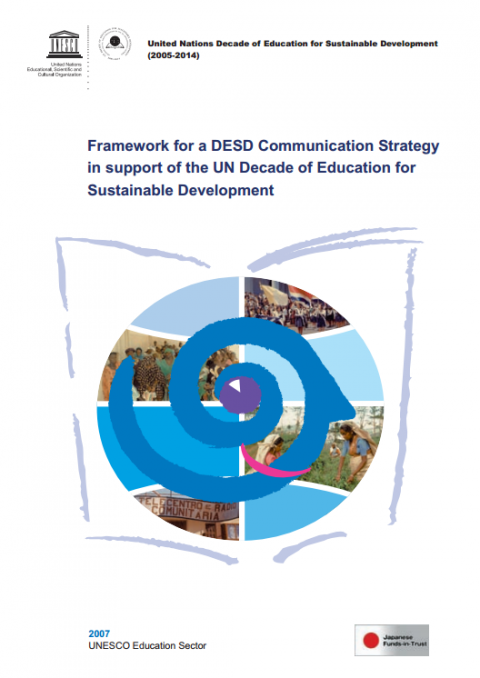 Framework for a DESD communication strategy in support of the UN decade of education for sustainable development سنة النشر: 2007 المؤلف المؤسسي: UNESCO The following framework for a DESD Communication Strategy seeks to provide guidelines for different stakeholders to come together and work on a joint harmonious communication strategy, dedicated to furthering the exchange of information on ESD issues in order to: • share ESD information and resources between and among partners; • promote better cooperation among partners doing ESD work and create synergies; • reduce duplication of efforts in programme planning, design, and ESD advocacy; • strengthen individual partner's ability to help create a viable future by working together with others, with each partner contributing its own "piece of the puzzle". Minimum elements of a DESD communication strategy include an appropriate emphasis on: • dissemination of basic ESD information to all partners; • dissemination of available information sources pertinent to partners’ needs in ESD; • sharing prototype training materials, experiences of demonstration activities and related resources for testing, adapting and translating them to other cultural contexts; • dissemination of information about the experiences of project participants, emphasizing openness and clarity about problems encountered, in order to allow others to benefit from the lessons learned in practice.
  UNESCO prize for peace education, 2008 سنة النشر: 2009 المؤلف المؤسسي: UNESCO The UNESCO Prize for Peace Education 2008 was awarded to the Institute for Justice and Reconciliation (South Africa) by Mr Koïchiro Matsuura, Director-General of UNESCO, on the recommendation of the International Jury of the Prize. The prize-giving ceremony, organized as part of the celebrations of the International Day of Peace (21 September), the International Decade for a Culture of Peace and Non-Violence for the Children of the World (2001- 2010) and the 60th anniversary of the Universal Declaration of Human Rights, was held at UNESCO Headquarters on 18 September 2008 in the presence of Mr Mohammed Arkoun, President of the International Jury, and H.E. Mr Javier Pérez de Cuéllar, member of the International Jury, former Prize laureates, Permanent Delegates of Member States and representatives of governmental and non-governmental organizations. The award ceremony was preceded by the screening of an excerpt from the documentary Truth, Justice, Memory: South Africa’s Truth and Reconciliation Process and by a video message from Archbishop Emeritus Desmond Tutu, winner of the 1984 Nobel Peace Prize for his role as a unifying leader in the campaign to resolve the problem of apartheid in South Africa, and former Chairperson of South Africa’s Truth and Reconciliation Commission
  UNESCO education strategy 2014-2021 سنة النشر: 2014 المؤلف المؤسسي: UNESCO This publication is a result of extensive collective work by my colleagues in UNESCO’s Education Sector over the past two years. It elaborates on UNESCO’s Medium-Term Strategy (2014–2021), which was drafted by the Organization’s Secretariat and approved by the 37th session of its General Conference in November 2013. This publication elaborates on the education component of the Medium-Term Strategy. While continuing to focus efforts on the ‘unfinished business’ of EFA, such as literacy, teachers and vocational skills development, UNESCO will lead and advocate for strengthened action towards empowering learners to be creative and responsible citizens. In a world of change, when individuals are increasingly called upon to make a positive contribution to their communities through the promotion of peace, solidarity, and respect for others and the environment, I am convinced that Education for Sustainable Development and Global Citizenship Education must also be considered crucial elements for well-rounded educational systems.
  Education for sustainable development; good practices in addressing biodiversity سنة النشر: 2012 المؤلف المؤسسي: UNESCO To support the growing interest in biodiversity issues and ESD, UNESCO is publishing this volume containing 24 examples of programmes addressing biodiversity in ESD settings and practices. These good practices and shared experiences, which were provided by a range of different stakeholders, are concrete examples of successful implementation of ESD in different fields and sectors, from the political to the school level, and including formal, non-formal and informal learning situations.