
الموارد
استكشف مجموعة واسعة من الموارد القيمة حول تعليم المواطنة العالمية لتعميق فهمك وتعزيز البحث والمناصرة والتعليم والتعلم.
تم العثور على 792 نتيجة
 Human rights education in the school systems of Europe, Central Asia and North America: a compendium of good practice سنة النشر: 2009 المؤلف المؤسسي: Council of Europe | UNESCO | UN. Office of the United Nations High Commissioner for Human Rights (UN. OHCHR) | OSCE. Office for Democratic Institutions and Human Rights (ODIHR) “Human Rights Education in the School Systems of Europe, Central Asia and North America: A Compendium of Good Practice” is a compilation of 101 examples of good practice in human rights education in primary schools, secondary schools and teacher training institutions in the Organization for Security and Co-operation in Europe (OSCE) area, which is also covered by the United Nations Educational, Scientific and Cultural Organization (UNESCO), the Office of the United Nations High Commissioner for Human Rights (OHCHR) and, partially, the geographical mandate of the Council of Europe (CoE).The term “human rights education” is often used in this resource in a broader sense, to also include educationfor democratic citizenship and education for mutual respect and understanding, which are all based on internationally agreed human rights standards. These three areas are seen as interconnected and essential within educational systems in order to prepare youth to be active, responsible and caring participants in their communities, as well as at the national and global levels.Human rights education has been defined as education, training and information aimed at building a universal culture of human rights. A comprehensive education in human rights not only provides knowledge about human rights and the mechanisms that protect them, but also imparts the skills needed to promote, defend and apply human rights in daily life. Education for democratic citizenship focuses on educational practices and activities designed to help young people and adults to play an active part in democratic life and exercise their rights and responsibilities in society. Education for mutual respect and understanding highlights self-respect, respect for others, and the improvement of relationships between people of differing cultural traditions.This book aims to support quality teaching in these areas and to inspire educational policymakers (those working in education ministries and local school boards) and administrators, teachers, teacher trainers, non-formal educators and all other interested actors, as well as to facilitate networking and the exchange of experience among education professionals.
  Stopping violence in schools: a guide for teachers سنة النشر: 2014 المؤلف المؤسسي: UNESCO “Stopping Violence in Schools: A Guide for Teachers” examines various forms of violence that take place in schools, and offers practical suggestions as to what teachers can do to prevent them. Ten action areas are proposed, each with specific examples that teachers can adapt to address and prevent violence. Excerpts from relevant international normative instruments as well as a list of links to online resources for stopping violence in schools are annexed at the end of the book.
  UNESCO World Heritage Education Programme سنة النشر: 2013 المؤلف المؤسسي: UNESCO The WORLD HERITAGE EDUCATION PROGRAMME gives young people a chance to voice their concerns and to become involved in the protection of our common cultural and natural heritage. Launched as a Special Project in 1994 by the United Nations Educational, Scientific and Cultural Organization (UNESCO), and officially called ‘Young People’s Participation in World Heritage Preservation and Promotion’, this programme seeks to encourage and enable tomorrow’s decision-makers to participate in heritage conservation and to respond to the continuing threats facing our World Heritage. Young people learn about World Heritage sites, about the history and traditions of their own and other cultures, about ecology and the importance of protecting biodiversity. They become aware of the threats facing the sites and learn how the international community works together to save our common heritage. Most importantly, they discover how they can contribute to heritage conservation and make themselves heard.
  A Guide for ensuring inclusion and equity in education سنة النشر: 2017 المؤلف المؤسسي: UNESCO As countries seek to strengthen their national educational systems, finding ways of including all learners and ensuring that each individual has an equal opportunity for educational progress remain major challenges. This guide is intended to support countries in embedding inclusion and equity in educational policy. The ultimate objective is to create system-wide change for overcoming barriers to quality educational access, participation, learning processes and outcomes, and to ensure that all learners are valued and engaged equally.
 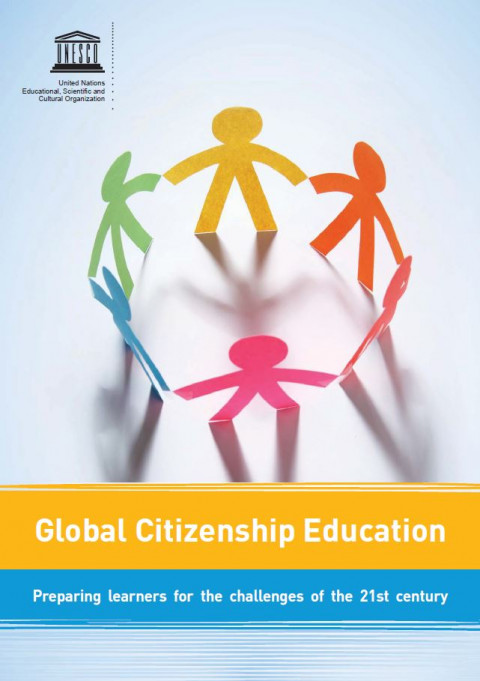 Global Citizenship Education: Preparing Learners for the Challenges of the 21st Century سنة النشر: 2014 المؤلف المؤسسي: UNESCO The United Nations Secretary-General’s Global Education First Initiative (GEFI) has established education as a means to ‘foster global citizenship’ – one of its three priority areas. To support this, UNESCO organized two landmark meetings on GCE in 2013. This publication aims to define the parameters of GCE by using the collective expertise, experience and wisdom of those participants who gathered at these landmark events, and to plan for future action in line with emerging thinking and other ongoing work. The review establishes that GCE has a critical role to play in equipping learners with competencies to deal with the dynamic and interdependent world of the twenty-first century. While GCE has been applied in different ways in different contexts, regions and communities, it has a number of common elements, which include fostering in learners. In formal settings, GCE can be delivered as an integral part of an existing subject (such as civic or citizenship education, social studies, environmental studies, geography or culture), or as an independent subject area. Integrated models appear to be more common. Some less traditional, but at least as effective, pathways for GCE have included the following: the use of information and communication technologies and social media, sport competitions and the use of art and music, and youth-led initiatives employing a wide variety of approaches. Both traditional and new horizons for GCE are profiled in this review. This publication also explores a number of enabling conditions for the promotion and implementation of GCE. These include: the existence of an open environment for universal values, the implementation of transformative pedagogy and support for youth-led initiatives.The review acknowledges that there are a number of ongoing tensions with the concepts of global citizenship and global citizenship education. While these tensions vary, they all point to the fundamental question of how to promote universality (e.g. common and collective identity, interest, participation, duty), while respecting singularity (e.g. individual rights, self-improvement). Some ways forward to resolve these tensions are suggested, whilst maintaining that challenges around theoretical elements of GCE should not undermine its practice. The processes documented in this publication have strengthened partnerships, built coalitions and contributed to improving the evidence base on the theory and practice of global citizenship education. While there are tasks that remain, this foundation bodes well for improving the enabling conditions and the practices highlighted in this review. By preparing learners to fulfil their potential in an increasingly globalized world, we are promoting transformed societies that are also better equipped to deal with the twenty-first century challenges and to seize twenty-first century opportunities.
  70 quotes for peace: UNESCO's 70th anniversary celebrations سنة النشر: 2015 المؤلف: Guila Clara Kessous المؤلف المؤسسي: UNESCO This book, created to mark the 70th anniversary of the United Nations Educational Scientific and Cultural Organization (UNESCO), features 70 quotes from artists, intellectuals, activists, politicians and statesmen. The quotes all testify to a strong conviction that peace, in order to be sustainable, must be built upon a mutual understanding between people and the intellectual solidarity of humankind. But they also demonstrate that each person bears within himself a huge capacity for tolerance and dignity that he can choose to use to achieve this ideal.
  Education for peace: planning for curriculum reform; guidelines for integrating an education for peace curriculum into education sector plans and policies سنة النشر: 2015 المؤلف المؤسسي: UNESCO | UNESCO International Bureau of Education (IBE) | UNESCO International Institute for Educational Planning (IIEP) This Resource and Development Capacity Package was developed based on the belief that, as part of a wider social, economic and political effort, education can play a significant role in a country’s peace-building efforts. Its purpose is to assist Member States in integrating or strengthening peace education programs in their national education systems to promote peace and prevent future conflict. UNESCO, IBE, and IIEP developed this resource within the framework of UNESCO’s Intersectoral Project, Promoting a culture of peace and nonviolence in Africa through education for peace and conflict prevention. The Package contains Technical Guidelines and Capacity Development training modules on policy, program design and curriculum planning to integrate peace and conflict prevention into all aspects of the education system. It is meant for curriculum developers and planners from Africa. The development of the package received the support of the UNESCO Addis-Ababa Office, which assisted in the testing of materials in Addis-Ababa (Ethiopia) and Yaounde (Cameroon).This resource will furthermore help to ensure that curricula, teaching and learning resources and teacher education are in line with the post-2015 vision of education for holistic development. This vision reconceptualises education in terms of global citizenship and responsibility by focusing on inclusion and social cohesion that is global in orientation. In this regard, Global Citizenship Education (GCED) seeks to empower learners with knowledge, skills, values and attitudes that are needed to forge more just and inclusive societies, capable of resolving existing conflicts and emerging global challenges.
  MTB-MLE: mother tongue-based multilingual education; lessons learned from a decade of research and practice سنة النشر: 2014 المؤلف المؤسسي: UNESCO What role can language play in improving education for minority language communities? What are language rights? What place does Mother Tongue-Based Multilingual Education have in realizing other development goals?These important questions were addressed by the 4th International Conference on Language and Education. The conference brought together over 300 practitioners from 30 countries, reflecting the incredible diversity of the Asia-Pacific region and clearly demonstrating the importance of Mother Tongue-Based Multilingual Education (MTB-MLE). This brochure summarizes some of the key messages from this landmark event. Educação para a cidadania global: preparando alunos para os desafios do século XXI سنة النشر: 2014 المؤلف المؤسسي: UNESCO The United Nations Secretary-General’s Global Education First Initiative (GEFI) has established education as a means to ‘foster global citizenship’ – one of its three priority areas. To support this, UNESCO organized two landmark meetings on GCE in 2013. This publication aims to define the parameters of GCE by using the collective expertise, experience and wisdom of those participants who gathered at these landmark events, and to plan for future action in line with emerging thinking and other ongoing work. The review establishes that GCE has a critical role to play in equipping learners with competencies to deal with the dynamic and interdependent world of the twenty-first century. While GCE has been applied in different ways in different contexts, regions and communities, it has a number of common elements, which include fostering in learners. In formal settings, GCE can be delivered as an integral part of an existing subject (such as civic or citizenship education, social studies, environmental studies, geography or culture), or as an independent subject area. Integrated models appear to be more common. Some less traditional, but at least as effective, pathways for GCE have included the following: the use of information and communication technologies and social media, sport competitions and the use of art and music, and youth-led initiatives employing a wide variety of approaches. Both traditional and new horizons for GCE are profiled in this review. This publication also explores a number of enabling conditions for the promotion and implementation of GCE. These include: the existence of an open environment for universal values, the implementation of transformative pedagogy and support for youth-led initiatives. The review acknowledges that there are a number of ongoing tensions with the concepts of global citizenship and global citizenship education. While these tensions vary, they all point to the fundamental question of how to promote universality (e.g. common and collective identity, interest, participation, duty), while respecting singularity (e.g. individual rights, self-improvement). Some ways forward to resolve these tensions are suggested, whilst maintaining that challenges around theoretical elements of GCE should not undermine its practice. The processes documented in this publication have strengthened partnerships, built coalitions and contributed to improving the evidence base on the theory and practice of global citizenship education. While there are tasks that remain, this foundation bodes well for improving the enabling conditions and the practices highlighted in this review. By preparing learners to fulfil their potential in an increasingly globalized world, we are promoting transformed societies that are also better equipped to deal with the twenty-first century challenges and to seize twenty-first century opportunities.
 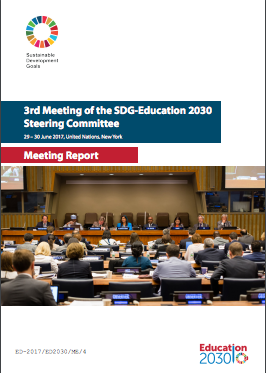 3rd Meeting of the SDG-Education 2030 Steering Committee, 29-30 June 2017, United Nations, New York: meeting report سنة النشر: 2017 المؤلف المؤسسي: UNESCO An inclusive high-level multi-stakeholder partnership, the SDG-Education 2030 Steering Committee (SC) provides a global forum for consultation and a mechanism to coordinate and harmonize global education efforts. It is mandated to provide strategic guidance to Member States and the education community, make recommendations for catalytic action, advocate for adequate financing, and monitor progress toward SDG4 targets through the UNESCO Institute for Statistics and the Global Educational Monitoring (GEM) Report. The 3 rd meeting of the SC was organized in New York on 29-30 June 2017 back to back with the HighLevel Action SDG Action Event on Education convened by the President of the UN General Assembly, Peter Thompson, in partnership with key SDG 4 stakeholders, to drive a new push for inclusive and equitable quality education and lifelong learning opportunities. At this meeting the SC examined successes and challenges in the implementation of SDG4 since the adoption of the 2030 Agenda. After highlighting the critical role of regional organizations as policy peer learning mechanisms in enhancing effective implementation of SDG4-Education 2030, the SC endorsed a set of recommendations for improved implementation in 2018 and 2019.