
الموارد
استكشف مجموعة واسعة من الموارد القيمة حول تعليم المواطنة العالمية لتعميق فهمك وتعزيز البحث والمناصرة والتعليم والتعلم.
تم العثور على 68 نتيجة
 Aprender a vivir juntos: ¿hemos fracasado? Síntesis de las reflexiones y los aportes surgidos durante la 46a Conferencia Internacional de Educación de la UNESCO, Ginebra, 5-8 de septiembre de 2001 سنة النشر: 2003 المؤلف المؤسسي: UNESCO International Bureau of Education (IBE) | UNESCO Brasilia The present book is based mainly on the work of the forty-sixth session of the International Conference on Education (ICE), organized by UNESCO’s International Bureau of Education (IBE) and held in Geneva from 5 to 8 September 2001. The theme of the conference was ‘Education for All for Learning to Live Together: Contents and Learning Strategies - Problems and Solutions’. Unless stated otherwise, the numerous quotations chosen to illustrate the points made in this book are from ICE documents and contributions. The Conclusions and Proposals for Action adopted by the 2001 ICE are provided in Chapter V.The ICE is the only regularly occurring event during which Ministers of Education from all over the world can meet. It therefore serves as a unique and highly appreciated international forum for high-level dialogue on educational issues and their policy implications.The 2001 ICE brought together over 600 participants from 127 countries, including in particular 80 Ministers and 10 Vice-Ministers of Education, as well as representatives of intergovernmental and non-governmental organizations. The themes of the 2001 ICE were, and still are, very relevant all over the world: those in charge of education have become well aware of the necessity and complexity of living together, as well as of the role and limits of education in this respect.The ICE was inspired by abundant literature dealing with the principle issues that participants debated, including: Preparatory reports;National reports presented by the Member States;Examples of initiatives and good practice (including those presented at the conference as video case studies);Messages from Ministers of Education attending the Conference;And contributions from the numerous researchers, experts, educationists and decision makers at all levels of education who also participated in the Netforum between April and August 2001.More information and opinions on the vast issue of Education for All for Learning to Live Together were added during the Conference itself, in the form of keynote addresses, presentations and debates during the two plenary sessions, six thematic workshops and the special session devoted to partnerships with civil society.The present book draws on this wealth of experience, research, opinions, ideas and visions of the future. It seeks to contribute to bringing the debate on Education for All for Learning to Live Together closer to actors of the global educational community. By setting out ins concise way the key issues and proposed actions, and illustrating them with concrete examples, numerous quotations and a number of questions, this book is intended particularly for teacher trainers, teachers themselves and their professional organizations, as well as for all actors in civil society who endeavour to improve the quality of education, to encourage dialogue and to foster in this way the capacity for living together.Neither a ‘conference report’ nor a scientific or academic work, this book is intended to be a sort of ‘gallery of photographs’ of the forty-sixth session of the ICE – its atmosphere of dialogue, the themes of its debates, and the first-hand descriptions and experiences exchanged. Far from prescribing norms or standards, it intends to share information, ideas and practices, rather like the ICE itself, in a spirit of exchange and dialogue.
  Global Monitoring of Target 4.7: Themes in National Curriculum Frameworks; Background Paper Prepared for the 2016 Global Education Monitoring Report سنة النشر: 2016 المؤلف المؤسسي: UNESCO International Bureau of Education (IBE) This study is an initial attempt to monitor ESD and GCED content in curricula globally. The goal here is to analyse national curriculum documents to reveal if, how, and to what extent ESD and GCED content is present across the globe. For this purpose, the research team developed a coding scheme based on key ESD and GCED knowledge, skills, behaviours and pedagogies that was used in evaluating the various national curriculum documents for evidence of ESD and GCED content. In this paper, we present the study in the following order. Further explanation of ESD and GCED, and a discussion of issues relating to their implementation and monitoring will come first. Then we will review similar studies that have also attempted to monitor GCED and ESD through content analysis. The study’s methods and findings will then be presented, followed by a discussion of the challenges addressed in developing a coding system to monitor curricula effectively. Finally, we share a series of recommendations that will focus on ways for moving forward in monitoring GCED and ESD effectively, both at a curricular level and beyond.
  Fifteen Analytical Keys to Strengthen the Education 2030 Agenda سنة النشر: 2017 المؤلف: Renato Opertti المؤلف المؤسسي: UNESCO International Bureau of Education (IBE) The joint review of the goals of the Education 2030 agenda and global change accentuated by the emergence of a fourth industrial revolution highlights the need to rethink the concepts that have influenced education over the past forty years. This necessity is accompanied by a major challenge: that of giving a new meaning to these concepts, in the same way education systems, in a transformational and united perspective. The present document proposes a global reflection based on fifteen keys of analysis, in order to help define a vision of education and learning that is in line with the Education 2030 agenda examines the following aspects: 1) education as a reflection of the type of society targeted; 2) the state as guarantor of the right to education; 3) education as a cultural, social and economic ; 4) the characteristics and roles of education systems; 5) learning throughout life long; 6) education according to age groups; 7) inclusion as a basis for education systems; 8) education for global and local citizenship; 9) education for sustainable development ; 10) STEM training to build sustainable societies; 11) the relevance of the gender issue at a time of the democratization of society and education; 12) computer programming as a new challenge in the teaching of ICT; 13) the evolution of the relationship between training and work; 14) the trio formed by curricula, educational establishments and pedagogy; and 15) teachers as decision-makers. Quinze clés d’analyse pour renforcer l’agenda Éducation 2030 سنة النشر: 2017 المؤلف: Renato Opertti المؤلف المؤسسي: UNESCO International Bureau of Education (IBE) L’examen conjoint des objectifs de l’agenda Éducation 2030 et des changements planétaires accentués par l’émergence d’une quatrième révolution industrielle met en évidence la nécessité de repenser les concepts qui ont influencé l’éducation au cours des quarante dernières années. Cette nécessité s’accompagne d’un défi de taille : celui de donner un sens nouveau à ces concepts, de même qu’aux systèmes éducatifs, dans une perspective transformationnelle et unie. Le présent document propose une réflexion globale reposant sur quinze clés d’analyse, en vue de contribuer à définir une vision de l’éducation et de l’apprentissage qui soit en adéquation avec l’agenda Éducation 2030. Il se penche ainsi sur les aspects suivants : 1) l’éducation en tant que reflet du type de société visé ; 2) l’État en tant que garant du droit à l’éducation ; 3) l’éducation en tant que politique culturelle, sociale et économique ; 4) les caractéristiques et les rôles des systèmes éducatifs ; 5) l’apprentissage tout au long de la vie ; 6) l’éducation en fonction de groupes d’âge ; 7) l’inclusion en tant que fondement des systèmes éducatifs ; 8) l’éducation à la citoyenneté mondiale et locale ; 9) l’éducation pour le développement durable ; 10) la formation aux STEM en vue de bâtir des sociétés durables ; 11) la pertinence de la problématique hommes-femmes à l’heure de la démocratisation de la société et de l’éducation ; 12) la programmation informatique en tant que nouveau défi dans l’enseignement des TIC ; 13) l’évolution de la relation entre la formation et le travail ; 14) le trio formé par les curricula, les établissements éducatifs et la pédagogie ; et 15) les enseignants en tant que décideurs.
 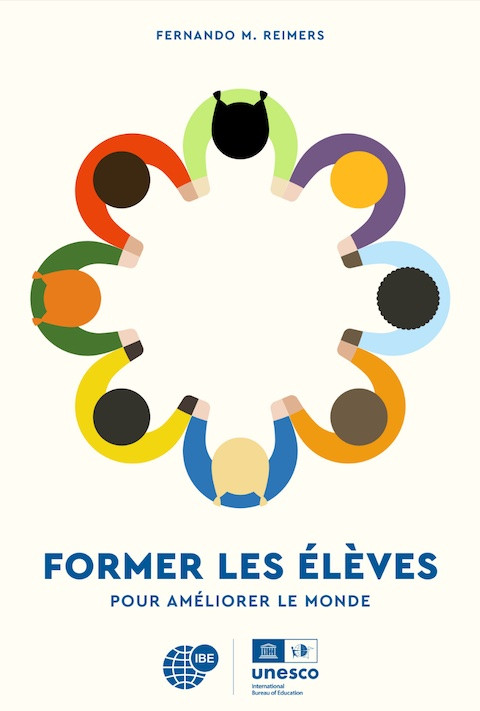 Educating Students to Improve the World سنة النشر: 2021 المؤلف: Fernando Reimers المؤلف المؤسسي: UNESCO International Bureau of Education (IBE) This book highlights the key role of global citizenship education to prepare learners for a rapidly changing world. In a probing and visionary analysis of the field of global education Fernando Reimers explains how to lead the transformation of schools and school systems in order to more effectively prepare students to address today’s most urgent challenges and to invent a better future. It discusses several global citizenship curricula that have been adopted by schools and school networks, and ties them into an approach to lead school change into the uncharted territory of the future. Former les élèves pour améliorer le monde سنة النشر: 2021 المؤلف: Fernando Reimers المؤلف المؤسسي: UNESCO International Bureau of Education (IBE) Ce livre porte sur la manière d’aider les élèves à trouver un sens à leur vie dans un monde un mutation rapide. Par une analyse approfondie et visionnaire du domaine de l’éducation à la citoyenneté mondiale, Fernando Reimers explique comment conduire la transformation des écoles et des systèmes scolaires afin de préparer plus efficacement les élèves à relever les défis actuels les plus urgents et à inventer un avenir meilleur.
  The Impact of AI on Curriculum Systems: Towards an Orbit-Shifting Dialogue (In-Progress Reflection; no. 32, 2019) سنة النشر: 2019 المؤلف المؤسسي: UNESCO International Bureau of Education (IBE) ‘Artificial Intelligence’ (AI) refers to the theory and development of computer systems able to perform tasks normally requiring human intelligence. In order to achieve transformational change in contemporary curriculum systems and learning environments, we need to engender an orbitshifting dialogue about the potential relationship between AI and education, in terms of both independent variables (threats), and dependent variables (opportunities). Through such a dialogue, we need to create foresight indicators that can predict the process of this relationship. It is, however, crucial that the relationship between AI and education is strong and directly proportionate. If the potential of the relationship is not exploited sufficiently, then underdeveloped education systems will lag behind and fail to achieve their potential for transformation, whether radical or incremental. Indeed, some may even become obsolete. The paper contends that in order to effectively contribute to the knowledge economy and to sustainable development in the age of the 4th Industrial Revolution (characterized by a fusion of cyber-physical technologies) modern educational systems need to overcome obstacles to innovation in order to maximize the potential for transformative change. To achieve this will require an ‘orbital shift’ in educational planning, practice and resourcing, to enable schools to respond more effectively to the rapidly changing needs of young people, society, the economy and environment in the third decade of the 21st century. Schools, educational institutions and environments, need to transform from being primarily spaces for teaching and taking exams, into spaces for innovation and personal learning, based on a culture of actively listening to the voices, choices, needs and goals of learners. Teachers need to become facilitators, coaches and mentors for learners. Schools need to create AI-enabled, flexible, collaborative working spaces. Visionary, energetic educational leaders need to communicate effectively with all stakeholders, including employers and parents, to inspire and manage change and smart decision-making to develop schools of the future. The aim of this reflection is to initiate an ‘orbit-shifting’ dialogue about the potential of AI applications to transform all components of the curriculum system to meet emergent 21st century educational goals. The conceptualization aims to explore the variable roles and impact of curriculum learning and assessment on these emerging educational goals. Theme 1 of the paper outlines the concepts and characteristics of a range of existing AI systems and their potential to enhance teaching learning and assessment. Theme 2 reflects on the potential to embrace AI systems across the curriculum system. Theme 3 proposes an action model to enable AI to have an ‘orbit shifting impact’ on all the components of the curriculum system (i.e. learners, teachers, learning environments, leadership and management, content, pedagogy and assessment) by enhancing opportunities for individualization, creativity and uniqueness.
  Strengthening Social and Emotional Learning in Hybrid Modes of Education: Building Support for Students, Teachers, Schools and Families; A UNESCO-IBE Discussion Paper سنة النشر: 2024 المؤلف المؤسسي: UNESCO International Bureau of Education (IBE) The COVID-19 pandemic intensified existing educational disparities globally, prompting a reevaluation of school curricula to include Social and Emotional Learning (SEL). This shift recognized the holistic needs of learners, teachers, and families, emphasizing competencies beyond traditional knowledge acquisition. Despite SEL's increasing global recognition, it is often absent from formal curricula, prompting the UNESCO-IBE to address this gap. This Discussion Paper explores the crucial role of SEL in the broader transformation of global education, particularly in the post-COVID-19 era. It highlights six key topics, presenting diverse experiences in integrating SEL into education. Experts from various fields contribute insights, focusing on socio-emotional and hybrid learning advancements worldwide. The report aims to inspire global change-makers, advocating for robust policies aligned with UNESCO's Futures of Education framework. This call to action aligns with the UNESCO-IBE's HELA initiative, promoting flexible hybrid learning models for crisis response and sustainable educational strategies in line with the UN Transforming Education Summit's vision.
  Reaching Out to All Learners: A Resource Pack for Supporting Inclusion and Equity in Education سنة النشر: 2021 المؤلف المؤسسي: UNESCO International Bureau of Education (IBE) The Reaching Out to All Learners resource materials tackle the practicalities of addressing these challenges in schools and other education centres, including early years and further education provision. More specifically, the materials focus on three strategic questions:How can schools be developed in order to respond positively to student diversity?How can classroom practices be developed that will ensure that lessons are inclusive?How can practitioners engage families, partner schools and the wider community in their efforts to become inclusive and equitable? Llegando a todos los estudiantes: Una caja de recursos de la UNESCO-OIE para apoyar la inclusión y la equidad en la educación سنة النشر: 2021 المؤلف المؤسسي: UNESCO International Bureau of Education (IBE) El material de recursos LLEGANDO A TODOS LOS ESTUDIANTES aborda los aspectos prácticos de la solución a estos problemas. En concreto, estos recursos se centran en tres cuestiones estratégicas:¿Cómo pueden crecer las escuelas para responder positivamente a la diversidad de los estudiantes?¿Cómo pueden desarrollarse prácticas docentes en el aula que garanticen que las lecciones sean inclusivas?¿Cómo pueden las escuelas involucrar a las familias, a las escuelas asociadas y a la comunidad en general en sus esfuerzos por ser inclusivas y equitativas?