
الموارد
استكشف مجموعة واسعة من الموارد القيمة حول تعليم المواطنة العالمية لتعميق فهمك وتعزيز البحث والمناصرة والتعليم والتعلم.
تم العثور على 28 نتيجة
 Planifier l'éducation avec et pour les jeunes سنة النشر: 2015 المؤلف: Anja Hopma | Lynne Sergeant المؤلف المؤسسي: UNESCO International Institute for Educational Planning (IIEP) En tant que partie prenante centrale dans l'éducation, les jeunes doivent être impliqués dans la planification de l'éducation. Cette publication met l'aCECnt sur les raisons et les obstacles à la participation des jeunes, ainsi que les efforts des ministères de l'éducation pour engager les jeunes dans leur travail de planification. Il est basé sur des discussions et des recommandations issues du forum de politique internationale de haut niveau sur «Engager les jeunes dans l'enseignement de la planification pour la transformation sociale» organisé par l'Institut international de l'UNESCO pour la planification de l'éducation (IIPE) à Paris du 16 au 18 Octobre 2012. Cette forum politique a entrepris d'explorer les grands thèmes suivants: (i) l'engagement des jeunes dans l'enseignement de la planification pour la transformation des conflits et de consolidation de la paix; (Ii) le renforcement des compétences et des possibilités d'engagement civique dans les systèmes formels et d'éducation non formelle des jeunes; et (iii) l'amélioration de la pertinence des systèmes d'éducation pour les jeunes dans leur transition vers l'emploi. Cette publication se fonde sur les échanges au cours de la pré-forum en ligne des débats, des discussions entre les participants lors du forum, et des témoignages de praticiens et les jeunes.
  Six ways to ensure higher education leaves no one behind سنة النشر: 2017 المؤلف المؤسسي: UNESCO International Institute for Educational Planning (IIEP) This policy paper, written in partnership with the UNESCO International Institute for Education Planning (IIEP), makes policy recommendations for equitable and affordable higher education to better support the implementation of the SDG agenda. To do this, it reviews recent trends in higher education expansion, identifies disparities in student participation, examines policy tools and practices for fostering equity, and explores ways to target assistance at those who need it most. Six façons de garantir que l'enseignement supérieur ne laisse personne sur le carreau سنة النشر: 2017 المؤلف المؤسسي: UNESCO International Institute for Educational Planning (IIEP) This policy paper, written in partnership with the UNESCO International Institute for Education Planning (IIEP), makes policy recommendations for equitable and affordable higher education to better support the implementation of the SDG agenda. To do this, it reviews recent trends in higher education expansion, identifies disparities in student participation, examines policy tools and practices for fostering equity, and explores ways to target assistance at those who need it most. Seis maneras de asegurar que la educación superior no deje a nadie atrás سنة النشر: 2017 المؤلف المؤسسي: UNESCO International Institute for Educational Planning (IIEP) This policy paper, written in partnership with the UNESCO International Institute for Education Planning (IIEP), makes policy recommendations for equitable and affordable higher education to better support the implementation of the SDG agenda. To do this, it reviews recent trends in higher education expansion, identifies disparities in student participation, examines policy tools and practices for fostering equity, and explores ways to target assistance at those who need it most.
  SDG-4: Flexible Learning Pathways in Higher Education – from Policy to Practice: An International Comparative Analysis سنة النشر: 2022 المؤلف: Michaela Martin | Uliana Furiv المؤلف المؤسسي: UNESCO International Institute for Educational Planning (IIEP) Higher education systems across the world are currently faced with a massive influx of learners with more diverse needs. They are expected to respond to this growing diversity through a more flexible learning offer and pathways that allow all learners, including those from disadvantaged groups, to access, progress through, and complete, higher education.To enhance knowledge on how to provide increased flexibility in higher education, IIEP–UNESCO undertook an international research project on SDG-4: Planning for Flexible Learning Pathways (FLPs) in Higher Education. The project included a stocktaking of policies, instruments, and practices, an international survey among UNESCO Member States, and eight in-depth country studies on Chile, Finland, India, Jamaica, Malaysia, Morocco, South Africa, and the UK.This book presents the findings from the research, including a cross-country analysis of available FLP policies and practices, and how they enhance equitable higher education systems. It also presents a series of country experiences with innovative approaches to alternative entry, flexible progression, and governance systems in support of FLPs.
  Flexible Learning Pathways in Malaysian Higher Education: Balancing Human Resources Development and Equity Policies سنة النشر: 2020 المؤلف: Morshidi Sirat | Abdul Karim Alias | Hazri Jamil | Wan Zuhainis Saad | Muhamad Saiful Bahri Yusoff | Munir Shuib | Mahiswaran Selvanathan | Muhammad Muftahu | Majid Ghasemy | Mazlinawati Mohamed المؤلف المؤسسي: Commonwealth Tertiary Education Facility (CTEF) | UNESCO International Institute for Educational Planning (IIEP) Malaysia’s higher education system is highly centralized, with a set of legislations to govern and monitor public universities and regulate the private higher education sector. The latest discourse, the Sustainable Development Goals (SDGs), particularly SDG4, pitted against existing policies on lifelong learning, presented an opportunity to assess practices at the institutional level. In the national context, there is a need to confirm the extent to which the linkages between national policies on lifelong learning, strategies, instruments, and institutional practices in terms of flexible learning pathways (FLPs) have benefited nontraditional learners, disadvantaged and marginalized groups. Hence, this research aims to investigate how FLPs have benefited particularly the bottom 40 percent of households (B40 households), disadvantaged and marginalized groups, persons with disabilities, and also women in Malaysia.
  Education Sector Analysis: Methodological Guidelines (Vol. 3) سنة النشر: 2021 المؤلف المؤسسي: UNESCO International Institute for Educational Planning (IIEP) | United Nations Children's Fund (UNICEF) | Global Partnership for Education (GPE) | Foreign, Commonwealth & Development Office (UK) This present volume is the third in a series of education sector analysis (ESA) guidelines following two volumes published in 2014. The series provides methodologies and applied examples for diagnosing education systems and informing national education policies and plans. This volume proposes guidelines to strengthen national capacities in analyzing education systems in four areas: inclusive education system for children with disabilities, risk analysis for resilient education systems, functioning and effectiveness of the educational administration, and stakeholder mapping and problem-driven analysis (governance and political economy).
 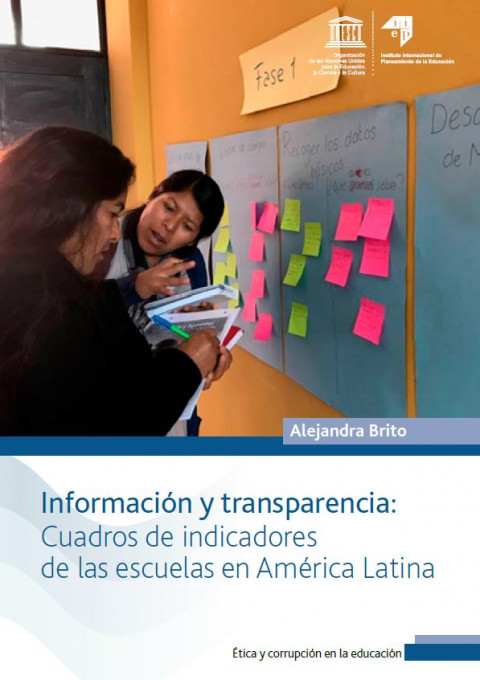 Información y transparencia: cuadros de indicadores de las escuelas en América Latina سنة النشر: 2019 المؤلف: Alejandra Brito المؤلف المؤسسي: UNESCO International Institute for Educational Planning (IIEP) ¿La publicación de indicadores sobre cada escuela y compartirlos con los actores escolares mejoran la transparencia y la rendición de cuentas y ayudan a combatir la corrupción de manera eficaz? Mientras que los cuadros de indicadores de las escuelas se están desarrollando en un número creciente de países de América Latina, esta pregunta aparece particularmente aguda; la información y las evaluaciones disponibles sobre el tema siguen siendo parcelarias.Este estudio muestra un panorama de la situación a nivel regional, revisando los sistemas de información e indicadores escolares de acceso público de 15 países de América Latina. Además, examina en profundidad siete cuadros de indicadores de información escolar en cuanto a su contenido, periodicidad, mecanismos de relevamiento y difusión de la información, diseño, uso e impacto en temas de transparencia, rendición de cuentas y lucha contra la corrupción.En conclusión, formula recomendaciones detalladas para los encargados de la toma de decisiones, entre las que se incluyen: considerar la utilidad, claridad y accesibilidad de los cuadros; mejorar la validez y vigencia de los datos; fomentar la comprensión y uso de la información; vincular los cuadros con los sistemas de rendición de cuentas actuales; incluirlos en los canales de comunicación en uso; proporcionar consecuencias o sanciones en caso de corrupción; asegurar la comprensión y difusión de los resultados por los padres de familias, así como su participación en los planes de mejora.
 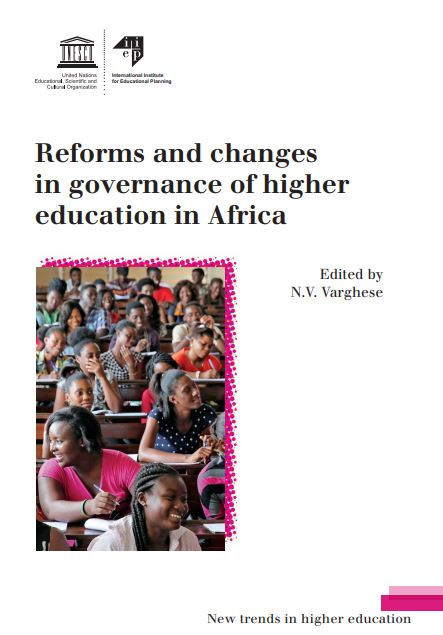 Reforms and Changes in Governance of Higher Education in Africa سنة النشر: 2016 المؤلف: N.V. Varghese المؤلف المؤسسي: UNESCO International Institute for Educational Planning (IIEP) Higher education in Africa has received favourable political attention and funding support in the period following independence. The rationale for state funding was questioned in the 1980s, and the higher education reforms in the 1990s centred on finding alternative ways of financing and on improving the managerial efficiency of universities. This focus was reflected in the market-friendly reforms that led to the privatization of public institutions and the promotion of private institutions. These reforms resulted in substantial changes in the governance and management of higher education. IIEP initiated a research study to analyse the reforms and to understand their effects on the governance of higher education at institutional and national levels. Based on studies carried out in Ethiopia, Ghana, Kenya, Nigeria, and South Africa, this book shows how the reforms have effected changes in the governance and management of institutions of higher education in Africa.
  SDG 4 - Policies for flexible learning pathways in higher education: Taking stock of good practices internationally (IIEP-UNESCO Working Papers) سنة النشر: 2020 المؤلف: Michaela Martin | Ana Godonoga المؤلف المؤسسي: UNESCO International Institute for Educational Planning (IIEP) This paper draws on country examples across different UNESCO regions to illustrate policy-relevant as well as practical approaches to developing flexible learning pathways in higher education. It shows that policies can facilitate flexible learning pathways include legislative and regulatory frameworks, articulation and transfer policies, and lifelong learning policies. It also presents a number of supportive policy instruments that can serve to bridge policy and practice, such as national qualifications frameworks, quality assurance and accreditation, credit accumulation and transfer systems, and information and guidance services. Finally, apart from discussing system-wide approaches, this paper also gives examples of more decentralized, institution-led practices that contribute to flexible learning pathways. This paper concludes that well-designed policy frameworks and instruments and targeted measures can create an enabling environment for flexible learning pathways, but their effectiveness requires strong administrative capacity and coordination, as well as the involvement of all relevant stakeholders, including those who design, implement, and benefit from policies. It is also essential that policies, instruments, and practices are in alignment with one another and work towards a common objective. Therefore, a holistic approach, comprising an adequate and well-coordinated mix of policies, instruments, and targeted measures, is required, in order to translate flexible learning pathways from a national priority into an institutionalized practice that reaches its intended beneficiaries.