
الموارد
استكشف مجموعة واسعة من الموارد القيمة حول تعليم المواطنة العالمية لتعميق فهمك وتعزيز البحث والمناصرة والتعليم والتعلم.
تم العثور على 28 نتيجة
 Open School Data: What Planners Need to Know; Ethics and Corruption in Education سنة النشر: 2021 المؤلف: Muriel Poisson المؤلف المؤسسي: UNESCO International Institute for Educational Planning (IIEP) Open school data refers to the action of sharing school-level information with the general public, either in paper or electronic format. Generated by government authorities or civil society organizations, the data – often in the form of a school report card – can help monitor the services provided by a school. To be useful, data should be comprehensive, relevant, accurate, accessible, and timely. Topics covered can include funding, teacher attendance, student achievement, availability of facilities, equipment, and materials.
  Quality TVET for the Successful Training to Employment Transition of Africa’s Youth سنة النشر: 2020 المؤلف المؤسسي: UNESCO International Institute for Educational Planning (IIEP) | Agence luxembourgeoise pour la coopération au développement (LuxDev) | Institut de la Francophonie pour l'éducation et la formation (IFEF) This report constitutes the analytical synthesis of the 2nd Regional Workshop for Exchange between Vocational Training Actors in Africa and their Mutual Strengthening, held in Nairobi from 18-20 June 2019, on the theme of “Quality TVET for the successful training to employment transition of Africa’s youth”. Des systèmes d’EFTP de qualité pour une transition formation-emploi réussiedes jeunes en Afrique سنة النشر: 2020 المؤلف المؤسسي: UNESCO International Institute for Educational Planning (IIEP) | Agence luxembourgeoise pour la coopération au développement (LuxDev) | Institut de la Francophonie pour l'éducation et la formation (IFEF) Ce rapport constitue la synthèse analytique du 2e atelier régional de partage et de renforcement mutuel des acteurs de la formation professionnelle en Afrique, tenu à Nairobi du 18 au 20 juin 2019 sur le thème : « Améliorer la gestion de la qualité des systèmes d’EFTP pour une transition formation-emploi des jeunes d’Afrique réussie ».
 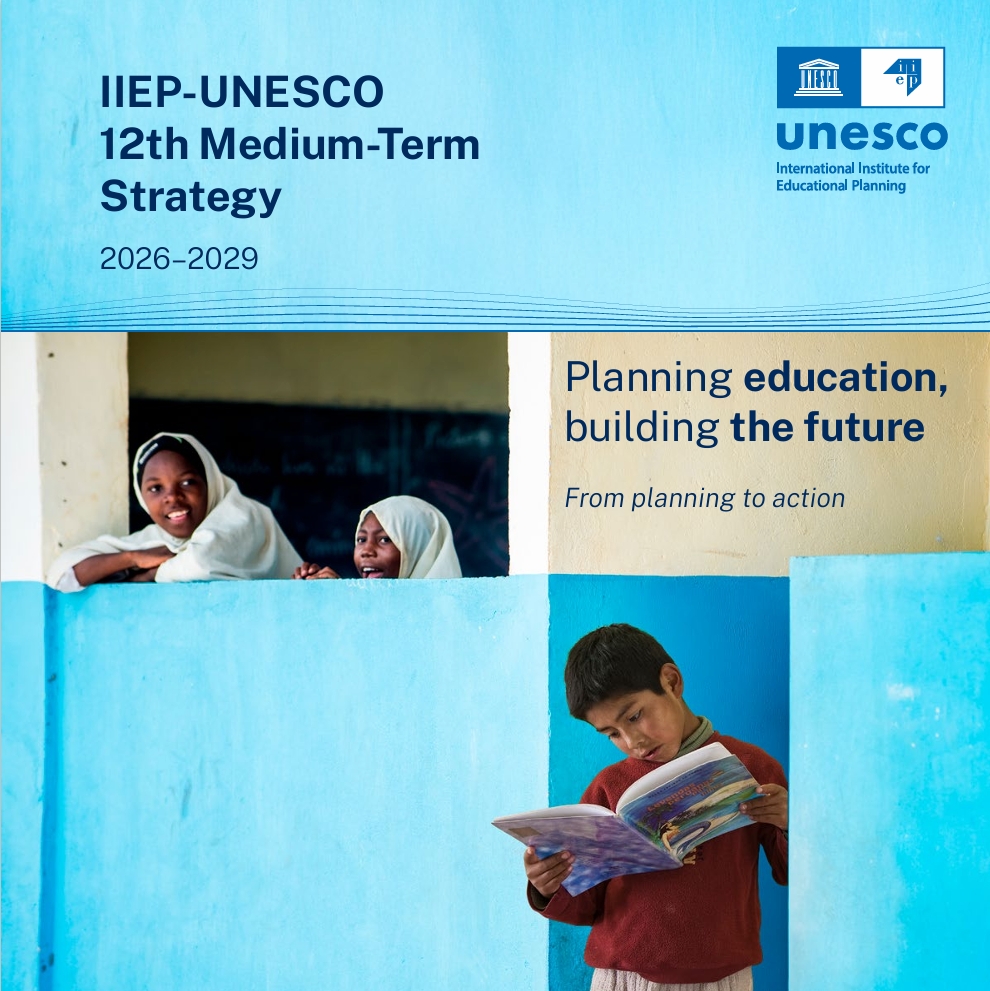 IIEP-UNESCO 12th Medium-Term Strategy: 2026–2029 سنة النشر: 2026 المؤلف المؤسسي: UNESCO International Institute for Educational Planning (IIEP) The 2026-2029 Medium-Term Strategy of the UNESCO International Institute for Educational Planning provides a vision for transforming educational planning into tangible results for education systems across the globe. Building on more than 60 years of experience, the Strategy puts the focus not only on policy and plan design, but on collective and agile implementation.
  Nepal: lessons from integrating peace, human rights, and civic education into social studies curricula and textbooks سنة النشر: 2015 المؤلف: Melinda Smith المؤلف المؤسسي: UNESCO International Institute for Educational Planning (IIEP) | United Nations Children's Fund (UNICEF) | Education Above All (Qatar) This case study examines the process undertaken by the Ministry of Education (MoE) in collaboration with development partners to revise the social studies curriculum in Nepal. The aim was to promote education for peace, human rights, and civic education (PHRCE) in the wake of a 10-year Maoist insurgency and the transition to a democratic republic. It provides a critical analysis of the process, synthesizing information from two assessments of the initiative, and makes recommendations for the future based on challenges and gaps identified by stakeholders. The study also provides recommendations to countries in post-conflict transition which are interested in undertaking similar curriculum reform initiatives.Information is drawn from a number of reports and programme documents developed by the implementing partners, as well as 12 interviews with individuals involved in the process of curriculum reform. Interviewees included representatives of the major agencies involved in the revision process: the MoE’s Curriculum Development Centre, the National Centre for Education Development, Save the Children, UNESCO, and UNICEF. In addition, interviews were conducted with representatives of civil society and non-governmental agencies supporting peace education and representing marginalized groups, and the external international consultant who provided technical assistance. Népal: leçons tirées de l'intégration de la paix, des droits de la personne et de l'éducation civique dans les programmes d'études et les manuels scolaires سنة النشر: 2015 المؤلف: Melinda Smith المؤلف المؤسسي: UNESCO International Institute for Educational Planning (IIEP) | United Nations Children's Fund (UNICEF) | Education Above All (Qatar) Cette étude de cas examine le processus entrepris par le Ministère de l'Éducation (MdE) en collaboration avec les partenaires au développement pour réviser le programme d'études sociales au Népal. L'objectif était de promouvoir l'éducation pour la paix, les droits humains et l'éducation civique (PDHEC) à la suite d'une insurrection maoïste de 10 ans et la transition vers une république démocratique. Il fournit une analyse critique du processus, synthétise l'information à partir de deux évaluations de l'initiative et formule des recommandations pour l'avenir en fonction des défis et des lacunes identifiés par les intervenants. L'étude fournit également des recommandations aux pays en transition post-conflit qui sont intéressés à entreprendre des initiatives de réforme du curriculum similaires. L'information provient d'un certain nombre de rapports et de documents de programme élaborés par les partenaires d'exécution, ainsi que de 12 entrevues avec des personnes impliquées dans le processus de réforme du curriculum. Les personnes interrogées comprenaient des représentants des principaux organismes impliqués dans le processus de révision: Centre de développement, le Centre national pour le développement Education Curriculum MdE, Save the Children, l'UNESCO et l'UNICEF. En outre, des entrevues ont été menées avec des représentants de la société civile et les organisations non gouvernementales qui soutiennent l'éducation de la paix et représentant des groupes marginalisés, et le consultant international externe qui a fourni une assistance technique.
  Education for peace: planning for curriculum reform; guidelines for integrating an education for peace curriculum into education sector plans and policies سنة النشر: 2015 المؤلف المؤسسي: UNESCO | UNESCO International Bureau of Education (IBE) | UNESCO International Institute for Educational Planning (IIEP) This Resource and Development Capacity Package was developed based on the belief that, as part of a wider social, economic and political effort, education can play a significant role in a country’s peace-building efforts. Its purpose is to assist Member States in integrating or strengthening peace education programs in their national education systems to promote peace and prevent future conflict. UNESCO, IBE, and IIEP developed this resource within the framework of UNESCO’s Intersectoral Project, Promoting a culture of peace and nonviolence in Africa through education for peace and conflict prevention. The Package contains Technical Guidelines and Capacity Development training modules on policy, program design and curriculum planning to integrate peace and conflict prevention into all aspects of the education system. It is meant for curriculum developers and planners from Africa. The development of the package received the support of the UNESCO Addis-Ababa Office, which assisted in the testing of materials in Addis-Ababa (Ethiopia) and Yaounde (Cameroon).This resource will furthermore help to ensure that curricula, teaching and learning resources and teacher education are in line with the post-2015 vision of education for holistic development. This vision reconceptualises education in terms of global citizenship and responsibility by focusing on inclusion and social cohesion that is global in orientation. In this regard, Global Citizenship Education (GCED) seeks to empower learners with knowledge, skills, values and attitudes that are needed to forge more just and inclusive societies, capable of resolving existing conflicts and emerging global challenges. Éducation pour la paix: la planification de la réforme du curriculum; lignes directrices pour l'intégration d'un programme d'éducation pour la paix dans les plans et politiques du secteur éducatif سنة النشر: 2015 المؤلف المؤسسي: Organisation des Nations Unies pour l'éducation, la science et la culture (UNESCO) | UNESCO International Bureau of Education (IBE) | UNESCO International Institute for Educational Planning (IIEP) Cette trousse de ressources et de développement des capacités a été élaborée sur la base de la conviction que, dans le cadre d'un effort plus large social, économique et politique, l'éducation peut jouer un rôle important dans les efforts de consolidation de la paix d'un pays. Son but est d'aider les États membres à intégrer ou renforcer les programmes d'éducation à la paix dans leurs systèmes nationaux d'éducation pour promouvoir la paix et prévenir les conflits futurs. UNESCO, le BIE, et l'IIPE ont développé cette ressource dans le cadre du projet intersectoriel de l'UNESCO, Promouvoir une culture de la paix et de la non-violence en Afrique par l'éducation pour la paix et la prévention des conflits. Le paquet contient des directives techniques et des modules de formation de renforcement des capacités sur la politique, la conception des programmes et de la planification des programmes pour intégrer la paix et de prévention des conflits dans tous les aspects du système d'éducation. Il est destiné aux concepteurs de programmes et les planificateurs de l'Afrique. Le développement de l'emballage a reçu le soutien du Bureau d'Addis-Abeba de l'UNESCO, qui a participé à l'essai des matériaux à Addis-Abeba (Ethiopie) et Yaoundé (Cameroun).Cette ressource sera en outre aider à faire en sorte que les programmes, les ressources d'enseignement et d'apprentissage et la formation des enseignants sont en ligne avec la vision post-2015 de l'éducation pour le développement holistique. Cette vision reconceptualise l' éducation en termes de citoyenneté et de responsabilité globale en mettant l'accent sur l'inclusion et la cohésion sociale qui est mondiale dans l'orientation. À cet égard, Éducation à la Citoyenneté Mondiale (ECM) vise à habiliter les apprenants des connaissances, des compétences, des valeurs et des attitudes qui sont nécessaires pour forger des sociétés plus justes et inclusives, capables de résoudre les conflits existants et nouveaux défis mondiaux.