
الموارد
استكشف مجموعة واسعة من الموارد القيمة حول تعليم المواطنة العالمية لتعميق فهمك وتعزيز البحث والمناصرة والتعليم والتعلم.
تم العثور على 154 نتيجة
 Présentation de l'assurance de la qualité de l'éducation à la citoyenneté démocratique dans les écoles - étude comparative de 10 pays سنة النشر: 2009 المؤلف المؤسسي: Conseil de l'Europe (Recommandation Rec (2002) 12). Selon cette recommandation, les gouvernements européens ont reconnu leur responsabilité de veiller à la base culturelle de la démocratie par l'éducation. Cependant, la politique est pas si simple que les recommandations supranationales sont immédiatement traduites en politique dans les Etats nationaux. Cet écart entre les politiques convenues et réalisés a été appelé un «écart de conformité». Une des raisons les plus logiques pour la non-conformité provient d'un manque de sensibilisation ou de compétences. Par conséquent, le Conseil de l'Europe concentrée sur la production de matériaux qui pourraient aider à sensibiliser et développer les compétences. Les principaux produits résultant de cet effort ont été collectées comme un «ECD / EDH Pack » depuis 2005. Cette collection couvre les domaines de l'élaboration des politiques, la gouvernance démocratique des établissements d'enseignement, la formation des enseignants et l'assurance qualité. Le «Outil pour l'assurance qualité de l'éducation à la citoyenneté démocratique dans les écoles» (Bîrzea et al., 2005), qui est l'un de ces matériaux, constitue le document de référence pour cette étude. Cette étude analyse les conditions pertinentes et les activités possibles en ce qui concerne la mise en œuvre de l'outil dans 10 systèmes éducatifs nationaux. Comme les conditions pertinentes, l'étude considère les tentatives existantes pour offrir une qualité d'enseignement au sein des pays, ainsi que les programmes de formation des enseignants qui accompagnent ces tentatives. Comme les activités possibles, les adaptations nationales de l'outil, et diverses façons de travailler avec différents groupes cibles, sont également pris en compte. Les sections suivantes fournissent des informations de base concernant le projet. Cela aidera le lecteur à comprendre pourquoi l'outil doit être adapté dans des circonstances différentes. La section 2 présente des points de référence qui ouvrent des perspectives théoriques sur le travail présenté. Section 3 fournit une justification pour la sélection des pays participants et donne et décrit la méthodologie utilisée lors de la réalisation de cette étude. Enfin, la section 4 donne un aperçu du reste du contenu de ce livre.
  Competences for Democratic Culture: Living together as equals in culturally diverse democratic societies سنة النشر: 2016 المؤلف المؤسسي: Council of Europe This document is a product of a Council of Europe project which is taking place in four phases during 2014-17. The first phase has been devoted to the development of a conceptual model of the competences which citizens require to participate effectively in a culture of democracy. This document describes the model and the methods that were used to develop it. The document is aimed at readers who wish to understand the underlying assumptions and technical details of the model. Phase two of the project will be devoted to the development of descriptors (i.e. statements or descriptions of what a person is able to do if they have mastered the various competences that are specified by the model), phase three to ascertaining whether it is possible to assign the descriptors to levels of proficiency, and phase four to the production of supporting documentation. This documentation will be addressed to educational practitioners and policy makers, and will provide a less technical description of the current competence model. It will also explain how the model and the descriptors can be used to assist curriculum design, pedagogical design and the development of new forms of assessment (for use in either selfassessment or assessment by others). All of the materials that are produced by the project will eventually be incorporated into a Council of Europe reference framework of competences for democratic culture. Further information about the project is available from the project website: www.coe.int/competences Developing Positive Values: A case study of Holocaust Memorial Day in the primary schools of one local authority in Scotland Many schools and local authorities saw the initial Holocaust Memorial Day as an important stimulus to develop lessons and events in Holocaust history amongst young people of vital importance for today. The focus of this paper is to examine the potential for Holocaust education in the primary curriculum in Scotland and whether the instance of Holocaust Memorial Day and the undertaking of a serious commitment to it by a local authority had an impact on the teaching and raising of Holocaust issues in the primary schools in that area. The authors previously argued (Maitles & Cowan, 1999) that there needed to be a major commitment from the Scottish Executive and/or local councils to encourage teachers and schools to coordinate or introduce Holocaust education in the schools. To test this, the field research for this survey was conducted by means of a questionnaire to every primary school in the local authority and achieved a 91% response rate. Strong national commitment to Holocaust educational activities, backed up by commitment from the local authority, in terms of staff development and teaching materials, ensured a quality of experience as well as the quantity. Linked to this was an effective structure in the schools, with a designated Holocaust education coordinator and the involvement of the wider community. This led teachers in schools to imaginatively develop pupil skills, knowledge and understanding and informed attitudes in Holocaust history which potentially has a resonance in the wider citizenship area. (By the publisher)
 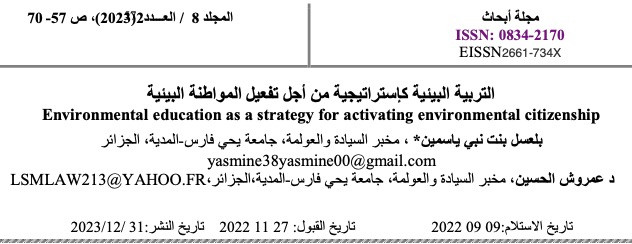 Environmental Education as a Strategy for Activating Environmental Citizenship (vol.8, no.2; Research Journal) سنة النشر: 2023 المؤلف: Bel'asal Bint Nabi Yasmine | Amroush Al Houcine المؤلف المؤسسي: Yahia Fares University of Medea This research paper aims to explore environmental education as a strategy for promoting environmental citizenship. Throughout the latter half of the twentieth century, the environment became a focal point for numerous thinkers and researchers across various fields. The concept of environmental citizenship emerged as a crucial term aimed at fostering individual responsibility towards the environment. Achieving environmental citizenship necessitates effective environmental education, which endeavors to impart direction, values, and behaviors conducive to environmental stewardship. It seeks to elucidate key concepts and cultivate essential skills for comprehending and appreciating the intricate relationships between humanity, culture, and the environment. Topics explored include citizenship, environment, environmental education, the Tbilisi conference, and responsible environmental behavior. التربية البيئية كإستراتيجية من أجل تفعيل المواطنة البيئية (vol.8, no.2 مجلة أبحاث) سنة النشر: 2023 المؤلف: بلعسل بنت نبي ياسمين | عمروش الحسين المؤلف المؤسسي: Yahia Fares University of Medea في هذه الورقة البحثية سنحاول التطرق إلى التربية البيئية كإستراتيجية من أجل تفعيل المواطنة البيئية، فقد شغلت البيئة بال الكثير من المفكرين والباحثين على مختلف اختصاصاتهم في بدايات النصف الثاني من القرن الماضي فبرز مفهوم المواطنة البيئية كمصطلح حيوي يتم استخدامه لتعزيز مسؤولية المواطن تجاه بيئته، وحتى تتحقق المواطنة البيئية لابد من وجود تربية بيئية تعمل على غرس الاتجاهات والقيم والسلوكيات البيئية، وتهدف إلى توضيح المفاهيم وتنمية المهارات اللازمة لفهم وتقدير العلاقات التي تربط بين الإنسان وثقافته وبيئته. Introducing quality assurance of education for democratic citizenship in schools - comparative study of 10 countries سنة النشر: 2009 المؤلف المؤسسي: Council of Europe For over a decade the Council of Europe has been working on policies in the field of education for democratic citizenship (EDC). One result has been that the Committee of Ministers of the Council of Europe agreed on a recommendation stating that EDC is central to educational politics, and that it is a “factor for innovation in terms of organising and managing overall education systems, as well as curricula and teaching methods” (Recommendation Rec(2002)12). According to this recommendation, European governments acknowledged their responsibility for ensuring the cultural basis of democracy through education. However, politics is not so simple that supranational recommendations are immediately translated into policy in national states. This gap between agreed and realised policies has been termed a “compliance gap”. One of the most logical reasons for noncompliance comes from a lack of awareness or competences. Therefore the Council of Europe concentrated on producing materials that could help raise awareness and develop competences. Key products resulting from this effort have been collected as an “EDC/HRE Pack” since 2005.This collection covers the areas of policy making, democratic governance of educational institutions, teacher training and quality assurance. The “Tool for Quality Assurance of Education for Democratic Citizenship in Schools” (Bîrzea et al., 2005), which is one of these materials, forms the reference document for this study.This study analyses relevant conditions and possible activities with regard to implementing the tool in 10 national educational systems. As relevant conditions, the study considers the existing attempts to deliver educational quality within countries, together with the teacher training programmes that accompany these attempts. As possible activities, national adaptations of the tool, and various ways of working with different target groups, are also taken into account.The following sections provide background information concerning the project. This will help the reader understand why the tool needs to be adapted in different circumstances. Section 2 presents points of reference that open theoretical perspectives on the work presented. Section 3 provides a rationale for the selection of participating countries and gives and describes the methodology used when conducting this study. Finally, Section 4 provides an overview of the remaining contents of this book. Democracy and diversity: principles and concepts for educating citizens in a global age سنة النشر: 2005 المؤلف: James A. Banks | Cherry A. McGee Banks | Carlos E. Cortes | Carole L. Hahn | Merry M. Merryfield | Kogila A. Moodley | Stephen Murphy-Shigematsu | Audrey Osler | Caryn Park | Walter C. Parker المؤلف المؤسسي: Center of Multicultural Education, University of Washington The Center for Multicultural Education at the University of Washington convened—with support from the Spencer Foundation—a Diversity, Citizenship, and Global Education Consensus Panel. The Panel’s goal was to develop a set of principles, concepts, and guidelines that school practitioners can use to build or renew citizenship education programs that balance diversity and unity and prepare students to become effective citizens in a global context. An important resource for the Panel’s work was the book that resulted from an earlier conference sponsored by the Center, Diversity and Citizenship Education: Global Perspectives (Banks, 2004a).The Consensus Panel developed four principles and identified ten concepts, which are detailed in this publication. The Panel also developed a checklist that is designed for use by educators who want to consider the extent to which the principles and concepts identified by the Panel are reflected in their classrooms and schools.PRINCIPLESSection I Diversity, Unity, Global Interconnectedness, and Human Rights1. Students should learn about the complex relationships between unity and diversity in their local communities, the nation, and the world.2. Students should learn about the ways in which people in their community, nation, and region are increasingly interdependent with other people around the world and are connected to the economic, political, cultural, environmental, and technological changes taking place across the planet.3. The teaching of human rights should underpin citizenship education courses and programs in multicultural nation-states.Section II Experience and Participation4. Students should be taught knowledge about democracy and democratic institutions and provided opportunities to practice democracy. Démocratie et diversité: principes et concepts pour l'éducation des citoyens dans un âge global سنة النشر: 2005 المؤلف: James A. Banks | Cherry A. McGee Banks | Carlos E. Cortes | Carole L. Hahn | Merry M. Merryfield | Kogila A. Moodley | Stephen Murphy-Shigematsu | Audrey Osler | Caryn Park | Walter C. Parker المؤلف المؤسسي: Center of Multicultural Education, University of Washington Le Centre pour l'éducation multiculturelle à l'Université de Washington a convoqué-avec le soutien de la Fondation-a Spencer Diversité, Citoyenneté et Éducation Globale Panel Consensus . L'objectif du Groupe est de développer un ensemble de principes, des concepts et des lignes directrices que les praticiens de l'école peuvent utiliser pour construire ou de renouveler les programmes d'éducation à la citoyenneté que la diversité de l'équilibre et de l'unité et de préparer les étudiants à devenir des citoyens efficaces dans un contexte mondial. Une ressource importante pour les travaux du Groupe spécial était le livre qui résulte d'un earlierconférencesponsored par le Centre, la diversité et l'éducation à la citoyenneté: perspectives mondiales (banques, 2004a). Le groupe de concertation a élaboré quatre principes et identifi é dix concepts, qui sont détaillées dans cette publication. Le Groupe spécial a également mis au point une liste de contrôle qui est conçu pour être utilisé par les éducateurs qui veulent examiner la mesure dans laquelle les principes et les concepts identifi és par le Groupe sont refl ète dans leurs salles de classe et les écoles. PRINCIPES Section I Diversité, Unité, Global interconnectivité et droits de l'homme 1. Les élèves devraient en apprendre davantage sur les relations complexes entre l'unité et la diversité dans leurs communautés locales, la nation et le monde. 2. Les élèves devraient en apprendre davantage sur les façons dont les gens dans leur communauté, de la nation et de la région sont de plus en plus interdépendantes avec d'autres personnes dans le monde et sont reliés aux changements économiques, politiques, culturels, environnementaux et technologiques qui ont lieu à travers la planète. 3. L'enseignement des droits de l'homme devrait soutenir les cours et les programmes d'éducation à la citoyenneté dans les États-nations multiculturelles. Section II Expérience et participation 4. Les élèves doivent apprendre les connaissances sur la démocratie et les institutions démocratiques et a fourni des occasions de pratiquer la démocratie. Citizenship, identity and education: examining the public purposes of schools in an age of globalization سنة النشر: 2006 المؤلف: Fernando Reimers المؤلف المؤسسي: UNESCO International Bureau of Education (IBE) Educational institutions exist to achieve public purposes. One of those purposes is to develop citizenship. In the 21st century, citizenship includes global citizenship. In an era of globalization effective citizenship includes the knowledge, ability and disposition to engage peacefully and constructively across cultural differences for purposes of addressing personal and collective needs and of achieving sustainable human–environmental interactions, this requires internalizing global values. Addressing these challenges of globalization will require making citizenship education and the development of global values an explicit objective of efforts to improve quality throughout the world, critically examining theories and evidence about the effectiveness of various approaches to developing citizenship and global citizenship and supporting activities aligned with this public purpose. This public purpose should support the development of a political culture that fosters the rule of national and international law and respect of human rights, the development of understanding to support trade and economic and peaceful bilateral and international diplomacy as the preferred means to solve international disputes, the development of the capability to understand and address the serious environmental challenges facing humanity and to collaborate across national boundaries in the creation of sustainable forms of human–environmental interactions and in the development of the skills to promote rationality in deliberation and action, and to advance science and technology as means to improve human health and well-being. At present, however, many education systems and reforms are insufficiently focused on quality, or focus instead on a very narrow and self-referenced definition of quality. It is possible to educate people to understand and appreciate cultural differences and to understand and accept human rights in a framework of global values that includes compassion and caring, concern for others, respect and reciprocity. These values, dispositions, knowledge and skills can be developed in a range of institutions that societies have to pass on what they value to the young, and to re-create culture: families, religious institutions, the media, workplaces, political institutions and also schools. While there is no reason to assume that schools can be more effective in this task than any of these other institutions, they have greater potential to be aligned with transnational efforts to promote global civility. They are a public space, and consequently also a globally public space, in ways in which families and religious institutions are not. If schools actively engage in teaching hatred or intolerance, or if they fail to prepare students adequately for global civility, these failures can be noted by international institutions that can potentially mobilize resources to support national and local efforts to prepare students for global citizenship. There is not a similar network linking national and transnational institutions, public and private, governmental and non-governmental, that attends to the dynamics of families and other ‘‘private’’ spaces. Citoyenneté, identité et de l'éducation: l'examen des fins publiques des écoles à l'ère de la mondialisation سنة النشر: 2006 المؤلف: Fernando Reimers المؤلف المؤسسي: UNESCO International Bureau of Education (IBE) Les établissements d'enseignement existent pour parvenir à des fins publiques. L'un de ces objectifs est de développer la citoyenneté. Au 21e siècle, la citoyenneté comprend la citoyenneté mondiale. Dans une ère de mondialisation citoyenneté effective comprend les connaissances, la capacité et la disposition à engager pacifique et constructive entre les différences culturelles aux fins de répondre aux besoins personnels et collectifs et de réaliser des interactions humaines-environnementales durables, ce qui nécessite l'intériorisation des valeurs globales. Pour relever ces défis de la mondialisation, il faudra faire de l'éducation à la citoyenneté et le développement des valeurs mondiales un objectif explicite des efforts pour améliorer la qualité dans le monde entier, l'examen critique des théories et des preuves sur l'efficacité des différentes approches pour développer la citoyenneté et la citoyenneté mondiale et soutenir les activités alignées cet effet public. Cet objectif public devrait soutenir le développement d'une culture politique qui favorise la primauté du droit national et international et le respect des droits de l'homme, le développement de la compréhension pour soutenir le commerce et la diplomatie bilatérale et internationale économique et pacifique comme le moyen privilégié pour résoudre les conflits internationaux, le développement de la capacité à comprendre et à relever les défis environnementaux humanité face à de graves et de collaborer à travers les frontières nationales dans la création de formes durables d'interactions homme-environnement et dans le développement des compétences pour promouvoir la rationalité dans la délibération et de l'action, et de faire avancer la science et la technologie comme moyen d'améliorer la santé humaine et le bien-être. À l'heure actuelle, cependant, de nombreux systèmes d'éducation et les réformes ne sont pas suffisamment axées sur la qualité, ou se concentrent plutôt sur une définition très étroite et auto-référencé de la qualité. Il est possible d'éduquer les gens à comprendre et à apprécier les différences culturelles et à comprendre et à acept droits de l'homme dans un cadre de valeurs globales qui comprend la compassion et la compassion, le souci des autres, le respect et la réciprocité. Ces valeurs, les dispositions, les connaissances et les compétences peuvent être développées dans un éventail d'institutions que les sociétés doivent passer sur ce qu'ils apprécient le jeune, et de recréer la culture: les familles, les institutions religieuses, les médias, les milieux de travail, les institutions politiques et aussi écoles. Bien qu'il n'y ait aucune raison de supposer que les écoles peuvent être plus efficaces dans cette tâche que l'une de ces autres institutions, ils ont un plus grand potentiel pour être aligné avec les efforts transnationaux visant à promouvoir la civilité mondiale. Ils sont un espace public, et par conséquent aussi un espace public à l'échelle mondiale, dans les façons dont les familles et les institutions religieuses ne sont pas. Si les écoles participent activement à l'enseignement à la haine ou l'intolérance, ou si elles ne parviennent pas à préparer les étudiants de manière adéquate pour la civilité mondiale, ces échecs peuvent être notées par les institutions internationales qui peuvent potentiellement mobiliser des ressources pour soutenir les efforts nationaux et locaux pour préparer les élèves à la citoyenneté mondiale. Il n'y a pas un réseau similaire reliant les institutions nationales et transnationales, publiques et privées, gouvernementales et non-gouvernementales, qui assiste à la dynamique des familles et d'autres «espaces» «privés».