
الموارد
استكشف مجموعة واسعة من الموارد القيمة حول تعليم المواطنة العالمية لتعميق فهمك وتعزيز البحث والمناصرة والتعليم والتعلم.
تم العثور على 154 نتيجة
 Digital kids Asia-Pacific: insights into children’s digital citizenship سنة النشر: 2019 المؤلف: Taeseob Shin | Hyeyoung Hwang | Jonghwi Park | Jian Xi Teng | Toan Dang المؤلف المؤسسي: UNESCO Bangkok This report responds to the growing needs of Member States in the Asia-Pacific region to understand children’s knowledge, behaviour and attitudes in a hyper-connected digital world. It aims to create a data-driven, conducive educational and policy environment that maximizes opportunities that Information and Communications Technology (ICT) offers, while minimizing potential threats that the same may pose. The report was also developed in the context of the Education 2030 Agenda identifying digital skills as one of the key competencies for youth and adults to achieve and monitor until 2030.
  Holocaust Education: How Students and Teachers Experience Teaching and Learning about National Socialism and the Holocaust سنة النشر: 2008 المؤلف المؤسسي: Bayerische Landeszentrale fürpolitische Bildungsarbeit The original title: Holocaust Education: Wie Schüler und Lehrer den Unterricht zum Thema Nationalsozialismus und Holocaust Erleben(Bayerische Zeitschrift für Politik und Geschichte, 1(8) [Themenheft Einsichten und Perspektiven]) Special issue of a Journal presenting several articles of a pilot study carried out in Bayern, focusing on the subjective experiences and representations of teachers and students when dealing with the Holocaust and with National Socialism. The above abstract is taken from the International Holocaust Remembrance Alliance Education Research Project. Please also consult the full list of abstracts in 15 languages and the accompanying publication Research in Teaching and Learning about the Holocaust: A Dialogue Beyond Borders. Ed: IHRA, Monique Eckmann, Doyle Stevick, Jolanta Ambrosewicz-Jacobs, 2017, Metropol Verlag at www.holocaustremembrance.com/resources/publications.
  The Memory of Nazism and the Migration Society: Fears, Experiences and Attributions. Intergenerational Historical Consciousness سنة النشر: 2008 المؤلف: Angela Kühner The original title: NS-Erinnerung und Migrationsgesellschaft: Befüchtungen, Erfahrungen und Zuschreibungen(Einsichten und Perspektiven, Bayerische Zeitschrift für Politik und Geschichte, 1(8), pp. 52-65) The articles deals with a specific part of the pilot-study (see Kühner et al. 2008) on teachers’ and students’ experiences and representations, i.e. with the dimension of a migration-society. The author suggests to use the idea of “a society of migration as a context,” instead of the “migrants as target group.” This approach allows the author to work out several ways in which the students and teachers position themselves towards the national-socialist past of German society, and how the attribution of guilt, shame or esponsibility to several groups of “Others” serves as an interactive pattern in a migration society. Migration can therefore offer on one hand a tool to project their own fears or feelings, but on the other hand, it can also offer an opportunity for dialog and a higher degree of reflexivity on the past and the present. The above abstract is taken from the International Holocaust Remembrance Alliance Education Research Project. Please also consult the full list of abstracts in 15 languages and the accompanying publication Research in Teaching and Learning about the Holocaust: A Dialogue Beyond Borders. Ed: IHRA, Monique Eckmann, Doyle Stevick, Jolanta Ambrosewicz-Jacobs, 2017, Metropol Verlag at www.holocaustremembrance.com/resources/publications.
  Constructions of Generational Relations: Childhood and the Theme of National Socialism in Primary-School Education سنة النشر: 2012 المؤلف: Alexandra Flügel The original title: Konstruktionen des Generationalen Verhältnisses: Kindheit und das Thema Nationalsozialismus im Grundschulunterricht(Kinder und Zeitgeschichte: Jüdische Geschichte und Gegenwart, Nationalsozialismus und Antisemitismus, Supplement 8, pp. 75–84) This is a qualitative study, based on the results in Fügel 2009, of German primary school children’s communication about Nazism and the Holocaust. It demonstrates how interwoven these exchanges are with general German memory discourses about these topics, but also how the children already at the age of 9–10 reflect upon their need to learn about this dark side of German history.The above abstract is taken from the International Holocaust Remembrance Alliance Education Research Project. Please also consult the full list of abstracts in 15 languages and the accompanying publication Research in Teaching and Learning about the Holocaust: A Dialogue Beyond Borders. Ed: IHRA, Monique Eckmann, Doyle Stevick, Jolanta Ambrosewicz-Jacobs, 2017, Metropol Verlag at www.holocaustremembrance.com/resources/publications.
 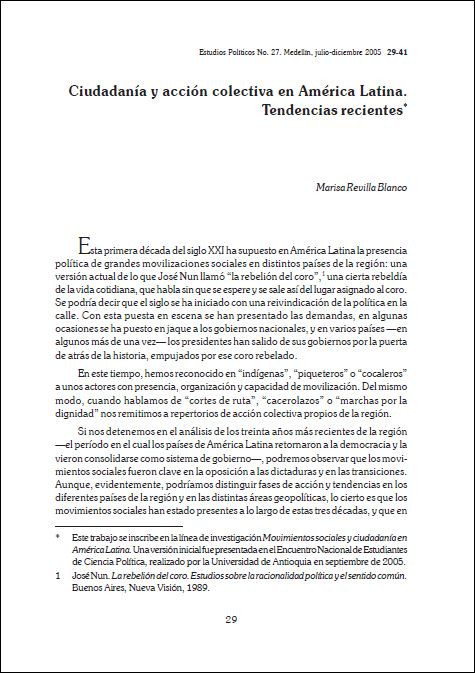 Citizenship and Collective Action in Latin America. Recent Trends سنة النشر: 2005 المؤلف: Marisa Revilla Blanco The following text intends to analyze those forms of collective action through which citizens have been present in the streets of the region during the last thirty years. It seeks to understand the actors and the conditions of their appearance and continuity; In this way, it is also intended to make a small contribution to the theoretical development of the analysis of social movements in Latin America. Ciudadanía y Acción Colectiva en América Latina. Tendencias Recientes سنة النشر: 2005 المؤلف: Marisa Revilla Blanco En el siguiente texto se pretende analizar esas formas de acción colectiva mediante las cuales la ciudadanía se ha estado haciendo presente en las calles de la región durante los treinta años más recientes. Se busca comprender los actores y las condiciones de su aparición y continuidad; de este modo, también se pretende hacer un pequeño aporte al desarrollo teórico del análisis de los movimientos sociales en América Latina.Este artículo está publicado en Estudios Políticos. [en linea] 2005, (Julio-Diciembre)
  Citizenship Initiatives and Pupil Values: A Case Study of One Scottish School's Experience As the education for citizenship agenda continues to make an impact on schools, there is a need to discuss and examine the kind of initiatives that can push it forward. In Scotland the proposals should, it is argued, permeate the curriculum throughout the school. Yet there is the fear that the responsibility of all can become the responsibility of none. This research is designed to examine the impact on the young people involved in a dedicated and intense citizenship programme in one large secondary (high) school in Scotland. The results suggest that there was a marked change in the general values of the young people involved. Further, that there are some stark gender differences in the findings. (By the author) One country, many cultures! Does Holocaust education have an impact on pupils' citizenship values and attitudes? The Holocaust has been regarded as the defining moment of modern history and perhaps of all time. For most people it still evokes the ultimate in barbarism and inhumanity. The focus of this paper is to examine the impact that Holocaust education has on citizenship values in the primary and secondary stages of schooling. Previous research on teaching the Holocaust, primarily case studies in either the primary or the secondary sectors, suggests that the contribution of Holocaust education to citizenship includes developing pupils' understanding of the notion of justice, tolerance and the many forms of racism and discrimination, and provides opportunities for developing the positive values of empathy, awareness of antiracism, and an understanding that the individual can make a difference. Further, it can make a significant contribution to citizenship in developing pupils' awareness of human rights issues and genocides, the concepts of stereotyping and scapegoating and the exercise of power in local, national and global contexts. Our ongoing longitudinal research (sponsored by the Scottish Executive Education Department and running from November 2003 until summer 2005) aims to examine the value of Holocaust education in achieving aspects of citizenship. It is concerned with the immediate and longer term effects of Holocaust education on pupils' values and attitudes. Initially focused on primary pupils aged 11-12 years, it will follow them into secondary and compare their values and attitudes with pupils in their year who did not study the Holocaust in their primary schools. The proposed paper, which will report on the first stages of this ongoing research, will concentrate on: the relevance of Holocaust education to citizenship; the research methodology; the first results of the understanding of pupils and the impact of Holocaust teaching; tentative conclusions. (By the author)
 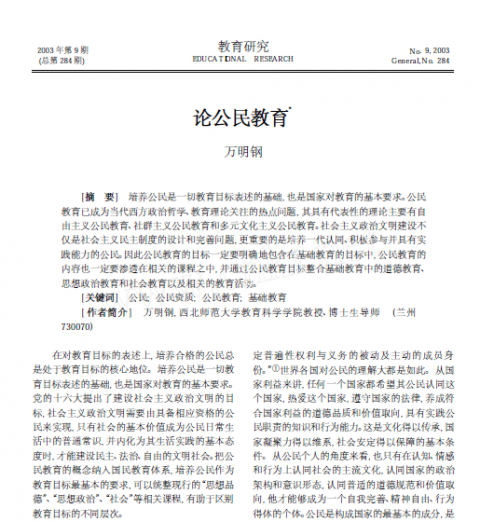 On Citizenship Education سنة النشر: 2003 المؤلف: Wan Minggang Cultivation of citizens is the basis of all educational objectives and the State's basic requirement for eductaion. Citizenship education has become a hot issue at tracting the solicitude of modern Western political philosophy and educational theories. The citizenship education is characterized by its representative theories of liberalist citizenship education, corporatist citizenship education and muticulturalist citizenship eduction. The construction of socialist politics and civilization not only involves the designing and optimization of socialist democratic system, but also concerns the cultivation of citizens with strong sense of participation and practical ability. Therefore, the aim of citizenship eduction must be clearly included in the objectives of basic education and the content of citizenship education must be reflected in relevant courses. The objectives of citizenship education should be used to integrate moral education, ideological and political education, social education and relevant educational activities in basic education. 论公民教育 سنة النشر: 2003 المؤلف: Wan Minggang 培养公民是一切教育目标表述的基础,也是国家对教育的基本要求。公民教育已成为当代西方政治哲学、教育理论关注的热点问题,其具有代表性的理论主要有自由主义公民教育、社群主义公民教育和多元文化主义公民教育。社会主义政治文明建设不仅是社会主义民主制度的设计和完善问题,更重要的是培养一代认同、积极参与并具有实践能力的公民。因此公民教育的目标一定要明确地包含在基础教育的目标中,公民教育的内容也一定要渗透在相关的课程之中,并通过公民教育目标整合基础教育中的道德教育、思想政治教育和社会教育以及相关的教育活动。