
الموارد
استكشف مجموعة واسعة من الموارد القيمة حول تعليم المواطنة العالمية لتعميق فهمك وتعزيز البحث والمناصرة والتعليم والتعلم.
تم العثور على 154 نتيجة
 Informe de referente regional 2010: oportunidades de aprendizaje escolar de la ciudadanía en América Latina: currículos comparados سنة النشر: 2010 المؤلف: Cristián Cox Donoso المؤلف المؤسسي: Sistema Regional de Evaluacion y Desarrollo de Competencias Ciudadanas (SREDECC) This report has three purposes, the first, to describe the contexts and challenges of education for citizenship education in Latin America; secondly, to describe the process of implementation and creation of the Latin American version of the International Civic and Citizenship Education Study (ICCS) test and compare the categories of both evaluation tools; lastly, to characterize, in a comparative way, the citizenship education curricula of Colombia, Chile, Guatemala, Mexico, Paraguay, and the Dominican Republic. The results of the report rise from the analysis of secondary sources on the socio-educational contexts in which citizenship education is based upon in Latin America, as well as a comparative analysis of the original educational curricula of the six countries of this project. The structure of the chapters and the sections of this document are arranged according to the referred purposes. The first chapter focuses on the sociocultural context of the educational system that is in charge of shaping citizens. Recent evidence on beliefs and democratic practices in the region will be examined. Later, the evolution of the school systems in the last decade and a half will be described. Finally, in order to establish a “base line” on the role of citizenship education in education policy, first the curricula, pedagogies, and teacher formation and evaluation will be examined. The second chapter focuses on the process of generation of the Latin American evaluative method, part of the ICCS test. Then, in a detailed manner, a comparative analysis of the categories or evaluation criteria of both tests will be presented in order to show the predominant opinion of citizenship education in the 6 countries. Trying to identify certain patterns, the report concludes with a chapter that makes interpretations and projections about the tendencies observed in current curricula and propose new criteria for the development of new education curricula.
  Securitising Education to Prevent Terrorism or Losing Direction? سنة النشر: 2016 المؤلف: Bill Durodie المؤلف المؤسسي: Society for Educational Studies | Taylor & Francis This article examines the growing relationship between security and education, particularly in the light of the UK government’s Prevent Duty that seeks to tackle radicalization in a variety of milieus, including universities. However, rather than seeing this process as being merely one-way, through a so-called securitization of education, what is explored here is the dialectic between these two spheres. It is suggested that a heightened sensitivity to the supposed consequences of inflammatory rhetoric on the well-being of supposedly suggestible or vulnerable students has been in existence within education for quite some time. Securitising Education to Prevent Terrorism or Losing Direction? سنة النشر: 2016 المؤلف: Bill Durodie المؤلف المؤسسي: Society for Educational Studies | Taylor & Francis Cet article examine le lien grandissant entre la sécurité et l'éducation, à la lumière, en particulier, du programme « Prevent Duty » du gouvernement britannique, qui vise à lutter contre la radicalisation dans différents milieux, tels que les universités. Cependant, plutôt que de voir un simple processus de sécurisation de l'éducation, il s’agit ici d’explorer la dialectique entre ces deux éléments. On pose comme hypothèse qu'une sensibilité accrue aux soi-disant conséquences d’un discours enflammé sur le bien-être des élèves prétendus influençables ou vulnérables existe au sein de l'éducation depuis un certain temps. The Holocaust in the textbooks and in the History and citizenship education program of Quebec This article analyzes the treatment of the Holocaust in Quebec's history textbooks, in view of the subject's potential and actual contribution to human rights education. Given that Quebec's curriculum includes citizenship education in its history programme, it could be argued that the inclusion of the Holocaust has particular relevance in this context, as it contributes to the study of both history and civics, and familiarizes Quebec's youth with representations of Quebec's Jewish community, which is primarily concentrated in Montreal. This article demonstrates that the textbooks' treatment of the Holocaust is often superficial and partial, and prevents Quebec's students from fully grasping the impact of this historical event on contemporary society. (By the publisher) Citizenship education: does it have a place in the curriculum? سنة النشر: 2005 المؤلف: Carol Mutch المؤلف المؤسسي: NZCER Press The call for citizenship education as a compulsory part of the curriculum has met with a varied response worldwide. While everyone would espouse the ideals of ensuring our young people grow up to be active and fair-minded citizens, why does citizenship education not figure more prominently in our curriculum?This article discusses the past, present, and possible future of citizenship education in the New Zealand curriculum. L’éducation à la Citoyenneté: a-t-il une place dans le programme? سنة النشر: 2005 المؤلف: Carol Mutch المؤلف المؤسسي: NZCER Press L’appel à propositions sur l'éducation à la citoyenneté comme une partie obligatoire du programme a rencontré une réponse variée dans le monde entier. Alors que tout le monde serait épouser les idéaux de sorte que nos jeunes grandissent pour devenir des citoyens actifs et équitable d'esprit, pourquoi l'éducation à la citoyenneté figurait pas une place plus importante dans notre programme? Cet article décrit le passé, le présent et l'avenir possible de l'éducation civique dans le programme Nouvelle-Zélande. National curricular guidelines and citizenship education in schools in Latin American countries سنة النشر: 2013 المؤلف: Martín Bascopé | Macarena Bonhomme | Cristián Cox | Juan Carlos Castillo | Daniel Miranda المؤلف المؤسسي: Centro de Estudios de Políticas y Prácticas en Educación (CEPPE) The aim of this study is to contrast two different sources of information regarding citizenship education in Latin America: curricular guidelines, and students’ civic attitudes and practices. When analyzing curricular guidelines, we consider the official national documents of the respective Ministries of Education, whereas regarding civic practices and attitudes, we analyze the results of the 2009 ICCS study. By using quantitative methods, we contrast the curricular emphasis and students’ results for each of the six countries considered. Our findings show that several curricular absences are associated with students’ low achievement in civic and citizenship knowledge and attitudes. Therefore, these results provide some guidelines for improving the official curricular documents and developing more empirical research on less-covered civic topics. Finally we encourage further research on classroom practices, especially on the topics highlighted in this research, such as authoritarianism, peaceful coexistence, national and regional identity, and accountability. Inside classroom research is very important to have a complete view of civic/citizenship curricular guidelines and practices, considering the limitations implied by looking at the intended curriculum (official documents) rather than the one implemented.
 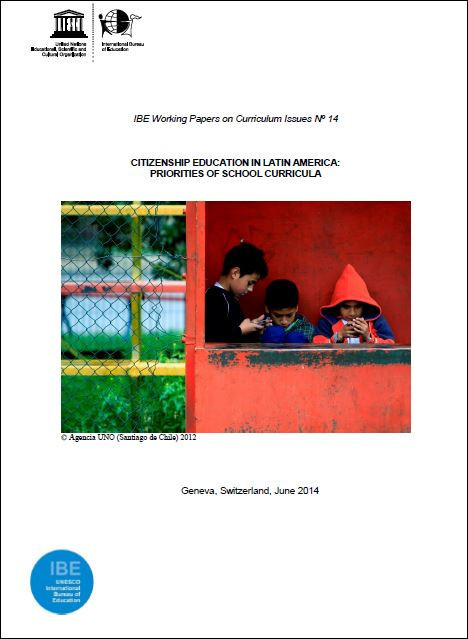 Citizenship education in Latin America: Priorities of School Curricula سنة النشر: 2014 المؤلف: Cristián Cox | Martín Bascopé | Juan Carlos Castillo | Daniel Miranda | Macarena Bonhomme المؤلف المؤسسي: UNESCO International Bureau of Education (IBE) This work focuses on the curricula of six Latin American countries – Colombia, Chile, the Dominican Republic, Guatemala, Mexico and Paraguay – which at the close of the past decade agreed to be part of the project Regional System of Evaluation and Development of Citizenship Competencies (SREDECC). With the support of the Inter-American Development Bank, SREDECC developed the Latin American module of the International Civic and Citizenship Study (ICCS- 2009) undertaken by the International Association for the Evaluation of Educational Achievement (IEA), in addition to encouraging the participation of the countries in that study (Cox 2010; Schulz, Ainley, Friedman and Lietz 2011). This document comprises four parts. The first section takes stock of the state of democratic belief in the region, drawing upon the most significant opinion studies of the past decade, so as to offer broader meaning bases for curriculum analysis and, more generally, for educational work in the field of citizenship. The second section describes the organizational (or structural) characteristics of the curricula of the six countries and presents a framework of categories for their comparative analysis. The subsequent section describes and analyses the contents of the six curricula examined and how they deal with the values, institutions and citizenship relations in their civic (political) and civil (coexistence) dimensions. On the basis of the most significant findings, the closing section includes some reflections regarding curriculum development with regard to citizenship. Educación Ciudadana en América Latina: Prioridades de los Currículos Escolares سنة النشر: 2014 المؤلف: Cristián Cox | Martín Bascopé | Juan Carlos Castillo | Daniel Miranda | Macarena Bonhomme المؤلف المؤسسي: UNESCO International Bureau of Education (IBE) El documento se organiza en cuatro partes. En la primera se da cuenta del estado de la creencia democrática en la región, recurriendo a evidencia de los estudios de opinión más importantes de la última década, de modo de ofrecer contexto y bases de significado amplios al análisis curricular, así como, más en general, al trabajo educativo en el área de ciudadanía. En la segunda sección se describe las características organizativas (o de estructura) de los currículos de los seis países y se presenta un esquema de categorías para el análisis comparado de los mismos. La sección siguiente describe y analiza los contenidos de los seis currículos examinados y su tratamiento de los valores, las instituciones y las relaciones de ciudadanía, en su dimensión cívica (política) y civil (convivencia). A partir de los hallazgos más importantes, la sección de cierre ofrece unas reflexiones orientadas al desarrollo curricular en el área.
 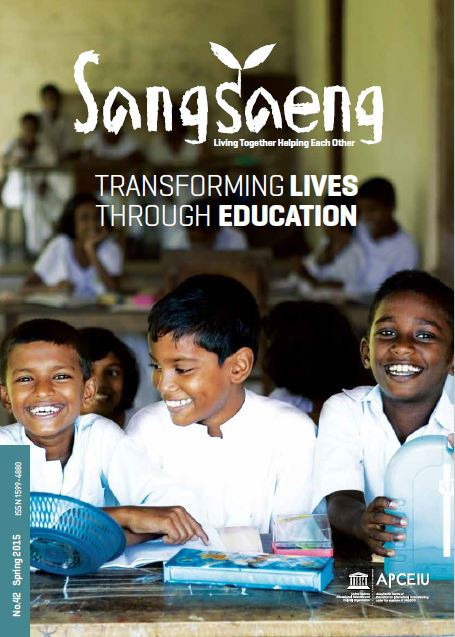 Transforming lives through education (SangSaeng no. 42 spring 2015) سنة النشر: 2015 المؤلف المؤسسي: APCEIU The 42nd issue of SangSaeng, ‘Transforming Lives Through Education’, has been published. This spring edition has been released prior to the World Education Forum 2015 to provide the context for the post-2015 education agenda. It contains compelling articles that underline the importance of Global Citizenship Education in building a more sustainable and peaceful society. 3 Director’s Message4 Special Column Every Child Deserves a Child-Friendly World8 Focus: Transforming Lives Through Education 8 Emergence of Global Citizenship Education in the Post-2015 Education Agenda13 Re-Visioning Education Beyond 201518 Global Citizenship Education for the 21st Century23 Young People Are Ready to Lead: The Education We Want26 Interview Education Beyond 201531 Special ReportGlobal UNESCO Clearinghouse on Global Citizenship Education Hosted by APCEIU34 Best Practices34 Citizenship Education in a Community Setting38 Pangaea42 Letter Unity in Diversity44 Peace in My MemoryPresenting a Message of Peace Through Music47 Understanding the Asia-Pacific Region Timeless Festivity of the Ancient World: Hidirellez50 APCEIU in Action