
الموارد
استكشف مجموعة واسعة من الموارد القيمة حول تعليم المواطنة العالمية لتعميق فهمك وتعزيز البحث والمناصرة والتعليم والتعلم.
تم العثور على 358 نتيجة
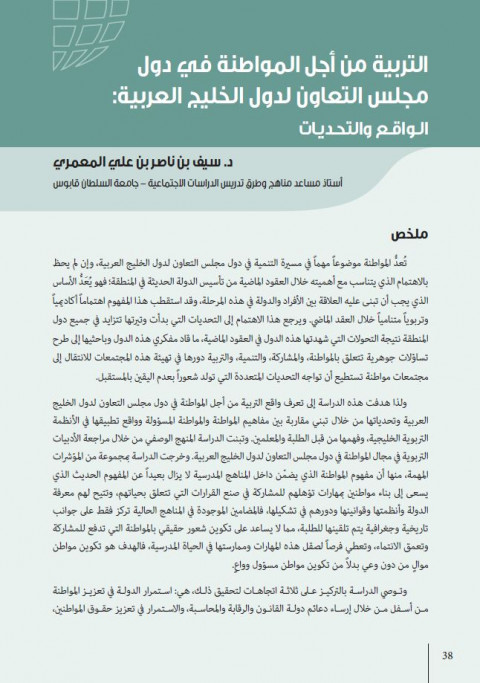 Education for Citizenship in the Arab Gulf Cooperation Council States: Reality and Challenges سنة النشر: 2014 المؤلف: Saif Al-Maamari المؤلف المؤسسي: Emirates Center for Strategic Studies and Research This study aimed at identifying the reality of education for citizenship in the Gulf Cooperation Council states and its challenges by adopting an approach between the concepts of citizenship and responsible citizenship and the reality of its application in the Gulf educational systems, and its understanding by students and teachers. The study adopted the descriptive approach by reviewing the educational literature in the field of citizenship in the countries of the Cooperation Council for the Arab Gulf States.
  مجلة تنمية الموارد البشرية مج. 6، ع. 2، 2015 سنة النشر: 2015 المؤلف المؤسسي: University Mohamed Lamine Debaghine - Setif2 مجموعة من الأوراق العلمية لعدد من الباحثين. هذه الاوراق منشورة في مجلة تنمية الموارد البشرية، العدد 2، 2015. هذه الاوراق جميعها تركز على المواطنة، وتستخدم منهجيات مختلفة. Human Resources Development Journal Vol. 6, no. 2, 2015 سنة النشر: 2015 المؤلف المؤسسي: University Mohamed Lamine Debaghine - Setif2 A set of scientific papers for a number of researchers. These papers are published in the Human Resources Development Magazine, Issue 2, 2015. All these papers focus on citizenship, and they use different methodologies.
  Educación para la ciudadanía y la convivencia: ciudadanos y ciudadanos del mundo, hijas e hijos de Bogotá; ciclo cuatro (octavo y noveno) سنة النشر: 2014 المؤلف المؤسسي: Secretaría de Educación del Distrito (SED) | Fe y Alegría These twelve modules make reference to a series of activities that focus on how children from all the educative grades understand and live citizenship, strengthening and facilitating the learning processes based on autonomy. This educative materials, which are aimed at being implemented inside the classrooms, attempt to serve as input resources for educators and other agents that work on or are interested in working with citizenship education and coexistence. The overall objective is to provide quality education. Educación para la ciudadanía y convivencia: protagonistas de la realidad, dirigimos la historia; ciclo tres (quinto, sexto y séptimo) سنة النشر: 2014 المؤلف المؤسسي: Secretaría de Educación del Distrito (SED) | Fe y Alegría These twelve modules make reference to a series of activities that focus on how children from all the educative grades understand and live citizenship, strengthening and facilitating the learning processes based on autonomy. This educative materials, which are aimed at being implemented inside the classrooms, attempt to serve as input resources for educators and other agents that work on or are interested in working with citizenship education and coexistence. The overall objective is to provide quality education. Educación para la ciudadanía y la convivencia: ciberciudadanía para la paz, una aldea digital de la que haces parte; ciclo cinco (décimo, undécimo, duodécimo) سنة النشر: 2015 المؤلف المؤسسي: Secretaría de Educación del Distrito (SED) | Fe y Alegría These twelve modules make reference to a series of activities that focus on how children from all the educative grades understand and live citizenship, strengthening and facilitating the learning processes based on autonomy. This educative materials, which are aimed at being implemented inside the classrooms, attempt to serve as input resources for educators and other agents that work on or are interested in working with citizenship education and coexistence. The overall objective is to provide quality education. Educación para la ciudadanía y la convivencia: hacemos sinergías para vivir y convivir en territorios de paz; ciclo cuatro (octavo y noveno) سنة النشر: 2015 المؤلف المؤسسي: Secretaría de Educación del Distrito (SED) | Fe y Alegría These twelve modules make reference to a series of activities that focus on how children from all the educative grades understand and live citizenship, strengthening and facilitating the learning processes based on autonomy. This educative materials, which are aimed at being implemented inside the classrooms, attempt to serve as input resources for educators and other agents that work on or are interested in working with citizenship education and coexistence. The overall objective is to provide quality education. Educación para la ciudanía y la convivencia: parceras y parceros por la paz (en 140 caracteres); ciclo tres (quinto, sexto y séptimo) سنة النشر: 2015 المؤلف المؤسسي: Secretaría de Educación del Distrito (SED) | Fe y Alegría These twelve modules make reference to a series of activities that focus on how children from all the educative grades understand and live citizenship, strengthening and facilitating the learning processes based on autonomy. This educative materials, which are aimed at being implemented inside the classrooms, attempt to serve as input resources for educators and other agents that work on or are interested in working with citizenship education and coexistence. The overall objective is to provide quality education. Education à la citoyenneté et de la coexistence: la citoyenneté et le module de coexistence de la construction collective des significations et des réseaux; unité 1; sujets citoyens et les communautés vivant سنة النشر: 2014 المؤلف المؤسسي: Centro de Investigación y Educación Popular (CINEP) | Secretaría de Educación del Distrito (SED) Ces modules et guides sont dirigés vers Facilitateurs Réseau Citoyenneté et Coexistence pour les aider dans un processus de formation et de réflexion qui leur permet d'être au courant de leurs capacités, et les outils dont nous disposons, en fournissant une banque d'activités d'apprentissage, ainsi qu'un général guide pour le développement, en fonction des besoins des processus avec leurs communautés éducatives. Par conséquent, les processus de dialogue et d'échange qui ont été développés avec les mêmes animateurs de réseau, et l'interaction et de réflexion avec tous les acteurs de l'éducation à Bogota, ont été prises en compte dans les orientations conceptuelles, méthodologiques et didactiques des modules et des guides. Citizenship education and coexistence: teaching modules for citizenship and coexistence based on the collective construction of meaning and networks; unit 2; citizenship, society, and territory سنة النشر: 2014 المؤلف المؤسسي: Centro de Investigación y Educación Popular (CINEP) | Secretaría de Educación del Distrito (SED) These modules and guides are directed to Facilitators Network Citizenship and Coexistence to help them through a process of training and reflection that allows them to be aware of their capabilities, and the tools we have, providing a bank of learning activities, as well as a general guide for development, according to the needs of the processes with their educational communities .Therefore, the processes of dialogue and exchange that have been developed with the same Network facilitators, and the interaction and reflection with all educational stakeholders in Bogota, have been taken into account in the conceptual, methodological and didactic guidelines of the modules and guides.