
الموارد
استكشف مجموعة واسعة من الموارد القيمة حول تعليم المواطنة العالمية لتعميق فهمك وتعزيز البحث والمناصرة والتعليم والتعلم.
تم العثور على 20 نتيجة
 Buenas prácticas de educación para el desarrollo sostenible en la primera infancia سنة النشر: 2012 المؤلف المؤسسي: UNESCO To support the growing interest in early childhood issues and ESD, UNESCO is publishing this volume containing 12 examples of programmes addressing ESD in early childhood settings and practices. These good practices and shared experiences, which were provided by a range of different stakeholders, are concrete examples of successful implementation of ESD in different fields and sectors, from the political to the school level, and including formal, nonformal and informal learning situations. Éducation pour le développement durable: bonnes pratiques dans l'éducation de la petite enfance سنة النشر: 2012 المؤلف المؤسسي: UNESCO To support the growing interest in early childhood issues and ESD, UNESCO is publishing this volume containing 12 examples of programmes addressing ESD in early childhood settings and practices. These good practices and shared experiences, which were provided by a range of different stakeholders, are concrete examples of successful implementation of ESD in different fields and sectors, from the political to the school level, and including formal, nonformal and informal learning situations. Education for sustainable development good practices in early childhood سنة النشر: 2012 المؤلف المؤسسي: UNESCO To support the growing interest in early childhood issues and ESD, UNESCO is publishing this volume containing 12 examples of programmes addressing ESD in early childhood settings and practices. These good practices and shared experiences, which were provided by a range of different stakeholders, are concrete examples of successful implementation of ESD in different fields and sectors, from the political to the school level, and including formal, nonformal and informal learning situations. Inclusion from the start: guidelines on inclusive early childhood care and education for Roma children سنة النشر: 2014 المؤلف المؤسسي: UNESCO | Council of Europe Inclusion from the start: guidelines on inclusive early childhood care and education for Roma children (Guidelines hereafter) is a joint contribution by the Council of Europe and UNESCO to improving access to quality early childhood services for Roma children. They are a concrete follow-up to the recommendations arising from an expert meeting, organised by the two organisations in 2007.1 Recognising that quality early childhood experience is an important stepping stone toward inclusive participation in school and society, the Guidelines address the challenges specifc to Roma children in the early years and transition to primary education. They provide guidance on key themes, such as the conceptualisation of early childhood care and education (ECCE) services, agenda-setting, stakeholders’ responsibilities, curricular and pedagogical approaches, staf training and professional development, assessment and transition to primary education. The Guidelines primarily address formal ECCE services – such as kindergartens and preschools – which typically cater for children from ages 3-6 years. The reason for this focus is that providing care and education experience prior to primary school entry is crucial for supporting Roma children’s school readiness and for facilitating an equal start in their frst year. This being said, the Guidelines also acknowledge the critical importance of the years pre-natal to age 3, and consider health and nutrition interventions and non-formal ECCE programmes (e.g. community-based childcare, parenting education) as essential services in deprived neighbourhoods and settlements. Inclusion dès le début: les lignes directrices sur les soins de la petite enfance inclusive et éducation pour les enfants roms سنة النشر: 2014 المؤلف المؤسسي: Organisation des Nations Unies pour l'éducation, la science et la culture (UNESCO) | Conseil de l'Europe Inclusion dès le début: les lignes directrices sur les soins de la petite enfance inclusive et l'éducation des enfants roms (lignes directrices ci-après) est une contribution conjointe du Conseil de l'Europe et de l'UNESCO à l'amélioration de acesss aux services de la petite enfance de qualité pour les enfants roms. Ils sont un suivi concret aux recommandations découlant d'une réunion d'experts, organisée par les deux organisations en 2007.1. Reconnaissant que l'expérience de qualité de la petite enfance est une étape importante vers la participation inclusive à l'école et de la société, les lignes directrices abordent les défis spécifques aux enfants roms dans les premières années et la transition à l'enseignement primaire. Ils fournissent des conseils sur des thèmes clés, tels que la conceptualisation des soins de la petite enfance et les services d'éducation (EPPE), l'établissement de l'ordre du jour, les responsabilités des parties prenantes, des programmes et des approches pédagogiques, la formation des staf et le perfectionnement professionnel, l'évaluation et la transition à l'enseignement primaire. Les lignes directrices traitent principalement des services formels EPPE - tels que les jardins d'enfants et les écoles maternelles - qui répondent généralement pour les enfants âgés de 3-6 ans. La raison de cette mise au point est que la prestation de soins et de l'expérience de l'éducation avant l'entrée de l'école primaire est cruciale pour soutenir la maturité scolaire des enfants roms et pour faciliter un départ égal dans leur année frst. Ceci étant dit, les lignes directrices reconnaissent également l'importance critique des années pré-natal à 3 ans, et d'envisager des interventions de santé et de la nutrition et des programmes non formels EPPE (garde d'enfants, l'éducation parentale à base communautaire) comme des services essentiels dans les quartiers défavorisés et colonies.
 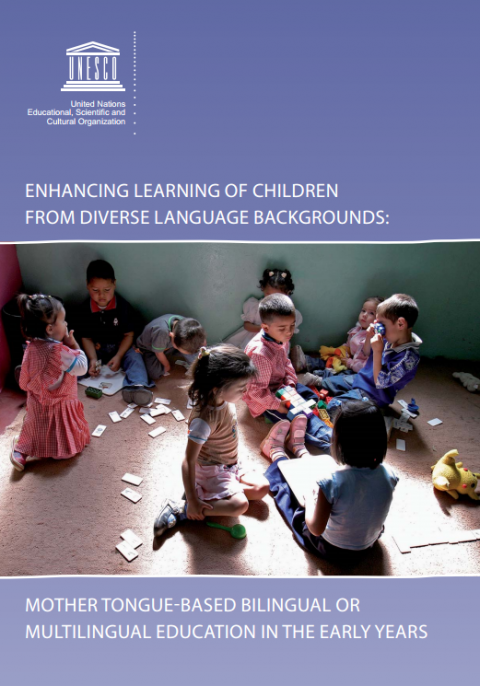 Enhancing learning of children from diverse language backgrounds: mother tongue-based bilingual or multilingual education in the early years سنة النشر: 2011 المؤلف: Jessica Ball المؤلف المؤسسي: UNESCO This literature review discusses mother tongue based bilingual or multilingual education for children starting in early childhood. The report: (1) informs policy-makers of existing research and practices in mother-tongue instruction in early childhood and early primary school years; and (2) raises awareness of the value of maintaining the world’s languages and cultures by promoting and resourcing mother tongue-based education for young children. This analysis of current literature is framed within UNESCO’s mandate and strong commitment to quality education for all and to cultural and linguistic diversity in education (UNESCO, 2003a). This discussion is especially timely, given the slow and uneven progress (UNESCO, 2000) in meeting international targets for universal education articulated in the Education for All Goals 1 (ECCE), Goal 2 (Primary Education), and Goal 6 (Quality of Education) (World Declaration on Education for All, 1990).1 Impetus for the current report is provided by the UNESCO (2008a) ‘Global Monitoring Report on Education for All: Will we make it?’ The 2008 GMR report calls for unwavering political will to ensure that education from early childhood onwards is a priority of national governments, civil society and the private sector in order to ensure educational inclusion for the 72 million children out of school and to reduce the numbers of young learners who leave school without acquiring essential skills and knowledge. The report calls for increased investments in the provision of pre-primary education for children aged 3 and above, and for policy measures to provide care and education to children below age 3. UNESCO (2007a) emphasizes the role of early childhood care and development in laying the foundation for learning and setting the stage for successful engagement in formal education. UNESCO has encouraged mother tongue instruction in early childhood and primary education since 1953 (UNESCO, 1953). Yet, monolingualism in official or dominant languages is still the norm around the world (Arnold, Bartlett, Gowani, & Merali, 2006; Wolff & Ekkehard, 2000). In its report, ‘Strong Foundations: Early Childhood Care and Education’, UNESCO (2007a) points out the overlooked advantages of multilingual education in the early years. When children are offered opportunities to learn in their mother tongue, they are more likely to enrol and succeed in school (Kosonen, 2005) and their parents are more likely to communicate with teachers and participate in their children’s learning (Benson, 2002). Mother tongue based education especially benefits disadvantaged groups, including children from rural communities (Hovens, 2002), and girls, who tend to have less exposure to an official language and tend to stay in school longer, achieve better, and repeat grades less oft en when they are taught in their mother tongue (UNESCO Bangkok, 2005). Renforcer l'apprentissage des enfants issus de milieux linguistiques diverses: basée sur la promotion de l'enseignement en langue maternelle ou de l'éducation bilingue multilingue سنة النشر: 2011 المؤلف: Jessica Ball المؤلف المؤسسي: UNESCO Cette revue de la littérature aborde la langue maternelle basée éducation bilingue ou multilingue pour les enfants à partir de la petite enfance. Le rapport: (1) informe les décideurs de la recherche et des pratiques en enseignement en langue maternelle dans la petite enfance et les premières années de l'école primaire existante; et (2) soulève conscience de la valeur du maintien des langues et des cultures du monde par la promotion et de ressourcement mère éducation fondée sur la langue, pour les jeunes enfants. Cette analyse de la littérature actuelle est encadrée au sein de l'UNESCO mandat et engagement fort à l'éducation de qualité pour tous et à la diversité culturelle et linguistique dans l'éducation (UNESCO, 2003a). Cette discussion est particulièrement opportune, compte tenu des progrès lents et inégaux (UNESCO, 2000) pour atteindre les objectifs internationaux pour l'Éducation Universelle énoncée dans l'Éducation Pour Tous les Objectifs 1, Objectifs 2 (enseignement primaire), et Objectifs 6 (qualité de l'éducation ) (déclaration mondiale sur l'éducation pour tous, 1990) .1 Impetus pour le rapport actuel est fourni par l'UNESCO (2008a) «Rapport mondial de suivi sur l'éducation pour tous: Allons-nous faire?» le rapport GMR 2008 appelle à une volonté politique sans faille veiller à ce que l'éducation de la petite enfance est en avant une priorité des gouvernements nationaux, la société civile et le secteur privé afin d'assurer l'insertion scolaire pour les 72 millions d'enfants de l'école et de réduire le nombre de jeunes apprenants qui quittent l'école sans avoir acquis les compétences essentielles et de la connaissance.
  The contribution of early childhood education to a sustainable society سنة النشر: 2008 المؤلف المؤسسي: UNESCO This report originates from the international workshop, ‘The Role of Early Childhood Education for a Sustainable Society’, jointly organized in Göteborg, Sweden, by Göteborg University, Chalmers University of Technology and the City of Göteborg, from 2 to 4 May 2007. It was attended by thirty-five participants from sixteen different countries (see ‘List of Participants’). The workshop was a follow-up to the international conference on education for sustainable development, ‘Learning to Change Our World’, held in May 2004, in Göteborg. It was one of four preparatory workshops leading to another international conference on education for sustainable development, to be organized in 2008 or 2009, in the same city. The aim of the four workshops is to discuss promoters and barriers related to learning for sustainability, and to propose recommendations for the upcoming international conference. The present workshop was conceived for the following reasons. First, our societies urgently require new kinds of education that can help prevent further degradation of our planet, and that foster caring and responsible citizens genuinely concerned with and capable of contributing to a just and peaceful world. Second, these new kinds of education must be available to all – not only a handful of people – and take place in various settings, including families and communities. Third, they must begin in early childhood, as the values, attitudes, behaviours and skills acquired in this period may have a long-lasting impact in later life. Thus, early childhood education clearly has an important place in the efforts to bring about sustainable development.
  Regional overview: Central and Eastern Europe and Central Asia سنة النشر: 2015 المؤلف المؤسسي: UNESCO Central and Eastern Europe (CEE) and Central Asia (CA) have both made significant advances towards Education for All (EFA) since 1999. However, the 2015 EFA Global Monitoring Report shows that despite progress, Education For All remains unfinished business, including in Central and Eastern Europe and in Central Asia. This must be taken into account in the post-2015 agenda. Региональный обзор: Центральная и Восточная Европа и Центральная Азия سنة النشر: 2015 المؤلف المؤسسي: UNESCO В настоящем региональном обзоре, где рассматривается прогресс, достигнутый с 2000 г., кратко излагаются ответы на важнейшие вопросы, которым посвящен Всемирный доклад по мониторингу (ВДМ) ОДВ за 2015 г. В ВДМ за 2015 г. показано, что, несмотря на прогресс, цели образования для всех еще не до конца достигнуты, в том числе в Центральной и Восточной Европе и Центральной Азии.