
الموارد
استكشف مجموعة واسعة من الموارد القيمة حول تعليم المواطنة العالمية لتعميق فهمك وتعزيز البحث والمناصرة والتعليم والتعلم.
تم العثور على 526 نتيجة
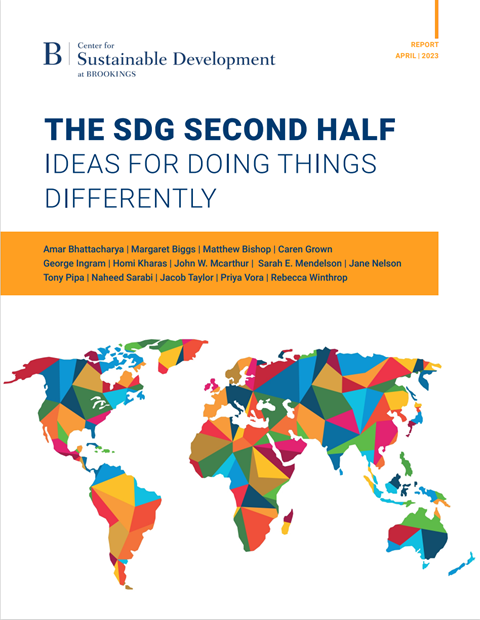 The SDG second half: Ideas for doing things differently سنة النشر: 2023 المؤلف: Amar Bhattacharya | Margaret Biggs | Matthew Bishop | Caren Grown | George Ingram | Homi Kharas | John W. Mcarthur | Sarah E. Mendelson | Jane Nelson | Tony Pipa | Naheed Sarabi | Jacob Taylor | Priya Vora | Rebecca Winthrop المؤلف المؤسسي: Center for Sustainable Development at Brookings This short compendium captures a cross section of SDG-focused insights and recommendations from CSD-affiliated scholars. Each brief essay describes something with the potential to be done differently during the second half of the SDG era. Across a dozen contributions, topics range from reframing media coverage of the SDGs to measuring and elevating the role of the private sector; from participatory approaches to transforming education systems to new learning paradigms for human rights; from better risk-taking in fragile countries to improving infrastructure and services for care; from fit-for-purpose multilateral development banks to a purpose-driven fund to end extreme poverty; from turbo-charged Canadian SDG approaches to renewed American SDG leadership; from breakthroughs in digital public infrastructure to innovative frontiers in the digitally empowered methods of collective behavior science.
  UNESCO at COP23: Climate Change Education سنة النشر: 2017 المؤلف المؤسسي: UNESCO This brochure contains information about UNESCO's role of education in climate change through ESD(Education for Sustainable Development). Education for Sustainable Development (ESD) is increasingly recognized around the world as an effective enabler for a more sustainable future. Building climate change awareness and building capacities for adaptation and mitigation are critical dimensions of ESD. The critical role of education in climate change responses was clearly recognized at the Paris Climate Conference (COP21) in December 2015. COP22 in Marrakesh and COP23 in Bonn reiterate the importance of climate change education in achieving the global agendas.
  Berlin Declaration on Education for Sustainable Development; Learn for Our Planet: Act for Sustainability سنة النشر: 2022 المؤلف المؤسسي: UNESCO From 17 May to 19 May 2021 around 2800 people – politicians, business people, youth leaders, scientists, Non-governmental organizations, and many more - from 160 countries came together virtually at the UNESCO World Conference on Education for Sustainable Development (ESD) 2021. During the conference, they expressed their commitment to use the transformative power of education in order to address the global challenges we face. The Berlin Declaration was the main result of the conference.The Berlin Declaration on Education for Sustainable Development is an important document that emphasizes the significance of ESD for each and every one of us. It identifies concrete challenges the global community is facing and calls for changes that are urgently needed in order to fully integrate and strengthen ESD in all educational contexts.
  Neuroscience Applied to Everyday Life: David del Rosario, Neuroscience Researcher (Full Version) سنة النشر: 2022 المؤلف: David del Rosario المؤلف المؤسسي: Banco Bilbao Vizcaya Argentaria (BBVA) Why are we unhappy even when everything is going well? What is thought? Do we know how our mind and body works? "Knowledge, if not applied, is useless," says scientist David del Rosario. In this video, the researcher analyzes different experiments and questions our relationship with what we think to address what he calls "everyday neuroscience". Neurociencia aplicada al día a día: David del Rosario, investigador en neurociencia (Versión Completa) سنة النشر: 2022 المؤلف: David del Rosario المؤلف المؤسسي: Banco Bilbao Vizcaya Argentaria (BBVA) ¿Por qué somos infelices incluso cuando todo va bien? ¿Qué es el pensamiento? ¿Conocemos cómo funciona nuestra mente y nuestro organismo? "El conocimiento, si no se aplica, no sirve para nada", asegura el científico David del Rosario. En este vídeo, el investigador analiza diferentes experimentos y cuestiona nuestra relación con lo que pensamos para abordar lo que él llama "neurociencia del día a día".
 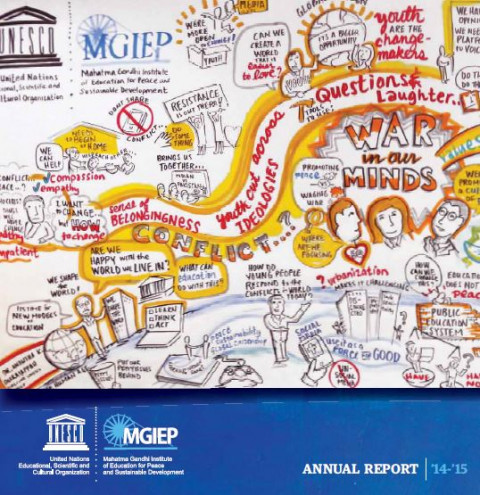 MGIEP Annual Report '14-'15 سنة النشر: 2016 المؤلف المؤسسي: Mahatma Gandhi Institute of Education for Peace and Sustainable Development (MGIEP) The Mahatma Gandhi Institute of Education for Peace and Sustainable Development (MGIEP) is UNESCO’s first Category I institute in the Asia-Pacific region, established with the generous support of the Government of India. UNESCO MGIEP focuses on transforming current education policies and practices by developing innovative teaching and learning methods.Their objective is to build generations of young people equipped to create peaceful and sustainable societies. This annual report describes MGIEP’s main works and various educational programmes for peace and sustainable development.
  Report of the Global Conference on Promoting Literacy for a World in Transition: Building the Foundation for Sustainable and Peaceful Societies سنة النشر: 2024 المؤلف المؤسسي: UNESCO The report presents an overview of the global celebration of International Literacy Day (ILD) 2023 held at UNESCO Headquarters in Paris, France on 8 September 2023. Under the ILD 2023 theme of ‘Promoting literacy for a world in transition: Building the foundation for sustainable and peaceful societies’, the Global Conference explored how literacy and numeracy can be better promoted as part of lifelong learning to achieve more peaceful and sustainable societies as envisioned by the international community through the Sustainable Development Goals (SDGs). The global celebration also included the award ceremony of the 2023 edition of the UNESCO International Literacy Prizes with six outstanding laureates from Bangladesh, Dominican Republic, Finland, Pakistan, South Africa and Uganda.
  Including Transformative Education in Pre-service Teacher Training: A Guide for Universities and Teacher Training Institutions in the Arab Region سنة النشر: 2024 المؤلف: Khalaf Al Abri | Marco Pasqualini المؤلف المؤسسي: UNESCO Beirut Transformative Education (TE), which includes concepts such as Global Citizenship Education (GCED) and Education for Sustainable Development (ESD), is an essential approach to provide learners with the tools to act for more just, peaceful and sustainable societies. Between 2021 and 2023, the experts of the UNESCO Arab Transformative Education Network identified the creation of a course on Transformative Education for teachers’ pre-service training as a key step to (i) provide teachers with the needed skills to promote Transformative Education as part of the national curriculum as well as though their daily teaching practices, and (ii) to support the reform of pedagogies more broadly, by making them more interactive and focused on critical thinking, and thus positively contributing to improving learners’ overall learning outcomes. This guidance document is addressed to all entities in charge of pre-service teacher training (e.g. departments of education within higher education institutions and teacher training institutions) in the Arab region interested in including Transformative Education as part of their programmes. The guidance document particularly supports faculty deans and academia in defining the scope and the key parameters to consider while developing a course on Transformative Education, including defining course objectives, format, content, and pedagogy, as well as choosing the right facilitator(s) to deliver the course. The document also provides useful references to other guides and tools which can further support the reflections around Transformative Education and how it can be concretely applied and promoted at the higher education level.
  Climate Change and Sustainability in Science and Social Science Secondary School Curricula سنة النشر: 2024 المؤلف: Marcia McKenzie | Aaron Benavot المؤلف المؤسسي: UNESCO There is an urgent need to transform the way climate change and sustainability are taught in classrooms and at schools. Learners must grasp the environmental impacts of climate change, how climate change relates to their own context and what actions can be undertaken and contribute to making societies more sustainable, equitable, just and climate-resilient. The findings presented in this publication indicate that accelerated efforts are needed. In a study of over 530 Grade 9 science and social science curricula from 85 countries worldwide, we found that 69 per cent of curricula contained no references to climate change, while 66 per cent had no references to sustainability. Furthermore, while 69 per cent of surveyed teachers from eight of the countries studied reported that environment, sustainability and climate change topics were included in the science and social science curricula in their schools only 50 per cent included them in their teaching. While there is a notable inclusion of environment, sustainability and climate change in science and social science curricula across countries, the depth of focus of this inclusion varies widely. Cognitive learning prevails over social and emotional or action-oriented learning. Climate change and sustainability in school practices must be strengthened, with teachers playing a key role in enhancing integration through teaching methods and materials.
  2023 Asia-Pacific Regional Global Citizenship Education (GCED): Network Activities Summary Report سنة النشر: 2023 المؤلف: Seek Ling Tan المؤلف المؤسسي: UNESCO Bangkok This is a summary report from the Global Citizenship Education (GCED) network activities in Asia-Pacific in 2023. The Asia-Pacific Regional Global Citizenship Education Network, spearheaded by UNESCO Bangkok and the Asia-Pacific Centre of Education for International Understanding (APCEIU), has illuminated the path to empower learners to become global citizens since its inception in 2018. In 2023, their journey was punctuated by significant milestones and a revitalized commitment to propel GCED across the region. This commitment is particularly evident in the key priority areas of advocacy, capacity building, learning/teaching materials, policy and research and the synergizing of regional collaboration towards Education 2030.