
الموارد
استكشف مجموعة واسعة من الموارد القيمة حول تعليم المواطنة العالمية لتعميق فهمك وتعزيز البحث والمناصرة والتعليم والتعلم.
تم العثور على 526 نتيجة
 Lignes directrices pour l'éducation au service du développement durable pour changer le climat de la formation des enseignants pour aborder la durabilité: mettre en pratique l'éducation transformatrice سنة النشر: 2011 المؤلف المؤسسي: UNESCO Jakarta Le présent document sur EDD pour les Institutions de Formations des Enseignants (IFE) est le résultat du Programme régional d'ateliers de formation intitulé «Développer les capacités des établissements d'enseignement de Brunei Darussalam, de l'Indonésie, de la Malaisie, des Philippines et du Timor-Leste pour réorienter la formation des enseignants pour la durabilité» et a été développé par les cinq pays du Bureau de l'UNESCO à Jakarta. Les lignes directrices élaborées visent en fin de compte à réorienter les programmes, les politiques, les pratiques et les programmes standard de chaque pays en vue d'aborder la durabilité et de la mettre en œuvre de façon tangible. Bien que de nombreuses descriptions idéalistes de la durabilité et de l'éducation en matière de durabilité existent, les facultés d'éducation doivent décider quels thèmes devraient recevoir une attention particulière et créer leurs propres lignes directrices et critères de conception dans ce domaine spécifique. Par conséquent, ces EDD directrices sont des étapes importantes pour assurer que les programmes de formation des enseignants correspondent aux conditions et aux objectifs environnementaux, sociaux, culturels et économiques des communautés, des régions et des nations de chaque pays. Water education for sustainable development: a global synthesis سنة النشر: 2012 المؤلف المؤسسي: International Hydrological Programme (IHP) Water education is key to achieve the water related MDGs. While there is a range of materials and projects focusing on water-related education, these are not well connected to offer customised solutions to individual countries. Some of the limitations identified with the existing water education include use of outdated, biased or irrelevant information; poor medium of instruction; lack of continuity between different levels of water education; lack of integration with the wider curriculum and with local knowledge; lack of practical relevance to local and community needs; lack of resources; and poor linkages with locally available professional bodies. The programme on “Water Education” is an initiative of the International Hydrological Programme (IHP) of UNESCO, Water and Sustainable Education focused on an integrated understanding of biological and hydrological processes at a catchment’s scale in order to create a scientific basis for a new, cost-effective and systemic approach to the sustainable management of freshwater resources. Каким быть образованию завтрашнего дня Доклад 2012 года о проводимом ООН Десятилетии образования в интересах устойчивого развития Сокращенный вариант سنة النشر: 2013 المؤلف المؤسسي: UNESCO As the lead agency for the UN Decade of Education for Sustainable Development (DESD, 2005 – 2014), UNESCO is responsible for monitoring and evaluating progress during the DESD. UNESCO is publishing three reports during the DESD – in 2009, 2012 and 2014. This second report focuses specifically on processes and learning in the context of Education for Sustainable Development (ESD). What kinds of learning processes have emerged in the course of the DESD? What is the role of ESD in supporting them? What changes in ESD have occurred since the early years of the Decade? The report is informed by a broad consultation process that includes input from hundreds of policy makers, scholars and practitioners engaged in ESD around the world. Forjar la educación del mañana: decenio de las Naciones Unidas de la educación para el dessarollo sostenible: informe 2012, abreviado سنة النشر: 2012 المؤلف المؤسسي: UNESCO As the lead agency for the UN Decade of Education for Sustainable Development (DESD, 2005 – 2014), UNESCO is responsible for monitoring and evaluating progress during the DESD. UNESCO is publishing three reports during the DESD – in 2009, 2012 and 2014. This second report focuses specifically on processes and learning in the context of Education for Sustainable Development (ESD). What kinds of learning processes have emerged in the course of the DESD? What is the role of ESD in supporting them? What changes in ESD have occurred since the early years of the Decade? The report is informed by a broad consultation process that includes input from hundreds of policy makers, scholars and practitioners engaged in ESD around the world. Shaping the education of tomorrow: 2012 report on the UN decade of education for sustainable development, abridged سنة النشر: 2012 المؤلف المؤسسي: UNESCO As the lead agency for the UN Decade of Education for Sustainable Development (DESD, 2005 – 2014), UNESCO is responsible for monitoring and evaluating progress during the DESD. UNESCO is publishing three reports during the DESD – in 2009, 2012 and 2014. This second report focuses specifically on processes and learning in the context of Education for Sustainable Development (ESD). What kinds of learning processes have emerged in the course of the DESD? What is the role of ESD in supporting them? What changes in ESD have occurred since the early years of the Decade? The report is informed by a broad consultation process that includes input from hundreds of policy makers, scholars and practitioners engaged in ESD around the world. 可持续发展教育(ESD)为21世纪建设一个更加美好和更加公平的世界 سنة النشر: 2012 المؤلف المؤسسي: UNESCO Education for Sustainable Development allows every human being to acquire the knowledge, skills, attitudes and values necessary to shape a sustainable future. Education for Sustainable Development means including key sustainable development issues into teaching and learning; for example, climate change, disaster risk reduction, biodiversity, poverty reduction, and sustainable consumption. It also requires participatory teaching and learning methods that motivate and empower learners to change their behaviour and take action for sustainable development. Education for Sustainable Development consequently promotes competencies like critical thinking, imagining future scenarios and making decisions in a collaborative way. Education for Sustainable Development requires far-reaching changes in the way education is often practised today. UNESCO is the lead agency for the UN Decade of Education for Sustainable Development (2005-2014).
 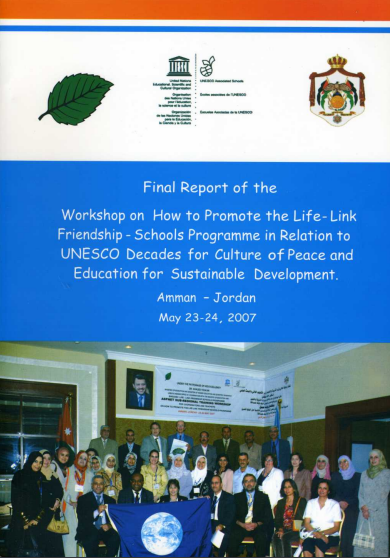 Final report of the workshop on how to promote the life-link friendship-schools programme in relation to UNESCO decades for culture of peace and education for sustainable development, Amman, Jordan, May 23-24, 2007 سنة النشر: 2007 المؤلف المؤسسي: UNESCO Amman This chapter provides a brief summary of the speeches presented at the official opening and closing ceremonies as well as presentations delivered by the experts of Life-Link and UNESCO staff at the two day workshop The sub-regional workshop for ASPnet National Coordinators and Life-Link Friendship Schools Programme, organized in close collaboration with the Ministry of Education, was constructed according to the following format: (i). An organizing Committee was formed comprising of staff from the Ministry of Education and UNESCO Amman Office and Chairperson of Life-Link Programme. The committee oversaw the organization, preparation of documentation, venue, draft agenda, logistic and procedural aspects of the workshop. (ii). The selection of participants for the workshop was done by the National Commissions for UNESCO to Lebanon, Palestine, Iraq, Egypt, Oman and Jordan. The participating Arab Countries were selected by UNESCO Office-Amman and Life-Link. (iii).The selected participants comprised the National Coordinators and teachers for ASPnet in their countries. A member from Life-Link in Jordan was invited as an observer for the workshop. (iv).The resource persons (trainers) for the workshop were carefully selected on the basis of their expertise, experience and relevance to the main subjects of the workshop. The experts came from the Ministry of Education, Life-Link, UNESCO and UNRWA. (v). The format of the workshop was basically structured to firstly provide an overview and background of the Life-Link Friendship Schools Programme and ASPnet, followed by experts' presentations relevant to the main subjects of Life-Link Programme. The workshop also had three sessions of discussion on the different aspects of Life Link Programme. Participants were circulated to these sessions one after another. The workshop also had a session on how to plan for implementing peace actions as Extra Curricula Activities in schools. (vi). The ASPnet national workshop was organized under the patronage of his Excellency Dr. Khaled Toukan, the Minister of Education and the Minister of Higher Education & Scientific Research and Chairman of the Jordan National Commission for UNESCO. Rapport final de l'atelier sur la façon de promouvoir le programme de liaison de vie amitié écoles par rapport aux décennies UNESCO pour la culture de la paix et de l'éducation pour le développement durable, Amman, Jordanie, 23 au 24 mai 2007 سنة النشر: 2007 المؤلف المؤسسي: UNESCO Amman Ce chapitre présente un bref résumé des discours présentés lors de l'ouverture officielle et de clôture ainsi que les présentations faites par les experts de Life-Link et personnel de l'UNESCO à l'atelier de deux jours. L'atelier sous-régional pour réseau des coordonnateurs nationaux et de Life-Link Programme des Écoles Amitié, organisée en étroite collaboration avec le Ministère de l'éducation, a été construit selon le format suivant: (i). Un comité d'organisation a été formé, comprenant des membres du personnel du ministère de l'Education et le Bureau UNESCO à Amman et présidente programme Life-Link. Le comité a supervisé l'organisation, la préparation de la documentation, le lieu, le projet de l'ordre du jour, la logistique et les aspects procéduraux de l'atelier. (Ii). La sélection des participants de l'atelier a été fait par les Commissions nationales pour l'UNESCO au Liban, en Palestine, en Irak, en Egypte, à Oman et en Jordanie. Les pays arabes participants ont été sélectionnés par l'UNESCO Bureau-Amman et Life-Link. (Iii). Les participants sélectionnés comprennent les coordonnateurs nationaux et les enseignants pour Réseau dans leur pays. Un membre de la Life-Link en Jordanie a été invité à titre d'observateur à l'atelier. (Iv). Les personnes ressources (formateurs) pour l'atelier ont été soigneusement sélectionnés sur la base de leur expertise, de l'expérience et de la pertinence des principaux sujets de l'atelier. Les experts provenaient du ministère de l'Education, Life-Link, l'UNESCO et l'UNRWA. (V). Le format de l'atelier a été essentiellement structuré pour fournir d'abord une vue d'ensemble et contexte de Life-Link Programme Amitié Ecoles et Reseau, suivie par les présentations des experts compétents pour les sujets principaux programme Life-Link de. L'atelier a également eu trois séances de discussion sur les différents aspects du Programme Life Link. Les participants ont été distribués à ces sessions un après l'autre. L'atelier a également eu une séance sur la façon de planifier la mise en œuvre des actions de paix en tant Activités extra curricula dans les écoles. (Vi). L'atelier national a été organisé reseau sous le patronage de son excellence Dr. Khaled Toukan, Ministre de l'Éducation et le Ministre de l'Enseignement Supérieur et de la Recherche et Président de la Commission Nationale Jordanienne pour l'UNESCO Scientifique. Address by Mr Koïchiro Matsuura, Director-General of UNESCO on the occasion of the First Meeting of the UN Inter-Agency Committee (IAC) on the United Nations Decade on Education for Sustainable Development (2005-2014); UNESCO, 12 June 2006 سنة النشر: 2006 المؤلف المؤسسي: UNESCO. Director-General, 1999-2009 (Matsuura, K.) This address was delivered by Mr. Koïchiro Matsuura, Director-General of UNESCO on the occasion of the first meeting of the UN Inter-Agency Committee (IAC) on the United Nations Decade on Education for Sustainable Development (2005-2014). Discours de M. Koïchiro Matsuura, Directeur général de l'UNESCO à l'occasion de la première réunion du Comité interinstitutions des Nations Unies (CCI) sur la Décennie des Nations Unies سنة النشر: 2006 المؤلف المؤسسي: UNESCO. Director-General, 1999-2009 (Matsuura, K.) Ce discours a été prononcé par M. Koïchiro Matsuura, Directeur général de l'UNESCO à l'occasion de la première réunion du Comité interinstitutions des Nations Unies sur la Décennie des Nations Unies sur l'éducation pour le développement durable (2005-2014).