
الموارد
استكشف مجموعة واسعة من الموارد القيمة حول تعليم المواطنة العالمية لتعميق فهمك وتعزيز البحث والمناصرة والتعليم والتعلم.
تم العثور على 526 نتيجة
 Recorridos nacionales rumbo a la educación para el desarrollo sostenible, 2011: análisis de las experiencias de los países Chile, Indonesia, Kenya, Omán, Países Bajos سنة النشر: 2011 المؤلف: I. Mulà | Daniella Tilbury المؤلف المؤسسي: UNESCO This publication has sourced information from a series of national reviews commissioned by UNESCO in 2010 and written by authoritative stakeholders in Chile, Indonesia, Kenya, the Netherlands and Oman. The selection of countries was based on: i) work showcased at the 2009 World Conference on Education for Sustainable Development held in Bonn, Germany; ii) submissions to the monitoring and evaluation process for the Decade of Education for Sustainable Development (DESD); as well as iii) through evaluation material submitted by UNESCO staff in regional bureaux of education. The countries showcased in this report are not necessarily the ‘best’ examples of the region, as many other countries are also progressing effectively towards implementing ESD. Rather, the countries selected illustrate the wide diversity of ESD approaches and initiatives taking place in different parts of the learnt world. The national studies were then edited and harmonized before common themes and lessons learned were identified to support other national efforts in moving towards the second half of the UN Decade of Education for Sustainable Development. UN decade of education for sustainable development: success stories سنة النشر: 2011 المؤلف المؤسسي: UNESCO The UN Decade of Education for Sustainable Development (DESD, 2005-2014) is a global initiative led by UNESCO. It aims at reorienting education worldwide: everyone should have the opportunity to acquire the values, competencies, skills and knowledge that are needed to contribute to sustainable development. This document includes some achievements of the UN DESD. UN decade of education for sustainable development: success stories سنة النشر: 2011 المؤلف المؤسسي: UNESCO La Décennie de l'Éducation pour le Développement Durable (DEDD, 2005-2014) de l’ONU est une initiative mondiale menée par l'UNESCO. Il vise à réorienter l'éducation dans le monde entier: tout le monde devrait avoir la possibilité d'acquérir les valeurs, les compétences, les aptitudes et les connaissances qui sont nécessaires pour contribuer au développement durable. Ce document comprend quelques réalisations de la DEDD de l’ONU. مؤتمر اليونسكو العالمي للتعليم من أجل التنمية المستدامة: ٣١ آذار/مارس - ٢ نيسان/أبريل ٢٠٠٩ سنة النشر: 2009 المؤلف المؤسسي: German Federal Ministry of Education and Research (BMBF) | German Commission for UNESCO As the United Nations Decade of Education for Sustainable Development (DESD) approached its midpoint, the “UNESCO World Conference on Education for Sustainable Development – Moving into the Second Half of the UN Decade” was held from 31 March to 2 April 2009 in Bonn, Germany. It brought together 900 participants from 147 countries, among them 49 Ministers and Deputy-Ministers. Participants included representatives of UNESCO Member States, UN agencies, civil society organizations, education institutions, youth, and the private sector, as well as individual experts. The Conference was organized by UNESCO and the German Federal Ministry of Education and Research, in cooperation with the German Commission for UNESCO. The programme was developed in consultation with an international advisory group.
 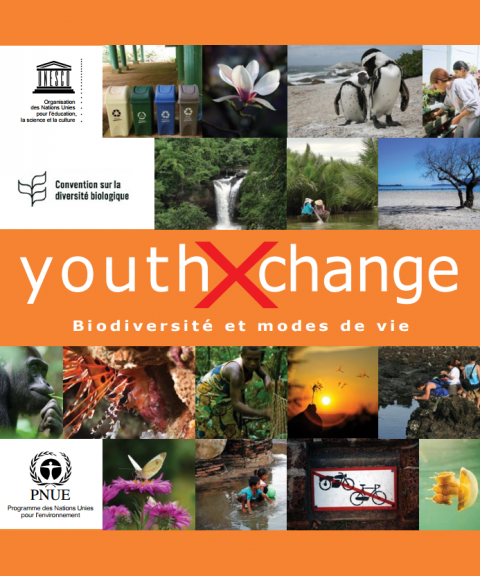 Série de guides youthXchange: biodiversité et modes de vie سنة النشر: 2015 المؤلف المؤسسي: UNESCO | United Nations Environment Programme (UNEP) The YouthXchange Biodiversity and LifestylesGuidebook is designed to help young people familiarize themselves with the dimensions of global biological and cultural diversity, as well as help them to develop essential skills whileengaging with biodiversity.The guidebook aims to:• Explore the interactions between biodiversity and lifestyle choices by explaining the interrelatedness of food, consumption, culture and biodiversity conservation;• Help young people familiarize themselves with the dimensions of global biological and cultural diversity, as well as help them to develop essential skills while engaging with biodiversity; and• Help young people consider how they can preserve biodiversity though responsible lifestyle choices, engagement and action. UNESCO-Weltkonferenz bildung für nachhaltige Entwicklung, 31. März-2.April 2009, Bonn: Tagungsbericht سنة النشر: 2009 المؤلف المؤسسي: German Federal Ministry of Education and Research (BMBF) | German Commission for UNESCO As the United Nations Decade of Education for Sustainable Development (DESD) approached its midpoint, the “UNESCO World Conference on Education for Sustainable Development – Moving into the Second Half of the UN Decade” was held from 31 March to 2 April 2009 in Bonn, Germany. It brought together 900 participants from 147 countries, among them 49 Ministers and Deputy-Ministers. Participants included representatives of UNESCO Member States, UN agencies, civil society organizations, education institutions, youth, and the private sector, as well as individual experts. The Conference was organized by UNESCO and the German Federal Ministry of Education and Research, in cooperation with the German Commission for UNESCO. The programme was developed in consultation with an international advisory group. Regional guiding framework of education for sustainable development in the Arab Region سنة النشر: 2008 المؤلف المؤسسي: UNESCO Beirut The Regional Guiding Framework of Education for Sustainable Education in the Arab Region (2005-2014) provides a general and reference vision of the activities that could be implemented by any of the partners such as education and training institutions, production and services, international and regional organizations, civil society and NGOs, within the framework of the DESD. The Framework highlighted the role of partners and beneficiaries in the implementation of joint activities related to society, life and work within the UN DESD. Annex (3) in the Arabic text provides details description of the expected role of partners in the region. Le Prisme de l'éducation pour le développement durable: un outil d'analyse des politiques et des pratiques سنة النشر: 2010 المؤلف المؤسسي: UNESCO The Education for Sustainable Development (ESD) Lens has been prepared to support UN Member States to respond to these challenges through implementation of the United Nations Decade of Education for Sustainable Development (DESD, 2005- 2014). The ESD Lens supports the goals of the DESD, and encourages policy-makers and practitioners in Member States to initiate the process of re-orienting education, particularly the formal education system, towards sustainable development. The overall goal of the UN Decade of Education for Sustainable Development (DESD) is for countries to integrate the understandings, skills and values inherent in sustainable development into all aspects of national education plans to encourage changes in lifestyles and behaviour that allow for a more sustainable and just society for all. This complements existing Education for All initiatives, and strengthens the objectives of the Millennium Development Goals. Education for Sustainable Development has the potential to improve the quality and relevance of education everywhere. Education for sustainable development lens: a policy and practice review tool سنة النشر: 2010 المؤلف المؤسسي: UNESCO The Education for Sustainable Development (ESD) Lens has been prepared to support UN Member States to respond to these challenges through implementation of the United Nations Decade of Education for Sustainable Development (DESD, 2005- 2014). The ESD Lens supports the goals of the DESD, and encourages policy-makers and practitioners in Member States to initiate the process of re-orienting education, particularly the formal education system, towards sustainable development. The overall goal of the UN Decade of Education for Sustainable Development (DESD) is for countries to integrate the understandings, skills and values inherent in sustainable development into all aspects of national education plans to encourage changes in lifestyles and behaviour that allow for a more sustainable and just society for all. This complements existing Education for All initiatives, and strengthens the objectives of the Millennium Development Goals. Education for Sustainable Development has the potential to improve the quality and relevance of education everywhere. 联合国 可持续发展教育十年 后半期战略 سنة النشر: 2010 المؤلف المؤسسي: UNESCO The UNESCO Strategy for the Second Half of the United Nations (UN) Decade of Education for Sustainable Development (DESD) draws on the findings and lessons learnt from the first phase of the DESD monitoring and evaluation (M&E) process (as reflected in the 2009 DESD M&E report Learning for a Sustainable World: Review of Contexts and Structures for Education for Sustainable Development. It also builds on the UNESCO World Conference on ESD and the Bonn Declaration as well as on the outcomes of other key international ESD meetings. The Bonn Declaration gives particular emphasis to the importance of education for the global development agenda and underlines the essential contribution of ESD to shaping the purpose, content and quality of all education. The UNESCO strategy will be implemented in line with the International Implementation Scheme (IIS), which, along with the Bonn Declaration, will provide the global strategic framework for UNESCO and its DESD partners during the second half of the Decade. The Strategy takes into account key DESD regional challenges and opportunities. It is also shaped by the shared vision of education emerging from the four 2008-2009 UNESCO international education conferences: one of education systems that encourage equity and inclusion, quality learning, flexibility and innovation. While UNESCO puts highest emphasis on achieving Education for All (EFA), the Organization’s actions in education extend beyond this, to pay explicit attention to inclusion, social cohesion and social justice, to lifelong learning and to the crucial role of higher education and research. The overall goal of the UNESCO Strategy for the Second Half of the DESD is to support Member States and other stakeholders in addressing global sustainable development challenges at regional, national and global level through ESD, thus addressing the challenges of learning for bringing about a more sustainable world.