
الموارد
استكشف مجموعة واسعة من الموارد القيمة حول تعليم المواطنة العالمية لتعميق فهمك وتعزيز البحث والمناصرة والتعليم والتعلم.
تم العثور على 52 نتيجة
 What Kind of Power Does Technology Have on the Development of Education: On the Development Principle of Technical Force in the Process of Educational Modernization (Modern Education Review; No.3, 2022) سنة النشر: 2022 المؤلف: 余清臣 In the process of continuously promoting the comprehensive modernization of education, the issue of what influence technology has on the development of education has caused many debates and disputes. Therefore, it is necessary to deeply explore the connotation of technology and the possible influence of technology on the development of education. Up to now, technology has been a concept with multiple connotations, which can be divided into two levels:core essence and peripheral influence. At present, the influence of technology with multiple connotations on educational development is manifested in three aspects:technology enriches and upgrades educational means, promotes and changes the action efficiency and life form of educational subjects, and influences and changes the way the educational world is organized. In the process of comprehensively promoting the modernization of education, the planning and application of technological forces in education should focus on promoting the all-round development of mankind in the world, not on defeating or replacing other forces, and pursue the organic combination with other forces. In addition, continuous introspection, feedback and correction are also very important. 技术对教育发展具有什么样的力量: 兼论教育现代化进程中的技术力量发展原则 (现代教育论丛; No.3, 2022) سنة النشر: 2022 المؤلف: 余清臣 在持续推进教育全面现代化的进程中,关于技术对教育发展拥有什么样影响力的问题已引发不少争议和分歧,因而有必要深入探索技术内涵以及技术对教育发展的可能影响力。不断发展至今,技术已是一个具有多重内涵的概念,可以分为内核实质与外围影响两个层次。具有多重内涵的技术对教育发展的影响力量在当前表现为三个方面:技术丰富和升级着教育手段,技术提升和改变着教育主体的行动效能和生命形态,技术影响和转变着教育世界的组织方式。在全面推进教育现代化的过程中,对技术力量的筹划和使用需要坚持四个主要原则:要以推动世界之中的人类全面发展为中心,不以战胜或取代其他力量为重要目的,要追求与其他力量有机结合,需要进行持续的自省、反馈与校正。
 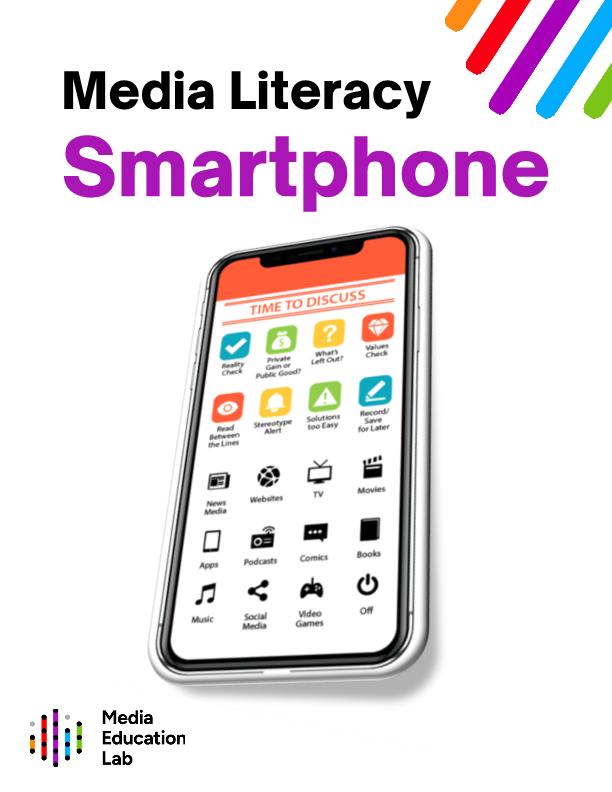 Media Literacy Smartphone سنة النشر: 2020 المؤلف: Renee Hobbs | Pam Steager المؤلف المؤسسي: Media Education Lab Learn how to use the Media Literacy Smartphone with learners of all ages! Download the free Learning Guide to bring the power of media literacy analysis to your learners!These easy-to-use cards, shaped exactly in the size of a smartphone, are available to educators for classroom use. You can use these simple paper cards to introduce a structured approach that helps students learn to critically analyze any media text --- web sites, books, advertising, news, TV shows, movies, video games, magazines and music. One side of the smartphone displays the various "apps" for analyzing a media text and the other side displays the "five critical questions" of media literacy developed by Renee Hobbs.Pair the smart phone with the LOVE IT OR HATE IT cards for a dynamic and fun learning experience.
  Teaching Media Production Online During a Pandemic: Brief Report Submitted to PBS NewsHour Student Reporting Labs سنة النشر: 2020 المؤلف: Yonty Friesem المؤلف المؤسسي: Media Education Lab How are media production teachers coping with remote video production with students?Starting in mid-March, US schools moved to remote instruction due to COVID-19 pandemic. Media production teachers had to shift their teaching to online without the possibility to use their high-end equipment in school. This report showcase the findings from Dr. Yonty Friesem’s research with media teachers who used the curriculum of PBS NewsHour Student Reporting Lab as they adapt to online and remote instruction. Dr. Friesem shared the report with PBS NewsHour Student Reporting Lab and the audience of the webinar.
  The White Paper of EKOME on Media & Information Literacy سنة النشر: 2018 المؤلف المؤسسي: EKOME S.A. EKOME is concluding 2018 Global UNESCO Media and Information Literacy Week celebrations with the launch of the White Paper on Media & Information Literacy available in Greek & English.The White Paper is EKOME’s viewpoint on the third pillar, Education, setting out a paradigm for a national infrastructure on media and information literacy. By highlighting the main priorities in the field, the White Paper of EKOME aims to contribute to a national strategic plan and build a constructive relationship with the creative industry.
 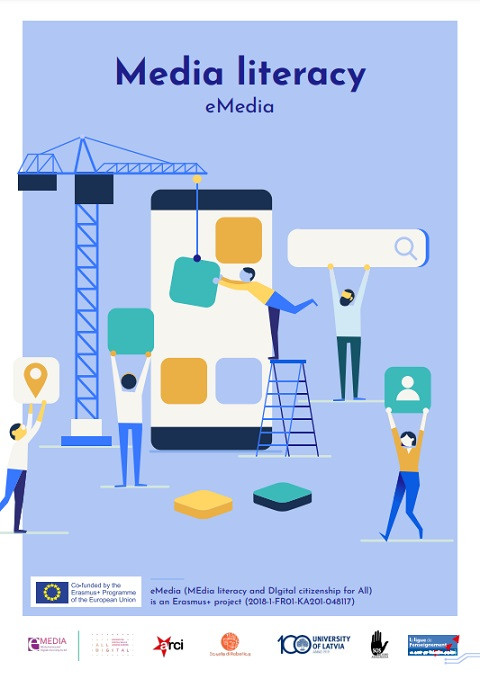 Media Literacy: eMedia سنة النشر: 2021 المؤلف المؤسسي: e-Media project Consortium The eMedia: Media Literacy and Digital Citizenship for All project aims to promote education for all by producing educational guidelines (handbooks) related to digital practices. These handbooks support possibilities for a new and innovative way of teaching different subjects at school. They address educators who are interested in developing their digital competence and improving their understanding of educational robotics as a pedagogical approach in formal or non-formal education.The handbooks are devoted to three aspects of digital competence:Educational robotics: to develop computational thinking with hands-on activities.Media literacy: to understand the power and the risks of online social media.Online Expression: to promote a more responsible use of social media, blogs, web radios and web TVs.In addition to the printed manuals, their electronic versions are also available, with additional information on the topic in question. Free online courses have been created on the Moodle platform.The handbook on Media Literacy gives an insight on the influence of media on young people development and the role of of new information technology in manipulating reality. It is intended to be used as a guideline and source for inspiration for teachers who are willing to expand their knowledge thanks to the practical examples that the handbook provides in order to deal with media literacy in class. The handbook:explains in brief the influence of media on young people developmentgives technical considerations on what media literacy isprovides an overview of the legislative frame, licenses and media ownershipgives practical examples to deal with media literacy in class.
  A Study on Information Literacy in Social Media Age: Focusing on Redefinition, Contents and Media of Information Literacy سنة النشر: 2013 المؤلف: Euikyung Oh المؤلف المؤسسي: Korean Society for Library and Information Science This study redefines information literacy (IL) and recommends its contents and media (platforms). Redefinition of IL was based on concepts such as ‘Information Literacy 2.0’, ‘Social Context’, ‘Metaliteracy’, ‘Transliteracy’, ‘Social Media Literacy’ and related researches. ‘Social Relationship’, ‘Media Convergence’, ‘Critical and Evaluative Insight on Information’ was extracted by major contents of new IL. To determine program methods, mass media’s ‘ubiquity’ was applied to the study. Some social statistics reports proved that ubiquity of social media is quite high. Finally, proposed empirical study of IL using social media by follow-up study.)
  소셜미디어 시대의 정보리터러시에 관한 소고: 재정의, 교육내용, 교육방법을 중심으로 سنة النشر: 2013 المؤلف: Euikyung Oh المؤلف المؤسسي: Korean Society for Library and Information Science 본 연구는 정보리터러시의 개념을 재정의하고, 이를 바탕으로 정보리터러시의 교육내용과 교육방법을 제안하였다. 재정의를 위하여, 오늘날의 정보환경을 표현하는 정보리터러시 2.0, 사회적 맥락, 메타리터러시, 트랜스리터러시, 소셜미디어 리터러시의 개념을 조사, 분석하였다. 정보리터러시를 구성하는 주요 요소로 ‘사회적 관계’, ‘미디어 융합과 다양성 인식’, ‘정보에 대한 평가적 안목’ 등을 추출하였다. 교육의 방법(미디어)을 결정하기 위하여, 소셜미디어의 편재성을 조사하였고, 조사결과 소셜미디어는 편재성이 높은 미디어로서, 정보리터러시 교육에 활용되는 것이 적절함을 밝혔다. 후속연구로 소셜미디어를 활용한 정보리터러시 교육에 관한 실증적 연구가 수행되어야 할 것을 제안하였다.
  Input for Report on Disinformation سنة النشر: 2021 المؤلف المؤسسي: International Federation of Library Associations and Institutions (IFLA) IFLA responded to a call for inputs about human rights impacts of measures against disinformation, issued by the United Nations Special Rapporteur on the promotion and protection of the right to freedom of opinion and expression. Concerns over – and dialogue about ways to address – the negative impacts of false and misleading information online have remained high on the agenda over the past months, particularly in light of prominent examples of health and electoral dis- and mis-information.Disinformation, uniquely challenging in the increasingly dense and complex digital information environment, interferes with individuals’ ability to make informed decisions and realise their essential human rights. However, the new call for inputs by the UN Special Rapporteur also draws attention to the concerns about human rights impacts of measures which different stakeholders – from states to online platforms, human rights organisations and others – take to combat disinformation.These include, of course, the impacts of broadly- or vaguely-defined “fake news” laws on freedom of expression and opinion; or internet shutdowns that bear a heavy cost on people’s access to information as a driver of development and rights.In light of this, IFLA’s submission highlights the potential of media and information literacy interventions to help address the challenges of mis- and dis-information. Drawing on the global library field’s experiences, it points to some possible good practices and insights from the ongoing work and research in this field – from targeted and tailored outreach initiatives that can help reach those who are not currently in formal education, to scalability and replicability of interventions.Of course, this is an emerging field. Our understanding of how media and information literacy interventions can be effectively leveraged against disinformation, pitfalls to avoid and ways to maximise impact, continues to evolve. That’s why the submission emphasises the need for more research and cross-stakeholder collaboration – and libraries can and do offer valuable practical and theoretical insights for this ongoing discussion.
  Artificial Intelligence: Media and Information Literacy, Human Rights and Freedom of Expression سنة النشر: 2020 المؤلف: Igor Shnurenko | Tatiana Murovana | Ibrahim Kushchu المؤلف المؤسسي: UNESCO Institute for Information Technologies in Education (IITE) | TheNextMinds The collection of papers “Artificial Intelligence: Media and Information Literacy, Human Rights and Freedom of Expression” continues the UNESCO IITE’s series of publications entitled “Digital Transformation of Education”.The publication describes the fundamentals of artificial intelligence and AI-based technologies, their impact on the modern information and media environment, new challenges in the field of media and information literacy associated with the growing automation of the processes of creating, disseminating and accessing information, the use of AI in decision-making and control systems in various areas. There is a strong focus on the growing risks of reducing individual agency, people’s ability to interpret reality autonomously and to act according to their own agenda.These issues are more relevant now than ever before for education undergoing digital transformation. The publication seeks to contribute to a critical understanding of the digital environment in which learning and teaching unfold, and strategies and tactics for the use of new technologies and the digitalization of educational interactions.