
الموارد
استكشف مجموعة واسعة من الموارد القيمة حول تعليم المواطنة العالمية لتعميق فهمك وتعزيز البحث والمناصرة والتعليم والتعلم.
تم العثور على 78 نتيجة
 Active citizens: globally connected, locally engaged; facilitator's toolkit سنة النشر: 2014 المؤلف المؤسسي: British Council This toolkit has been created to help facilitators to design and deliver the Active Citizens programme all over the world. Active Citizens is a social leadership programme which promotes intercultural dialogue and social responsibility as key leadership competencies in the 21st century. Active Citizens is run by the British Council working with civil society organisations all over the world. It began in 2009 and has been delivered in Europe, the Middle East, Africa and South Asia. It has reached more than 100,000 people to date through its training, conferences, social research and International Study Visits. The toolkit is in five sections - the introduction to the programme, preparing a workshop, delivering a workshop and post-workshop. There is also a large resource of workshop activity plans to support facilitators throughout the training cycle. The Active Citizens programme promotes community-led social development. It motivates members of communities to take responsibility for their social needs and gives them the knowledge, skills and experience to address them. The main audiences for the programme are community leaders working in, and with marginalised communities. They are people and institutions established, trusted and valued in the community - CSOs, NGOs, religious leaders, politicians, youth workers etc. They are influential and working to improve the lives of people living in their community. The programme develops skills and knowledge to identify and engage networks to help achieve goals as well as skills to plan and implement a project. The networks are between individuals at community level; institutions engaged in social action at community level; and institutions engaged in social policy dialogue at a national level. It includes cross-sectoral networking e.g. with the business community, media, etc. The building of these networks increases social inclusion, community resilience to conflict and increases social development in communities. See Diagram 1 on page 9. The programme is flexible and adaptable. It has been delivered to diverse groups, from rural communities in North-West Frontier Province Pakistan to urban communities in East London UK, to communities vulnerable to post-election violence in Kenya and internally displaced persons (IDPs) in Sri Lanka. Des Citoyens Actifs: connecté globalement recrutés sur place; la boîte à outils de l'animateur سنة النشر: 2014 المؤلف المؤسسي: British Council Cette boîte à outils a été créé pour aider les animateurs à concevoir et à exécuter le programme des citoyens actifs partout dans le monde. Citoyens actifs est un programme de leadership social qui favorise le dialogue interculturel et la responsabilité sociale comme compétences clés en leadership au 21e siècle. Citoyens actifs est géré par le British Council travaille avec des organisations de la société civile partout dans le monde. Il a commencé en 2009 et a été livré en Europe, au Moyen-Orient, en Afrique et en Asie du Sud. Il a atteint plus de 100.000 personnes à ce jour par le biais de sa formation, les conférences, la recherche sociale et visites d'étude internationaux. La boîte à outils est en cinq sections - l'introduction au programme, la préparation d'un atelier, offrant un atelier et post-atelier. Il y a aussi une ressource importante de l'activité de l'atelier prévoit de soutenir les animateurs tout au long du cycle de formation. Le programme des citoyens actifs favorise le développement social dirigé par la communauté. Il motive les membres des communautés à prendre en charge leurs besoins sociaux et leur donne les connaissances, les compétences et l'expérience nécessaires pour y remédier. Les principaux publics pour le programme sont des leaders communautaires qui travaillent dans et avec les communautés marginalisées. Ce sont des gens et des institutions établies, fiables et appréciés dans la communauté - OSC, les ONG, les chefs religieux, les politiciens, les travailleurs de la jeunesse, etc. Ils sont influents et travaille à améliorer la vie des personnes vivant dans leur communauté. Le programme développe les compétences et les connaissances pour identifier et engager des réseaux pour aider à atteindre les objectifs ainsi que les compétences nécessaires pour planifier et mettre en œuvre un projet. Les réseaux sont entre les individus au niveau de la communauté; les institutions engagées dans l'action sociale au niveau communautaire; et les institutions engagées dans un dialogue de politique sociale au niveau national. Il comprend la mise en réseau intersectoriel par exemple avec la communauté des affaires, des médias, etc. La construction de ces réseaux augmente l'inclusion sociale, la résilience des communautés aux conflits et augmente le développement social dans les communautés. Voir diagramme 1 à la page 9. Le programme est flexible et adaptable. Il a été remis à divers groupes, des communautés rurales en North-West Frontier Province du Pakistan aux communautés urbaines à East London au Royaume-Uni, aux communautés des personnes vulnérables à la violence post-électorale au Kenya et déplacées à l'intérieur (PDI) au Sri Lanka.
 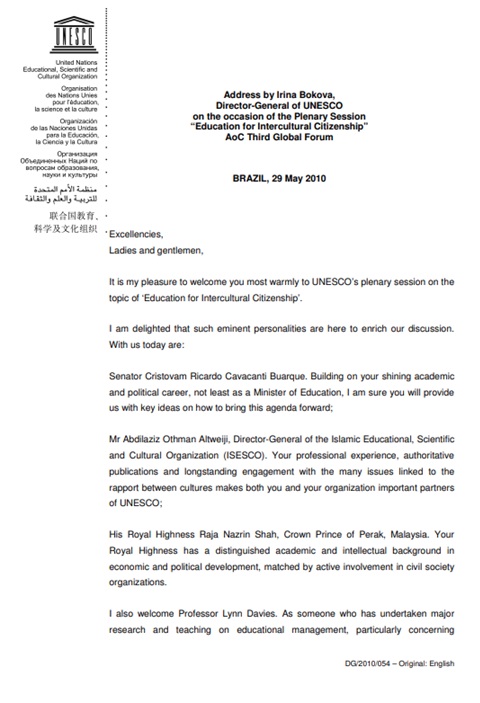 Address by Irina Bokova, Director-General of UNESCO on the occasion of the Plenary Session: Education for Intercultural Citizenship, AoC Third Global Forum; Brazil, 29 May 2010 سنة النشر: 2010 المؤلف المؤسسي: UNESCO. Director-General, 2009-2017 (Bokova, I.G.) This is an address by Irina Bokova, Director-General of UNESCO on the occasion of the plenary session for Education for Intercultural Citizenship in Brazil, on 29 May 2010. She insisted the importance of education for 'Learning to Live together'. She also highlited education for inter-cultural understanding as an important theme for the 21st centry. Address by Irina Bokova, Director-General of UNESCO on the occasion of the Plenary Session: Education for Intercultural Citizenship, AoC Third Global Forum; Brazil, 29 May 2010 سنة النشر: 2010 المؤلف المؤسسي: UNESCO. Director-General, 2009-2017 (Bokova, I.G.) This is an address by Irina Bokova, Director-General of UNESCO on the occasion of the plenary session for Education for Intercultural Citizenship in Brazil, on 29 May 2010. She insisted the importance of education for 'Learning to Live together'. She also highlited education for inter-cultural understanding as an important theme for the 21st centry. Discours de Mme Irina Bokova, Directrice générale de l'UNESCO à l'occasion de la session plénière: Education à la citoyenneté interculturelle, AoC Troisième Forum mondial; Brésil 29 Mai 2010 سنة النشر: 2010 المؤلف المؤسسي: UNESCO. Director-General, 2009-2017 (Bokova, I.G.) Ceci est une adresse par Irina Bokova, Directrice générale de l'UNESCO à l'occasion de la session plénière de l'éducation à la citoyenneté interculturelle au Brésil, le 29 mai 2010. Elle a insisté sur l'importance de l'éducation pour «Apprendre à vivre ensemble». Elle a également highlited éducation pour la compréhension inter-culturelle comme un thème important pour le 21e centry.
  Education for intercultural understanding سنة النشر: 2010 المؤلف: Joy de Leo المؤلف المؤسسي: UNESCO Bangkok The theme of intercultural understanding and respect for cultural diversity falls within the social dimension of peace, equality and human rights, underpinned by the cultural context, within and through which learning occurs, and which forms the basis for inter-linkages between the various sustainability dimensions (i.e., socio-political, environmental and economic). Within the International Implementation Scheme, the value of respect is seen as central to all aspects of sustainable development: respect for self, for others and for all life on earth. L'éducation pour la compréhension interculturelle سنة النشر: 2010 المؤلف: Joy de Leo المؤلف المؤسسي: UNESCO Bangkok Le thème de la compréhension interculturelle et le respect de la diversité culturelle relève de la dimension sociale de la paix, l'égalité et les droits de l'homme, sous-tendue par le contexte culturel, à l'intérieur et à travers lequel l'apprentissage se produit, et qui constitue la base des liens entre les différentes dimensions de la durabilité (ie, socio-politique, environnemental et économique). Dans le cadre du programme d'application international, la valeur du respect est considérée comme essentielle à tous les aspects du développement durable: le respect de soi, des autres et de toute vie sur terre. 상호 문화 간 이해 교육 سنة النشر: 2010 المؤلف: Joy de Leo المؤلف المؤسسي: UNESCO Bangkok 상호 문화 간 이해와 문화 다양성에 대한 존중이라는 주제는 문화적 맥락에 기반을 둔 인권과 평등 및 평화의 사회적 영역에 속하며 학습 안에서 또한, 그 과정을 통해 이루어지며, 다양한 지속가능한 영역내에서 다양한 문화 간 상호 연계의 기반(즉, 사회·정치적, 환경적, 경제적으로)을 구축한다. 국제 실행계획(International Implementation Scheme)내에서, 존중의 가치는 지속가능한 발전의 모든 측면에서 핵심적인 것으로 간주된다. 곧, 자기 존중, 타인과 지구상의 모든 삶에 대한 존중을 의미한다. 2013 Asia-Pacific Education Research Institutes Network (ERI-Net) regional study on: transversal competencies in education policy and practice (Phase I): regional synthesis report سنة النشر: 2015 المؤلف المؤسسي: UNESCO Bangkok The Asia-Pacific region has been spearheading global, social, and economic development for the last several decades. Millions of people have been lifted out of poverty and basic education (primary and lower secondary) has become near universal in many countries in the region. Upper secondary and higher education enrollment rates have also increased significantly. However, while these are tremendous achievements, education quality remains a major concern among emerging economies and industrialized nations alike. While some countries in the region excel in international assessments, such as the Programme for International Student Assessment (PISA), the Trends in International Mathematics and Science Study (TIMSS), and the Progress in International Reading Literacy Study (PIRLS), other countries still attain low scores. National assessment results of countries that have not participated in international assessments reveal large knowledge and skills disparities among students of the same country. In some cases the results also indicate a very low attainment level of basic skills, even after years of schooling.At the same time, the debate surrounding what actually constitutes quality education and learning in the 21st century is ongoing. There is a growing concern that education systems are focusing too much on the accumulation of academic “cognitive” skills at the expense of the more elusive and hard-to-measure “nonacademic” skills and competencies. The accumulation of these skills and competencies, which include skills and competencies in efficient communication with others, innovative thinking, respect for diversity and the environment, conflict resolution, team work, problem solving, and so on, is not only important for students to be adequately prepared for the world of work, but is also paramount in ensuring future generations are equipped to live meaningful, sustainable, and responsible lives in a rapidly changing and interconnected world.1 The effects of the limited attention paid to such skills and competencies in education can be felt in a number of domains and include, for example: poor respect for diversity (including socio-economic, ethnic, and gender equality), neglect of environmental issues, and a lack of innovation and social entrepreneurship among students.To counter these challenges, many countries and economies in the Asia-Pacific region have introduced, or are in the process of introducing, policy and curriculum changes aimed at enhancing the cultivation of such “non-academic” skills and competencies in learners. To date, these important reforms in the Asia-Pacific region have not been widely documented, and hence, in 2013 members of the Asia-Pacific Education Research Institutes Network (ERI-Net), hosted by UNESCO Bangkok since 2009, agreed to make this their next topic of investigation. The research aims to document and consolidate reform initiatives for knowledge dissemination and policy consideration to the benefit of countries and economies in the Asia-Pacific region and beyond. In phase I, the 2013 ERI-Net research examined how different countries and economies in the region define and apply “non-academic” skills (often termed “non-cognitive skills”) in their education policies, practices, and curriculum frameworks, and identified emerging trends and challenges. This report synthesizes ten case studies and includes important information and insights gained from the discussions held during the ERI-Net annual meeting 2013.The objectives of the report are: (i) to capture the movements in the realm of “non-academic” learning in ten education systems in the Asia-Pacific region; (ii) to identify possible policy recommendations for promoting and enhancing well-rounded and holistic learning; and, (iii) to suggest further stages of investigation. 2013 Réseau des instituts de recherche en éducation en Asie-Pacifique (ERI-Net) سنة النشر: 2015 المؤلف المؤسسي: UNESCO Bangkok La région Asie-Pacifique a été le fer de lance du développement mondial, social et économique depuis plusieurs décennies. Des millions de personnes ont été sorties de la pauvreté et de l'éducation de base (primaire et secondaire) est devenue quasi universelle dans de nombreux pays de la région. taux de scolarisation secondaire et le supérieur ont également augmenté de manière significative. Cependant, alors que ce sont des réalisations remarquables, la qualité de l'éducation demeure une préoccupation majeure parmi les économies émergentes et les pays industrialisés aussi bien. Alors que certains pays de la région d'exceller dans les évaluations internationales, telles que le Programme international pour le suivi des acquis des élèves (PISA), les Tendances de l'enquête internationale sur les mathématiques et les sciences (TEIMS) Le Programme international de recherche en lecture scolaire (PIRLS), et d'autres pays encore atteindre des scores faibles. Les résultats nationaux des pays qui n'ont pas participé aux évaluations internationales d'évaluation révèlent de grandes disparités entre les connaissances et les compétences chez les élèves d'un même pays. Dans certains cas, les résultats indiquent également un niveau de réalisation très faible des compétences de base, même après des années de scolarité.Dans le même temps, le débat entourant ce qui constitue effectivement l'éducation et un apprentissage de qualité dans le 21ème siècle est en cours. Il y a une préoccupation croissante que les systèmes éducatifs se concentrent trop sur l'accumulation de compétences académiques «cognitives» au détriment des compétences plus insaisissables et difficiles à mesurer "non académiques" et les compétences. L'accumulation de ces aptitudes et compétences, qui comprennent les compétences et les compétences en communication efficace avec les autres, la pensée novatrice, le respect de la diversité et de l'environnement, la résolution des conflits, le travail d'équipe, la résolution de problèmes, et ainsi de suite, est non seulement important pour les étudiants d'être adéquatement préparé pour le monde du travail, mais elle est aussi primordiale pour assurer les générations futures sont équipés pour mener une vie enrichissante, durables et responsables dans un monde1 en évolution rapide et interconnecté les effets de l'attention accordée à ces aptitudes et compétences en matière d'éducation peut se faire sentir dans un certain nombre de domaines et comprennent, par exemple: faible respect de la diversité (y compris l'égalité socio-économique, ethnique et le sexe), la négligence des questions environnementales, et un manque d'innovation et de l'entrepreneuriat social chez les étudiants.Pour contrer ces difficultés, de nombreux pays et économies de la région Asie-Pacifique ont mis en place ou sont en train d'introduire des changements de politiques et de programmes visant à améliorer la culture de ces aptitudes et compétences «non universitaires» chez les apprenants. À ce jour, ces réformes importantes dans la région Asie-Pacifique n'a pas été largement documentés, et donc, en 2013 les membres de l'Education Research Institutes Réseau Asie-Pacifique (ERI-Net), organisé par l'UNESCO à Bangkok depuis 2009, a aCECpté de faire cette leur sujet suivant l'enquête. La recherche vise à documenter et à consolider les initiatives de réforme pour la diffusion des connaissances et l'examen de la politique au profit des pays et des économies de la région Asie-Pacifique et au-delà. Dans la phase I, la recherche 2013 ERI-Net examiné comment les pays et les économies différentes dans la région de définir et d'appliquer les compétences «non universitaires» (souvent appelés «compétences non cognitives») dans leurs politiques d'éducation, des pratiques et des cadres du curriculum, et identifié les tendances et les défis nouveaux. Ce rapport synthétise dix études de cas et comprend des informations et des connaissances importantes acquises à partir des discussions tenues lors de la réunion annuelle ERI-Net 2013.Les objectifs du rapport sont les suivants: (i) de capturer les mouvements dans le domaine de la «non-académique" apprentissage dans dix systèmes d'éducation dans la région Asie-Pacifique; (Ii) de formuler des recommandations politiques possibles pour la promotion et l'amélioration de l'apprentissage bien équilibrée et holistique; et, (iii) à proposer d'autres stades de l'enquête.