
الموارد
استكشف مجموعة واسعة من الموارد القيمة حول تعليم المواطنة العالمية لتعميق فهمك وتعزيز البحث والمناصرة والتعليم والتعلم.
تم العثور على 78 نتيجة
 ПЕРЕКЛИКАЮЩИЕСЯ ГОЛОСА: Десятая годовщина принятия Всеобщей декларации ЮНЕСКО о культурном разнообразии سنة النشر: 2011 المؤلف المؤسسي: Организация Объединенных Наций по вопросам образования, науки и культуры (UNESCO) This founding text was the first to acknowledge cultural diversity as “the common heritage of humanity”. It is with great pride that UNESCO is commemorating the 10th anniversary of the Declaration. Commemorate – from the Latin cum memorare – means quite literally “to remember together” or “to remember with”. This collection is compiled the voices of all those who have contributed to the heightening of human awareness by throwing into relief the inestimable value of cultural diversity. These excerpts from books, articles and statements by global intellectual and political leaders, artists and Nobel Prize-winners all call for the safeguarding of cultural diversity, which is inseparable from respect for human dignity. Their voices resound in bearing witness to the strength of cultural diversity and to its capacity to enlighten the minds of women and men. We are duty-bound to ensure that it is central to public policies and a resource for development and dialogue among nations. The United Nations was born of the determination of men and women “to save succeeding generations from the scourge of war...”. In accordance with that principle, UNESCO was established on a key idea, expressed at the very beginning of its Constitution: “... since wars begin in the minds of men, it is in the minds of men that the defences of peace must be constructed”. In the world today, globalized, connected and interdependent as never before, this mission is more vital than ever. The rapprochement of peoples and cultures requires a commensurately global awareness. Cultural diversity has always been at the heart of international relations. It is also, increasingly, a feature of the contemporary mixed and plural societies in which we live. In view of this reality, we must formulate appropriate public policies and rethink the mechanisms of social cohesion and civic participation. How can we build common ground on the basis of such diversity? How can we construct genuine moral and intellectual solidarity of humanity? Any new vision of humanism must be grounded itself in the dynamism and diversity of cultural heritage. It is a source of inspiration and knowledge to be shared and a means of broadening our horizons. The goal of the UNESCO Universal Declaration on Cultural Diversity is to provide keys and benchmarks for capitalizing on this wealth. There can be no sustainable governance if cultural diversity is not acknowledged. There can be no economic and social development if specific features of every culture are belittled and ignored. أصداء، التنوع الثقافي: طريق نحو تحقيق التنمية؛ الذكرى السنوية العاشرة لإعتماد الإعلان العالمي لليونسكو بشأن التنوع الثقافي سنة النشر: 2011 المؤلف المؤسسي: UNESCO This founding text was the first to acknowledge cultural diversity as “the common heritage of humanity”. It is with great pride that UNESCO is commemorating the 10th anniversary of the Declaration. Commemorate – from the Latin cum memorare – means quite literally “to remember together” or “to remember with”. This collection is compiled the voices of all those who have contributed to the heightening of human awareness by throwing into relief the inestimable value of cultural diversity. These excerpts from books, articles and statements by global intellectual and political leaders, artists and Nobel Prize-winners all call for the safeguarding of cultural diversity, which is inseparable from respect for human dignity. Their voices resound in bearing witness to the strength of cultural diversity and to its capacity to enlighten the minds of women and men. We are duty-bound to ensure that it is central to public policies and a resource for development and dialogue among nations. The United Nations was born of the determination of men and women “to save succeeding generations from the scourge of war...”. In accordance with that principle, UNESCO was established on a key idea, expressed at the very beginning of its Constitution: “... since wars begin in the minds of men, it is in the minds of men that the defences of peace must be constructed”. In the world today, globalized, connected and interdependent as never before, this mission is more vital than ever. The rapprochement of peoples and cultures requires a commensurately global awareness. Cultural diversity has always been at the heart of international relations. It is also, increasingly, a feature of the contemporary mixed and plural societies in which we live. In view of this reality, we must formulate appropriate public policies and rethink the mechanisms of social cohesion and civic participation. How can we build common ground on the basis of such diversity? How can we construct genuine moral and intellectual solidarity of humanity? Any new vision of humanism must be grounded itself in the dynamism and diversity of cultural heritage. It is a source of inspiration and knowledge to be shared and a means of broadening our horizons. The goal of the UNESCO Universal Declaration on Cultural Diversity is to provide keys and benchmarks for capitalizing on this wealth. There can be no sustainable governance if cultural diversity is not acknowledged. There can be no economic and social development if specific features of every culture are belittled and ignored.
 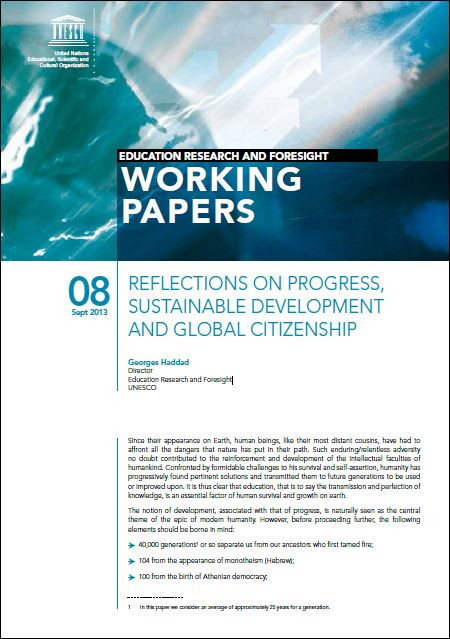 Reflexiones Sobre el Progreso, el Desarrollo Sostenible y la Ciudadanía Mundial سنة النشر: 2013 المؤلف: Georges Haddad المؤلف المؤسسي: UNESCO Los argumentos desarrollados en esta breve ponencia ponen de manifiesto que el desarrollo sostenible, el progreso y la ciudadanía mundial sólidamente arraigados en la Sociedad del Conocimiento contribuyen indudablemente a construir este Nuevo Humanismo promovido por la Directora General de la UNESCO, y que todos coincidimos en considerar esencial para la riqueza y la prosperidad de la Humanidad, en un entorno común grato, pacífico y cordial. Proceedings of the international congresses of: education for shared values for intercultural and interfaith understanding, (and) religion in peace and conflict: responding to militancy and fundamentalism سنة النشر: 2005 المؤلف المؤسسي: UNESCO The results of this conference, and its direct linkages with the Associated Schools Project Network in your region, will support efforts to mould education so that it becomes more conducive to the development of world citizens, proud of their identities and able to contribute to a sustainable and peaceful future for the world’s peoples. Actes des congrès internationaux de: l'éducation pour les valeurs partagées pour la compréhension interculturelle et interreligieuse, (et) la religion dans la paix et les conflits: répondre au militantisme et le fondamentalisme سنة النشر: 2005 المؤلف المؤسسي: Organisation des Nations Unies pour l'éducation, la science et la culture (UNESCO) Les résultats de cette conférence, et ses liens directs avec le réseau des écoles associées dans votre région, soutiendront les efforts visant à modeler l'éducation afin qu'il devienne plus propice au développement des citoyens du monde, fiers de leur identité et en mesure de contribuer à une durable et l'avenir pacifique pour les peuples du monde. Expert meeting on intercultural education, Paris, 20-22 March 2006; report سنة النشر: 2006 المؤلف المؤسسي: UNESCO This report will give for each panel a summary of the presentation, the ensuing debates and a synthesis. The discussions of the draft UNESCO Guidelines and of the database on Intercultural Education, including the results and next steps to be taken are also presented. In addition, the report provides a summary of the debate around the presentation of the UNESCO World Report on Cultural Diversity. Expert meeting on intercultural education, Paris, 20-22 March 2006; report سنة النشر: 2006 المؤلف المؤسسي: UNESCO Ce rapport donnera pour chaque panneau un résumé de la présentation, les débats qui ont suivi et une synthèse. Les discussions sur le projet de directives de l'UNESCO et de la base de données sur l'éducation interculturelle, y compris les résultats et les prochaines mesures à prendre sont également présentés. En outre, le rapport fournit un résumé du débat autour de la présentation du Rapport mondial de l'UNESCO sur la diversité culturelle. 상호 문화 간 교육에 관한 전문가 회의 보고서(2006년 3월 20~23일, 파리) سنة النشر: 2006 المؤلف المؤسسي: 유네스코 이 보고서는 각 패널을 위하여 프리젠테이션 요약, 연이은 토론과 그 종합적인 것들을 제공한다. 또한 유네스코 가이드라인 초안 및 상호문화 간 교육에 관한 데이터베이스에 대한 논의와 그 결과, 그리고 그 다음 단계를 제시한다. 아울러, 유네스코 세계문화 다양성 보고서(UNESCO World Report on Cultural Diversity) 프리젠테이션과 관련된 토론에 대한 요약본도 제공한다. Directrices de la UNESCO sobre la educación intercultural سنة النشر: 2006 المؤلف المؤسسي: Organización de las Naciones Unidas para la Educación, la Ciencia y la Cultura (UNESCO) These Guidelines have been prepared as a contribution to the understanding of the issues around intercultural education. They draw together the key standard-setting instruments and the results of numerous conferences, in particular, the Expert Meeting held at UNESCO Headquarters in March 2006, in order to present those concepts and issues which may be used to guide future activities and policy making in this area. The document refl ects UNESCO’s unique role as international standard setter and convenor of diverse cultural and ideological perspectives. Principes directeurs de l'UNESCO pour l'éducation interculturelle سنة النشر: 2006 المؤلف المؤسسي: Organisation des Nations Unies pour l'éducation, la science et la culture (UNESCO) These Guidelines have been prepared as a contribution to the understanding of the issues around intercultural education. They draw together the key standard-setting instruments and the results of numerous conferences, in particular, the Expert Meeting held at UNESCO Headquarters in March 2006, in order to present those concepts and issues which may be used to guide future activities and policy making in this area. The document refl ects UNESCO’s unique role as international standard setter and convenor of diverse cultural and ideological perspectives.