
الموارد
استكشف مجموعة واسعة من الموارد القيمة حول تعليم المواطنة العالمية لتعميق فهمك وتعزيز البحث والمناصرة والتعليم والتعلم.
تم العثور على 78 نتيجة
 UNESCO guidelines on intercultural education سنة النشر: 2006 المؤلف المؤسسي: UNESCO This paper aims to synthesize the central issues surrounding Intercultural Education, and presents the fundamental guiding principles for an intercultural approach to education as viewed by UNESCO. It is divided into three parts. Part I outlines the key issues surrounding Intercultural Education, as well as its objectives and basic operating principles. Part II contains a short presentation of the normative framework for Intercultural Education, based on an analysis of international standard-setting instruments that make reference to education and intercultural issues, and on outcomes from International Conferences. Part III synthesizes the international position on this issue and provides a set of three basic principles that should guide educational policies with regard to Intercultural Education.
  Etude comparative de manuels scolaires: document de travail dans le cadre du dialogue Euro-Arabe, rapport de synthèse سنة النشر: 2015 المؤلف: Jacqueline Costa-Lascoux | Janine d'Artois Pursuant to the Charter of the United Nations and the Constitution of UNESCO, calling for peace between peoples and respect for cultural diversity, several National Commissions for UNESCO have taken the initiative to create the conditions for a Euro-Arab dialogue in the field of education. The French and Moroccan National Commissions, in particular, have decided to launch studies to highlight stereotypes, misunderstandings and subliminal bias about Arab countries in European textbooks and about European countries in textbooks in the Arab world. First, these studies were conducted by researchers focusing on their own countries' textbooks in order to analyse how the history of the countries on "the other side of the Mediterranean" was represented. Second, a common methodology was developed to allow comoparative approaches favourable to Euro-Arab dialogue. This was to address any mutual bias or misrepresentations that may exist between the two regions and to work togehter to find ways of preventing and combating them. The originality of the approach was to conduct a critical analysis of textbooks published in each country and then underetake a comparative study to be used as the basis for common recommendations. Participants in this project initiated by the National Commissions defined three main objectives: 1. To strengthen dialogue, laying the foundations for learning to live together, based on mutual respect. 2. To help National Commissions for UNESCO, experts, institutions and non-governmental organizations (NGOs) to find ways to work together in areas of research of common interest. 3. To contribute to UNESCO's efforts to develop a stretegy relating to textbooks, to improve the quality of education for peace, human rights, mutual understanding and intercultural dialogue. دراسة مقارنة للكتب املدرسية وثيقة عمل في إطار الحوار األوروبي - العربي سنة النشر: 2015 المؤلف: Jacqueline Costa-Lascoux | Janine d'Artois Pursuant to the Charter of the United Nations and the Constitution of UNESCO, calling for peace between peoples and respect for cultural diversity, several National Commissions for UNESCO have taken the initiative to create the conditions for a Euro-Arab dialogue in the field of education. The French and Moroccan National Commissions, in particular, have decided to launch studies to highlight stereotypes, misunderstandings and subliminal bias about Arab countries in European textbooks and about European countries in textbooks in the Arab world. First, these studies were conducted by researchers focusing on their own countries' textbooks in order to analyse how the history of the countries on "the other side of the Mediterranean" was represented. Second, a common methodology was developed to allow comoparative approaches favourable to Euro-Arab dialogue. This was to address any mutual bias or misrepresentations that may exist between the two regions and to work togehter to find ways of preventing and combating them. The originality of the approach was to conduct a critical analysis of textbooks published in each country and then underetake a comparative study to be used as the basis for common recommendations. Participants in this project initiated by the National Commissions defined three main objectives: 1. To strengthen dialogue, laying the foundations for learning to live together, based on mutual respect. 2. To help National Commissions for UNESCO, experts, institutions and non-governmental organizations (NGOs) to find ways to work together in areas of research of common interest. 3. To contribute to UNESCO's efforts to develop a stretegy relating to textbooks, to improve the quality of education for peace, human rights, mutual understanding and intercultural dialogue.
  Comparative study of textbooks: working document in the framework of the Euro-Arab Dialogue; summary report سنة النشر: 2015 المؤلف: Jacqueline Costa-Lascoux | Janine d'Artois Pursuant to the Charter of the United Nations and the Constitution of UNESCO, calling for peace between peoples and respect for cultural diversity, several National Commissions for UNESCO have taken the initiative to create the conditions for a Euro-Arab dialogue in the field of education. The French and Moroccan National Commissions, in particular, have decided to launch studies to highlight stereotypes, misunderstandings and subliminal bias about Arab countries in European textbooks and about European countries in textbooks in the Arab world. First, these studies were conducted by researchers focusing on their own countries' textbooks in order to analyse how the history of the countries on "the other side of the Mediterranean" was represented. Second, a common methodology was developed to allow comoparative approaches favourable to Euro-Arab dialogue. This was to address any mutual bias or misrepresentations that may exist between the two regions and to work togehter to find ways of preventing and combating them. The originality of the approach was to conduct a critical analysis of textbooks published in each country and then underetake a comparative study to be used as the basis for common recommendations. Participants in this project initiated by the National Commissions defined three main objectives: 1. To strengthen dialogue, laying the foundations for learning to live together, based on mutual respect. 2. To help National Commissions for UNESCO, experts, institutions and non-governmental organizations (NGOs) to find ways to work together in areas of research of common interest. 3. To contribute to UNESCO's efforts to develop a stretegy relating to textbooks, to improve the quality of education for peace, human rights, mutual understanding and intercultural dialogue.
 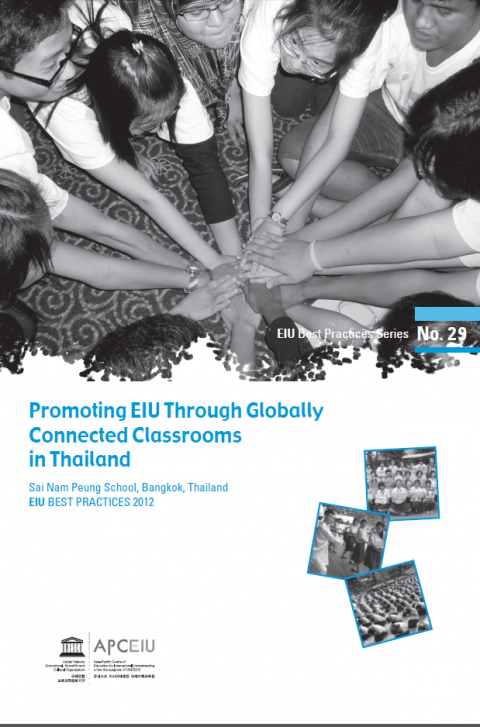 EIU Best Practice Series No. 29: Promoting EIU through globally connected classrooms in Thailand سنة النشر: 2012 المؤلف: Ajarn Kanchaphat Chaoplaina المؤلف المؤسسي: APCEIU This issue presents a multilateral project in Thailand, which interconnected students from Thailand, United Kingdom, Korea, Indonesia, Malaysia, Taiwan, and Vietnam to share their values and thoughts on EIU issues. Through the portals of connection, students from different regions were able to collaborate in doing group works and activities, which were focused on sharing ideas on students’ interest and every day experiences. This case highlights the specific practice that encouraged students to actively learn from one another and understand the cultural diversity, which optimized the outcome of the students’ capacity in communication skills, language skills, and personal development as global citizens. In addition to strengthening the network among participating schools, the impact of the multilateral project extended to teachers while they were engaged in exchanging pedagogical methods and knowledge to support and inspire each other. Promouvoir ECI travers les salles de classe branchés sur le monde en Thaïlande (ECI Série des Meilleures Pratiques no.29) سنة النشر: 2012 المؤلف: Ajarn Kanchaphat Chaoplaina المؤلف المؤسسي: Centre Asie-Pacifique d'éducation pour la compréhension internationale (APCEIU) Cette question présente un projet multilatéral en Thaïlande, qui interconnectée étudiants en provenance de Thaïlande, Royaume-Uni, la Corée, l'Indonésie, la Malaisie, Taïwan et le Vietnam pour partager leurs valeurs et leurs réflexions sur les questions ECI. A travers les portails de connexion, les étudiants de différentes régions ont été en mesure de collaborer à faire des travaux et des activités de groupe, qui ont été axées sur le partage des idées sur l'intérêt des élèves et expériences quotidiennes. Ce cas met en lumière la pratique spécifique qui a encouragé les élèves à apprendre activement les uns des autres et de comprendre la diversité culturelle, qui a optimisé le résultat de la capacité des étudiants en techniques de communication, les compétences linguistiques et le développement personnel en tant que citoyens. En plus de renforcer le réseau entre les écoles participantes, l'impact du projet multilatéral étendu aux enseignants alors qu'ils étaient engagés dans l'échange de méthodes et de connaissances pédagogiques pour soutenir et inspirer les uns des autres.
 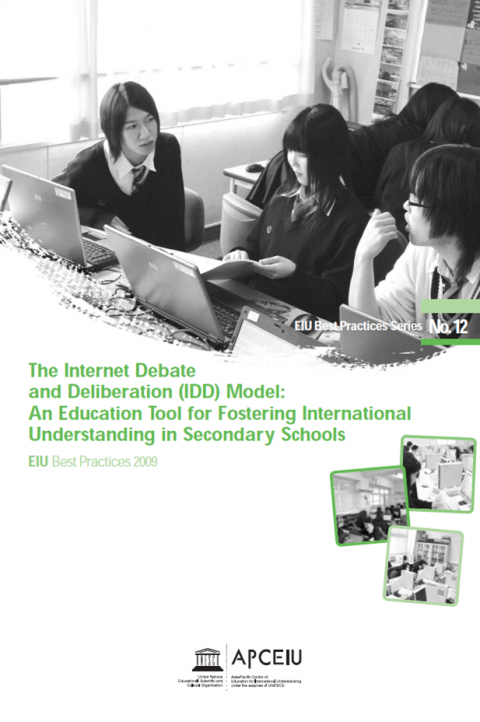 EIU Best Practice Series No. 12: The Internet Debate and Deliberation (IDD) Model: An Education Tool for Fostering International Understanding in Secondary Schools سنة النشر: 2009 المؤلف: Rose Sabanal المؤلف المؤسسي: APCEIU This document introduces a case of the internet-based debate and deliberation with an aim to strengthen critical and integrated thinking among high school students from various countries. The case demonstrates that the school in case has been making a devoted effort to develop effective methods of communication among young people with different cultural backgrounds and perspectives, eventually leading to the development of educational content that will enable young learners to critically reflect on highly contending issues of EIU. Le débat sur Internet et Délibération (The Internet Debate and Deliberation, IDD) modèle: un outil pédagogique pour favoriser la compréhension internationale dans les écoles secondaires (ECI Série des Meilleures Pratiques no.12) سنة النشر: 2009 المؤلف: Rose Sabanal المؤلف المؤسسي: Centre Asie-Pacifique d'éducation pour la compréhension internationale (APCEIU) Ce document présente un cas du débat basé sur Internet et de délibération dans le but de renforcer la pensée critique et intégrée entre les élèves du secondaire provenant de divers pays. Le cas démontre que l'école en cas a été un effort consacré à développer des méthodes de communication efficaces entre les jeunes de différentes origines et perspectives culturelles, menant éventuellement à l'élaboration du contenu éducatif qui permettra aux jeunes apprenants à une réflexion critique sur des questions très rivales d’ECI.