
الموارد
استكشف مجموعة واسعة من الموارد القيمة حول تعليم المواطنة العالمية لتعميق فهمك وتعزيز البحث والمناصرة والتعليم والتعلم.
تم العثور على 29 نتيجة
 Education as a Security Issue المؤلف: Ian Jamison المؤلف المؤسسي: Tony Blair Faith Foundation Le recours des extrémistes religieux à l'éducation comme, à la fois, outil et cible est peut-être l'un des défis les plus importants de cette génération, auquel nous sommes confrontés aujourd'hui dans le monde. Pour que la prochaine génération soit ouverte à un monde plus pluraliste, nous devons veiller à ce que leur éducation les prépare à des échanges pacifiques avec « l’Autre ». Cela signifie non seulement d’améliorer les connaissances, la compréhension et l'interaction, mais aussi d’investir urgemment dans le développement des compétences générales essentielles qui en garantissent une bonne utilisation.
 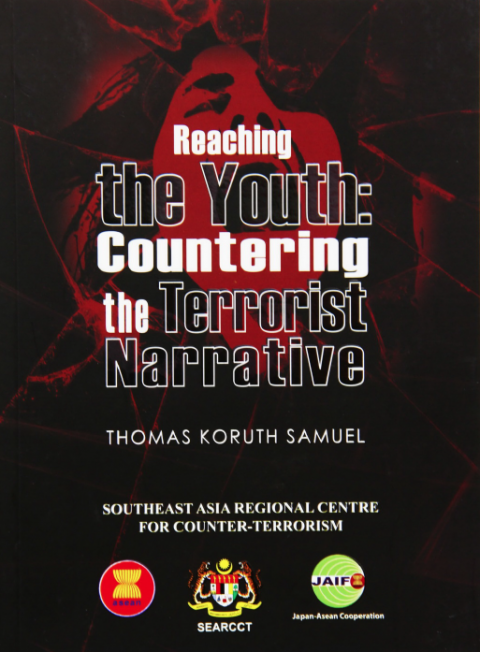 Reaching the Youth: countering the Terrorist Narrative سنة النشر: 2012 المؤلف: Thomas Koruth Samuel This monograph studies the issue of the dynamics of youth and terrorism, paying close attention to the methods used by terrorists to entice the youth, the message or the narrative of the terrorists, and the possible counter-narrative that could be subsequently developed. Reaching the Youth: countering the Terrorist Narrative سنة النشر: 2012 المؤلف: Thomas Koruth Samuel Cette monographie étudie la dynamique entre la jeunesse et le terrorisme en accordant une attention particulière aux méthodes utilisées par les terroristes pour attirer les jeunes, leurs messages ou discours, et le contre-récit éventuel qui pourrait être développé par la suite.
 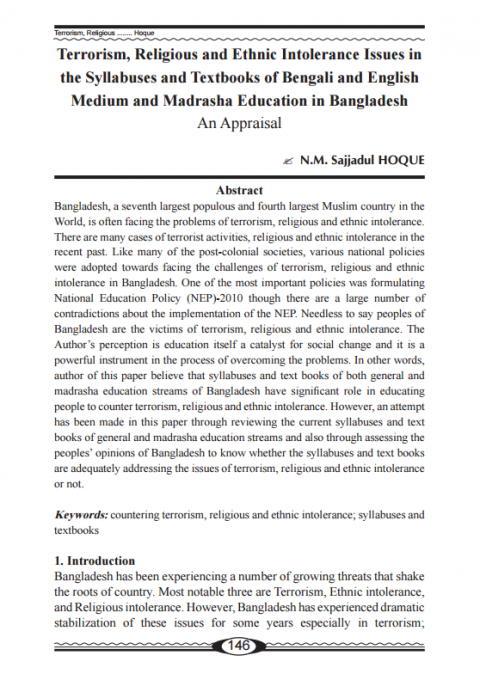 Terrorism, Religious and Ethnic Intolerance Issues in the Syllabuses and Textbooks of Bengali and English Medium and Madrasah Education in Bangladesh an Appraisal سنة النشر: 2014 المؤلف: NM Sajjadul Hoque The author argues that education is a catalyst for social change and a powerful instrument for overcoming social and security problems. In other words, the author believes that syllabuses and textbooks of both the general and madrasa education streams of Bangladesh have a significant role in educating people to counter terrorism as well as religious and ethnic intolerance. This paper attempts, however, by reviewing the current syllabuses and textbooks of general and madrasa education streams, and also by assessing peoples’ opinions in Bangladesh, to know whether the syllabuses and text books are adequately addressing, or not, the issues of terrorism and religious and ethnic intolerance. Terrorism, Religious and Ethnic Intolerance Issues in the Syllabuses and Textbooks of Bengali and English Medium and Madrasah Education in Bangladesh an Appraisal سنة النشر: 2014 المؤلف: NM Sajjadul Hoque L'auteur fait valoir que l'éducation est un catalyseur du changement social et un instrument puissant pour surmonter les problèmes sociaux liés à la sécurité. En d'autres termes, l'auteur estime que les programmes et les manuels scolaires de l’enseignement général et de la madrasa au Bangladesh ont un rôle important à jouer dans la lutte contre le terrorisme, l'intolérance religieuse et ethnique, à travers l'éducation. Ce document s’efforce, toutefois, d’examiner, si les programmes et les manuels abordent de manière adéquate, ou non, les questions du terrorisme et de l'intolérance religieuse et ethnique. L’auteur évalue les programmes actuels et les manuels en cours d’utilisation dans les établissements d’enseignement général et dans les madrasas, ainsi que les points de vue des Bangladeshis.
 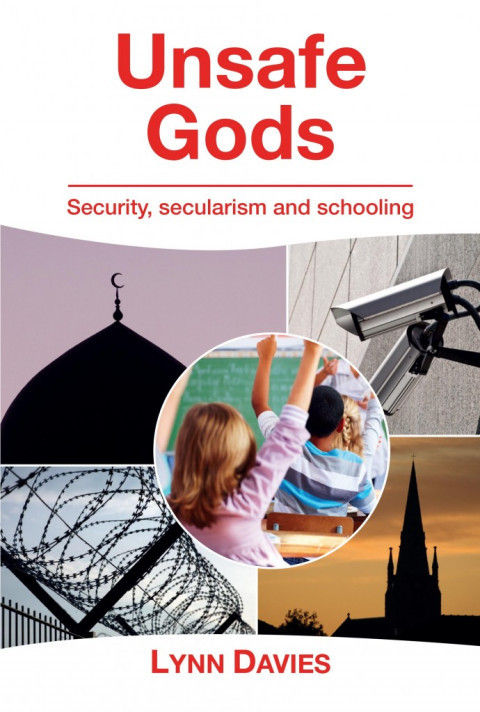 Unsafe Gods: Security, secularism and schooling سنة النشر: 2014 المؤلف: Lynn Davies This book makes the compelling argument that religion can be complicit in conflict and that a new secularism is vital to foster security. Using insights from complexity science, it shows how dynamic secularism can be used to accommodate diverse faiths and beliefs within worldly politics. Exploration of the interplay of religion and education in the context of security and notions of safe schools offers new understandings of how religions learn – or instead remain frozen accidents that hinder societies from adapting to change. The book shows how turbulence and amplification underscore the necessity for an education that is critical even of patriarchal religious texts and that recognizes the power of satire and humour. Unsafe Gods: Security, secularism and schooling سنة النشر: 2014 المؤلف: Lynn Davies Ce livre avance l'idée forte que la religion étant un facteur de conflictualité, une sécularisation plus poussée est vitale pour renforcer la sécurité. En mobilisant une approche inspirée des sciences de la complexité, il montre comment une sécularisation dynamique peut être appliquée à des systèmes politiques du monde entier afin de permettre la cohabitation de plusieurs religions et croyances. L'analyse des effets de l'interaction entre la religion et l'éducation en matière de sécurité et des dispositifs "safe schools" permet de comprendre la façon dont les religions s'adaptent, ou au contraire restent figées, empêchant les sociétés de s’adapter aux changements. Le livre montre que la conflictualité croissante souligne la nécessité de mettre en place une éducation centrée autour d'un regard critique, même à l'égard des textes religieux fondateurs, et qui reconnaisse l'intérêt de la satire et de l'humour.
  [Video] Learning to live together in peace through Global Citizenship Education سنة النشر: 2016 المؤلف المؤسسي: UNESCO The UNESCO video on “Learning to live together in peace through Global Citizenship Education” explains the importance of Global Citizenship Education (GCED) in a globalized and increasingly interconnected and interdependent world. GCED is key to understand the interconnections between the local and the global and nurture a sense of belonging to a common humanity. It builds motivation to assume active roles to contribute to a more just, peaceful, tolerant and sustainable world. The video also illustrates how GCED can be delivered in and outside of schools. [Vidéo] Apprendre à vivre ensemble dans la paix par l’éducation à la citoyenneté mondiale سنة النشر: 2016 المؤلف المؤسسي: UNESCO La vidéo de l'UNESCO sur le thème "Apprendre à vivre ensemble dans la paix par l’Éducation à la Citoyenneté Mondiale", explique l'importance de l'Éducation à la Citoyenneté Mondiale (ECM) dans un monde globalisé et de plus en plus interconnecté et interdépendant. ECM est essentiel de comprendre les interconnexions entre le local et le global et à favoriser un sentiment d'appartenance à une humanité commune. Il construit la motivation à assumer un rôle actif pour contribuer à un monde plus juste, pacifique, tolérante et durable. La vidéo montre également comment ECM peut être livré dans et à l'extérieur des écoles.