
الموارد
استكشف مجموعة واسعة من الموارد القيمة حول تعليم المواطنة العالمية لتعميق فهمك وتعزيز البحث والمناصرة والتعليم والتعلم.
تم العثور على 59 نتيجة
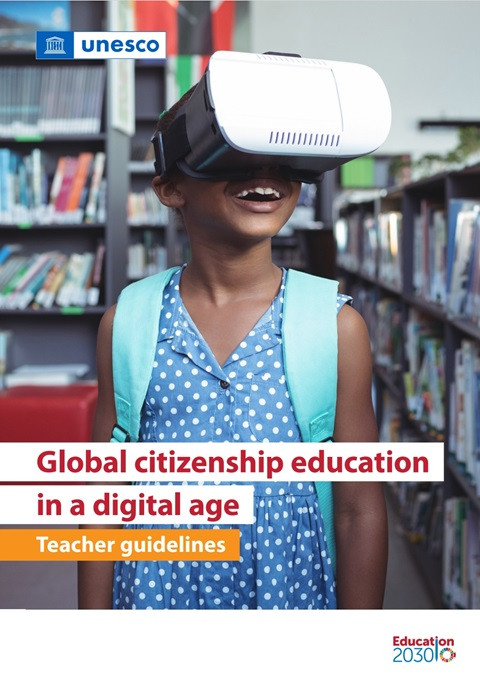 Global Citizenship Education in a Digital Age: Teacher Guidelines سنة النشر: 2024 المؤلف المؤسسي: UNESCO This book is an essential resource for teachers seeking to understand the critical role that digital citizenship education plays in promoting a more informed, engaged, and responsible global citizenry. While digital technologies have opened up new opportunities for life-long learning, they have also given rise to emerging concerns, notably in relation to the rise of disinformation and hate speech online. Aimed at building the capacities of teachers to prepare learners to act ethically and responsibly in physical and digital environments, these guidelines stress the importance of considering how Global Citizenship Education (GCED) and related knowledge, values, skills and attitudes can be fostered for teaching, learning and engaging for a more sustainable, inclusive, just and peaceful world.
  미디어․정보 리터러시 갖춘 시민 되기: 비판적으로 사고하고 현명하게 클릭하기! سنة النشر: 2022 المؤلف: Alton Grizzle | Carolyn Wilson | Ramon Tuazon | C.K. Cheung | Jesus Lau | Rachel Fischer | Dorothy Gordon | Kwame Akyempong | Jagtar Singh | Paul R. Carr | Kristine Stewart | Samy Tayie | Olunifesi Suraj | Maarit Jaakkola | Gina Thésée | Curmira Gulston المؤلف المؤسسي: 유네스코 현명한 클릭으로 우리 사회를 개선할 수 있을까? 도서관을 비롯한 아카이브, 박물관, 미디어와 디지털 통신 회사 같은 콘텐츠 제공자는 모든 이를 포용하고 지속 가능한 개발을 이루어내려는 역할을 지니고 있다. 하지만 콘텐츠 제공자가 그와 같은 이상에 근거해서만 움직이는 것은 아니기 때문에 서비스 사용자들은 어려움을 겪게 된다. 모든 콘텐츠 제공자는 평생학습의 기회를 열어 주기도 하지만 동시에 잘못된 정보나 허위정보, 혐오 표현, 온라인 프라이버시 침해 등과 같은 과제도 안겨 준다. 미디어·정보 리터러시란 사람들이 취할 수 있는 혜택은 최대로 얻고, 입을 수 있는 피해는 최소화할 수 있도록 하는 일련의 역량을 의미한다. 미디어·정보 리터러시는 커뮤니케이션 콘텐츠와 해당 콘텐츠를 제공하는 기관 및 디지털 기술을 비판적이고 효과적으로 이용할 수 있는 역량이다. 이는 나이, 배경과 관계없이 모든 시민이 필수적으로 갖추어야 하는 능력이다. 이 선구적인 커리큘럼은 미디어·정보 리터러시 역량의 종합적인 프레임워크를 제공하며, 교육자와 학습자가 활용할 수 있는 체계적인 교육적 방안을 제안한다. 또한 다양한 모듈을 제시하여 오늘날의 커뮤니케이션 생태계를 이해하는 데 필수적인 역량 범위를 상세하게 다루고 있다. 이 자료에서는 미디어·정보 리터러시를 지금 우리 사회에서 새롭게 부상하고 있는 문제들, 즉 인공지능을 비롯해 디지털 시민 교육, 지속가능 발전 교육, 문화 리터러시 및 허위정보와 잘못된 정보의 급증 등과 연계하여 다루고 있다. 본 커리큘럼을 효과적으로 활용한다면 누구나 미디어·정보 리터러시를 갖춘 시민은 물론, 미디어·정보 리터러시 동료 교육자도 될 수 있을 것이다.
  Operational Guidelines: Constructing UNESCO Media and Information Literacy Cities سنة النشر: 2024 المؤلف المؤسسي: UNESCO To support the integration of media and information literacy in urban spaces, UNESCO is releasing operational guidelines for city governance stakeholders. These guidelines aim to help cities align their goals with the benefits of integrating MIL into physical and virtual spaces.The guidelines offer examples of actions for cities interested in pioneering the MIL Cities. Cities are encouraged to share their progress and achievements with UNESCO for future initiatives.All cities and municipalities can participate, regardless of size, internet penetration, or technology use. The guidelines aim to foster diverse partnerships at the municipal level for implementing MIL actions and programmes. Directrices operativas: construyendo Ciudades de Alfabetización Mediatica eIinformacional de la UNESCO سنة النشر: 2024 المؤلف المؤسسي: UNESCO Con miras a apoyar la integración de la alfabetización mediática e informacional en los entornos urbanos, la UNESCO publica directrices operativas para las partes interesadas en la gobernanza de las ciudades. Estas directrices procuran ayudar a las ciudades a alinear sus objetivos con los beneficios de integrar la AMI en espacios físicos y virtuales.Las directrices ofrecen ejemplos de actividades a las ciudades interesadas en ser pioneras en “Ciudades AMI”. Se les alienta a compartir sus avances y logros con la UNESCO para la elaboración de iniciativas en el futuro.Todas las ciudades y municipios pueden participar, independientemente de su tamaño, penetración de Internet o utilización de tecnología. Las directrices intentan propiciar asociaciones diversas a nivel municipal con objeto de ejecutar actividades y programas AMI.
  User Empowerment through Media and Information Literacy Responses to the Evolution of Generative Artificial Intelligence (GAI) سنة النشر: 2024 المؤلف: Divina Frau-Meigs المؤلف المؤسسي: UNESCO Key messages Artificial Intelligence and Generative AI are having a significant impact on people’s engagement with information, digital technology, and media. This raises concerns about control human agency and autonomy over information, decision making, gender equality, and freedoms in general. User empowerment through Media and Information Literacy (MIL) as a response to GAI, which is still in its infancy, needs to be fully deployed and public policy makers should be concerned in developing it well from the outset. MIL is necessary to build people’s ethical use of synthetic media, i.e. video, text, image or voice content fully or partially generated by AI-systems. The societal opportunities being deepened by GAI include: access to information, participation, employability, creativity, lifelong learning and creative industries. The societal potential risks being deepened by GAI include: disinformation, loss of data privacy, threats to integrity of elections, surveillance, lack of source reliability, discrimination, including gender-based and racial stereotypes, and copyrights violations. Building on familiarity in the face of urgency, AI literacy can be embedded in MIL to teach and train all sorts of communities (educators, librarians, youth workers, women networks, etc.). Ensuring explainable AI is key to both the design of MIL curricula and to the design of policy and governance around GAI. To build trust in information and education, source reliability needs to be revised to encompass the different types of “evidence” provided by GAI. MIL can train informed people from outside the technology industry to participate in the design, implementation and regulation of AI, in a manner that remains human-centered, gender-responsive and mindful of the public interest. Training for MIL is within the remit of governments and institutions of higher education, which have a duty to ensure MIL policy actions are sustained and strengthened over time, to be future-proof, in the face of an ever-evolving AI/GAI. L’autonomisation des utilisateurs grâce aux réponses apportées par l’éducation aux médias et à l’information à l’évolution de l’intelligence artificielle générative (IAG) سنة النشر: 2024 المؤلف: Divina Frau-Meigs المؤلف المؤسسي: UNESCO Messages clés L’intelligence artificielle et l’IA générative influent grandement sur les rapports des indivi- dus à l’information, aux technologies numériques et aux médias. Mais cela ne va pas sans inquiétudes quant à leur contrôle, au pouvoir d’action et à l’autonomie dont disposent les utilisateurs vis-à-vis de l’information, à la prise de décisions, à l’égalité des genres et aux libertés en général. . Pour constituer une réponse à l’IAG, technologie qui en est à ses balbutiements, l’autonomisation des utilisateurs grâce à l’éducation aux médias et à l’information (EMI) doit être pleinement déployée, et les autorités publiques doivent s’efforcer de la promouvoir dès le début. L’EMI est indispensable pour garantir une utilisation éthique des médias synthétiques, c’est-à-dire des vidéos, textes, images et sons totalement ou partiellement créés à l’aide de systèmes d’IA. L’IAG offre de nombreuses opportunités sociales dans différents domaines, dont l’accès à l’information, la participation, l’employabilité, la créativité, l’apprentissage tout au long de la vie et les industries créatives, entre autres. Il existe cependant des risques sociaux potentiels aggravés par l’IA générative, dont : la désinformation, la perte de contrôle sur la confidentialité des données, les menaces pour l’intégrité des élections, la surveillance, le manque de fiabilité des sources, la discrimination notamment fondée sur le genre et les stéréotypes raciaux et les violations des droits d’auteur. Pour mettre à profit la familiarité face à l’urgence, la maîtrise de l’IA pourrait être intégrée dans les programmes d’EMI afin d’éduquer et de former des communautés très diverses (éducateurs, bibliothécaires, animateurs pour la jeunesse, réseaux de femmes, etc.). Pour bien concevoir non seulement les programmes d’EMI mais aussi la gouvernance de l’IAG et les politiques connexes, l’IA explicable joue un rôle essentiel. Pour renforcer la confiance dans l’information et l’éducation, la fiabilité des sources doit être réexaminée pour englober tous les différents types de « preuves » fournies par l’IAG. L’EMI peut former des acteurs éclairés n’appartenant pas au secteur de la technologie afin qu’ils contribuent à la conception, à la mise en œuvre et à la réglementation de l’IA d’une manière qui reste centrée sur l’humain, sensible au genre et soucieuse de l’intérêt public. La formation dans le cadre de l’EMI relève des gouvernements et des établissements d’enseignement supérieur, qui doivent veiller à ce que les actions politiques en la matière soient soutenues et renforcées dans la durée, pour s’adapter aux évolutions constantes de l’IA/IAG. Directives opérationnelles : Vers la création de villes UNESCO pour l’éducation aux médias et à l’information سنة النشر: 2024 المؤلف المؤسسي: UNESCO Pour soutenir l’intégration de l’éducation aux médias et à l’information dans les espaces urbains, l’UNESCO publie des lignes directrices opérationnelles à l’intention des acteurs de la gouvernance des villes.Ces lignes directrices ont pour objectif d’aider les villes à aligner leurs objectifs sur les avantages de l’intégration de l’éducation aux médias et à l’information dans les espaces physiques et virtuels.Les lignes directrices proposent des actions à titre d’exemple aux villes désireuses d’être parmi les pionnières Villes EMI. Les villes sont encouragées à partager leurs progrès et leurs réalisations avec l’UNESCO dans la perspective d’initiatives futures. Как создавать города медийной и информационной грамотности ЮНЕСКО سنة النشر: 2024 المؤلف المؤسسي: UNESCO Чтобы содействовать интеграции медийной и информационной грамотности в городские пространства, ЮНЕСКО выпускает практическое руководство для участников процесса управления городами. Это руководство призвано помочь городам формировать цели своего развития с учетом преимуществ интеграции МИГ в физические и виртуальные пространства.В руководстве приводятся примеры действий для населенных пунктов, которые заинтересованы в том, чтобы стать первопроходцами в деле создания городов медийной и информационной грамотности. ЮНЕСКО будет рада узнать об их успехах и достижениях для будущих проектов.К инициативе могут присоединиться любые города и населенные пункты независимо от размера, уровня проникновения интернета или использования технологий. Задача данного руководства — содействовать развитию сотрудничества на муниципальном уровне для реализации мероприятий и программ в сфере МИГ.
  Global Media and Information Literacy Assessment Framework: Country Readiness and Competencies سنة النشر: 2013 المؤلف المؤسسي: UNESCO The MIL Assessment Framework can foster lifelong learning initiatives by building on the relationship between information, media, digital, and ICT literacies, along with societal transformations, education, workforce, policy and decision making processes, economic growth and democracy. The overall goal of the publication is to guide UNESCO’s Member States throughout the assessment of country readiness and competencies regarding the media and information literacy of citizens, in particular teachers in service and in training. The document is particularly aimed at the following stakeholders: policy makers and decision makers; national officers responsible for statistical data collection and analysis; educational policy makers and planners working in formal and informal education settings; teacher training institutions and teachers. It is also of relevance to the professional information and communication community, and has wide applicability for civil society at large.