
الموارد
استكشف مجموعة واسعة من الموارد القيمة حول تعليم المواطنة العالمية لتعميق فهمك وتعزيز البحث والمناصرة والتعليم والتعلم.
تم العثور على 3 نتيجة
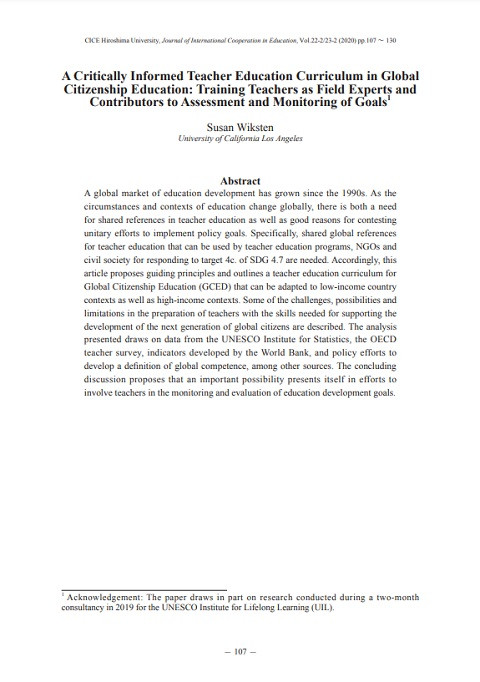 A Critically Informed Teacher Education Curriculum in Global Citizenship Education: Training Teachers as Field Experts and Contributors to Assessment and Monitoring of Goals (Journal of International Cooperation in Education; Vol.22-2/23-2) سنة النشر: 2020 المؤلف: Susan Wiksten المؤلف المؤسسي: CICE Hiroshima University A global market of education development has grown since the 1990s. As the circumstances and contexts of education change globally, there is both a need for shared references in teacher education as well as good reasons for contesting unitary efforts to implement policy goals. Specifically, shared global references for teacher education that can be used by teacher education programs, NGOs and civil society for responding to target 4c. of SDG 4.7 are needed. Accordingly, this article proposes guiding principles and outlines a teacher education curriculum for Global Citizenship Education (GCED) that can be adapted to low-income country contexts as well as high-income contexts. Some of the challenges, possibilities and limitations in the preparation of teachers with the skills needed for supporting the development of the next generation of global citizens are described. The analysis presented draws on data from the UNESCO Institute for Statistics, the OECD teacher survey, indicators developed by the World Bank, and policy efforts to develop a definition of global competence, among other sources. The concluding discussion proposes that an important possibility presents itself in efforts to involve teachers in the monitoring and evaluation of education development goals.
  A Study on the Monitoring Framework of GCED in South Korea سنة النشر: 2020 المؤلف: Hwanbo Park | Daehoon Jho | Kyunghee Park | Jeongmin Eom المؤلف المؤسسي: APCEIU The purpose of this study is to establish a feasible monitoring system for the implementation of Global Citizenship Education (GCED) in South Korea that can both align itself with the global indicator (SDG 4.7.1) and reflect the domestic context and feasibility. The study further builds upon previous studies carried out by the Asia-Pacific Centre of Education for International Understanding (APCEIU). Particularly, it aims to refine and validate the GCED indicator system for domestic monitoring as proposed in the previous studies, which are also in line with SDG 4.7.1, the global indicator to monitor the mainstreaming of GCED/ESD.To this end, the study involved a Delphi survey and expert consultation to build the refined list and classification of GCED related thematic areas and keywords contextualized in Korea, and aligned these with global indicators so that it could establish a set of sub-indicators for the South Korean context. Then, it pilot-tested the sub-indicators by codifying and statistically analyzing key policy documents and the curricula of Teacher Education Institutes (TEIs) to validate the sub-indicators and to examine the extent to which GCED is mainstreamed in the given domains of the Korean context. Case analyses with focused interviews for some TEI curricula were also added to enrich the study. Lastly, the study draws key implications and proposes some recommendations for the establishment of a feasible and sustainable GCED monitoring system in South Korea. Considering the importance of national input in initiating the SDG agenda, the research concluded with a proposal on how to manage the global citizenship indicators in South Korea.
  ACER-APCEIU Global Citizenship Education Monitoring Toolkit: For Teachers, Schools and System Leaders سنة النشر: 2024 المؤلف: Rachel Parker | Amy Berry | Payal Goundar | Karena Menzie-Ballantyne المؤلف المؤسسي: Australian Council for Educational Research (ACER) | APCEIU The APCEIU-ACER GCED Monitoring Toolkit was developed and informed by research conducted from 2022-2024 in collaboration with partners in Australia, Lao PDR, Philippines, and South Korea. The toolkit aims to assist education stakeholders to embed GCED within policy and practice in alignment with local, regional, and international frameworks. Target users of this toolkit include policy makers, education department and ministry personnel, leaders, and educators at all levels in both formal and non-formal education sectors.The toolkit explores effective GCED including how to conceptualise and define, plan, enact and monitor implementation, and how to measure success. By guiding educators and leaders to align their enactment and monitoring efforts to international guidance, research, theory and practice, this toolkit supports a robust and evidence-informed process for enacting GCED in ways that nurture learners as proactive and empowered global citizens.Phase I Report (Link): https://www.unescoapceiu.org/post/4995Phase II Report (Link): https://www.unescoapceiu.org/post/5184