
الموارد
استكشف مجموعة واسعة من الموارد القيمة حول تعليم المواطنة العالمية لتعميق فهمك وتعزيز البحث والمناصرة والتعليم والتعلم.
تم العثور على 340 نتيجة
 Environmental education in action: a story from the Tonle Sap biosphere reserve in Cambodia سنة النشر: 2013 المؤلف: Keat Kunthea Osmose is a not-for-profit association linking community-based conservation, ecotourism and environmental education in Prek Toal. Osmose has been supported by UNESCO in Phnom Penh in many projects including: production of a poster depicting the flooded forest and plants of the Tonle Sap Biosphere Reserve, handicraft, and particularly, environemental education (EE). EE was initiated in 2000 when Osmose realized there was an increase in the child population and that education was therefore needed in order to protect their natural resources. Stratégie du réSEAU pour 2014-2021 Un réseau mondial d’ecoles pour répondre aux défis mondiaux: renforcer la citoyenneté mondiale et promouvoir le développement durable سنة النشر: 2014 المؤلف المؤسسي: UNESCO Associated Schools Project Network (ASPnet) Over the next 8 years (2014-2021), ASPnet needs to respond to the needs of education in a rapidly changing and increasingly complex world. The following strategy, therefore, has to remain flexible and requires regular re-evaluation in the light of a changing environment. Globalization and growing interconnectedness ask for increased networking and cooperation. ASPnet has proven to have a great potential for global school networking and educational innovations, which remain largely untapped. UNESCO can make much fuller use of ASPnet in its quest for and implementation of a successful Post-2015 Global Education Agenda. Pan-African forum: sources and resources for a culture of peace سنة النشر: 2013 المؤلف المؤسسي: African Union The Pan-African Forum “ Sources and resources for a culture of peace” was held in Luanda, Angola, from 26 to 28 March 2013, and was jointly organized by UNESCO, the African Union and the Government of Angola, under the High Patronage of H. E. Mr José Eduardo dos Santos, President of the Republic of Angola. This forum was the result of a close cooperation between UNESCO and the African Union, one of their main objectives being building peace in Africa, through the promotion of a culture of peace based on the intrinsic values of African societies. The Republic of Angola Government, through its President of the Republic H. E. Mr José Eduardo dos Santos, resolutely engaged in this process with major financial and technical support for the organization of the Forum in the Angolan capital city. As indicated in the Action Plan adopted by the participants in plenary (Annex I), recommendations made during the Forum are directed at all components of African society : political leaders, national and regional institutions, civil society, community associations, youth movements and women’s organizations, religious and traditional leaders, entrepreneurs and leaders from the private sector, etc. The implementation of the Action Plan will be continuously monitored by the two institutions that jointly organized the Luanda Forum, the African Union and UNESCO. Representatives from the 55 African countries participating in the Forum will both contribute to the proposal for action by bringing their national experience and take the lead in the follow‐up of the recommendations made at country level. In order to ensure this follow‐up it will be important to link together the participants by the creation of an African Network for the Promotion of a Culture of Peace and Non‐violence. The representatives of African countries will play the role of focal points of the awareness campaign at the national level. Finally, the agenda of the Forum includes a plan to hold a roundtable on the establishment of a multi-stakeholder partnership for action. Organized with the participation of regional institutions, public and private economic actors as well as representatives of Governments and Civil Society, this session will be the occasion to launch a continental and lasting Movement for the promotion of a culture of peace. For this round table and for the Campaign, the stakeholders can now witness the action as their Foundation / Company / Institution / Organization leads to help in building the defence of peace in the minds of men and women and ensure that peace is a reality: "Make Peace Happen". Forum panafricain: sources et ressources pour une culture de paix سنة النشر: 2013 المؤلف المؤسسي: African Union Le Forum «Sources et ressources pour une culture de paix » panafricaines a eu lieu à Luanda, en Angola, du 26 au 28 Mars 2013, et a été organisée conjointement par l'UNESCO, l'Union africaine et le Gouvernement de l'Angola, sous le Haut Patronage de SEM José Eduardo dos Santos, Président de la République d'Angola. Ce forum a été le résultat d'une étroite collaboration entre l'UNESCO et l'Union africaine, l'un de leurs principaux objectifs étant consolidation de la paix en Afrique, à travers la promotion d'une culture de la paix fondée sur les valeurs intrinsèques des sociétés africaines. Le gouvernement de la République d'Angola, à travers son Président de la République H. E. M. José Eduardo dos Santos, résolument engagé dans ce processus avec le soutien financier et technique majeur pour l'organisation du Forum dans la capitale angolaise. Comme indiqué dans le Plan d'action adopté par les participants en séance plénière (annexe I), les recommandations formulées lors du Forum visent à toutes les composantes de la société africaine: les dirigeants politiques, les institutions nationales et régionales, la société civile, les associations communautaires, les mouvements de jeunesse et les organisations de femmes , les chefs religieux et traditionnels, les entrepreneurs et les dirigeants du secteur privé, etc. la mise en œuvre du plan d'action seront surveillés en permanence par les deux institutions qui ont organisé conjointement le Forum Luanda, l'Union africaine et l'UNESCO. Les représentants des 55 pays africains participant au Forum seront tous deux contribuer à la proposition d'action en apportant leur expérience nationale et prendre les devants dans le suivi des recommandations formulées au niveau des pays. Afin d'assurer ce suivi, il sera important de relier entre eux les participants par la création d'un Réseau africain pour la promotion d'une culture de la paix et de la non-violence. Les représentants des pays africains vont jouer le rôle des points focaux de la campagne de sensibilisation au niveau national. Enfin, l'ordre du jour du Forum comprend un plan pour tenir une table ronde sur la mise en place d'un partenariat multipartite pour l'action. Organisé avec la participation des institutions régionales, publiques et acteurs économiques privés ainsi que des représentants des gouvernements et de la société civile, cette session sera l'occasion de lancer un mouvement continental et durable pour la promotion d'une culture de la paix. Pour cette table ronde et de la campagne, les parties prenantes peuvent maintenant témoigner de l'action que leur / Société / Institution / Organisation Fondation mène pour aider à la construction de la défense de la paix dans l'esprit des hommes et des femmes et de veiller à ce que la paix est une réalité: « Agissons pour la paix ». مرحلة ما بعد عام 2015: التعليم الذي نصبو إليه سنة النشر: 2014 المؤلف المؤسسي: UNESCO | United Nations Children's Fund (UNICEF) The post-2015 education agenda should be aspirational, transformative and holistic, and an integral part of the broader post-2015 development agenda. It should be of universal relevance and mobilize all stakeholders in all countries. Education must be a stand-alone goal in the broader post-2015 development agenda and should be framed by a comprehensive overarching goal, with measurable global targets and related indicators. In addition, education must be integrated into other development goals. The future education agenda should be rights-based and reflect a perspective based on equity and inclusion, with particular attention to gender equality and to overcoming all forms of discrimination in and through education, ensuring that no-one is left behind. It must support free and compulsory basic education. It should expand the vision of access for all to reflect relevant learning outcomes through the provision of quality education at all levels, from early childhood to higher education, in safe and healthy environments. It should take a holistic and lifelong learning approach, and provide multiple pathways of learning using innovative methods and information and communication technologies. It should reinforce approaches such as global citizenship education and education for sustainable development, which foster attitudes and behaviours that promote peace, conflict resolution and mutual understanding, tolerance, critical thinking, and respect for cultural diversity and for the environment. Más allá de 2015: la educación que queremos سنة النشر: 2014 المؤلف المؤسسي: UNESCO | United Nations Children's Fund (UNICEF) The post-2015 education agenda should be aspirational, transformative and holistic, and an integral part of the broader post-2015 development agenda. It should be of universal relevance and mobilize all stakeholders in all countries. Education must be a stand-alone goal in the broader post-2015 development agenda and should be framed by a comprehensive overarching goal, with measurable global targets and related indicators. In addition, education must be integrated into other development goals. The future education agenda should be rights-based and reflect a perspective based on equity and inclusion, with particular attention to gender equality and to overcoming all forms of discrimination in and through education, ensuring that no-one is left behind. It must support free and compulsory basic education. It should expand the vision of access for all to reflect relevant learning outcomes through the provision of quality education at all levels, from early childhood to higher education, in safe and healthy environments. It should take a holistic and lifelong learning approach, and provide multiple pathways of learning using innovative methods and information and communication technologies. It should reinforce approaches such as global citizenship education and education for sustainable development, which foster attitudes and behaviours that promote peace, conflict resolution and mutual understanding, tolerance, critical thinking, and respect for cultural diversity and for the environment.
 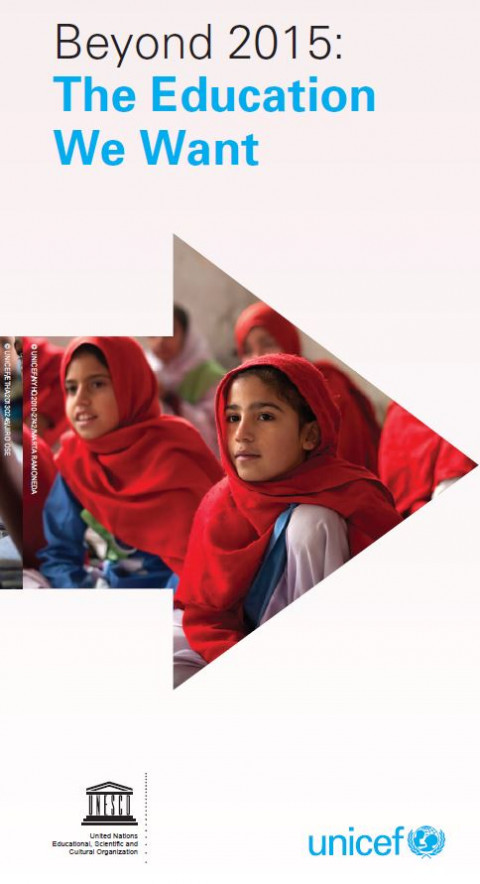 Beyond 2015: the education we want سنة النشر: 2014 المؤلف المؤسسي: UNESCO | United Nations Children's Fund (UNICEF) The post-2015 education agenda should be aspirational, transformative and holistic, and an integral part of the broader post-2015 development agenda. It should be of universal relevance and mobilize all stakeholders in all countries. Education must be a stand-alone goal in the broader post-2015 development agenda and should be framed by a comprehensive overarching goal, with measurable global targets and related indicators. In addition, education must be integrated into other development goals. The future education agenda should be rights-based and reflect a perspective based on equity and inclusion, with particular attention to gender equality and to overcoming all forms of discrimination in and through education, ensuring that no-one is left behind. It must support free and compulsory basic education.It should expand the vision of access for all to reflect relevant learning outcomes through the provision of quality education at all levels, from early childhood to higher education, in safe and healthy environments. It should take a holistic and lifelong learning approach, and provide multiple pathways of learning using innovative methods and information and communication technologies. It should reinforce approaches such as global citizenship education and education for sustainable development, which foster attitudes and behaviours that promote peace, conflict resolution and mutual understanding, tolerance, critical thinking, and respect for cultural diversity and for the environment. L'Après-2015: l'éducation que nous voulons سنة النشر: 2014 المؤلف المؤسسي: UNESCO | United Nations Children's Fund (UNICEF) The post-2015 education agenda should be aspirational, transformative and holistic, and an integral part of the broader post-2015 development agenda. It should be of universal relevance and mobilize all stakeholders in all countries. Education must be a stand-alone goal in the broader post-2015 development agenda and should be framed by a comprehensive overarching goal, with measurable global targets and related indicators. In addition, education must be integrated into other development goals. The future education agenda should be rights-based and reflect a perspective based on equity and inclusion, with particular attention to gender equality and to overcoming all forms of discrimination in and through education, ensuring that no-one is left behind. It must support free and compulsory basic education. It should expand the vision of access for all to reflect relevant learning outcomes through the provision of quality education at all levels, from early childhood to higher education, in safe and healthy environments. It should take a holistic and lifelong learning approach, and provide multiple pathways of learning using innovative methods and information and communication technologies. It should reinforce approaches such as global citizenship education and education for sustainable development, which foster attitudes and behaviours that promote peace, conflict resolution and mutual understanding, tolerance, critical thinking, and respect for cultural diversity and for the environment. Forum panafricain: sources et ressources pour une culture de la Paix سنة النشر: 2013 المؤلف المؤسسي: African Union The Pan-African Forum “ Sources and resources for a culture of peace” was held in Luanda, Angola, from 26 to 28 March 2013, and was jointly organized by UNESCO, the African Union and the Government of Angola, under the High Patronage of H. E. Mr José Eduardo dos Santos, President of the Republic of Angola. This forum was the result of a close cooperation between UNESCO and the African Union, one of their main objectives being building peace in Africa, through the promotion of a culture of peace based on the intrinsic values of African societies. The Republic of Angola Government, through its President of the Republic H. E. Mr José Eduardo dos Santos, resolutely engaged in this process with major financial and technical support for the organization of the Forum in the Angolan capital city. As indicated in the Action Plan adopted by the participants in plenary (Annex I), recommendations made during the Forum are directed at all components of African society : political leaders, national and regional institutions, civil society, community associations, youth movements and women’s organizations, religious and traditional leaders, entrepreneurs and leaders from the private sector, etc. The implementation of the Action Plan will be continuously monitored by the two institutions that jointly organized the Luanda Forum, the African Union and UNESCO. Representatives from the 55 African countries participating in the Forum will both contribute to the proposal for action by bringing their national experience and take the lead in the follow‐up of the recommendations made at country level. In order to ensure this follow‐up it will be important to link together the participants by the creation of an African Network for the Promotion of a Culture of Peace and Non‐violence. The representatives of African countries will play the role of focal points of the awareness campaign at the national level. Finally, the agenda of the Forum includes a plan to hold a roundtable on the establishment of a multi-stakeholder partnership for action. Organized with the participation of regional institutions, public and private economic actors as well as representatives of Governments and Civil Society, this session will be the occasion to launch a continental and lasting Movement for the promotion of a culture of peace. For this round table and for the Campaign, the stakeholders can now witness the action as their Foundation / Company / Institution / Organization leads to help in building the defence of peace in the minds of men and women and ensure that peace is a reality: "Make Peace Happen".
 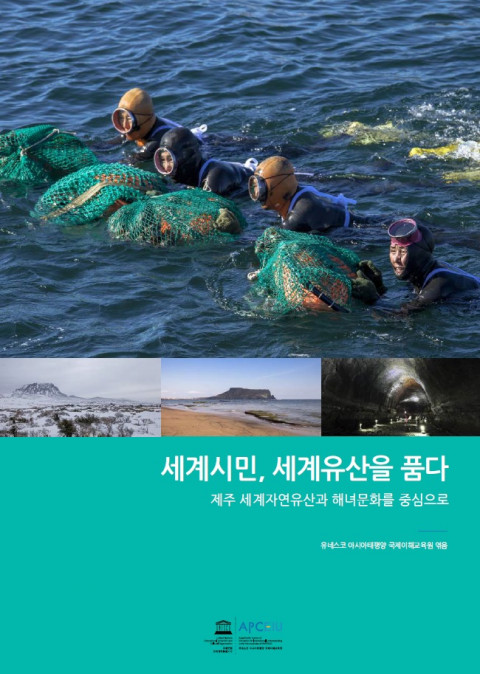 세계시민, 세계유산을 품다 - 제주 세계자연유산과 해녀문화를 중심으로 سنة النشر: 2018 المؤلف المؤسسي: APCEIU 유네스코 아시아태평양 국제이해교육원은 세계유산을 활용한 세계시민교육 교재개발 사업으로 “세계시민, 세계유산을 품다”를 출간하였다. 이 책은 세계유산을 단순한 관광의 대상으로 소개하는 것이 아니라, 현장체험, 토론, 조사 등의 다양한 활동을 통해 세계유산이 가진 가치와 의미를 깨달아 세계시민으로 성장하도록 하는 내용으로 구성했다. 세계유산을 통해 국제이해, 평화, 인권, 문화다양성, 지속가능한 발전 등의 보편적 가치를 배우고 내재화하도록 돕는 교재이다.한국의 세계유산을 활용한 이번 세계시민교육 자료는 제주를 중심으로 구성하였다. 제주도는 현재 유네스코 세계자연유산과 인류무형문화유산을 가지고 있다. 이 책은 세계자연유산 ‘제주 화산섬과 용암동굴’과 인류무형문화유산 ‘제주 해녀문화’의 가치를 세계시민교육으로 연계하여 교육함으로써 세계시민의식 함양의 길잡이가 되고자 한다. 특히 유형유산과 무형유산을 통합적으로 연계하여 소개하는 시도를 하였다.이 책의 세계시민교육은 제주세계자연유산과 더불어 제주 해녀문화의 공동체 의식에 주목하고 이를 소개했다. 또한 이 책은 학교 현장의 교사가 세계유산 교육과 세계시민교육을 동시에 하고자 할 때 학습자료로서 도움이 될 것이다. 또한 학생이 세계유산을 통하여 지속가능성을 이해하고, 이를 통하여 세계시민으로 성장하는데 기여할 것이다.