
الموارد
استكشف مجموعة واسعة من الموارد القيمة حول تعليم المواطنة العالمية لتعميق فهمك وتعزيز البحث والمناصرة والتعليم والتعلم.
تم العثور على 340 نتيجة
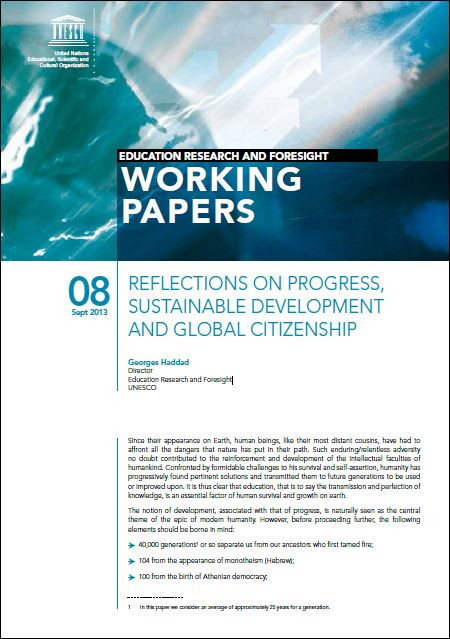 Reflections on Progress, Sustainable Development and Global Citizenship سنة النشر: 2013 المؤلف: Georges Haddad المؤلف المؤسسي: UNESCO The arguments developed in this concise presentation demonstrate that sustainable development, progress and global citizenship, efficiently embedded in the context of the Knowledge Society, undeniably participate in the development of the New Humanism promoted by the Director-General of UNESCO, and which we all agree to consider essential for the wealth and prosperity of Humanity in an agreeable, peaceful and friendly common environment. Reflexiones Sobre el Progreso, el Desarrollo Sostenible y la Ciudadanía Mundial سنة النشر: 2013 المؤلف: Georges Haddad المؤلف المؤسسي: UNESCO Los argumentos desarrollados en esta breve ponencia ponen de manifiesto que el desarrollo sostenible, el progreso y la ciudadanía mundial sólidamente arraigados en la Sociedad del Conocimiento contribuyen indudablemente a construir este Nuevo Humanismo promovido por la Directora General de la UNESCO, y que todos coincidimos en considerar esencial para la riqueza y la prosperidad de la Humanidad, en un entorno común grato, pacífico y cordial.
  Reflexiones sobre el progreso, el desarrollo sostenible y la ciudadanía mundial سنة النشر: 2013 المؤلف: Georges Haddad المؤلف المؤسسي: UNESCO The arguments developed in this concise presentation demonstrate that sustainable development, progress and global citizenship, efficiently embedded in the context of the Knowledge Society, undeniably participate in the development of the New Humanism promoted by the Director-General of UNESCO, and which we all agree to consider essential for the wealth and prosperity of Humanity in an agreeable, peaceful and friendly common environment.
 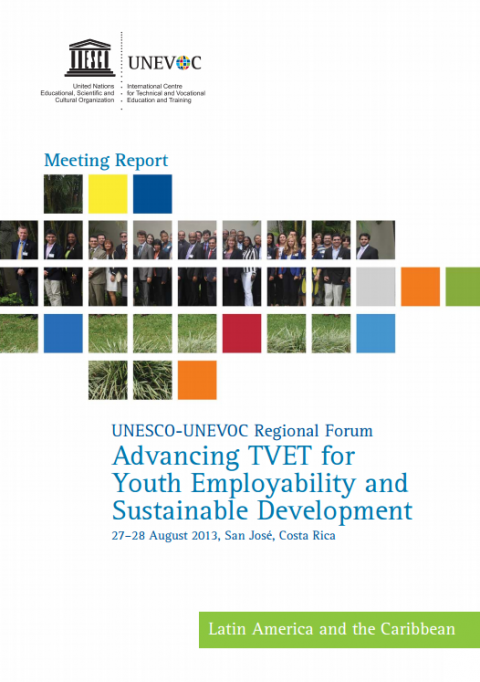 UNESCO-UNEVOC forum régional: Promouvoir l'EFTP pour l'employabilité des jeunes et le développement durable, en Amérique latine et dans les Caraïbes, 27-28 Août 2013, San José, Costa Rica; rapport de la réunion سنة النشر: 2013 المؤلف المؤسسي: UNESCO International Centre for Technical and Vocational Education and Training (UNEVOC) Le Forum régional des centres UNEVOC en Amérique latine et dans les Caraïbes (ALC), présenté dans le présent rapport fait partie d'une série d'activités visant à renforcer l'harmonisation mondiale et régionale pour la promotion de la transformation de l'EFTP à travers les capacités de réseau mondial unique de UNEVOC de l'EFTP spécialisée institutions et partenaires affiliés, suite à l'UNESCO Troisième Congrès international sur l'enseignement technique et professionnel et de la formation (EFTP) qui a eu lieu en Chine en mai 2012. le Forum a également été l'occasion de présenter des preuves sur les deux domaines thématiques prioritaires pour l'UNESCO-UNEVOC pour 2013, la jeunesse et les compétences et l'écologisation de l'EFTP. Ceci a été réalisé grâce à la présentation et à la discussion de plusieurs pratiques prometteuses dans ces deux domaines.
  Electronic resources on education for sustainable development سنة النشر: 2007 المؤلف المؤسسي: APCEIU | UNESCO Bangkok The Asia-Pacific Programme of Educational Innovation for Development (APEID) of UNESCO Bangkok and the Asia-Pacific Centre of Education for International Understanding (APCEIU) collaborated to produce this document listing these electronic resources. The value of such resources is not limited to teachers alone; it is also useful to policy and decision makers, teacher educators, researchers and academics as well as students themselves. Les ressources électroniques sur l'éducation pour le développement durable سنة النشر: 2007 المؤلف المؤسسي: APCEIU | UNESCO Bangkok Le Programme d'innovation éducative en vue du développement en Asie et dans le Pacifique(APEID)e l'UNESCO à Bangkok et le Centre d'Asie-Pacifique pour la Compréhension Internationale(APCECI) ont collaboré pour produire ce document énumérant ces ressources électroniques. La valeur de ces ressources ne se limite pas aux seuls enseignants; il est également utile pour les politiques et les décideurs, formateurs d'enseignants, des chercheurs et des universitaires ainsi que des étudiants eux-mêmes. Integrating sustainable development in technical and vocational education and training: six case studies from Southern and Eastern Africa سنة النشر: 2010 المؤلف: Roland Dubois | Koontee Balgobin | Modesto Sylvester Gomani | Joy Kasandi Kelemba | Gabriel S. Konayuma | Matthews Lebogang Phiri | John W. Simiyu المؤلف المؤسسي: UNESCO International Centre for Technical and Vocational Education and Training (UNEVOC) The case studies in Southern and Eastern Africa were commissioned in Botswana, Kenya, Malawi, Mauritius and Zambia. They were carried out by writers connected with the UNEVOC Network as part of capacity building and of contributing to knowledge building and sharing. They have described and have analysed experiences, practices relating to integrating ESD in TVET programmes, primarily. Also, they have identified gaps for additional action so that the integration can be satisfactorily done. Through the case studies it is intended to build a pool of resources and tools of what works as part of the UNESCO-UNEVOC International Centre’s clearinghouse. Intégration du développement durable dans l'enseignement et la formation techniques et professionnels: six études de cas en Afrique australe et orientale سنة النشر: 2010 المؤلف: Roland Dubois | Koontee Balgobin | Modesto Sylvester Gomani | Joy Kasandi Kelemba | Gabriel S. Konayuma | Matthews Lebogang Phiri | John W. Simiyu المؤلف المؤسسي: UNESCO International Centre for Technical and Vocational Education and Training (UNEVOC) Les études de cas en Afrique australe et orientale ont été commandées au Botswana, au Kenya, au Malawi, à Maurice et en Zambie. Ils ont été réalisés par des auteurs liés au Réseau UNEVOC dans le cadre du renforcement des capacités et de la contribution à la construction et au partage des connaissances. Ils ont décrit et analysé les expériences, les pratiques relatives à l'intégration de la EDD dans les programmes d'EPT, principalement. De plus, ils ont identifié des lacunes pour des actions supplémentaires afin que l'intégration puisse être effectuée de manière satisfaisante. Grâce aux études de cas, il est prévu de constituer un pool de ressources et d'outils de ce qui fonctionne dans le cadre du centre d'échange du Centre international UNESCO-UNEVOC.
 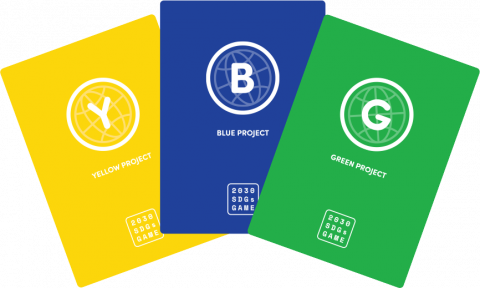 2030 SDGs GAME سنة النشر: 2016 المؤلف المؤسسي: Imacocollabo The 2030 SDGs Game is a multiplayer, in-person, card-based game that simulates taking the “real world” into the year 2030. Designed in Japan in 2016, this experience has become a powerful and impactful social phenomenon in Japan, earning extensive media coverage and reaching over 12,000 participants last year. 2030 SDGs Game events are held in corporate, governmental, educational, and community settings, and now has over 100 trained facilitators in a rapidly growing community within Japan. Now, due to a growing demand to bring the game to the rest of the world, we have created an English edition and are beginning to introduce it to a wider audience overseas. The game is designed to be played with anywhere from 5 to 50 players. (That number can be expanded to a maximum of around 200 with multiple parallel ‘worlds’ operating at the same time.) Play time is approximately 1 hour; with the necessary explanation and reflection afterward, it requires a minimum of 90 minutes, and generally works best in a 2 ½ hour time frame.
  Sustainability Education Principal Training Manual سنة النشر: 2012 المؤلف المؤسسي: UNESCO | Beijing Sustainable Development Education Association | China National Council for Sustainable Development Education Secretariat This article is devoted to explaining the application of sustainable development in China.