
الموارد
استكشف مجموعة واسعة من الموارد القيمة حول تعليم المواطنة العالمية لتعميق فهمك وتعزيز البحث والمناصرة والتعليم والتعلم.
تم العثور على 109 نتيجة
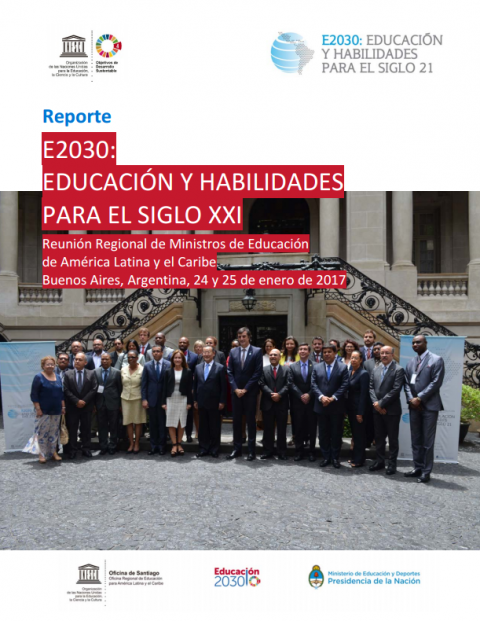 E2030: education and skills for the 21st century: Regional Meeting سنة النشر: 2017 المؤلف المؤسسي: UNESCO Santiago This report provides a systematization of the discussions at the Regional Meeting of Ministers of Education of Latin America and the Caribbean “E2030: Education and skills for the 21st century” held 24‐25 January 2017 in Buenos Aires, Argentina. The objectives of the meeting were to: • adopt a Ministerial Declaration on a joint approach to achieve the SDG4-E2030 Agenda in the region, including means of implementation, technical instruments of support and follow-up mechanisms. • agree on a roadmap for the implementation of E2030, including a contextualized followup mechanism that responds to the region’s educational challenges and expectations. Reporte: Educación y habilidades para el siglo XXI; Reunión Regional de Ministros de Educación de América Latina y el Caribe, Buenos Aires, Argentina, 24 y 25 de enero 2017 سنة النشر: 2017 المؤلف المؤسسي: UNESCO Santiago This report provides a systematization of the discussions at the Regional Meeting of Ministers of Education of Latin America and the Caribbean “E2030: Education and skills for the 21st century” held 24‐25 January 2017 in Buenos Aires, Argentina. The objectives of the meeting were to: • adopt a Ministerial Declaration on a joint approach to achieve the SDG4-E2030 Agenda in the region, including means of implementation, technical instruments of support and follow-up mechanisms. • agree on a roadmap for the implementation of E2030, including a contextualized followup mechanism that responds to the region’s educational challenges and expectations.
  Mudança climática em sala de aula: curso da UNESCO para professores secundários (fundamental II e ensino médio) sobre educação em mudança climática e desenvolvimento sustentável (EMCDS) سنة النشر: 2014 المؤلف: David Selby | Fumiyo Kagawa المؤلف المؤسسي: UNESCO Brasilia This course has been created with the goal of bringing climate change education outside the science classroom into the many other subject areas upon which climate change now has an impact, or will impact in the future, such as ethics, social studies, economics, political science, among others. The course materials are organized into four parts: 1. Course Framework and Overview, 2. Teachers’ Education Course daily materials, 3. Regional Resource Packs, 4. Daily Classroom Materials for teachers. These materials are all described in more detail and can be accessed from the Start Menu found on the following pages. This course is designed to enable teachers at the secondary level from diverse subject areas to introduce climate change education for sustainable development (CCESD) across the curriculum. UNESCO has identified the professional development of teachers in education for sustainable development as the top priority in recognition of the transformative role that teachers and teacher educators need to play in re-orienting education to help realize a sustainable future (UNESCO, 2005, p. 19). But good intentions for the professional development of teachers have fallen short in practice. Although taken up by enthusiasts, teacher education for sustainable development has rarely been mainstreamed, and, where there are courses, is often approached within a disciplinary as opposed to an interdisciplinary frame (Wals, A., 2009). If professional development in education for sustainable development is at an adolescent stage, teacher education in climate change education for sustainable development is in its infancy. For instance, according to a 2009 international comparative study on climate change education and sustainable development in ten countries, climate change education has peripheral status in educational research and practice, and when it is addressed it is only within science education (Læssøe,J. Schnack, K., Breiting, S. & Rolls, S., 2009). There is a clear and present need to respond to climate change challenges through systematic teacher education programmes that are not restricted to a single subject area. This teacher education course is an attempt to fill the current gap and is in line with one of UNESCO’s key objectives for climate change education for sustainable development, that is, to support teacher training on climate change for sustainable development (UNESCO, 2010, p. 9). The programme has four distinctive features: 1. It helps teachers to understand the causes, dynamics and impacts of climate change through a holistic approach. 2. Teachers are exposed to, and experience, a range of pedagogical approaches and techniques, that they can use in their own school environment. This includes engagement of themselves and their students in whole school and school-in-community approaches. 3. Teachers will develop their capacities to facilitate students’ community based learning. 4. Teachers will develop future-oriented and transformative capacities in facilitating climate change mitigation, adaptation, and disaster risk reduction learning. The role of education and training in sustainable development: social, economic and environmental dimensions سنة النشر: 2006 المؤلف: Mohammad Jabir Ali | Abdallah AmboSaeedi | Jilani Lamloumi | Sulieman Sulieman المؤلف المؤسسي: UNESCO Beirut Education, Training and Sustainable Development are three fields for life were selected to be the topic in the Regional Workshop on the Role of Education and Training in Sustainable Development (Manama - Kingdom of Bahrain, 19-21 September 2005), as part of TVET-UNEVOC programme for 2004-2005, and follow-up on Bonn Declaration issued at the end of the International Expert Meeting on “Learning for Work, Citizenship and Sustainability”, Bonn, 25-28 October 2004. Thirty five (35) officials, experts and specialists from thirteen (13) Arab countries, UNESCO Offices in Beirut and Doha, and the International Centre for TVET - Bonn Centre took part in Bahrain Workshop. The Organizing Committee for the Workshop had highlighted the social, economic and enviromental dimensions of sustainable development, according to the plan of action of the UN Decade on Education for Sustainable Development (2005-2014). The main working papers discussed in the Workshop were developed into a reference study in TVET-UNEVOC Searies to reflect on future orientations in the fields related to Sustainable Development in the Arab countries. Le rôle de l'éducation et de la formation dans le développement durable: les dimensions sociales, économiques et environnementales سنة النشر: 2006 المؤلف: Mohammad Jabir Ali | Abdallah AmboSaeedi | Jilani Lamloumi | Sulieman Sulieman المؤلف المؤسسي: UNESCO Beirut L’éducation, formation et développement durable sont trois champs pour la vie ont été choisis pour être le sujet à l'atelier régional sur le rôle de l'éducation et de la formation dans le développement durable (Manama - Royaume de Bahreïn, 19-21 Septembre 2005), dans le cadre de TVET- programme UNEVOC pour 2004-2005, et le suivi de la Déclaration de Bonn émis à la fin de la réunion internationale d'experts sur «Apprendre pour le travail, la citoyenneté et la durabilité», Bonn, 25-28 Octobre 2004. Trente-cinq (35) fonctionnaires, experts et des spécialistes de treize (13) pays arabes, Bureaux de l'UNESCO à Beyrouth et à Doha, et le Centre international pour l'EFTP - Centre de Bonn ont pris part à Bahreïn Atelier. Le Comité d'organisation de l'atelier a mis en évidence les dimensions sociales, économiques et Enviromental du développement durable, selon le plan d'action de la Décennie des Nations Unies sur l'éducation pour le développement durable (2005-2014). Les principaux documents de travail abordés dans l'atelier ont été mis au point dans une étude de référence dans l'EFTP-UNEVOC Searies à réfléchir sur les orientations futures dans les domaines liés au développement durable dans les pays arabes.
  AI Competency Framework for Teachers سنة النشر: 2024 المؤلف: Fengchun Miao | Mutlu Cukurova المؤلف المؤسسي: UNESCO AI processes vast information, generates new content, and helps decision-making through predictive analyses. In education, AI has transformed the traditional teacher–student relationship into a teacher–AI–student dynamic.This shift requires a re-examination of teachers’ roles and the competencies they need in the AI era. Yet, few countries have defined these competencies or developed national programmes to train teachers in AI, leaving many educators without proper guidance.The AI competency framework for teachers addresses this gap by defining the knowledge, skills, and values teachers must master in the age of AI. Developed with principles of protecting teachers’ rights, enhancing human agency, and promoting sustainability, the publication outlines 15 competencies across five dimensions: Human-centred mindset, Ethics of AI, AI foundations and applications, AI pedagogy, and AI for professional learning. These competencies are categorized into three progression levels: Acquire, Deepen, and Create.As a global reference, this tool guides the development of national AI competency frameworks, informs teacher training programmes, and helps in designing assessment parameters. It also provides strategies for teachers to build AI knowledge, apply ethical principles, and support their professional growth.
  Digital Citizenship in Asia-Pacific: Translating Competencies for Teacher Innovation and Student Resilience سنة النشر: 2023 المؤلف المؤسسي: UNESCO Bangkok A digitally-equipped and competent teaching force is crucial for cultivating students' digital citizenship skills. This UNESCO report, consisting of a comprehensive analysis comprising 15 countries in the Asia-Pacific region, unveils compelling evidence pertaining to what factors influence teachers' Information and Communication Technology (ICT) skills and their impact on students’ digital citizenship competencies. Perhaps unsurprisingly, the findings of this report show that students are developing most of their digital citizenship competencies through self-directed learning and outside of school. Nevertheless, teachers still play an important role, particularly in coaching students to use technology safely and effectively. Thus as UNESCO reports, Digital Creativity and Innovation remains relatively underdeveloped in all participating research countries. Additionally, female students tend to benefit more from teachers' guidance and advice, especially in terms of Digital Safety and Resilience. Support for teachers in terms of access to ICT infrastructure and training on ICT and pedagogical skills will contribute towards improving their ability to effectively guide and mentor their students, ultimately leading to better outcomes in terms of digital citizenship competencies. To achieve this, it is important for education systems to develop comprehensive and contextualized approaches to enhance digital citizenship capacities in teachers. Education policymakers and leaders are encouraged to use the 10 recommendations herein as a ‘roadmap’ to ensure that teachers are equipped with the necessary skills and knowledge to effectively integrate digital citizenship education into their teaching practices. This will ultimately help prepare students for the digital world and ensure their safety and well-being online.
  Training of Trainers Report: For the Project on: Teacher Training and Development for Peace-Building in the Horn of Africa and Surrounding Countries سنة النشر: 2017 المؤلف المؤسسي: UNESCO International Institute for Capacity-Building in Africa (IICBA) The overall framework of this project is to create a critical mass of teachers who can implement effective teaching and learning, producing economically productive and peace-loving youth. The project has a shortterm objective of training at least 8,000 young teachers through the Training of Trainers (TOT) model. The medium-term objectives will contribute to the 2030 SDGS. The long-term objectives are in line with AU’s Agenda 2063, which promotes increased regional integration, peace and stability, and equitable economic development. Training of Trainers Report: For the Project on: Teacher Training and Development for Peace-Building in the Horn of Africa and Surrounding Countries سنة النشر: 2017 المؤلف المؤسسي: UNESCO International Institute for Capacity-Building in Africa (IICBA) The overall framework of this project is to create a critical mass of teachers who can implement effective teaching and learning, producing economically productive and peace-loving youth. The project has a shortterm objective of training at least 8,000 young teachers through the Training of Trainers (TOT) model. The medium-term objectives will contribute to the 2030 SDGS. The long-term objectives are in line with AU’s Agenda 2063, which promotes increased regional integration, peace and stability, and equitable economic development. Training of Trainers Report: For the Project on: Teacher Training and Development for Peace-Building in the Horn of Africa and Surrounding Countries سنة النشر: 2017 المؤلف المؤسسي: UNESCO International Institute for Capacity-Building in Africa (IICBA) The overall framework of this project is to create a critical mass of teachers who can implement effective teaching and learning, producing economically productive and peace-loving youth. The project has a shortterm objective of training at least 8,000 young teachers through the Training of Trainers (TOT) model. The medium-term objectives will contribute to the 2030 SDGS. The long-term objectives are in line with AU’s Agenda 2063, which promotes increased regional integration, peace and stability, and equitable economic development.