
الموارد
استكشف مجموعة واسعة من الموارد القيمة حول تعليم المواطنة العالمية لتعميق فهمك وتعزيز البحث والمناصرة والتعليم والتعلم.
تم العثور على 153 نتيجة
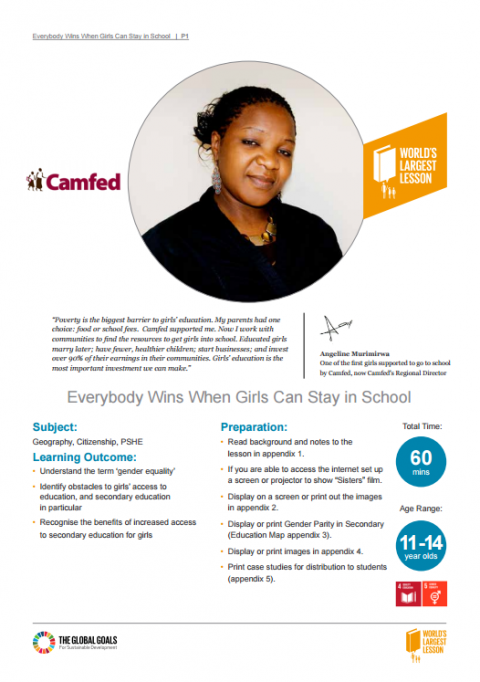 Everybody Wins When Girls Can Stay in School المؤلف المؤسسي: United Nations Children's Fund (UNICEF) World’s Largest Lesson is a collaborative education project to support the announcement of the United Nations Global Goals for Sustainable Development.Learning outcomes of the project: • Understand the term ‘gender equality’ • Identify obstacles to girls’ access to education, and secondary education in particular • Recognise the benefits of increased access to secondary education for girls
 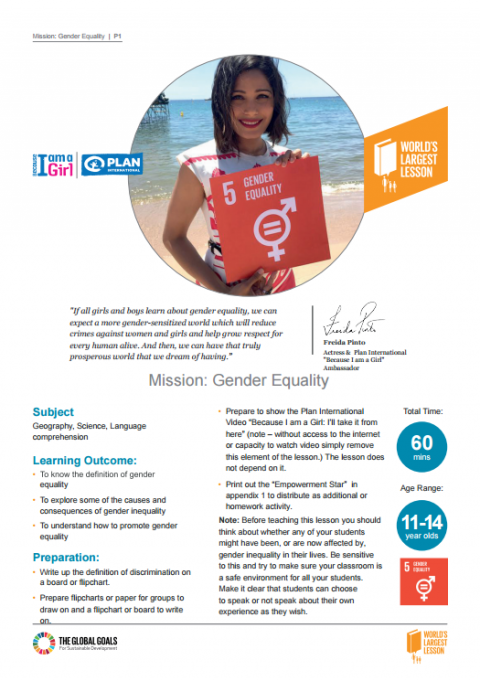 Mission: Gender Equality المؤلف المؤسسي: United Nations Children's Fund (UNICEF) World’s Largest Lesson is a collaborative education project to support the announcement of the United Nations Global Goals for Sustainable Development. Learning outcomes of the project: • To know the definition of gender equality • To explore some of the causes and consequences of gender inequality • To understand how to promote gender equality
  EiE-GenKit: A Core Resource Package on Gender in Education in Emergencies سنة النشر: 2021 المؤلف المؤسسي: Education Cannot Wait (ECW) | Inter-agency Network for Education in Emergencies (INEE) | United Nations Girls' Education Initiative (UNGEI) When gender-responsive, quality education is available to all it has the potential to transform societies and build sustainable peace. A joint initiative from the Inter-agency Network for Education in Emergencies (INEE), Education Cannot Wait (ECW) and the UN Girls’ Education Initiative (UNGEI), the EiE-GenKit is a core resource package for gender in education in emergencies. The EiE-GenKit is the first resource of its kind, providing education practitioners with practical tools to promote gender-responsive programming from crisis to peace and sustainable development.The EiE-GenKit is based on extensive research and consultation with the latest resources, evidence, new tools and good practice available in one easy-to-use package. The EiE-GenKit builds on existing humanitarian processes for a streamlined approach to gender-responsive EiE. The EiE-GenKit offers tools for practical and immediate use including checklists, tipsheets and assessment templates supporting practitioners to ensure that each phase of an EiE intervention is gender-responsive. Bridging the gap between what we know about gender-responsive EiE and the tools we need to make it happen, the EiE-GenKit aims to promote improved gender and education outcomes of learners living in crises.
  Key Concepts: A Feminist Approach to Human Rights Education (Chapter 4) سنة النشر: 2014 المؤلف: Julie Maia المؤلف المؤسسي: Stanford Human Rights Education Initiative (SHREI) Developed for the Stanford Human Rights Education Initiative (SHREI), this curriculum project examines connections among Gender Studies, feminist theory, and human rights movements around the world. This SHREI project presents its four key concepts through four curricular units, or chapters, each with a series of activities that can easily be adapted for use in courses in many disciplines. Each chapter contains these elements: A definition of the key concept An example of the use of the concept in a human rights document A brief essay on the value of the concept for human rights education A series of activities that guide students in using gender, race/ethnicity/nation, and class as lenses for analyzing social justice issues include transnational and multicultural perspectives on gender and human rights issues use "best practices" pedagogies for teaching human rights topics in community colleges. Within each chapter, activities are orgaized from simple to complex. Most activities, however, have self-contained objectives and can be used independently of the others. Sections on “Extending the Learning” offer longer readings or in-depth material for advanced courses. The GCED Clearinghouse introduces only chapter 4, "global citizenship" of this SHERI project.
  Holocaust & Human rights education center This curriculum guide was developed by a group of master teachers who have studied and taught the Holocaust in the context of history and the language arts. The New York State Core Curriculum and Learning Standards in English Language Arts and Social Studies have guided our selection of activities, historical documents and assessment tools. All materials and activities have been field-tested; they are challenging, age-appropriate and well suited to the needs of a diverse student population. Centre d'éducation Holocauste et Droits de l'homme Ce guide pédagogique a été développé par un groupe de maîtres enseignants qui ont étudié et enseigné l'Holocauste dans le contexte de l'histoire et les arts du langage. Le curriculum de l'État de New York de base et les normes d'apprentissage en English Language Arts et études sociales ont guidé notre sélection d'activités, des documents historiques et des outils d'évaluation. Tous les matériaux et les activités ont été testées sur le terrain; ils sont difficiles, adaptés à l'âge et bien adapté aux besoins d'une population étudiante diversifiée.
  Human rights education in the school systems of Europe, Central Asia and North America: a compendium of good practice سنة النشر: 2009 المؤلف المؤسسي: Council of Europe | UNESCO | UN. Office of the United Nations High Commissioner for Human Rights (UN. OHCHR) | OSCE. Office for Democratic Institutions and Human Rights (ODIHR) “Human Rights Education in the School Systems of Europe, Central Asia and North America: A Compendium of Good Practice” is a compilation of 101 examples of good practice in human rights education in primary schools, secondary schools and teacher training institutions in the Organization for Security and Co-operation in Europe (OSCE) area, which is also covered by the United Nations Educational, Scientific and Cultural Organization (UNESCO), the Office of the United Nations High Commissioner for Human Rights (OHCHR) and, partially, the geographical mandate of the Council of Europe (CoE).The term “human rights education” is often used in this resource in a broader sense, to also include educationfor democratic citizenship and education for mutual respect and understanding, which are all based on internationally agreed human rights standards. These three areas are seen as interconnected and essential within educational systems in order to prepare youth to be active, responsible and caring participants in their communities, as well as at the national and global levels.Human rights education has been defined as education, training and information aimed at building a universal culture of human rights. A comprehensive education in human rights not only provides knowledge about human rights and the mechanisms that protect them, but also imparts the skills needed to promote, defend and apply human rights in daily life. Education for democratic citizenship focuses on educational practices and activities designed to help young people and adults to play an active part in democratic life and exercise their rights and responsibilities in society. Education for mutual respect and understanding highlights self-respect, respect for others, and the improvement of relationships between people of differing cultural traditions.This book aims to support quality teaching in these areas and to inspire educational policymakers (those working in education ministries and local school boards) and administrators, teachers, teacher trainers, non-formal educators and all other interested actors, as well as to facilitate networking and the exchange of experience among education professionals. Образование в области прав человека в школьной системе Европы, Центральной Азии и Северной Америки: сборник примеров успешных практик سنة النشر: 2009 المؤلف المؤسسي: Council of Europe | UNESCO | UN. Office of the United Nations High Commissioner for Human Rights (UN. OHCHR) | OSCE. Office for Democratic Institutions and Human Rights (ODIHR) Сборник примеров успешных практик «Образование в области прав человека в школьной системе Европы, Центральной Азии и Северной Америки» включает 101 пример успешных практик в сфере образования в области прав человека в начальной, средней школе и в педагогических учебных заведениях в регионе ОБСЕ, на который также распространяются полномочия ЮНЕСКО, УВКПЧ ООН и, частично, географический мандат СЕ.Настоящее издание состоит из пяти основных разделов:Раздел I. Законодательные акты, руководящие принципы и стандарты; Раздел II. Подходы и практики улучшения учебной атмосферы; Раздел III. Учебные пособия для преподавателей и учащихся; Раздел IV. Повышение квалификации преподавателей; Раздел V. Методы оценки.Образование в области прав человека определяют как образование, обучение и информирование, направленное на формирование всеобщей культуры прав человека. Комплексное образование в области прав человека дает не только знания о правах человека и действующих механизмах их защиты, но и навыки, необходимые для продвижения, защиты и реализации прав человека в повседневной жизни. Воспитание демократической гражданственности нацелено на осуществление образовательных практик и мероприятий, призванных помочь молодым людям и взрослым принимать активное участие в жизни общества, основанного на принципах демократии, а также осуществлять свои права и обязанности в обществе. Воспитание в духе взаимного уважения и понимания подчеркивает важность самоуважения, уважения других людей и улучшения отношений между людьми, представляющими различные культурные традиции.Настоящая книга задумана как средство поддержки качества обучения в этих областях, как стимул для лиц, ответственных за формирование политики в области образования (сотрудников министерств образования и местных школьных советов), директоров, учителей, преподавателей педагогических учебных заведений, преподавателей, специалистов неформальной сферы образования и всех других заинтересованных лиц, а также как инструмент, содействующий формированию сетей и обмену опытом между специалистами в сфере образования. L'éducation aux droits de l'homme dans les systèmes scolaires d'Europe, d'Asie centrale et en Amérique du Nord: un recueil de bonnes pratiques سنة النشر: 2009 المؤلف المؤسسي: Conseil de l'Europe | Organisation des Nations Unies pour l'éducation, la science et la culture (UNESCO) | UN. Office of the United Nations High Commissioner for Human Rights (UN. OHCHR) | OSCE. Office for Democratic Institutions and Human Rights (ODIHR) “L'Éducation aux Droits de l'Homme dans les systèmes scolaires de l'Europe, l'Asie centrale et en Amérique du Nord: Un Recueil de Bonnes Pratiques" est une compilation de 101 exemples de bonnes pratiques dans l'éducation aux droits de l'homme dans les écoles primaires, les écoles secondaires et les établissements de formation des enseignants de l'Organisation pour Sécurité et la Coopération dans la zone Europe (OSCE), qui est également couvert par l'Organisation des Nations Unies pour l'éducation, la science et la culture (UNESCO), le Bureau du Haut Commissariat des Nations Unies aux Droits de l'Homme (HCDH) et, en partie, la situation géographique mandat du Conseil de l'Europe (CoE). Le terme «éducation aux droits de l'homme» est souvent utilisé dans cette ressource dans un sens plus large, pour inclure également l'éducation à la citoyenneté démocratique et l'éducation pour le respect et la compréhension mutuelle, qui sont toutes basées sur les normes des droits humains internationalement convenus. Ces trois domaines sont considérés comme interconnectés et essentiel dans les systèmes éducatifs afin de préparer les jeunes à être des participants actifs, responsables et dans leur communautés, ainsi qu'aux niveaux national et mondial. L'éducation aux droits de l'homme a été défini comme l'éducation, la formation et de l'information visant à la construction d'une culture universelle des droits de l'homme. Une formation approfondie dans les droits de l'homme fournit non seulement des connaissances sur les droits humains et les mécanismes qui les protègent, mais confère également les compétences nécessaires pour promouvoir, défendre et appliquer les droits de l'homme dans la vie quotidienne. L'éducation à la citoyenneté démocratique met l'aCECnt sur les pratiques et les activités visant à aider les jeunes et les adultes à jouer un rôle actif dans la vie démocratique et à exercer leurs droits et responsabilités dans la société de l'éducation. L'éducation pour le respect et la compréhension mutuelle met en évidence le respect de soi, respect des autres, et l'amélioration des relations entre les gens de différentes traditions culturelles. Ce livre vise à soutenir l'enseignement de qualité dans ces domaines et d'inspirer les décideurs éducatifs (ceux qui travaillent dans les ministères de l'éducation et les conseils scolaires locaux) et les administrateurs, les enseignants, les formateurs d'enseignants, les éducateurs non formels et tous les autres acteurs intéressés, ainsi que pour faciliter la mise en réseau et l'échange d'expériences entre les professionnels de l'éducation.
  International Understanding and Cooperation in Education in the Post-Corona World سنة النشر: 2020 المؤلف: Dongjoon Jo | Edward Vickers | Dina Kiwan | Fei Yan | Kyujoo Seol | Kyoko Nakayama المؤلف المؤسسي: APCEIU Research Report of International Understanding and Cooperation in Education in the Post-Corona World APCEIU has published a report, including research studies from 6 experts in order to figure out the role of education in promoting international understanding and cooperation in the education sector in the post-pandemic world. Through this research project, APCEIU mainly sought to answer the following questions; ▲What will be the implications of COVID-19 for international exchange and cooperation especially in education?▲What should we as educators, researchers, and practitioners do to counter the rise of populist nationalism?▲What should be the focus and direction of international cooperation in education during and after the pandemic in order to promote international understanding and GCED? This research project is expected to provide insightful views on the desirable direction for international understanding and cooperation in the education sector. Table of Contents 1. The development of UNESCO’s exchange programmes and their possible rearrangements in the post-pandemic years (Dong-Joon Jo, Professor at Department of Political Science and International Relations, Seoul National University, Korea) 2. ‘Rethinking Schooling’ once again: Post-corona challenges for education for peace and sustainability in Asia (Edward Vickers, Professor of Comparative Education at Kyushu University, Japan) 3. Race, gender, disability, and their intersections under the impact of COVID-19 (Dina Kiwan, Professor in Comparative Education, University of Birmingham, United Kingdom) 4. Competition or cooperation: Configuring ‘International’ in Chinese school textbooks (Fei Yan, Post-Doctoral Research Fellow, South China University, China) 5. The implications of democratic citizenship education and global citizenship education in South Korea for the post-corona era (Kyujoo Seol, Professor of Social Studies Education, Kyeongin National University of Education, Korea) 6. What can we learn from the pandemic of COVID-19?: An attempt to develop teaching materials for international understanding and cooperation based on Japanese educational issues (Kyoko Nakayama, Professor of Social Studies Education and Multicultural Education, Teikyo University, Japan)