
الموارد
استكشف مجموعة واسعة من الموارد القيمة حول تعليم المواطنة العالمية لتعميق فهمك وتعزيز البحث والمناصرة والتعليم والتعلم.
تم العثور على 28 نتيجة
 : Противодействие нетерпимости и дискриминации в отношении мусульман: руководящие принципы. Борьба с исламофобией через образование для преподавателей سنة النشر: 2013 المؤلف المؤسسي: UNESCO | Council of Europe | OSCE. Office for Democratic Institutions and Human Rights (ODIHR) Intolerance and discrimination against Muslims are not new phenomena. However, they have evolved and gained momentum in recent years, particularly under conditions of the “war on terror”, the global economic crisis, anxieties about national identity and difficulties in coping with the increased diversity in many societies. Such developments have contributed to a growth in resentment and fear of Muslims and Islam that often been fuelled by sections of the media and by some political discourse. Muslims are often portrayed as extremists who threaten the security and well-being of others.These stereotypes have impact not only on young people but also on their parents, as well as on teachers and other education professionals. This presents a new challenge for educators. While teachers cannot be expected to resolve the political and social tensions among communities, they can play a central role in shaping the attitudes and behaviours of young people. The actions and approaches adopted by teachers and school administrators can be crucial in promoting respect for diversity and mutual understanding, both in schools and in society.Developed by OSCE/ODIHR, the Council of Europe and UNESCO, these Guidelines aim to support educators in countering intolerance and discrimination against Muslims. They are intended for a wide audience, including teachers, principals and head teachers, education policymakers and officials, teacher trainers, teacher unions and professional associations, and NGOs. The Guidelines are relevant for both primary and secondary education and can also be used in non-formal education settings.
  Intolerance and Its Relationship to Extremism and Violence سنة النشر: 2017 المؤلف: Jad Al-Karim Al-Jabaei | Aladdin Zaatari | Karim Abu Halawa المؤلف المؤسسي: Damascus Center for Research and Studies This document is a set of research papers discussing intolerance and its relationship to extremism and violence. In this production, the researchers tried to shed light on one of the issues facing societies, which is intolerance. التعصب وعلاقته بالتطرف والعنف سنة النشر: 2017 المؤلف: Jad Al-Karim Al-Jabaei | Aladdin Zaatari | Karim Abu Halawa المؤلف المؤسسي: Damascus Center for Research and Studies مجموعة من الأوراق البحثية تناقش التعصب وعلاقته بالتطرف والعنف. حاول الباحثون في هذا الانتاج تسليط الضوء على واحد من القضايا التي تواجه المجتمعات وهو التعصب.
  The Role of the Teacher in Spreading the Culture of Peace among Secondary School Students in Riyadh سنة النشر: 2015 المؤلف: Ali bin Saad Al-Qahtani المؤلف المؤسسي: Fayoum University The study aimed to identify the role of the teacher in spreading the culture of peace among secondary school students in the city of Riyadh, and to clarify the statistically significant differences among the sample members in relation to the role of the teacher in spreading the culture of peace among secondary school students in Riyadh from the point of view of students and teachers. The study population included all day public high school students and teachers in the city of Riyadh, which numbered (51044) students and (3564) teachers. دور المعلم في نشر ثقافة السلام لدى طلاب المرحلة الثانوية بمدينة الرياض سنة النشر: 2015 المؤلف: Ali bin Saad Al-Qahtani المؤلف المؤسسي: Fayoum University هدفت الدراسة إلى التعرف على دور المعلم في نشر ثقافة السلام لدى طلاب المدارس الثانویة في مدینة الریاض، وتوضیح الفروق ذات الدلالة الإحصائیة أفراد العینة بالنسبة لدور المعلم في نشر ثقافة السلام لدى طلاب المدارس الثانویة بالریاض من وجهة نظر الطلاب والمعلمین. وشمل مجتمع الدراسة جمیع طلاب ومعلمي المرحلة الثانویة العامة الحكومیة النهاریة بمدینة الریاض، والبالغ عددهم ( ٥١٠٤٤ ) طالبًا و( ٣٥٦٤ ) معلمًا، وطبقت الدراسة على عینة عشوائیة عنقودیة، تكونت من ( ٦٠٠ ) طالبًا، و( ٣٦٠ ) معلمًا.
  Report of the Director-General of the United Nations Educational, Scientific and Cultural Organization on the follow-up to the implementation of the Declaration and Program of Action on a Culture of Peace سنة النشر: 2013 المؤلف المؤسسي: United Nations. Secretary-General, 2007-2016 (Ban, Ki-moon) | UNESCO. Director-General, 2009-2017 (Bokova, I.G.) This is a report submitted by the Director-General of the United Nations Educational, Scientific and Cultural Organization, pursuant to General Assembly resolution 67/1, to follow up on the implementation of the Declaration and Program of Action on a Culture of Peace. The Director-General has reviewed an overview of the activities carried out to promote a culture of peace and non-violence, jointly with the United Nations Educational, Scientific and Cultural Organization (UNESCO) as the lead agency in the United Nations system on this subject. تقرير المديرة العامة لمنظمة الأمم المتحدة للتربية والعلم والثقافة عن متابعة تنفيذ الإعلان وبرنامج العمل المتعلقين بثقافة السلام سنة النشر: 2013 المؤلف المؤسسي: United Nations. Secretary-General, 2007-2016 (Ban, Ki-moon) | UNESCO. Director-General, 2009-2017 (Bokova, I.G.) هذا هو تقريـر مقـدم مـن المـديرة العامـة لمنظمـة الأمـم المتحـدة للتربيـة والعلم والثقافة عملاً بقرار الجمعية العامة ٦٧/١، لمتابعة تنفيذ الإعلان وبرنامج العمل المتعلقين بثقافة السلام. وقد استعرضت المديرة العامة لمحة عامة عن الأنشطة المنفذة لترويج ثقافة السلام واللاعنف، بالاشتراك مع منظمة الأمم المتحدة للتربية والعلم والثقافة (اليونيسكو) باعتبارها الوكالة الرائدة في منظومة الأمم المتحدة المعنية بهذا الموضوع.
 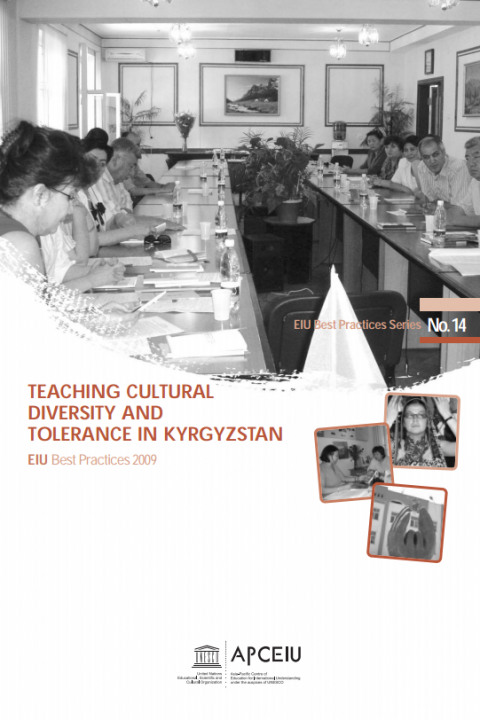 EIU Best Practices Series No. 14: Teaching Cultural Diversity and Tolerance in Kyrgyzstan سنة النشر: 2009 المؤلف: Erkeayim Jorobekavo | Almakan Naizabekova المؤلف المؤسسي: APCEIU This report is one of APCEIU's EIU Best Practices Series, which aims to encourage educators, scholars, and activists to implement and share local initiatives on EIU. The Series No.14 introduces ‘Culturology,’ a mandatory course instituted in Kyrgyz-Uzbek University, designed and implemented to teach cultural diversity and tolerance to students. Given the nation’s recent history of independence and racial and religious diversity, the University chose to develop the course program and methodology guidebook to foster understanding of international education and multiculturalism.