
الموارد
استكشف مجموعة واسعة من الموارد القيمة حول تعليم المواطنة العالمية لتعميق فهمك وتعزيز البحث والمناصرة والتعليم والتعلم.
تم العثور على 23 نتيجة
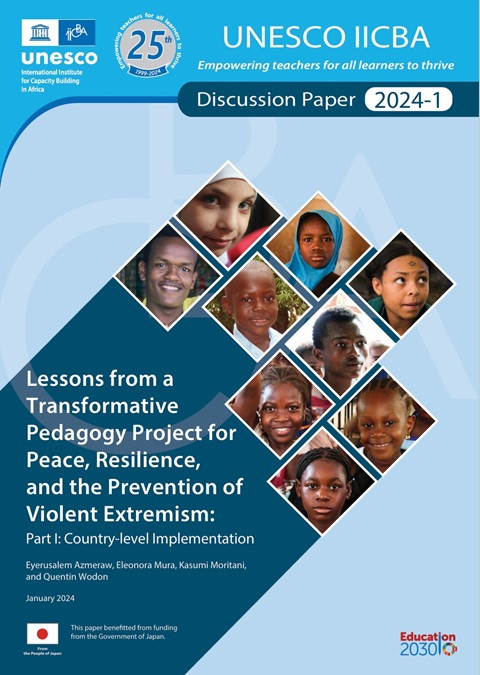 Lessons from a Transformative Pedagogy Project for Peace, Resilience, and the Prevention of Violent Extremism: Part I; Country-Level Implementation سنة النشر: 2024 المؤلف: Eyerusalem Azmeraw | Quentin Wodon | Eleonora Mura | Kasumi Moritani المؤلف المؤسسي: UNESCO International Institute for Capacity-Building in Africa (IICBA) From 2017 to 2022, UNESCO’s International Institute for Capacity Building in Africa (IICBA) led a series of projects for peacebuilding and the prevention of violent extremism through education with support from the Government of Japan. This two-part paper draws lessons from the projects. The first part of the paper briefly explains the transformative pedagogy approach that guided project implementation and provides examples of changes that were implemented at the country level under the projects. The analysis is qualitative, with the aim being to outline, through country examples, what can be achieved through such projects. Lessons on factors contributing to impact are also outlined.
  Transformative Learning Journeys: Venturing Into the Wilds of Global Citizenship Education سنة النشر: 2021 المؤلف المؤسسي: Bridge 47 With the intensive courses of the Transformative Learning Journey, Bridge 47 created experimental learning spaces for communities of practitioners, researchers and activists of transformative education from around the world.The courses endeavored to challenge common concepts of Global Citizenship Education, to explore questions like those below and to experiment with different, holistic and potentially more transformative, practices of learning and co-creating.What are the (cultural) root causes of the global multi-crisis?How to decolonize and transform a modern system that is broken beyond fixing?What do we have to learn, unlearn or let go of- individually and collectively - in order to allow, embrace and foster real change? What characterizes transformative learning, and how can education create holistic spaces to trigger, support and accompany such learning processes? How transformative is our own organizational and educational practice?Do we have to re-imagine education and activism and become more radical? Are we asking the right questions?Based on the positive resonance, Bridge 47 wants to share some of the learnings through this publication. The book gives insights into the design, content and methodology of the course. Featuring diverse contributions from participants, it is a mosaic of perspectives and experiences of transformation, decolonization and learning. It also comprises some tools and invitations for reflection. It is not a cohesive prescription of how to facilitate transformative learning – as there is none - but an invitation to relate to and play."This book is dedicated to all the curious people out there who are passionate about education in caring for our world and each other - the dreamers, the healers, the lovers, the teachers for a different future to emerge. It goes to the fighters who are desperate and overwhelmed in face of complex challenges and are worn out by their struggle for justice and change – to find inspiration, energy and courage to treat ourselves gently, to let go and to make space for new things to emerge."
  Living with Controversy: Teaching Controversial Issues through Education for Democratic Citizenship and Human Rights (EDC/HRE); Training Pack for Teachers سنة النشر: 2015 المؤلف المؤسسي: Council of Europe Learning how to engage in dialogue with people whose values are different from one’s own and to respect them is central to the democratic process and essential for the protection and strengthening of democracy and fostering a culture of human rights. Yet in Europe young people do not often have an opportunity to discuss controversial issues in school because they are seen as too challenging to teach, e.g., issues to do with extremism, gender violence, child abuse, or sexual orientation. Unable to voice their concerns, unaware of how others feel or left to rely on friends and social media for their information, young people can be frustrated or confused about some of the major issues which affect their communities and European society today. In the absence of help from school, they might have no reliable means of dealing with these issues constructively and no one to guide them. The idea for this Pack came out of a call from policy-makers and practitioners in a number of European countries for more effective training for teachers in the teaching of controversial issues.
  Vivir con la controversia: Cómo enseñar temas controvertidos mediante la Educación para la ciudadanía y los derechos humanos (EDC/HRE) Módulo de formación para el profesorado سنة النشر: 2015 المؤلف المؤسسي: European Union (EU) Learning how to engage in dialogue with people whose values are different from one’s own and to respect them is central to the democratic process and essential for the protection and strengthening of democracy and fostering a culture of human rights. ■ Yet in Europe young people do not often have an opportunity to discuss controversial issues in school because they are seen as too challenging to teach, e.g., issues to do with extremism, gender violence, child abuse, or sexual orientation. Unable to voice their concerns, unaware of how others feel or left to rely on friends and social media for their information, young people can be frustrated or confused about some of the major issues which affect their communities and European society today. In the absence of help from school, they might have no reliable means of dealing with these issues constructively and no one to guide them. ■ The idea for this Pack came out of a call from policy-makers and practitioners in a number of European countries for more effective training for teachers in the teaching of controversial issues.
  Inequidad de género en los logros de aprendizaje en educación primaria ¿Qué nos puede decir TERCE?; resumen ejecutivo سنة النشر: 2016 المؤلف: Denisse Gelber, Ernesto Treviño, Pamela Inostroza المؤلف المؤسسي: UNESCO Santiago This premise of work clearly establishes that promoting learning opportunities for all will be one of the priorities in the Education 2030. Within this framework, UNESCO Santiago has its own instrument that allows delivering diagnosis and analysis in depth about the learning inequality within the region; the Thrid Regional Comparative and Explanatory Study, TERCE - carried out by the Latin American Laboratory for Assessment of the Quality of Education, LLECE, body bringing together 15 countries and coordinated by our Office.
  Transformative pedagogy for learning to live together in Southern Africa: a practical guide سنة النشر: 2022 المؤلف المؤسسي: UNESCO International Institute for Capacity-Building in Africa (IICBA) IntroductionEducation is a powerful force for peacebuilding and transformation: it can contribute to changing individuals and communities, promoting a more just and equitable world fostering inclusion, social cohesion and ultimately contributing to creating peaceful societies. Teachers play a central role in the establishment of knowledge, attitudes and values among young people; they also empower them to propose alternative narratives, to engage with their communities and to contribute to building peaceful societies through their actions.This work can be done through subject areas, e.g., history, civic and moral education, art, music, sports etc., or through dedicated subjects. In any case, there is a need to equip teachers with specific skills and knowledge and this guide can also be used in science subjects.This work cannot begin or take place in the school environment only. It is important to establish a continuum between the school and its surrounding environment. This requires knowledge of the local context and mobilization of organizations and/or community stakeholders. All these aspects are building blocks of transformative pedagogy, which is the central element of this Guide. Chapter One provides concrete elements of analysis to help understand violence and its root causes in the SADC region and to identify prevention strategies. Chapter Two discusses the importance of education, highlighting key elements that contribute to education for peace building and transformation. Chapter Three focuses on the importance of fostering ethical reflections as spaces for dialogue and identity building to develop a sense of purpose and belonging. Chapter Four provides concrete approaches for teachers to adopt Transformative Pedagogy .Chapter Five highlights core competences for Learning to Live Together understood as the combination of knowledge, skills and attitudes essential to promote mutual understanding and social cohesion (the core competencies presented do not constitute an exhaustive list). Chapter Six discusses learners empowerment and participation in community engagement, equipping teachers with concrete tools and approaches to support learners as active change-makers to transform their communities. Chapter seven focuses on assessment as a key component of the transformative learning process allowing both teachers and learners to self-reflect, make connections, understand where they are in the learning process, how they arrived there and what questions they may still have. Chapter Eight introduces concrete activities for learners that can inspire teachers, as well as provide some ideas of initiatives that can be organised. A table at the beginning of Chapter Eight connects the relevant contents of the Guide with each activity presented. Mémoire et pédagogie. Autour de la transmission de la destruction des Juifs d'Europe Based on qualitative interviews, "Memory and pedagogy" takes inventory of the representations and fears teachers can encounter when they broach the Holocaust, especially if their personal background echoes that part of history. The author then describes different postures they can adopt ‒ centred victim empathy, genocide as a general theme or focused on "lessons" from the past. This book, one of the first research projects on this topic in Switzerland, is a contribution to a collective reflection on the current and future transmission of the history and memory of the destruction of European Jews. (By the author - Translation) Identity And Pedagogy In Holocaust Education: The Case Of Israeli State Schools This pedagogical and sociological analysis of Shoah (Holocaust) education in Israeli state schools is based on an empirical survey conducted in 2007-2009 among junior high school and high school students, teachers and principals in general and religious schools, and experts in the field. It explores issues such as materials and methods, beliefs and attitudes, messages imparted, pedagogical challenges, and implications for national and religious identity and universal values. Comparative and multi-dimensional analyses of sub-populations, such as by age and type of school, were conducted. The practical and theoretical implications of the findings are considered in the context of Shoah education in Israel and other educational settings over the past half century. (By the author)
  التعليم كوسيلة للتعافي: معالجة صدمة النزوح من خلال التعلم الاجتماعي والعاطفي سنة النشر: 2019 وتتناول هذه الوثيقة أنشطة التعليم النظامي وغير النظامي، ولا سيما الأنشطة التي تركز على التعلم الاجتماعي والعاطفي، كنهج واعد لتوفير الدعم النفسي والاجتماعي للمهاجرين واللاجئين في مواجهة الآثار السلبية للصدمات التي تعرضوا لها. وتغطي الوثيقة سياقات الطوارئ والأوضاع المجتمعية التي تقود فينهاية المطاف إلى استقرار أطفال المهاجرين واللاجئين. كما تغطي الدراسة مسألة توفير التعليم وبيئة التعلم؛ ومحتوى التعليم والتعلم لكل من الأطفال وأولياء أمورهم؛ والدور الذي يمكن أن يقوم به المعلمون وغيرهم من المهنيين . Education as healing: addressing the trauma of displacement through social and emotional learning سنة النشر: 2019 The conditions under which migrants and refugees have to leave their homes and homelands can be traumatic in the extreme. Whether they have crossed the Mediterranean in an overcrowded and unsafe boat, been barricaded in a Syrian basement for protection from shelling, or been chased away from a burning village in Myanmar, the events of their departures and their journeys can leave scars on those affected – and none more than on children who have witnessed and experienced death, loss, violence, separation from family and prolonged insecurity. Even those fortunate enough to find a sanctuary often face further hardship or discrimination in their host communities that can exacerbate their vulnerability.