
الموارد
استكشف مجموعة واسعة من الموارد القيمة حول تعليم المواطنة العالمية لتعميق فهمك وتعزيز البحث والمناصرة والتعليم والتعلم.
تم العثور على 46 نتيجة
 Ten Clues for Rethinking Curriculum (In-Progress Reflection; No. 42, 2021) سنة النشر: 2021 المؤلف: Renato Opertti المؤلف المؤسسي: UNESCO International Bureau of Education (IBE) This discussion document highlights the urgency of rethinking curriculum in light of reinforcing the commitments of the Education 2030 Agenda on learning, disruptive systemic worldwide societal changes, and crucially, the profound transformation of education and education systems post Covid-19. Curriculum is always at the core of giving effect to social aspirations and ideals on the why, what, how, when, and where of teaching, learning, and assessing. We propose a series of 10 interconnected clues to deepen on the systemic and holistic understanding of curriculum as contributing to lay foundations for a better, sustainable and fair future. These clues are: understanding the new generations; combatting factors related to vulnerability; reinforcing understanding between school and families; deepening glo-local education; enhancing the focus on the person; promoting synergies among values; valuing diversity; focusing on education that enhances freedom; moving toward hybrid modes of education; and inspiring affection for educators.
  Intercultural dialogue: involving young people around the world سنة النشر: 2010 المؤلف: Elizabeth Khawajkie المؤلف المؤسسي: UNESCO | DAIMLER It is hoped that this review will help to highlight why there is a persistent call for the continuation of such endeavors, like Mondialogo, which promoted dialogue among cultures and people, mutual respect and understanding so effectively. The Mondialogo journey, begun as an exploratory exercise, ended with compelling and often moving experiences.
  Values Education through Sport سنة النشر: 2016 المؤلف المؤسسي: UNESCO Innovative education for developmentEducation in the 21st century increasingly recognizes the role of values and social skills in tackling global challenges, such as inactivity, obesity, unemployment, and conflict. This approach is at the core of the Sustainable Development Goal 4 on quality education, which advocates for inclusive lifelong learning opportunities and innovative content delivery. Dynamic forms of values-based education using sport can be introduced in schools to support teachers deliver curricula actively and cooperatively.What are sport values?Sport can teach values such as fairness, teambuilding, equality, discipline, inclusion, perseverance and respect. Sport has the power to provide a universal framework for learning values, thus contributing to the development of soft skills needed for responsible citizenship.What can Values Education through Sport offer?Values Education through Sport (VETS) programmes support active learning, complement cognitive skills and give students increasing amounts of responsibility, and enhance their level of concentration and participation. VETS programmes are flexible and have a strong cross-curricular potential: they can reinforce existing curricula and can be streamed across different subjects, including physical education, civic and moral education, nutrition, biology, arts. Ultimately, these programmes help students to transfer and put values into action outside the school environment, by getting engaged in their communities, making informed decisions, being sensitive and respecting the others and the environment. VETS contributes to the development of self-confidence, active and healthy lifestyle choices, and an understanding of rights, supporting the delicate transition to the independence of adulthood.
  YouthXchange: guide sur le changement climatique et les modes de vie سنة النشر: 2015 المؤلف: Adam Cade | Rob Bowden المؤلف المؤسسي: UNESCO | United Nations Environment Programme (UNEP) Climate Change and Lifestyles is the first in a series of guidebooks supporting the UNESCO/ UNEP YouthXchange (YXC) Initiative, which was created in 2001 to promote sustainable lifestyles among youth (15-24 years) through education, dialogue, awareness raising and capacity building. The series is being produced for young people and people working with youth, such as educators, teachers, trainers and youth leaders in both developed and developing countries. Almost half of the world’s population is under the age of 25, and nearly 90 per cent of them live in developing countries. Youth is a critical stakeholder in the global economy and will be the main actor and motor for change in the near future. Thus, the energy, motivation and creativity of youth are essential assets to stimulating change. Aims of the YXC Guidebook on Climate Change and Lifestyles:• Explore the links between lifestyles and climate change; • Help young people consider the actions they should take towards more sustainable lifestyles;• Support courses and actions that promote greater understanding of climate change and lifestyles among youth. The guidebook:• Considers the causes and effects of climate change and its human impacts and responses, while connecting them to lifestyle choices and the technical and social infrastructures of a society;• Provides scientific, political, economic, social, ethical and cultural perspectives on climate change;• Explains complex issues in accessible language supported by facts, graphics, images, examples and web links;• Develops the critical skills young people need to make personal choices to address the challenges of climate change.
  Série de guides youthXchange: biodiversité et modes de vie سنة النشر: 2015 المؤلف المؤسسي: UNESCO | United Nations Environment Programme (UNEP) The YouthXchange Biodiversity and LifestylesGuidebook is designed to help young people familiarize themselves with the dimensions of global biological and cultural diversity, as well as help them to develop essential skills whileengaging with biodiversity.The guidebook aims to:• Explore the interactions between biodiversity and lifestyle choices by explaining the interrelatedness of food, consumption, culture and biodiversity conservation;• Help young people familiarize themselves with the dimensions of global biological and cultural diversity, as well as help them to develop essential skills while engaging with biodiversity; and• Help young people consider how they can preserve biodiversity though responsible lifestyle choices, engagement and action. Innovative practices of youth participation in media: a research study on twelve initiatives from around the developing and underdeveloped regions of the world سنة النشر: 2006 المؤلف: Sanjay Asthana المؤلف المؤسسي: UNESCO This book will be useful as a research and reference guide to community-based media centres, media education practitioners, non-governmental organizations, policy-makers, planners, media professionals, social activists, researchers, etc. A direct contribution of the book are the several examples that can be adapted and/or replicated by various initiatives as they embark on building youth media programmes around the world.
  Final Report: 2nd Youth Leadership Workshop on Global Citizenship Education سنة النشر: 2016 المؤلف المؤسسي: APCEIU This report provides an overview of the activities carried out during the 2nd Youth Leadership Workshop on Global Citizenship Education (GCED) held in Busan, Republic of Korea, from 11 - 16 July 2016. As an APCEIU's 2nd youth workshop, this programme gathered 49 youth activists from 38 countries around the world to exchange their ideas and identify GCED leadership strategies in order to mobilize young people for GCED in local and national contexts and advance the agenda globally. This report also aims to convey the voice of the youth on GCED: their thoughts and reflections on GCED and its priority areas. The workshop was co-organized by APCEIU and UN Secretary General’s Global Education First Initiative (GEFI); it was sponsored by Busan University of Foreign Studies and the Geum-jeong District of Busan Metropolitan City. For more information, please contact APCEIU's Office of Education and Training at ent@unescoapceiu.org.
 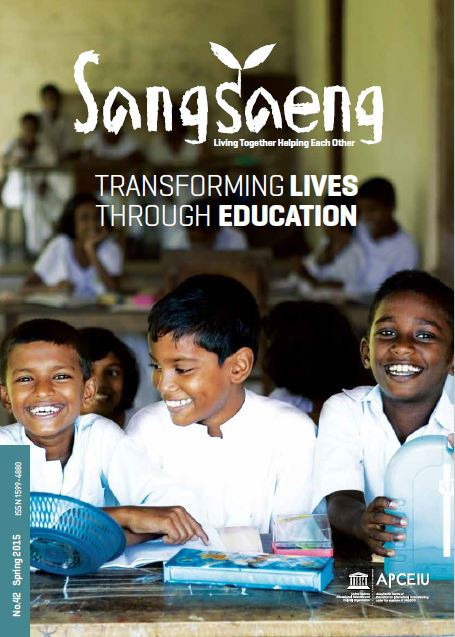 Transforming lives through education (SangSaeng no. 42 spring 2015) سنة النشر: 2015 المؤلف المؤسسي: APCEIU The 42nd issue of SangSaeng, ‘Transforming Lives Through Education’, has been published. This spring edition has been released prior to the World Education Forum 2015 to provide the context for the post-2015 education agenda. It contains compelling articles that underline the importance of Global Citizenship Education in building a more sustainable and peaceful society. 3 Director’s Message4 Special Column Every Child Deserves a Child-Friendly World8 Focus: Transforming Lives Through Education 8 Emergence of Global Citizenship Education in the Post-2015 Education Agenda13 Re-Visioning Education Beyond 201518 Global Citizenship Education for the 21st Century23 Young People Are Ready to Lead: The Education We Want26 Interview Education Beyond 201531 Special ReportGlobal UNESCO Clearinghouse on Global Citizenship Education Hosted by APCEIU34 Best Practices34 Citizenship Education in a Community Setting38 Pangaea42 Letter Unity in Diversity44 Peace in My MemoryPresenting a Message of Peace Through Music47 Understanding the Asia-Pacific Region Timeless Festivity of the Ancient World: Hidirellez50 APCEIU in Action
  Video sketch: Global Youth Advocacy Workshop on GCED سنة النشر: 2015 المؤلف المؤسسي: APCEIU APCEIU produced a video on the Global Youth Advocacy Workshop on GCED held in Busan, Republic of Korea, from 30 March to 4 April 2015. The workshop invited 45 youth participants from 34 countries around the world, who are actively engaged with and committed to advocating and educating youth for GCED in their local contexts.This short video sketch of the workshop provides an overview of the activities carried out during the workshop and also includes the interviews of the participants, who shared their expectations, impressions, and reflections on the workshop.The workshop was co-organized by APCEIU, UN Secretary General’s Global Education First Initiative (GEFI), and the UNESCO Mahatma Gandhi Institute of Education for Peace and Sustainable Development (MGIEP); and sponsored by Educate A Child and the Geum-jeong District of Busan Metropolitan City.
  Global youth advocacy workshop on GCED: final report سنة النشر: 2015 المؤلف المؤسسي: APCEIU The United Nations Secretary-General's Global Education First Initiative (GEFI) recognizes Global Citizenship Education (GCED) as one of its three priorities. UNSG GEFI has generated momentum for GCED which has since been in the target of the education goal in the Muscat Agreement 2014 and in the proposed Sustainable Development Goals (SDGs) of the Open Working Group. The proposed SDGs will provide the basis for further intergovernmental negotiations on the post 2014 development agenda.In support of UNSG GEFI, UNESCO held its Second Global Forum on Global Citizenship Education on Building Peaceful and Sustainable Societies: Preparing for Post-2015 from 28 to 30 January 2015 in Paris, France. The forum aimed to identify GCED related inputs to the emerging Framework for Action on Education for the post 2015 development agenda, as well as key dimensions of GCED in relation to peace. Furthermore, it had a concurrent session dedicated to youth on Driving the GCED Agenda Forward: Acting with and for Young People to assemble the perspectives, ideas, and priorities of youth on GCED. Against this background, the Global Youth Advocacy Workshop on GCED, co-organized by GEFI, the Asia-Pacific Centre of Education for International Understanding (APCEIU) and UNESCO's Mahatma Gandhi Institute of Education for Peace and Sustainable Development (MGIEP) aimed to build the capacity of dynamic youth leaders from countries around the world to advocate for GCED. The participants of the workshop were selected on the basis of their previous experiences, present engagement, and future commitment in educating youth at the local and national levels. The objectives of the workshop were: 1. To build a common understanding of GCED and its key priority areas by building on the dialogue initiated at the Paris GCED Forum.2. To allow the participating youth leaders to elaborate an advocacy strategy suitable for implementation at the local and national levels to advance the GCED agenda beyond 2015.3. To establish a wider network of youth advocates on GCED to advance the agenda globally.