
الموارد
استكشف مجموعة واسعة من الموارد القيمة حول تعليم المواطنة العالمية لتعميق فهمك وتعزيز البحث والمناصرة والتعليم والتعلم.
تم العثور على 71 نتيجة
 COMPASS: un manuel sur l'éducation aux droits de l'homme avec les jeunes سنة النشر: 2012 المؤلف: Patricia Brander المؤلف المؤسسي: Council of Europe Compass a été publiée en 2002 dans le cadre du Programme Jeunesse d'Éducation aux Droits de l'Homme de la Direction de la Jeunesse et du Sport du Conseil de l'Europe. Le programme a été créé parce que l'éducation aux droits de l'homme - à savoir les programmes et les activités qui mettent l'accent sur la promotion de l'égalité dans la dignité humaine éducation - a été et reste d'une valeur inestimable dans l'élaboration d'une dimension de la citoyenneté démocratique pour tous les jeunes et à promouvoir une culture des droits humains universels. Compass est devenu un manuel de référence pour de nombreux jeunes impliqués dans le travail de la jeunesse fondée sur des valeurs et de l'éducation non formelle. Il est actuellement disponible dans plus de 30 langues, allant de l'arabe et le japonais à l'islandais et le basque. Dans certains pays, il est devenu une partie des ressources pour l'éducation aux droits de l'homme dans les écoles et dans certains autres, il est impossible de l'utiliser dans les écoles. Les aventures de Compass en Europe reflètent souvent la réalité contrastée de l'éducation aux droits de l'homme: promotion ici et là combattu, loué par les uns et méprisé par les autres. Le succès de Compass a été suivi par son frère cadet, Compasito - un manuel pour l'éducation aux droits de l'homme avec les enfants est déjà disponible en plusieurs langues et sur la façon de devenir un autre best-seller pour l'éducation aux droits de l'homme. Plus important encore, Compass et sa publication dans différentes versions linguistiques a été le moyen par lequel l'éducation aux droits de l'homme a été mis sur l'ordre du jour du travail de jeunesse et dans le programme de nombreuses écoles. Les réseaux nationaux pour l'éducation aux droits de l'homme ont été créés dans plusieurs pays, où ils renforcent le travail accompli par les organisations des droits humains et professionnels de l'éducation à faire du droit à l'éducation des droits de l'homme une réalité à plus d'enfants et de jeunes à travers l'Europe. Le forum sur l'éducation aux droits de l'homme avec les jeunes, la vie, l'apprentissage, agir pour les droits de l'homme, tenue à Budapest en 2009, a souligné l'importance de l'éducation aux droits de l'homme aujourd'hui.
  Preventing Violent Extremism through Sport: Technical Guide; Criminal Justice Handbook Series سنة النشر: 2020 المؤلف المؤسسي: UN. Office on Drugs and Crime (UNODC) The Technical Guide on Preventing Violent Extremism through Sport, developed in consultation with international experts, recognizes the importance of promoting the well-being of children and youth. It applies an approach that encourages prosocial behaviour and good safeguarding and welfare practices, with particular emphasis on educational and social development measures in line with the United Nations Guidelines for the Prevention of Crime.The guide, addressed mainly to policy makers and implementing organizations, has been carefully designed to support effective integration of sport-based learning in primary prevention frameworks. By adopting a five-zone approach to prevent violent extremism namely safe space, empowerment, resilience, social inclusion and education, it supports informed policy development and a Theory of Change that can shape curriculum design and content. To further support global efforts in preventing violent extremism, UNODC is also developing an e-learning module and a practical tool for trainers that will be published soon and will complement this technical guide.
  تعليم المواطنة وحقوق الإنسان. دليل لشباب المغرب سنة النشر: 2015 المؤلف المؤسسي: UNESCO Rabat | Conseil national des droits de l'homme (Morocco) Prepared by UNESCO, in collaboration with the Moroccan National Human Rights Council (CNDH) and the support of the Spanish Agency for International Development Cooperation (AECID), this manual aims to sensitize young Moroccan to the fundamental concepts of citizenship and human rights. This educational tool, which consists of 20 didactic cards that describe and explain Morocco national legislation on human rights, documents the human rights international conventions and instruments and puts them in perspective in the Moroccan legislative context. The manual also includes practical exercises adapted to a young audience. Education à la citoyenneté et aux droits de l'homme: manuel pour les jeunes au Maroc سنة النشر: 2015 المؤلف المؤسسي: UNESCO Rabat | Conseil national des droits de l'homme (Morocco) Prepared by UNESCO, in collaboration with the Moroccan National Human Rights Council (CNDH) and the support of the Spanish Agency for International Development Cooperation (AECID), this manual aims to sensitize young Moroccan to the fundamental concepts of citizenship and human rights. This educational tool, which consists of 20 didactic cards that describe and explain Morocco national legislation on human rights, documents the human rights international conventions and instruments and puts them in perspective in the Moroccan legislative context. The manual also includes practical exercises adapted to a young audience.
  Generation Z: Global Citizenship Survey سنة النشر: 2017 المؤلف المؤسسي: Varkey Foundation The Varkey Foundation commissioned Populus to carry out research on a global scale into the attitudes of 15- to 21-year-olds on a variety of ethical, personal, community and political issues. We chose twenty countries to poll: Argentina, Australia, Brazil, Canada, China, France, Germany, India, Indonesia, Israel, Italy, Japan, New Zealand, Nigeria, Russia, South Africa, South Korea, Turkey, the UK and the US. We chose a range of countries that would give a geographic spread, include some of most populous nations, and would also include those that have particular political significance – as rising powers and/or countries that are important in global geopolitics and cultural influence.The first part of the survey asked about young people’s wellbeing, hopes and ambitions – from their relationships and future careers, to their physical and mental health.. The second part focused on their personal, community and religious values – from their attitudes towards abortion, same sex marriage and transgender rights, to the importance of religion in their lives and whether they feel equipped to contribute to their own community. Finally, it covered issues of global citizenship – attitudes towards migrants, the factors that make young people hopeful and fearful for the future, and their views on whether the world is becoming a better or worse place. This is the first time that there has been an international comparative study of the attitudes of young people on these matters. Not only have we asked them how they feel, what their attitudes are, and who influenced them: we have also reflected on what differences and similarities there may be in terms of their wellbeing, fears, hopes and views across the world.With this survey, we do not aim to document the events that loomed large in young people’s lives or the social forces that have shaped their emotions and opinions. That is a huge subject for expert analysis. Rather, we wanted to hold up a mirror to Generation Z and simply record the reflection that they give us – providing some illumination to help us all understand them better.
  دليل شباب تونس في تعلّم الديمقراطيّة سنة النشر: 2011 المؤلف المؤسسي: UNESCO Rabat The main aim of these manual and guide is to raise awareness among Tunisian youth about the values of democracy, human rights and responsible citizenship, and empower youth to make their voice heard during this critical period in the Tunisian democratic transition. Manuel d'apprentissage de la démocratie pour les jeunes en Tunisie سنة النشر: 2011 المؤلف المؤسسي: UNESCO Rabat The main aim of these manual and guide is to raise awareness among Tunisian youth about the values of democracy, human rights and responsible citizenship, and empower youth to make their voice heard during this critical period in the Tunisian democratic transition.
  Education à la citoyenneté et aux droits de l'homme: manuel pour les jeunes en Mauritanie سنة النشر: 2015 المؤلف: Sidi Mohamed Ould Mohamed Abdellahi | Bamariam Koita | Mohamed El Moctar Ould Sidina | Abdel Wedoud المؤلف المؤسسي: Mauritania. Ministère de la culture et de l'artisanat | Mauritanian National Commission for Education, Science and Culture | UNESCO Rabat Prepared by UNESCO in cooperation with the Mauritanian Ministry of Culture and Crafts, and with the support of the Spanish Agency for International Development Cooperation (AECID), this manual aims to - with the active help of trainers and facilitators - sensitize young Mauritanians to the fundamental concepts of citizenship and human rights. This educational tool, which includes practical exercises adapted to a young audience, consists of 20 didactic cards that describe and explain Mauritania national legislation on human rights.Ce Manuel, composé de 20 fiches thématiques, offre de manière inédite des connaissances sur les conventions et standards internationaux en matière de démocratie et de droits de l’homme, ainsi qu’une contextualisation aux cadres normatifs nationaux de la Mauritanie. Des questions clés, des exercices interactifs, et des références pour aller plus loin sont autant d’outils pédagogiques pour familiariser les jeunes avec des notions fondamentales, dans le cadre de l’éducation aussi formelle que non formelle. Car Si l’éducation à la citoyenneté est rattachée à un territoire national dans la mesure où est citoyenne toute personne disposant de droits et de devoirs attachés à une nationalité, à un État, à une histoire sociale et culturelle, l’éducation aux droits de l’homme se réfère quant à elle à un cadre normatif universel et déterritorialisé : sa mission est de cultiver le sentiment d’appartenance de chacun(e) à l’humanité, caractérisée par une dignité propre. Dans une démarche éducative, ce Manuel conjugue les deux dimensions, les interpé- nètre et les met en perspective. L’objectif est de permettre aux jeunes, avec l’aide de formateurs et d’animateurs, d’approfondir et de mettre en perspective leurs connaissances relatives aux valeurs de citoyenneté et aux principes de droits de l’homme, à travers un va-et vient constant entre l’idéal universel et le contexte politique, social, culturel et environnemental dans lequel ils se trouvent.Fruit de la collaboration entre l’UNESCO et le Ministère de la Culture et de l’Artisanat de Mauritanie, et bénéficiant du soutien de l’Agence espagnole pour la coopération internationale pour le développement (AECID), ce Manuel propose des pistes pour explorer et interroger les conditions d’exercice de la citoyenneté, ainsi que des problématiques sociétales émergeantes. Mieux comprendre, pour mieux agir, c’est aussi cela être un agent de changement, de paix et de développement. Education à la citoyenneté et aux droits de l'homme: manuel pour les jeunes en Mauritanie سنة النشر: 2015 المؤلف: Abdel-Wedoud (dit Deddoud Ould Abdallah) | Mohamed El Moctar Ould Sidina | Bamariam Koita | Sidi Mohamed Ould Mohamed Abdellahi المؤلف المؤسسي: Mauritania. Ministère de la culture et de l'artisanat | Mauritanian National Commission for Education, Science and Culture | UNESCO Rabat Ce Manuel, composé de 20 fiches thématiques, offre de manière inédite des connaissances sur les conventions et standards internationaux en matière de démocratie et de droits de l’homme, ainsi qu’une contextualisation aux cadres normatifs nationaux de la Mauritanie. Des questions clés, des exercices interactifs, et des références pour aller plus loin sont autant d’outils pédagogiques pour familiariser les jeunes avec des notions fondamentales, dans le cadre de l’éducation aussi formelle que non formelle. Car Si l’éducation à la citoyenneté est rattachée à un territoire national dans la mesure où est citoyenne toute personne disposant de droits et de devoirs attachés à une nationalité, à un État, à une histoire sociale et culturelle, l’éducation aux droits de l’homme se réfère quant à elle à un cadre normatif universel et déterritorialisé : sa mission est de cultiver le sentiment d’appartenance de chacun(e) à l’humanité, caractérisée par une dignité propre. Dans une démarche éducative, ce Manuel conjugue les deux dimensions, les interpé- nètre et les met en perspective. L’objectif est de permettre aux jeunes, avec l’aide de formateurs et d’animateurs, d’approfondir et de mettre en perspective leurs connaissances relatives aux valeurs de citoyenneté et aux principes de droits de l’homme, à travers un va-et vient constant entre l’idéal universel et le contexte politique, social, culturel et environnemental dans lequel ils se trouvent.Fruit de la collaboration entre l’UNESCO et le Ministère de la Culture et de l’Artisanat de Mauritanie, et bénéficiant du soutien de l’Agence espagnole pour la coopération internationale pour le développement (AECID), ce Manuel propose des pistes pour explorer et interroger les conditions d’exercice de la citoyenneté, ainsi que des problématiques sociétales émergeantes. Mieux comprendre, pour mieux agir, c’est aussi cela être un agent de changement, de paix et de développement.
 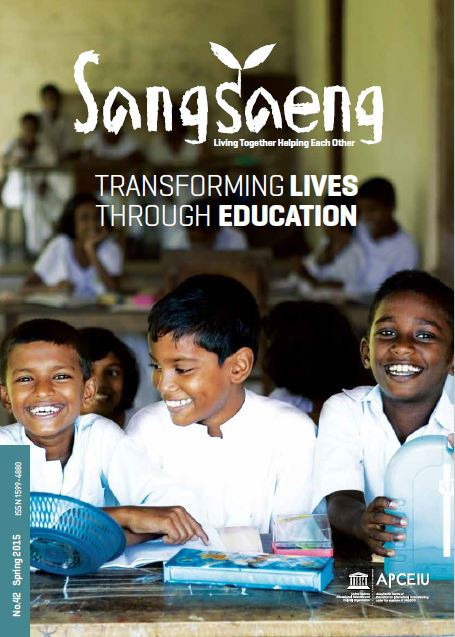 Transforming lives through education (SangSaeng no. 42 spring 2015) سنة النشر: 2015 المؤلف المؤسسي: APCEIU The 42nd issue of SangSaeng, ‘Transforming Lives Through Education’, has been published. This spring edition has been released prior to the World Education Forum 2015 to provide the context for the post-2015 education agenda. It contains compelling articles that underline the importance of Global Citizenship Education in building a more sustainable and peaceful society. 3 Director’s Message4 Special Column Every Child Deserves a Child-Friendly World8 Focus: Transforming Lives Through Education 8 Emergence of Global Citizenship Education in the Post-2015 Education Agenda13 Re-Visioning Education Beyond 201518 Global Citizenship Education for the 21st Century23 Young People Are Ready to Lead: The Education We Want26 Interview Education Beyond 201531 Special ReportGlobal UNESCO Clearinghouse on Global Citizenship Education Hosted by APCEIU34 Best Practices34 Citizenship Education in a Community Setting38 Pangaea42 Letter Unity in Diversity44 Peace in My MemoryPresenting a Message of Peace Through Music47 Understanding the Asia-Pacific Region Timeless Festivity of the Ancient World: Hidirellez50 APCEIU in Action