
الموارد
استكشف مجموعة واسعة من الموارد القيمة حول تعليم المواطنة العالمية لتعميق فهمك وتعزيز البحث والمناصرة والتعليم والتعلم.
تم العثور على 1,329 نتيجة
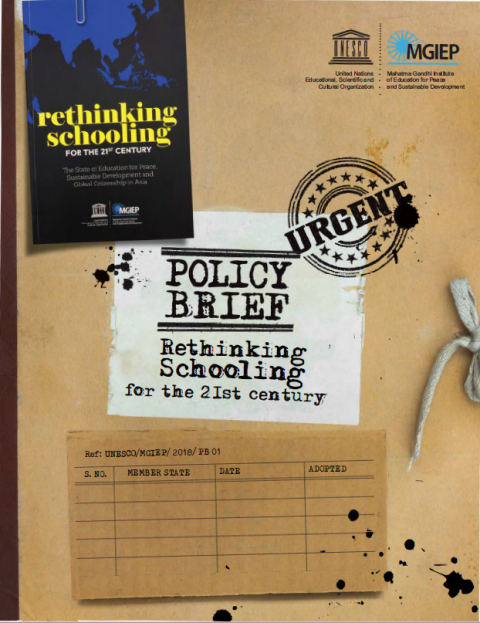 Policy brief: rethinking schooling for the 21st century سنة النشر: 2018 المؤلف المؤسسي: Mahatma Gandhi Institute of Education for Peace and Sustainable Development (MGIEP) Analysing how far the ideals of SDG 4.7 are embodied in policies and curricula across 22 Asian countries, this study establishes benchmarks against which future progress can be assessed. It also argues forcefully that we must redefine the purposes of schooling, addressing the fundamental challenges to efforts to promote peace, sustainability and global citizenship through education.
 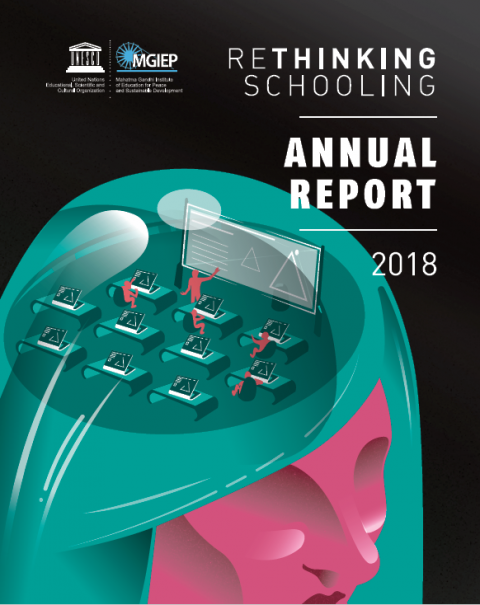 Rethinking schooling: annual report 2018 سنة النشر: 2019 المؤلف المؤسسي: Mahatma Gandhi Institute of Education for Peace and Sustainable Development (MGIEP) Calls to gear up schools for the 21st century are ubiquitous today. Some Asian education systems are held up as models for an innovation-led utopian future. Across much of Asia, however, neither the reality of schooling nor the patterns of development with which it is associated give cause for blithe optimism. This study is informed by UNESCO’s commitment to realizing the Sustainable Development Goals (SDGs) through educational reform worldwide. Since its inception, UNESCO has championed a humanistic vision of education (UNESCO, 2015)—a vision today encapsulated in SDG 4.7. These ideals need to be strongly restated and defended in an era when educational debate has come to be framed by a narrowly economistic and instrumentalist agenda. Deriving urgent significance from this broader context, the Rethinking Schooling report analyses how far the ideals of SDG 4.7 are embodied in policies and curricula across 22 Asian countries (UNESCO MGIEP, 2017a). The report seeks to develop benchmarks against which future progress can be assessed. It also argues forcefully that the fundamental purposes of schooling need to be reconfigured, if the ideals to which the global community has subscribed are actually to be realized.
 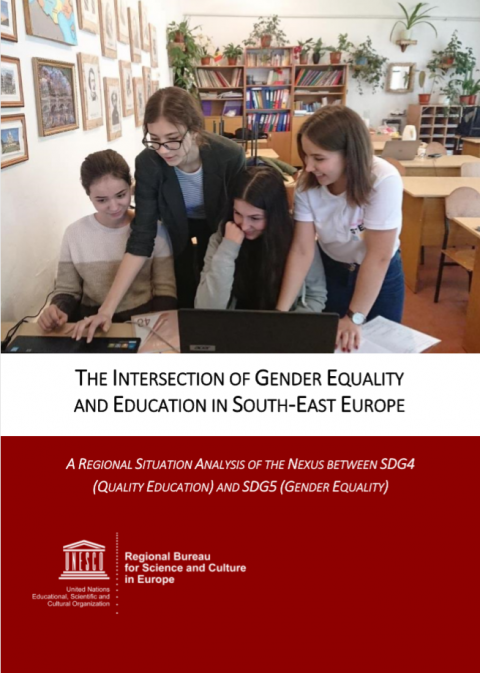 The Intersection of gender equality and education in South-East Europe: a regional situation analysis of the Nexus between SDG4 (Quality Education) and SDG5 (Gender Equality) سنة النشر: 2019 المؤلف المؤسسي: UNESCO Venice This report focuses on highlighting both progress and persistent challenges.It does so by analyzing the current situation of gender equality in education, including gender parity in participation, education quality, and outcomes, aswell as issues related to gender equality in which education plays an important role, suchas policies that disproportionately affect women, early and unintended pregnancy, child marriage, and human trafficking. It relies on the most recent available data from the UNESCO Institute of Statistics (UIS), as well as supplemental data including from UNICEF, UN Women, and theOrganization for Economic Cooperation and Development(OECD), to descriptively analyze the rates for females and males, considering also progress over the last decade, and to identify where progress in gender equality has been made and whereactions are needed to ensure gender equality in and through education.
 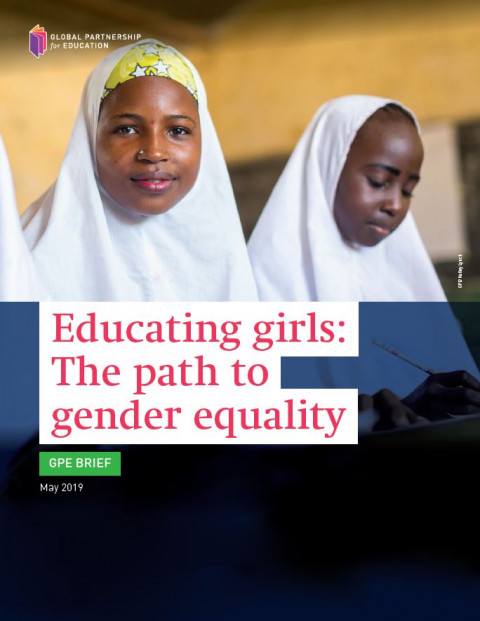 Educating Girls: The Path to Gender Equality; GPE Brief سنة النشر: 2019 المؤلف المؤسسي: GPE Despite significant gains in recent years, education outcomes for girls in developing countries continue to lag behind those of boys. Adolescence is a particularly critical stage for girls, marked by rapid biological and psychological changes as well as powerful social expectations of how their lives should unfold. For many girls in developing countries, adolescence also marks a time of extreme vulnerability: to child marriage, teenage pregnancy, sexual violence, nutritional deficiency and exposure to HIV/AIDS. It also marks a time when pressures of social norms and cultural practices place new restrictions on what girls can do and who they can be. Lack of access to education increases vulnerability to these risks and constraints. Conversely, being in education acts as a powerful protective factor as well as a route to empowerment for girls to determine their own destiny. Achieving gender equality means delivering on three interlinked areas for girls: health, education and safety. GPE uses its results-based partnership model to work with developing countries to prioritize planning and spending on girls’ education throughout the education cycle, to achieve gender equality. Ensuring girls and boys have equal access to inclusive, quality education is a core principle of GPE’s strategic plan, GPE 2020, and GPE’s Gender Equality Policy and Strategy 2016-2020. At the advocacy level and in conjunction with its partners, GPE is also promoting working across sectors to meet the holistic needs of girls, from a gender equality perspective.
  한국교육과 SDG4-교육2030 سنة النشر: 2018 المؤلف: 김광호 المؤلف المؤسسي: 유네스코한국위원회 영유아 교육부터 성인교육에 이르기까지 교육의 모든 분야를 망라하고 있는 SDG4는 매우 야심 찬 목표다. 세계 각국은 이를 달성하기 위해 여러 논의도 벌이고 교육 정책 에 반영도 하는 등 다각도로 노력하고 있다. 이러한 국제사회의 노력에 비해 국내의 SDG4 관련 움직임은 아직 그리 크지 않은 것 같다. 이에 유네스코한국위원회는 교육부와 함께 한국의 SDG4 달성 현황을 파악하고 앞으로 어떤 과제에 집중해야 하는지 점검하기 위하여 2017년 11월에 ‘제1회 SDG4-교육 2030 포럼: 한국교육과 SDG4-교육 2030’을 개최한 바가 있다. 이 책은 포럼 발표문과 토론문의 저자들이 포럼에서의 논의를 반영하여 수정한 원고를 한데 묶은 것이다. 일차적으로 교육 정책 담당자, 교육 연구자, 교육기관 종사자, 시민단체 활동가를 위한 내용을 담고 있지만, 일반 시민의 SDG4에 대한 관심과 이해를 높이는 데에도 유용할 것이다.
  Guide rapide des indicateurs de l'éducation pour l'ODD 4 سنة النشر: 2018 المؤلف المؤسسي: UNESCO Institute for Statistics (UIS) Ce guide sert de référence rapide sur la manière de suivre les progrès accomplis vers la réalisation de l’Objectif de développement durable 4 (ODD 4) sur une éducation de qualité. Il fournit les explications essentielles sur les cibles de l’ODD 4, leurs indicateurs, le mode d’élaboration des indicateurs et où trouver les données nécessaires à ces indicateurs.
 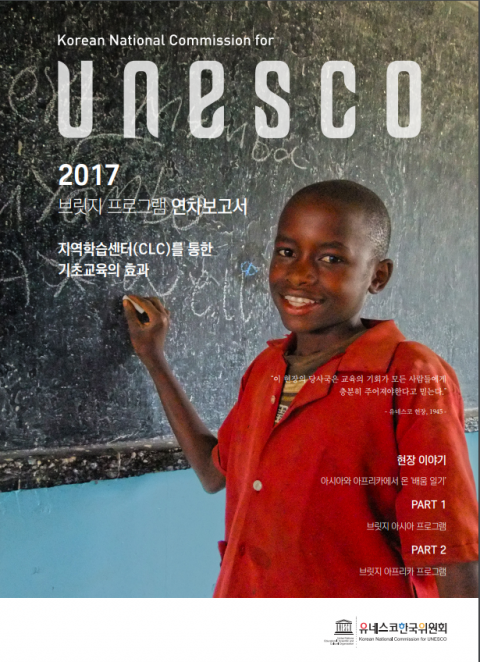 2017-18 브릿지 프로그램 연차보고서 سنة النشر: 2018 المؤلف المؤسسي: 유네스코한국위원회 브릿지 프로그램은 유네스코한국위원회가 교육부의 지원과 후원 모금을 통해 남아시아 지역과 사하라 이남 아프리카 지역에 거주하는 비문해자를 포함한 교육소외계층을 대상으로 교육의 기회를 제공하는 사업이다. 이 보고서는 2017년도부터 2018년도 상반기까지 유네스코한국위원회가 아시아 6개국과 아프리카 6개국에서 각국의 정부기관, 시민사회단체 및 유네스코국가위원회 등과 협력하여 추진한 사업들의 세부 활동과 성과를 보여준다. 아울러, 브릿지 프로그램을 통해 삶의 변화를 맞이한 사람들의 이야기도 확인할 수 있다.
 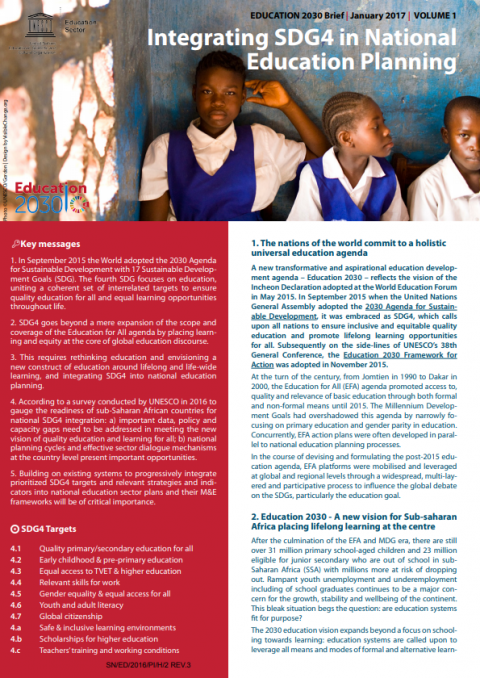 Online programme and meeting document Integrating SDG4 in National Education Planning سنة النشر: 2016 المؤلف: Neyestani-Hailu, Lily المؤلف المؤسسي: UNESCO Dakar Key messages1. In September 2015 the World adopted the 2030 Agenda for Sustainable Development with 17 Sustainable Develop-ment Goals (SDG). The fourth SDG focuses on education, uniting a coherent set of interrelated targets to ensure quality education for all and equal learning opportunities throughout life. 2. SDG4 goes beyond a mere expansion of the scope and coverage of the Education for All agenda by placing learn-ing and equity at the core of global education discourse. 3. This requires rethinking education and envisioning a new construct of education around lifelong and life-wide learning, and integrating SDG4 into national education planning. 4. According to a survey conducted by UNESCO in 2016 to gauge the readiness of sub-Saharan African countries for national SDG4 integration: a) important data, policy and capacity gaps need to be addressed in meeting the new vision of quality education and learning for all; b) national planning cycles and effective sector dialogue mechanisms at the country level present important opportunities. 5. Building on existing systems to progressively integrate prioritized SDG4 targets and relevant strategies and indi-cators into national education sector plans and their M&E frameworks will be of critical importance. Intégration de l'ODD4 dans la planification nationale de l'éducation سنة النشر: 2016 المؤلف: Neyestani-Hailu, Lily المؤلف المؤسسي: UNESCO Dakar Messages clés 1. En septembre 2015, le monde a adopté le Programme de développement durable à l’horizon 2030 et ses 17 objectifs de développement durable (ODD). Le quatrième ODD, relatif à l’éducation, regroupe un ensemble cohérent de cibles inter-dépendantes pour assurer une éducation de qualité pour tous et des possibilités égales d’apprentissage tout au long de la vie. 2. L’ODD4 va au-delà d’une simple expansion de la portée et de la couverture de l’agenda de l’Education pour tous (EPT) en plaçant l’apprentissage et l’équité au cœur du discours mondial sur l’éducation. 3. Cette vision implique de repenser l’éducation et d’envisager une nouvelle conception de l’éducation autour de l’apprentissage tout au long et dans toutes les circonstances de la vie et d’intégrer l’ODD4 dans la planification nationale de l’éducation. 4. Selon une enquête menée par l’UNESCO en 2016 pour mesurer l’état de préparation des pays d’Afrique subsaharienne en vue de l’intégration de l’ODD4 : a) des lacunes considérables en matière de données, de politiques et de capacités doivent être com-blées pour répondre à la nouvelle vision de l’éducation et de l’apprentissage de qualité pour tous ; b) les cycles nationaux de planification et les mécanismes efficaces de dialogue sectoriel au niveau des pays offrent d’importantes opportunités. 5. Il sera capital de s’appuyer sur les systèmes existants pour intégrer progressivement les cibles priorisées de l’ODD4 et les stratégies et indicateurs pertinents dans les plans sectoriels de l’éducation nationaux et leurs cadres de suivi et évaluation. URL:https://unesdoc.unesco.org/ark:/48223/pf0000247239?posInSet=2&queryId=54d6ce36-0065-4dd9-a570-4fe80ac5fcb6 Quick guide to education indicators for SDG 4 سنة النشر: 2018 المؤلف المؤسسي: UNESCO Institute for Statistics (UIS) This guide serves as a quick reference on how to monitor progress towards Sustainable Development Goal 4 (SDG 4) on quality education. It provides basic explanations of SDG 4 targets, their indicators, how they are created and where to find the information needed for these indicators.