
الموارد
استكشف مجموعة واسعة من الموارد القيمة حول تعليم المواطنة العالمية لتعميق فهمك وتعزيز البحث والمناصرة والتعليم والتعلم.
تم العثور على 1,330 نتيجة
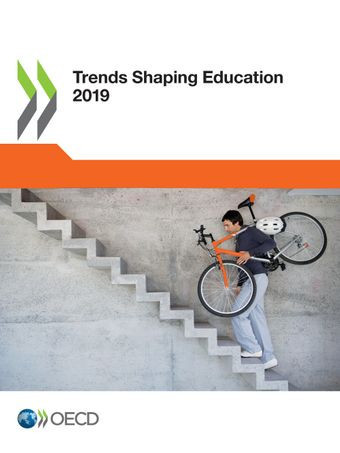 Trends Shaping Education 2019 سنة النشر: 2019 المؤلف المؤسسي: Organisation for Economic Co-operation and Development (OECD) This book, published every two to three years, is designed to give policy makers, researchers, educational leaders, administrators and teachers a robust, non-specialist source to inform strategic thinking and stimulate reflection on the challenges facing education, whether in schools, universities or programmes for older adults. Trends Shaping Education 2019 is designed to support long-term strategic thinking in education. It provides an overview of key economic, social, demographic and technological trends and raises pertinent questions about their impact on education. This book fills an important need: decision makers and practitioners in education often have only anecdotal or local information on the megatrends that play out in their context; too often they do not have solid facts in front of them, especially about trends.` Les grandes mutations qui transforment l'éducation 2019 سنة النشر: 2019 المؤلف المؤسسي: Organisation for Economic Co-operation and Development (OECD) Vous êtes-vous déjà demandé si l’éducation avait un rôle à jouer dans la préparation de nos sociétés à l’ère de l’intelligence artificielle ? Ou quel peut être l’impact du réchauffement climatique sur nos établissements scolaires, nos familles et collectivités ? La publication Les grandes mutations qui transforment l’éducation 2019 donne un aperçu des principales tendances économiques, politiques, sociales et technologiques qui affectent l’éducation. Si les mesures sont robustes, les questions soulevées dans ce recueil sont suggestives et ont pour objet d’informer la pensée stratégique et de stimuler une réflexion sur les défis de l’éducation – et montrer si et comment l’éducation peut influencer ces tendances. L’ouvrage couvre une riche variété de sujets liés à la mondialisation, la démocratie, la sécurité, le vieillissement et les cultures modernes. Le contenu pour l’édition 2019 a été révisé et étendu avec une large sélection d’indicateurs. En plus des différentes tendances et de leur interaction avec l’éducation, la publication inclut également une nouvelle section dédiée à la réflexion sur le futur, inspirée par des méthodologies de la prospective stratégique. Cet ouvrage a pour objet de fournir aux décideurs politiques, aux chercheurs, aux chefs d’établissements, aux administrateurs scolaires et aux enseignants, une source non spécialisée de tendances qui affectent l’éducation comparables à l’échelle internationale, dans les écoles, les universités ou encore dans les programmes de formation pour adultes. Cet ouvrage s’adresse également aux élèves/ étudiants et à la société dans son ensemble, notamment aux parents.
 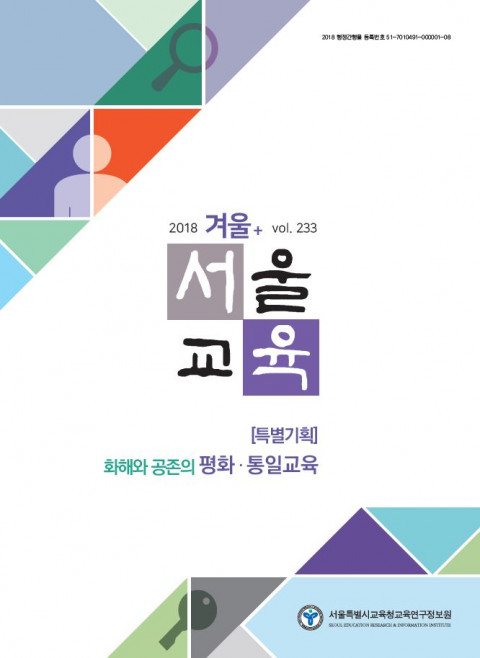 서울교육 2018년 겨울호 (제60권 통권 233호) سنة النشر: 2018 المؤلف المؤسسي: 서울특별시교육청 교육연구정보원 권두칼럼:통일교육 패러다임 전환 키워드: #평화특별기획:평화시대를 여는 새로운 통일교육 – 평화와 민주시민교육을 담는 통일교육으로 –화해로 나아가는 평화와 공존의 통일교육한반도 대변혁기의 학교 평화·통일교육 방향 – 통일교육연구학교 운영사례를 중심으로 –해외교육:독일 통일교육이 한국 통일교육에 주는 시사점통일독일의 동독청소년 사회통합을 통해 보는 21세기 통일한국의 청소년 사회통합 정책연구:평화에 대한 비판적 공부: 평화학 출처 URL:http://www.serii.re.kr/photo/viw.do?method=getView&mcode=S029a&seq=1081
 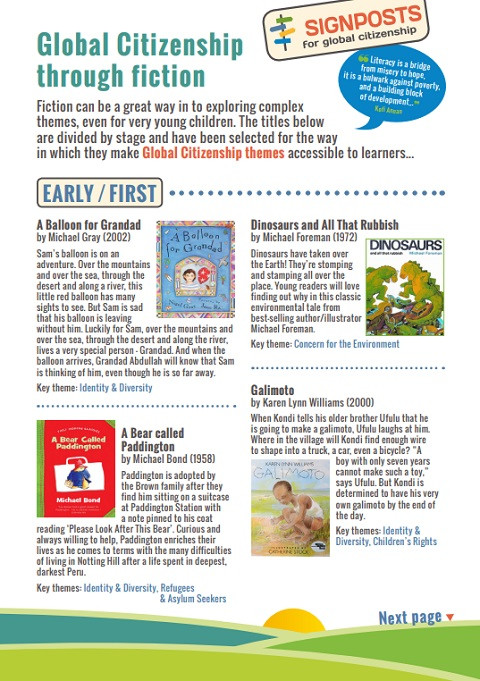 Global Citizenship through Fiction سنة النشر: 2016 المؤلف المؤسسي: Signposts | International Development Education Association Scotland (IDEAS) This flyer summarises a selection of texts linking global citizenship and fiction. There is a synopsis of each text and texts range from Early Years to Stage 2.
 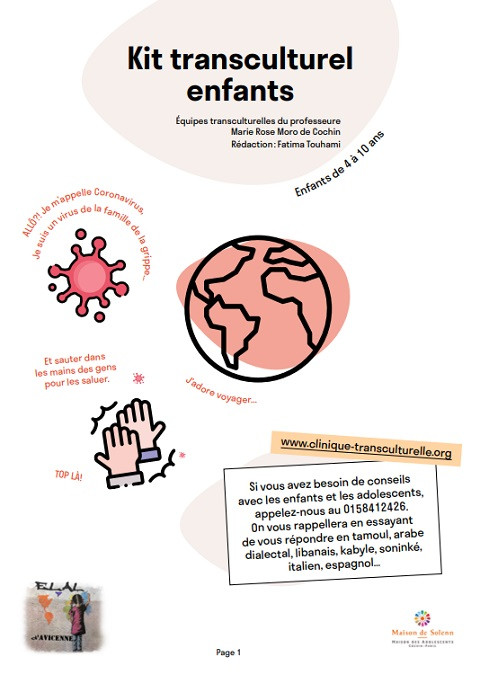 Kit transculturel enfants سنة النشر: 2020 المؤلف: Marie Rose Moro المؤلف المؤسسي: Maison de Solenn Ce kit transculturel est destiné à aider les les familles migrates en période de confinement où il devient crucial d’expliquer à chacun, avec les bons mots et dans sa langue, ce qui se passe. Il est nécéssaire d’aider l’enfant à continuer sa vie d’enfant.
 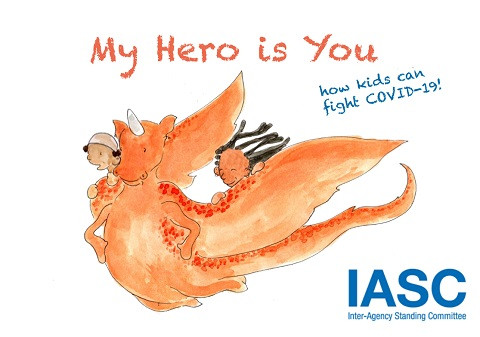 My Hero Is You: How Kids Can Fight COVID-19 سنة النشر: 2020 المؤلف: Helen Patuck المؤلف المؤسسي: Inter-Agency Standing Committee (IASC) A new story book that aims to help children understand and come to terms with COVID-19 has been produced by a collaboration of more than 50 organizations working in the humanitarian sector. With the help of a fantasy creature, Ario explains how children can protect themselves, their families and friends from coronavirus and how to manage difficult emotions when confronted with a new and rapidly changing reality. Mon héroïne, c’est toi: Comment combattre la COVID-19 quand on est un enfant سنة النشر: 2020 المؤلف: Helen Patuck المؤلف المؤسسي: Inter-Agency Standing Committee (IASC) Un novel livre qui a pour but d’aider les enfants à comprendre et à y faire face a été publié par plus d’une cinquantaine d’organisations actives dans le secteur humanitaire. Ario, une créature fantastique, comment les enfants peuvent se protéger et protéger leurs proches et leurs amis du coronavirus et comment ils peuvent gérer les émotions complexes qui s’emparent d’eux lorsqu’ils sont confrontés à une réalité nouvelle qui évolue rapidement.
 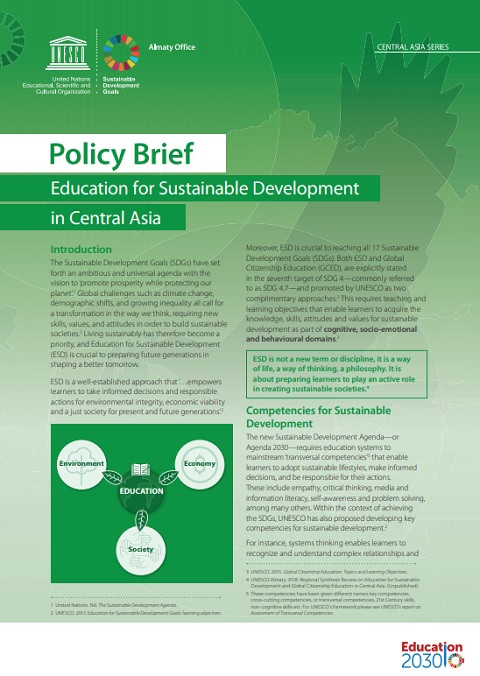 Policy Brief: Education for Sustainable Development in Central Asia سنة النشر: 2019 المؤلف المؤسسي: UNESCO Almaty Education for Sustainable Development(ESD) is crucial to reaching all 17 Sustainable Development Goals (SDGs). Both ESD and Global Citizenship Education (GCED) are explicitly stated in the seventh target of SDG4 and promoted by UNESCO as two complimentary approaches. This requires teaching and learning objectives that enable learners to acquire the knowledge, skills, attitudes and values for sustainable development as part of cognitive, socio-emotional and behavioural domains. This policy brief explores the challenges, promising practices, and policy recommendations when it comes to mainstreaming ESD in Central Asia’s education systems. Аналитическая записка: Образование в интересах устойчивого развития в Центральной Азии سنة النشر: 2019 المؤلف المؤسسي: UNESCO Almaty ОУР имеет решающее значение для достижения всех установленных 17 ЦУР. Как ОУР, так и Образование в духе глобальной гражданственности (ОГГ) непосредственно указаны в седьмой задаче ЦУР 4 как два взаимодополняющих подхода. Для этого перед преподаванием и обучением необходимо ставить задачи, которые позволяют учащимся приобретать знания, навыки, подходы и ценности для устойчивого развития в рамках когнитивных, социальноэмоциональных и поведенческих аспектов. В настоящей аналитической записке излагаются проблемы, примеры применения многообещающих практик и рекомендации по внедрению ОУР в системы образования стран Центральной Азии.
  Young Children’s Citizenship Education in Canada: Background, Content and Values; Based on the Analysis of Early Learning Guidelines in Alberta, British Columbia and Nova Scotia سنة النشر: 2019 المؤلف: Xu Peng المؤلف المؤسسي: Primary and Secondary Education in Foreign Countries Citizenship education for young children has been growingly emphasized by western countries. With the influence of global policy discourses, curriculum reform in early childhood education and studies of young children’s citizenship, citizenship education has become a key aspect in Canadian early childhood curriculum. Based on recent studies, this research forms a theoretical framework for citizenship education, which covers four dimensions of citizenship (political education, social education, subjectivity education and civic practice education). The early learning frameworks in Alberta, British Columbia and Nova Scotia are analyzed through thematic analysis. In general, citizenship education for young children in these three provinces reveal the following features: emphasizing young children’s rights and responsibilities, and advocating young children’s subject positions as citizens; the traditional citizenship is being changed and young children’s participation is highlighted as the root of democracy; young children’s citizenship lies in multiple discursive fields with indigenous perspective emerging.