
الموارد
استكشف مجموعة واسعة من الموارد القيمة حول تعليم المواطنة العالمية لتعميق فهمك وتعزيز البحث والمناصرة والتعليم والتعلم.
تم العثور على 3,158 نتيجة
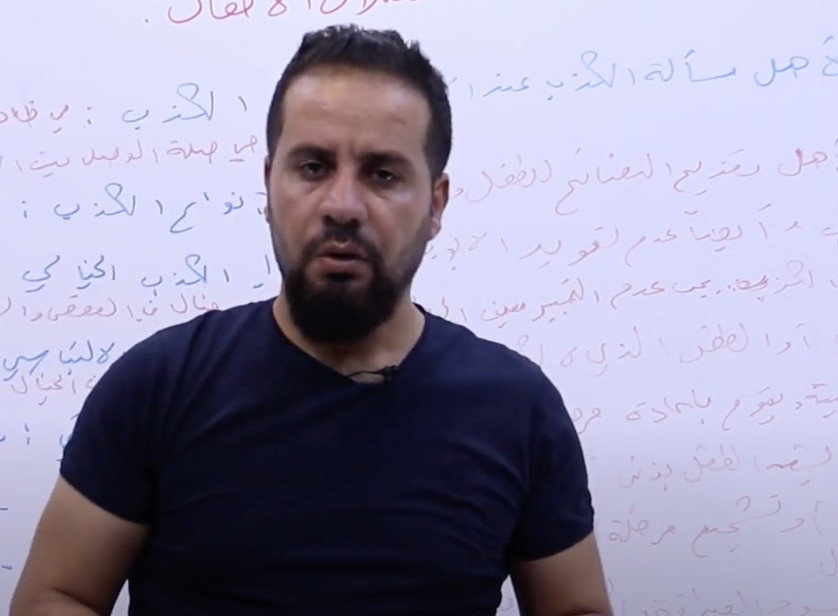 مشكلات الأطفال سنة النشر: 2021 المؤلف: Shaheen Ibrahim في هذا الفيديو تستعرض المعلمة درسا بعنوان "مشكلات الأطفال". هذا الدرس مخصص للصف الثاني عشر في شمال وشرق سوريا. والفيديو من إنتاج قناة تعليمية تابعة لهيئة التربية والتعليم في شمال وشرق سوريا Children's problems سنة النشر: 2021 المؤلف: Shaheen Ibrahim In this video, the teacher reviews a lesson entitled "Children's problems". This lesson is for grade 12 in North and East Syria. The video is produced by an educational channel affiliated with the Education Authority in North and East Syria
 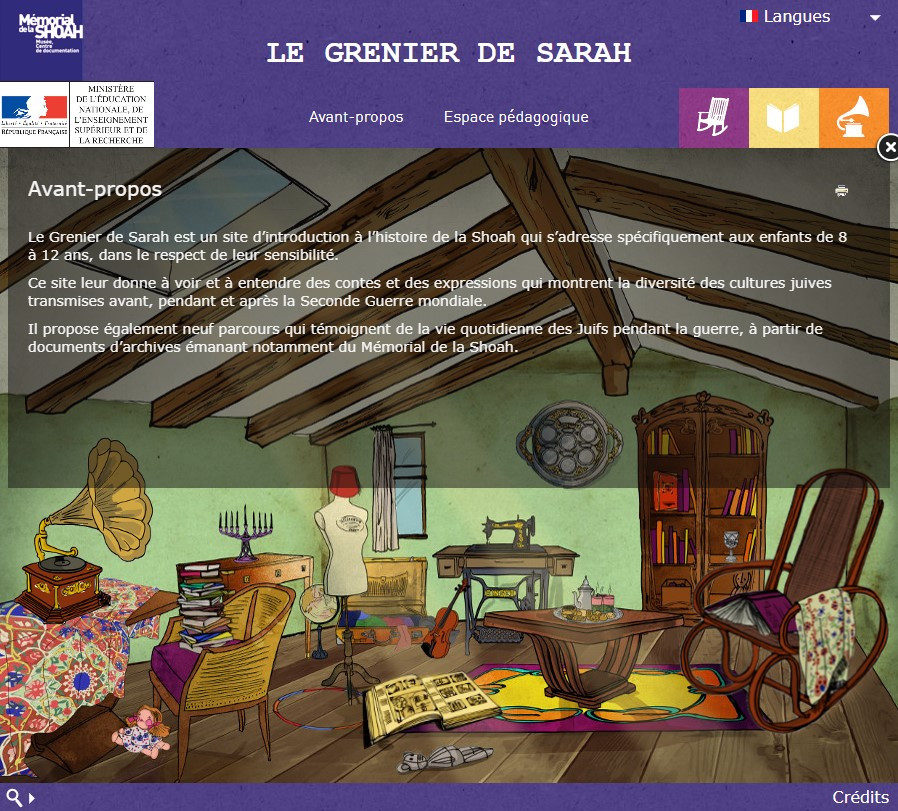 Le grenier de Sarah المؤلف: Jacques Fredj | Barbara Mellul | Adeline Salmon | Barbara Mellul | Adeline Salmon | Tralalère | Alliance concept | Judith Panijel | Alban Perrin | Iannis Roder Lior Lalieu-Smadja | Karen Taieb | Ariel Sion المؤلف المؤسسي: Memorial de la Shoah Le Grenier de Sarah est un site d’introduction à l’histoire de la Shoah, créé spécifiquement pour les enfants de 8 à 12 ans, dans le respect de la sensibilité des jeunes visiteurs. Les choix éditoriaux et iconographiques du site traduisent scrupuleusement cette volonté de ne pas les choquer. Le site a été conçu à partir du questionnement des enfants sur cette période.- Qui étaient ces personnes que les nazis ont voulu assassiner ?- Dans quels pays vivaient-elles ? Quelles langues parlaient-elles ?- Quels ont été les parcours propres à chacune d’entre-elles ?Le Grenier de Sarah permet aux enfants de naviguer sur le site de façon autonome. Toutefois, il est conseillé aux adultes de les accompagner lors de leur première visite afin d’instaurer un dialogue et de répondre à d’éventuelles questions.Pour y répondre, trois rubriques, « Il était une fois », « Des mots à l’oreille » et « En noir et blanc », donnent des clefs de compréhension.- Dans « Il était une fois », des contes donnent un aperçu de la diversité des cultures juives. - Dans « Des mots à l’oreille », des expressions en hébreu, yiddish, judéo-espagnol et judéo-arabe ouvrent une fenêtre sur la pluralité du judaïsme. - Dans « En noir en blanc », neuf parcours témoignent de la vie quotidienne des Juifs pendant la guerre. En cliquant sur l’album photo, l’enfant choisit d’entendre un des récits de vie proposés.Tout au long de chaque parcours, des définitions et des documents, sont à la disposition du jeune visiteur. Pour les enseignants, un espace pédagogique spécifique a été créé afin d’y trouver des ressources complémentaires et des pistes de travail. Sarah’s attic is a website introducing to the Shoah History. It was specifically created for children from age 8 to 12 and respects their sensibility as young visitors. The contents and iconography are carefully intended to suit their emotional and cognitive abilities.The website was designed and elaborated from questions asked by children in History classes teaching this time period - Who were these persons the Nazis wanted to murder?- In which countries did they live? Which languages did they speak?- What were their personal experiences? Sarah’s attic enables children to navigate through the website on their own. Nevertheless, we recommend that adults accompany them on their first visit in order to create a dialog and answer possible questions.As part of a school or extra-curricular framework, this program can be used in small groups with the guidance of an adult.In order to answer these questions, three sections “Once upon a time”, “Words to my ear” and “In black and white” give keys to understanding the event.- In “Once upon a time”, tales give a glimpse of the diversity of Jewish cultures. - In “Words to my ear”, expressions in Hebrew, Yiddish, Judeo-Spanish and Judeo-Arabic open a window on the pluralism of Judaism. - In “In Black and white”, nine personal itineraries bear witness of the daily life of Jews during the war. Along each personal story, definitions and documents are available to the young visitor.For teachers and educators, a specific educational section contains additional resources, guidelines and teaching materials.
  أدوات التقييم الخاصة بتطبيق أداة تعليم المهارات الحياتية والمواطنة: قياس المهارات الحياتية بناءً على إطار العمل الإقليمي لتعليم المهارات الحياتية والمواطنة في منطقة الشرق الأوسط وشمال أفريقيا; امللخص التنفيذي سنة النشر: 2021 المؤلف المؤسسي: UNICEF Middle East and North Africa "إن تعليم المهارات الحياتية مُهم للغاية لتمكين الأطفال والشباب من تحقيق النجاح في التعليم والعمل والأهداف الشخصية. ومع ذلك، قد أدرجت القليل من الأنظمة التعليمية المهارات الحياتية في نظامها التعليمي. ومن أسباب ذلك هو التحديات المتعلقة بنقص المعرفة الخاصة بكيفية قياس المهارات الحياتية وتقييمها. وبناءً على إطار العمل الإقليمي لتعليم المهارات الحياتية والمواطنة في الشرق الأوسط وشمال أفريقيا، فإن منظمة اليونيسف والبنك الدولي قد طورا أداة تعليم المهارات الحياتية والمواطنة لقياس المستوى الوطني لنتائج طلبة الصف السابع في ثماني مهارات حياتية بوصفه تقييم وطني واسع النطاق. يرجى أيضًا الاطلاع على منشور قياس المهارات الحياتية." LSCE Measurement Instrument: Measuring Life Skills in the Context of Life Skills and Citizenship Education in the Middle East and North Africal; Advocacy Brief سنة النشر: 2021 المؤلف المؤسسي: UNICEF Middle East and North Africa Teaching and learning life skills is incredibly important for empowering children and young people to achieve success in education, employment, and personal goals. Nevertheless, few education systems have integrated life skills into their education systems. One of the reasons for this is challenges concerning the lack of knowledge as to how life skills can be measured, assessed, and evaluated. Building on the regional Life Skills and Citizenship Education (LSCE) framework in the Middle East and North Africa (MENA), UNICEF and The World Bank have developed this LSCE Measurement Instrument, to measure the national level of grade 7 students’ scores in eight life skills as national large-scale assessment.
  Imagining the Classroom Full of Learning in the Future: Effective Teaching With Social Constructive Learning (Educational Journal ; Vol.48, No.2) سنة النشر: 2020 المؤلف: 洪瑜佩 This article used an observation scale, together with literature exploration and film observation, to imagine the future classroom. From literature review, it was found that constructivist teaching helps students acquire new knowledge and develop cognition through connecting new and old knowledge. Teaching with the social constructivism approach regards learning as the result of interaction with society and culture. This article aimed to explore the social constructivist teaching context, as well as to observe which aspects and connotations teachers should pay attention to in curriculum arrangement. The researcher amended the observation scale designed by Good & Lavigne (2018) with five steps: (a) raising questions;(b) collaboration and suggestions; (c) assessment and discussions; (d) application to scenarios; and (e) summarizing knowledge. Teachers’ teaching was observed and assessed based on the five steps. The following results were found: (a) students should have the responsibilities of learning;(b) teachers must have good questioning and guidance skills; (c) teachers need to incorporate learning into real-life situations; (d) students’ cognition must be reviewed and monitored frequently. The researcher believes that a classroom full of learning is not imaginary. Teachers already have the ability to construct effective classrooms and should treat students as the learning agent. 想像未来充满学习的教室──以社会建构学习谈有效教学 (教育学报; Vol.48, No.2) سنة النشر: 2020 المؤلف: 洪瑜佩 本文采用观察量表分析,透过文献探讨和影片观察,提出未来课堂教室的想像。从文献中发现建构主义的教学是透过连结新知识与旧知识,帮助学生获得新知、发展认知,而社会建构主义的教学则认为学习是与社会、文化互动所得的结果。本文目的是探究社会建构主义的教学情境建构,观察教师的课程安排有哪些该注意的面向和内涵。研究者从good & lavigne(2018)设计的观察量表修正成一份由提出问题、协作建议、评估讨论、应用情境、总结知识五步骤的量表,看待教师的社会建构主义教学,发现以下特征:(1)将学习责任逐步交还给学生;(2)教师须具备良好的提问与引导技巧;(3)将学习加入生活情境脉络之中;(4)必须时时刻刻检视学生的认知。研究者认为充满学习的教室并非想像,现场教师已有能力建构有效教学的教室,应将学习主体还给学生。
 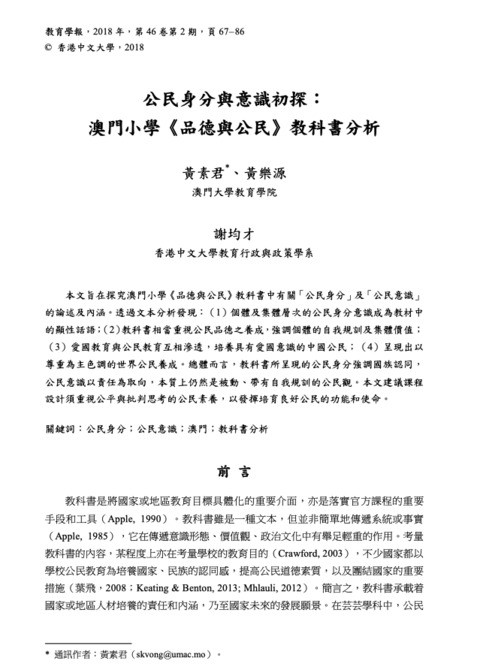 An Exploration of Citizenship Identity and Civic Awareness: An Analysis of Moral and Civic Education Primary School Textbooks in Macao (Educational Journal ; Vol.48, No.1) سنة النشر: 2018 المؤلف: 黄素君 | 黄乐源 | 谢均才 This article aims to explore the discourses of citizenship identity and civic awareness embedded in the series of Moral and Civic Education primary school textbooks in Macao. The study reveals that: (a) the personal and collective level of civic awareness is the dominant discourse in the textbooks; (b) the textbooks give an important weighting to the cultivation of the character of citizens as well as the importance of individual self-discipline and collective value; (c) patriotic education and civic education intertwine in order to cultivate a patriotic Chinese citizen; (d) “respect” is the key concept in cultivating the global citizen in the textbooks. The citizenship presented in the textbooks emphasizes the formation of national identity, and a form of responsibility-driven civic awareness. In essence, the cultivation of citizenship identity and civic awareness still demonstrates a passive and self-disciplined view. This article suggests that curriculum design should emphasize on the cultivation of fairness and critical thinking in order to fulfill a comprehensive mission and function of citizenship education. 公民身分与意识初探:澳门小学《品德与公民》教科书分析 (教育学报; Vol.46, No.2) سنة النشر: 2018 المؤلف: 黄素君 | 黄乐源 | 谢均才 本文旨在探究澳门小学《品德与公民》教科书中有关「公民身分」及「公民意识」的论述及内涵。透过文本分析发现:(1)个体及集体层次的公民身分意识成为教材中的显性话语;(2)教科书相当重视公民品德之养成,强调个体的自我规训及集体价值;(3)爱国教育与公民教育互相渗透,培养具有爱国意识的中国公民;(4)呈现出以尊重为主色调的世界公民养成。总体而言,教科书所呈现的公民身分强调国族认同,公民意识以责任为取向,本质上仍然是被动、带有自我规训的公民观。本文建议课程设计须重视公平与批判思考的公民素养,以发挥培育良好公民的功能和使命。
 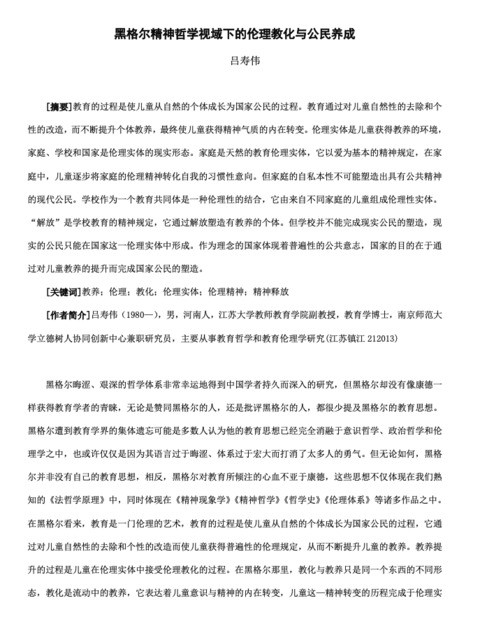 Ethical Civilization and the Cultivation of Citizens in the Perspective of Hegel’s Philosophy of Spirit (Ethical Education Research; No.2, 2019) سنة النشر: 2019 المؤلف: 吕寿伟 The process of education is to make children grow from natural individuals to national citizens. Education constantly improves individual upbring through the removal of children’s nature and the transformation of their individuality, and ultimately makes the inner change of children’s spirit. Ethical entities are the environment for children to be nurtured, and families, schools and states are the realistic forms. Family is the natural ethical entity of education, which takes love as the basic spiritual rule. In family, children gradually transform the family’s ethical spirit into the habitual intention of self. But the selfish nature of the family cannot create a modern citizen with a public spirit. The school, as an educational community, is an ethical combination which consists of children from different families. “Emancipation”,which is the spiritual rule of school education, creates educated individuals. But school cannot shape the real citizens, which can only be formed in the ethical entity of the country. The state, as a concept, embodies the common will of the public. The purpose of the state is to complete the shaping of the national citizens through the promotion of children' upbring.