
الموارد
استكشف مجموعة واسعة من الموارد القيمة حول تعليم المواطنة العالمية لتعميق فهمك وتعزيز البحث والمناصرة والتعليم والتعلم.
تم العثور على 3,559 نتيجة
 Policies and practices of holocaust education : international perspectives (Vol 40) Issue 153-154 سنة النشر: 2010 المؤلف المؤسسي: UNESCO International Bureau of Education (IBE) This double issue of Prospects (UNESCO/IBE) includes important contributions and new insights from researchers who have examined the practices of Holocaust education in various parts of the world. An open call for papers for this issue brought more than 30 contributions, a pool of high quality papers that greatly exceeded expectations, leading to the production of a double issue on the topic. The broad interest and new research are a testimony both to the significance of the field and to its challenges. The articles in the first volume contribute empirical research about the actual policies and practice of Holocaust education and carry direct lessons from school and classroom practices not only for countries in Europe but also for human rights and peace education worldwide. The second volume continues to reflect its authors’ practical and intellectual engagement with the implications of Holocaust education for human rights, multicultural, peace, and civic education. (By the publisher) Politiques et pratiques de l'éducation holocauste: perspectives internationales (Vol 40) Émission 153-154 سنة النشر: 2010 المؤلف المؤسسي: UNESCO International Bureau of Education (IBE) Ce double numéro de Perspectives (UNESCO / BIE) comprend des contributions importantes et de nouvelles perspectives de chercheurs qui ont examiné les pratiques de l'éducation de l'Holocauste dans diverses parties du monde. Un appel à communications pour cette question a plus de 30 contributions, un pool de documents de qualité qui ont largement dépassé les attentes, conduisant à la production d'un numéro double sur le sujet. L'intérêt général et de nouvelles recherches sont un témoignage à la fois l'importance du champ et à ses défis. Les articles dans le premier volume contribuent la recherche empirique sur les politiques et les pratiques réelles de l'Holocauste et portent des enseignements directs de pratiques scolaires et en classe, non seulement pour les pays d'Europe, mais aussi pour les droits de l'homme et éducation à la paix à travers le monde. Le deuxième volume continue de refléter l'engagement pratique et intellectuel de ses auteurs avec les conséquences de l'Holocauste pour les droits de l'homme, multiculturel, la paix et l'éducation civique. (Par l'éditeur)
  Fearful symmetry: Palestinian and Jewish teachers confront contested narratives in integrated bilingual education The present paper deals with Jewish and Palestinian teachers who work in an integrated school in Israel, and shows the challenges and possibilities by examining these teachers' powerful historical narratives in the context of in-service training sessions. It is shown how these teachers essentially remain firmly rooted in the hegemonic historical narratives of their own community, even when their attitudes are challenged and clearer alternatives are considered to the reigning narratives. The findings highlight predominantly the failures, concerning the potential of educational efforts to help overcome situations of intractable conflict, even within contexts specifically devised for this purpose; yet, some openings also become apparent in the process of negotiating competing narratives and inventing new dialogic possibilities. The paper suggests that schools with their historical tradition are places where it is difficult to reach change or to produce it—even in integrated schools in which partial structural change takes place—and teacher training may not always be the answer. However, it also indicates that an ongoing agonistics of raising critical issues regarding one's identifications with hegemonic narratives does offer openings to take responsibility for both the challenges and the dialogic possibilities that are created in the process.
  Discussion Papers Journal (Vol 3) Volume III presents a diverse group of authors writing on a wide range of topics. Among the contributors are academics, researchers, and sociologists, the chairman of a world-renowned Holocaust museum, the Special Advisers to the Secretary-General on the Prevention of Genocide and the Responsibility to Protect, a Hollywood filmmaker, and a former United Nations intern. They are from Canada, Denmark, Israel, Morocco, Senegal, Serbia, the United Kingdom and the United States. Their articles deal with a fascinating wide range of issues including Holocaust education in Denmark, and in Morocco; the International Holocaust Remembrance Alliance; music and the Holocaust; rescue; the preservation of former Nazi concentration and death camps; crimes committed against the Roma and Sinti during the Second World War; the post-Holocaust memory of German-Jewish achievements; and the prevention of atrocity crimes. (By the publisher) Discussion Papers Journal (Vol 3) Volume III présente un groupe diversifié d'auteurs écrivant sur un large éventail de sujets. Parmi les contributeurs sont des universitaires, des chercheurs et des sociologues, le président d'un musée de l'Holocauste de renommée mondiale, les Conseillers spéciaux du Secrétaire général sur la prévention du génocide et la responsabilité de protéger, un cinéaste d'Hollywood, et un ancien stagiaire des Nations Unies . Ils sont du Canada, le Danemark, Israël, le Maroc, le Sénégal, la Serbie, le Royaume-Uni et aux États-Unis. Leurs articles traitent d'un large éventail fascinant de questions, y compris l'Holocauste au Danemark et au Maroc; l'Alliance internationale Holocauste; la musique et l'Holocauste; porter secours; la préservation des anciens camps de concentration et d'extermination nazis; les crimes commis contre les Roms et les Sintis pendant la Seconde Guerre mondiale; la mémoire post-Holocauste des réalisations juifs allemands; et la prévention des crimes atroces. (Par l'éditeur)
  ´Holocaust Fatigue': Teaching it today The review "Research & Practice", established early in 2001, features educational research that is directly relevant to the work of classroom teachers. Here, I invited Simone Schweber to examine teaching and learning about the Holocaust in light of alternative approaches, current politics, and popular culture. (By the publisher) L'enseignement de la Shoah dans les écoles juives In this article, Katy Hazan studies the teaching of the Holocaust in Jewish schools. First, she portrays the educational systems of these specific schools and second, she establishes all the ethical, philosophical issues this theme entails. In the third part, she takes inventory of alternative ways of teaching the Holocaust, to conclude on the danger of emotional approaches. Teaching the Holocaust at a distance : reflections from the field As technology continues to improve and online learning programs continue to proliferate each year throughout the United States, it is necessary for teachers to establish a sound understanding of proper pedagogical techniques for a digital environment. This phenomenon has ushered in a new era of education, thus bringing forth a myriad of new questions and issues that must be addressed. For instance, how should online instructors properly transfer and teach traditional core subjects in an online milieu? Social studies educators are faced with additional quandaries, such as teaching democratic processes for effective citizenship and the teaching of controversial issues/topics like the Holocaust. Undeniably, controversial topics elicit strong emotions and come with a plethora of concerns that seem only possible to address in a face-to-face classroom. This current exploration draws upon the scholarship and experience of experts in the field of social studies education, distance learning, and Holocaust Studies to provide suggestions as to how teachers should approach controversial topics in a digital learning environment. An example lesson plan is also provided to showcase a successful integration of controversial issues into an online high school social studies classroom. (By the author)
  Seeing the world from today from a different viewpoint: The impact of the lessons from Auschwitz project on schools in Scotland Auschwitz remains the epitome of inhumanity and barbarism. In 2007, the Holocaust Educational Trust organised the first Lessons from Auschwitz (LFA) project for Scottish schools. Its participants were two plane-loads of Scottish pupils and teachers from 31 local authorities – typically two pupils from a school accompanied by a teacher. This research, funded by the Holocaust Educational Trust and the Pears Foundation, involved these participants being invited to complete an online questionnaire with selected follow-up interviews. The aims were to evaluate the LFA project and provide insight into the impact this project had on individuals, schools and communities. This paper will report on: Student evaluation of the LFA project ; The impact of the LFA project on individuals, schools and local communities. Conclusions as to the value of the LFA project in Scotland. (By the author)
 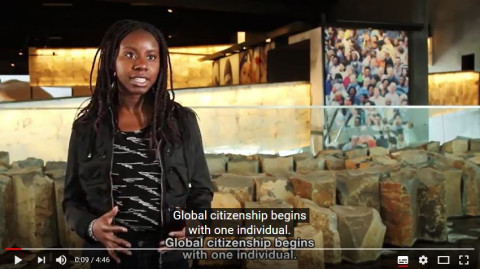 [Vidéo] Citoyenneté mondiale: citoyens du monde au 21e siècle سنة النشر: 2016 المؤلف المؤسسي: Canadian Commission for UNESCO Des participants de la Conférence nationale des écoles UNESCO se sont exprimés sur la définition de la citoyenneté mondiale et sur les qualités d'un citoyen du monde. L’événement avait lieu dans le cadre de la 56e Assemblée générale annuelle de la Commission canadienne pour l’UNESCO et avait pour but de promouvoir le rôle de chef de file de l'UNESCO dans l'Agenda 2030 pour l'éducation. Cette vidéo a été produite au Musée canadien pour les droits de la personne, à Winnipeg, au Manitoba.