
الموارد
استكشف مجموعة واسعة من الموارد القيمة حول تعليم المواطنة العالمية لتعميق فهمك وتعزيز البحث والمناصرة والتعليم والتعلم.
تم العثور على 3,559 نتيجة
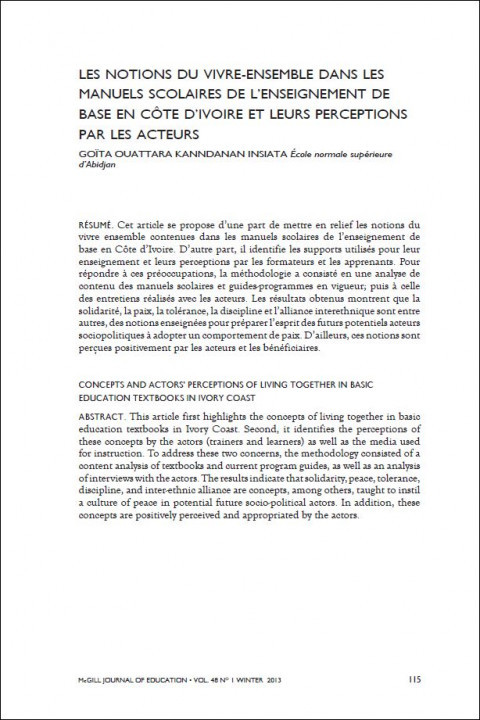 Concepts and Actors’ Perceptions of Living Together in Basic Education Textbooks in Ivory Coast سنة النشر: 2013 المؤلف: Goïta Ouattara Kanndanan Insiata المؤلف المؤسسي: McGill University. Faculty of Education This article first highlights the concepts of living together in basic education textbooks in Ivory Coast. Second, it identifies the perceptions of these concepts by the actors (trainers and learners) as well as the media used for instruction. To address these two concerns, the methodology consisted of a content analysis of textbooks and current program guides, as well as an analysis of interviews with the actors. The results indicate that solidarity, peace, tolerance, discipline, and inter-ethnic alliance are concepts, among others, taught to instil a culture of peace in potential future socio-political actors. In addition, these concepts are positively perceived and appropriated by the actors.
  Teaching, Learning, and the Holocaust: An Integrative Approach Classroom study of the Holocaust evokes strong emotions in teachers and students. Teaching, Learning, and the Holocaust assesses challenges and approaches to teaching about the Holocaust through history and literature. Howard Tinberg and Ronald Weisberger apply methods and insights of the Scholarship of Teaching and Learning to examine issues in interdisciplinary teaching, with a focus on the community college setting. They discuss student learning and teacher effectiveness and offer guidance for teaching courses on the Holocaust, with relevance for other contexts involving trauma and atrocity. (By the author)
 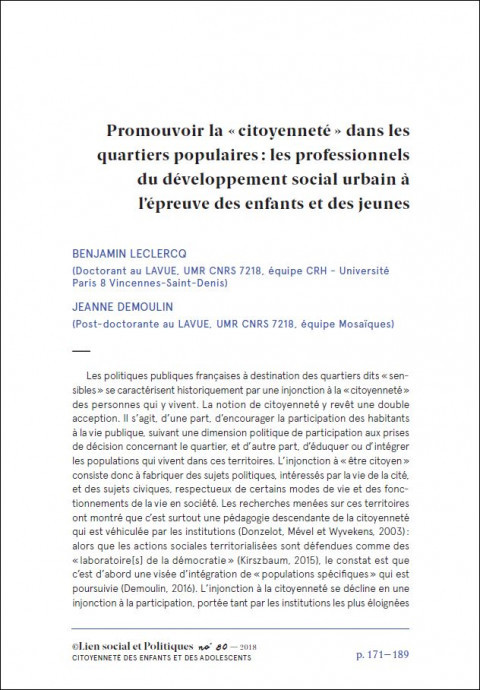 Fostering “Citizenship” in Poor Neighborhoods: The Professionals of Urban Social Development Tested at Children and Young People سنة النشر: 2018 المؤلف: Benjamin Leclercq | Jeanne Demoulin المؤلف المؤسسي: Lien social et Politiques This article examines the tensions that govern the injunction to behave like a citizen in the working-class neighborhoods in France. More specifically, it focuses on recruited or appointed professionals of social urban development’s practices by social housing organizations, who fight against antisocial behavior of which the tenants children are made responsible (damages, vandalism and so on…). The social interventions designed by these professionals for children and young people are similar to forms of citizenship education that oscillate between normalization behavior and development of commitment to the common good. On the one hand, they are meant to be encounters that can lead to questioning about living together in the neighborhood. And on the other hand, because they want to keep a managerial approach of public spaces, they find it hard to resist to the simple reminder of the basic norms of living together in a community. To avoid this moral approach to citizenship, agents seek to empower their audience so that it thinks itself about how to solve the problems it faces. According to a capability-driven of citizenship, this participatory work implies to master the rules of civility. Consequently, it is aimed at the most influential young people, the “bigger brothers” with coaching skills. The professionals then seek to give them “codes” to be recognized as partners of the institutions. But this partnership involves acquiring some skills, indeed these young people will have to adapt the ways of doing and saying local politics without publicizing their ordinary critics of the institutional functioning. Promouvoir la « citoyenneté » dans les quartiers populaires : les professionnels du développement social urbain à l’épreuve des enfants et des jeunes سنة النشر: 2018 المؤلف: Benjamin Leclercq | Jeanne Demoulin المؤلف المؤسسي: Lien social et Politiques Cet article interroge les tensions qui régissent l’injonction à se comporter en citoyen dans les quartiers populaires en France. Plus spécifiquement, il s’intéresse aux pratiques des professionnels du développement social urbain, recrutés ou mandatés par des organismes HLM pour lutter contre les incivilités dont les enfants des locataires sont rendus responsables (dégradations, vandalisme…). Les interventions sociales conçues par ces professionnels à l’intention des enfants et des jeunes s’apparentent à des formes d’éducation à la citoyenneté qui oscillent entre normalisation des conduites et valorisation de l’engagement pour le bien commun. D’un côté, elles constituent des expériences susceptibles d’engendrer des questionnements profanes sur le vivre-ensemble dans la Cité. De l’autre, en demeurant tributaires d’une approche gestionnaire de l’espace public, elles résistent mal au simple rappel des normes élémentaires du savoir-vivre en société. Pour éviter cette approche morale de la citoyenneté, les agents cherchent alors à donner des capacités à leur public afin que celui-ci résolve de lui-même les problématiques auxquelles il est confronté. Ce travail participatif est redevable d’une conception capacitaire de la citoyenneté, impliquant une maîtrise préalable de la civilité. Il s’adresse ainsi aux jeunes les plus influents, les « grands frères » qui détiennent des compétences d’encadrement de leurs pairs. Les professionnels cherchent alors à leur donner des « codes » pour être reconnus comme partenaires des institutions. Mais ce partenariat implique d’acquérir des compétences d’adaptation aux façons de faire et de dire la politique locale qui n’autorisent pas ces jeunes à publiciser leurs critiques ordinaires du fonctionnement institutionnel. Les notions du vivre-ensemble dans les manuels scolaires de l’enseignement de base en Côte d’Ivoire et leurs perceptions par les acteurs سنة النشر: 2013 المؤلف: Goïta Ouattara Kanndanan Insiata المؤلف المؤسسي: McGill University. Faculty of Education Cet article se propose d’une part de mettre en relief les notions du vivre ensemble contenues dans les manuels scolaires de l’enseignement de base en Côte d’Ivoire. D’autre part, il identifie les supports utilisés pour leur enseignement et leurs perceptions par les formateurs et les apprenants. Pour répondre à ces préoccupations, la méthodologie a consisté en une analyse de contenu des manuels scolaires et guides-programmes en vigueur; puis à celle des entretiens réalisés avec les acteurs. Les résultats obtenus montrent que la solidarité, la paix, la tolérance, la discipline et l’alliance interethnique sont entre autres, des notions enseignées pour préparer l’esprit des futurs potentiels acteurs sociopolitiques à adopter un comportement de paix. D’ailleurs, ces notions sont perçues positivement par les acteurs et les bénéficiaires.
  Historicizing the Uses of the Past: Scandinavian Perspectives on History Culture, Historical Consciousness and Didactics of History Related to World War II This book presents new developments in Scandinavian memory cultures related to World War II and the Holocaust by combining this focus with the perspective of history didactics. The theoretical framework of historical consciousness offers an approach linking individual and collective uses and re-uses of the past to the question how history can and should be taught. It also offers some examples of good practice in this field. The book promotes a teaching practice which, in taking the social constructivist notions of historical consciousness as a starting point, can contribute to self-reflecting and critical thinking - being fundamental for any democratic political culture. (By the author)
 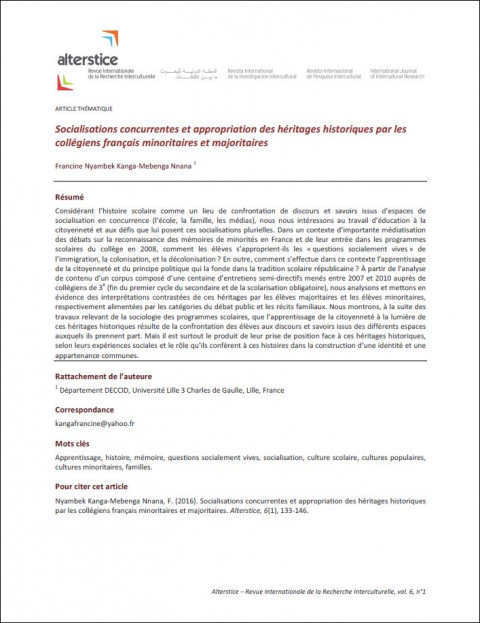 Socialisations concurrentes et appropriation des héritages historiques par les collégiens français minoritaires et majoritaires سنة النشر: 2016 المؤلف: Francine Nyambek Kanga-Mebenga Nnana المؤلف المؤسسي: Alterstice Considérant l’histoire scolaire comme un lieu de confrontation de discours et savoirs issus d’espaces de socialisation en concurrence (l’école, la famille, les médias), nous nous intéressons au travail d’éducation à la citoyenneté et aux défis que lui posent ces socialisations plurielles. Dans un contexte d’importante médiatisation des débats sur la reconnaissance des mémoires de minorités en France et de leur entrée dans les programmes scolaires du collège en 2008, comment les élèves s’approprient-ils les « questions socialement vives » de l’immigration, la colonisation, et la décolonisation ? En outre, comment s’effectue dans ce contexte l’apprentissage de la citoyenneté et du principe politique qui la fonde dans la tradition scolaire républicaine ? À partir de l’analyse de contenu d’un corpus composé d’une centaine d’entretiens semi-directifs menés entre 2007 et 2010 auprès de collégiens de 3e (fin du premier cycle du secondaire et de la scolarisation obligatoire), nous analysons et mettons en évidence des interprétations contrastées de ces héritages par les élèves majoritaires et les élèves minoritaires, respectivement alimentées par les catégories du débat public et les récits familiaux. Nous montrons, à la suite des travaux relevant de la sociologie des programmes scolaires, que l’apprentissage de la citoyenneté à la lumière de ces héritages historiques résulte de la confrontation des élèves aux discours et savoirs issus des différents espaces auxquels ils prennent part. Mais il est surtout le produit de leur prise de position face à ces héritages historiques, selon leurs expériences sociales et le rôle qu’ils confèrent à ces histoires dans la construction d’une identité et une appartenance communes.
  Thinking Today’s Adolescents’ Citizenship through Social Justice Lens: Why and How? سنة النشر: 2018 المؤلف: Caroline Caron المؤلف المؤسسي: Lien social et Politiques How do we know what we know about youth citizenship ? This epistemological question has been neglected in the field of youth citizenship and public discourses on youth political apathy. This article draws on the theoretical perspective of social justice studies to unmask the relations of power based on age that have shaped current knowledge about youth citizenship. The analysis draws attention to the epistemic injustices and methodological flaws in the specific field of civic literacy in Canada. It is argued that a difference-centered approach to youth citizenship could help foster a better understanding of youth experiences of civic engagement and political participation. Yet, this potentiel can only be achieved through a self-reflexive inquiry that critically investigates the research process itself in current research trends. Although a dominant approach in the study of civic literacy is limited in its capacity to produce knowledge that is socially just towards adolescents, the concept could be reinvigorated through a critical empirically-grounded examination of youth civic competencies that are evidenced in some of their engagments with new media technologies. Yet, to fulfill this goal also requires that scholars engage in crucial debates about their chosen epistemology and theory of democracy. Holocaust Education and English Language Learner Students - Reflections on Teaching the Shoah Teaching the Holocaust involves confronting many challenges regardless of the setting involved. The complex nature of Holocaust history demands that students and teachers function at high intellectual levels as they study that history, and the need to determine how sensitive topics should be approached challenges educators in ways that are not present when teaching most other topics. Thus, any teaching of the Shoah places significant demands on teachers‘ content knowledge and pedagogical expertise. These demands increase when educators teach students whose backgrounds differ from those of the general population. Specifically, students whose language skills limit their understanding of texts and classroom dialogue face multiple challenges as they seek to learn within new school environments. Moreover, the distinctive cultural milieu and life experiences that form the frames of references from which these students approach the study of all social studies topics make it imperative that teachers build curricula that include culturally relevant perspectives in order to ensure that students are provided an opportunity to learn material at sophisticated levels. This paper considers how these factors influence the teaching of the Shoah in a Roman Catholic high school located in a major city in the western United States. More than 80% of the school’s students are either immigrants to the United States or members of the first generation of their families to be born in this country; thus, most students have been identified as English Language Learners (ELLs), a category used to determine if special language services should be provided to them. This paper overviews English language learning in the United States and teaching social studies to ELL students before discussing teaching the Holocaust in a parochial school whose primary focus is on teaching ELL students. (By the author - Introduction) Challenging stereotypes and avoiding the superficial: A suggested approach to teaching the Holocaust Alison Kitson provides a rationale for a scheme of work for Year 9 (13-14 year olds). She argues that teachers should analyse the kind of historical learning that is taking place when the Holocaust is studied. Critical of the assumption that learning will take place as a result of exposure, she argues that teachers need to think about learning outcomes and to explore how these connect and support each other. She draws upon the types of historical thinking specified by the National Curriculum in England and shows how these can link up with areas of knowledge that pupils need if they are to understand the context of the Holocaust. Like Kate Hammond, she argues that emotional, human response and moral learning can and should be involved in teaching the Holocaust and that this can support ‒ rather than detract from ‒ rigorous historical analysis of sources and causes. (By the publisher)