
الموارد
استكشف مجموعة واسعة من الموارد القيمة حول تعليم المواطنة العالمية لتعميق فهمك وتعزيز البحث والمناصرة والتعليم والتعلم.
تم العثور على 3,530 نتيجة
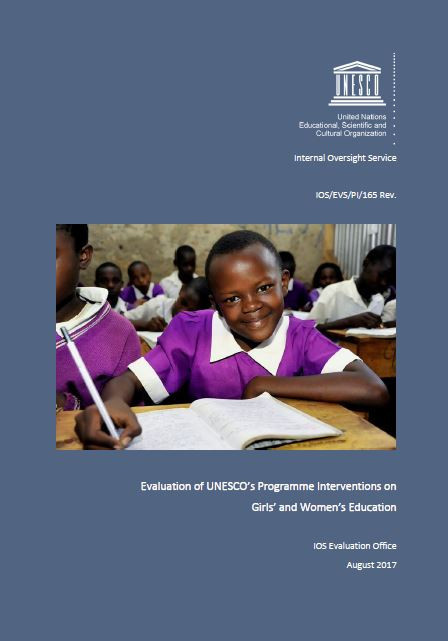 Evaluation of UNESCO's Programme Interventions on Girls' and Women's Education سنة النشر: 2017 المؤلف: Michael Reynolds, Martina Rathner, Estelle Loiseau المؤلف المؤسسي: UNESCO Internal Oversight Service (IOS) Since 2008, Gender Equality has been one of two global priorities for UNESCO. In May 2011, UNESCO launched the Global Partnership for Girls’ and Women’s Education, also known as “Better Life, Better Future”, which aims to increase learning opportunities for adolescent girls and women and to find solutions to some of the biggest obstacles to their education. To further advance the global priority of Gender Equality, since 2015 a dedicated Section of Education for Inclusion and Gender Equality specifically addresses the gender dimensions in education that contribute to differential access, participation, completion, and learning outcomes by boys and girls, and men and women. The evaluation examines UNESCO’s programme interventions in girls’ and women’s education during the period 2015 to 2017, in particular to ascertain the relevance, effectiveness, efficiency and sustainability of initiatives, and to clarify the strategic role and positioning of the Organization in supporting girls’ and women’s education at regional and country levels.The evaluation found that although UNESCO’s efforts for enhancing girls’ and women’s education are clearly aligned to SDG 4 and SDG 5 and also broadly in line with the overall principle of leaving no one behind, there is at times a trade-off between targeting the hardest to reach and other donor priorities, and UNESCO needs to more clearly position its efforts in support of girls’ and women’s education and its niche in the 2030 Agenda. Furthermore, continued efforts are required to scale up and/or replicate small-scale interventions, to better ensure sustainability and to consolidate mechanisms for coordination and information sharing among different interventions to seize synergies and enhance organizational learning.
  Key Concepts: A Feminist Approach to Human Rights Education (Chapter 4) سنة النشر: 2014 المؤلف: Julie Maia المؤلف المؤسسي: Stanford Human Rights Education Initiative (SHREI) Developed for the Stanford Human Rights Education Initiative (SHREI), this curriculum project examines connections among Gender Studies, feminist theory, and human rights movements around the world. This SHREI project presents its four key concepts through four curricular units, or chapters, each with a series of activities that can easily be adapted for use in courses in many disciplines. Each chapter contains these elements: A definition of the key concept An example of the use of the concept in a human rights document A brief essay on the value of the concept for human rights education A series of activities that guide students in using gender, race/ethnicity/nation, and class as lenses for analyzing social justice issues include transnational and multicultural perspectives on gender and human rights issues use "best practices" pedagogies for teaching human rights topics in community colleges. Within each chapter, activities are orgaized from simple to complex. Most activities, however, have self-contained objectives and can be used independently of the others. Sections on “Extending the Learning” offer longer readings or in-depth material for advanced courses. The GCED Clearinghouse introduces only chapter 4, "global citizenship" of this SHERI project.
  2014 syllabus: character and citizenship education: secondary سنة النشر: 2014 المؤلف المؤسسي: Singapore. Ministry of Education. Student Development Curriculum Division Character and Citizenship Education (CCE) has always been at the heart of Singapore's education system. In CCE, students learn to be responsible to family and community; and understand their roles in shaping the future of nation. The emerging trends and global developments that impact the society, such as social changes, globalisation and technological advancements are taken into consideration in the development of the CCE curriculum. The goal of CCE is to inculcate values and build competencies in students to develop them to be good individuals and useful citizens. Since 1959, various key programmes have been introduced to inculcate values, habits, competencies and skills in students. Some of these programmes include Civics and Moral Education (CME, 1992), National Education (NE, 1997), Social and Emotional Learning (SEL, 2005), and learning experiences such as Co-Curricular Activities (CCA).The new CCE curriculum shifts focus from programmes to a common purpose. The desired outcomes of CCE are aligned to the Key Stage Outcomes (KSOs) and Desired Outcomes of Education (DOE). CCE is central to the Framework for 21st Century Competencies and Student Outcomes. It emphasizes the interconnectedness of the core values, social and emotional competencies and civic literacy, global awareness and cross-cultural skills that are critical for character and citizenship development of students. 2014 syllabus: le caractère et l'éducation à la citoyenneté: secondaire سنة النشر: 2014 المؤلف المؤسسي: Singapore. Ministry of Education. Student Development Curriculum Division Caractère et éducation à la citoyenneté (CEC) a toujours été au cœur du système éducatif de Singapour. En CEC, les élèves apprennent à être responsables de la famille et de la communauté; et de comprendre leurs rôles dans l'élaboration de l'avenir de la nation. Les nouvelles tendances et évolutions mondiales qui influent sur la société, tels que les changements sociaux, la mondialisation et les progrès technologiques sont pris en considération dans l'élaboration du programme de la CCE. L'objectif de la CCE est d'inculquer des valeurs et de construire des compétences chez les élèves de les développer pour être de bons individus et des citoyens utiles. Depuis 1959, divers programmes clés ont été mis en place pour inculquer des valeurs, des habitudes, des compétences et des compétences chez les élèves. Certains de ces programmes comprennent l'éducation civique et l'éducation morale (ECM, 1992), l'éducation nationale (NE, 1997), social et apprentissage émotionnel (SPE, 2005), et les expériences d'apprentissage tels que Co-curriculaires Activités (CCA). Les nouveaux changements de curriculum CEC concentrent des programmes à un but commun. Les résultats escomptés de la CEC sont alignés sur les résultats clés de scène (RCS) et résultats souhaités de l'Education (RSE). CEC est au centre du cadre pour les compétences du 21e siècle et résultats des élèves. Il met l'accent sur l'interdépendance des valeurs fondamentales, les compétences sociales et émotionnelles et alphabétisation civique, la sensibilisation mondiale et les compétences interculturelles qui sont critiques pour le caractère et la citoyenneté développement des élèves.
  Holocaust & Human rights education center This curriculum guide was developed by a group of master teachers who have studied and taught the Holocaust in the context of history and the language arts. The New York State Core Curriculum and Learning Standards in English Language Arts and Social Studies have guided our selection of activities, historical documents and assessment tools. All materials and activities have been field-tested; they are challenging, age-appropriate and well suited to the needs of a diverse student population. Centre d'éducation Holocauste et Droits de l'homme Ce guide pédagogique a été développé par un groupe de maîtres enseignants qui ont étudié et enseigné l'Holocauste dans le contexte de l'histoire et les arts du langage. Le curriculum de l'État de New York de base et les normes d'apprentissage en English Language Arts et études sociales ont guidé notre sélection d'activités, des documents historiques et des outils d'évaluation. Tous les matériaux et les activités ont été testées sur le terrain; ils sont difficiles, adaptés à l'âge et bien adapté aux besoins d'une population étudiante diversifiée.
  Holocaust Education: Analysis of Curricula and Frameworks: A Case Study of Illinois This article addresses how far educational institutions have come in designing authentic and meaningful curricula for teaching the Holocaust at the secondary level. Examined in this article are the historical development of Holocaust education in the United States, with a focus on the state of Illinois as a case study, what contributes to the development of a full curriculum, and what constitutes the boundary between a curriculum and a framework, based on examination of the work of scholars and institutions in the field. Analysis of existing frameworks according to criteria developed by the authors has yielded the finding that a framework can only guide teachers to an extent because of its looser structure. A full curriculum, however, is structured with greater detail and more direct ways of determining evidence that demonstrates understanding of the content and mastery of essential skills. Recommendations are provided for Holocaust Education curriculum development, underscoring the significance of an engaging design that makes learning more lasting and meaningful. (By the author)
  Understanding Matters: Holocaust Curricula and the Social Studies Classroom Over the past two decades, interest in Holocaust education has grown substantially as individual states, starting in the 1980s, began to mandate and/or recommend Holocaust studies as part of the social studies curriculum. As a result, these mandates and/or interest in the Holocaust have spawned any number of curriculum products, some of which seek less to help the student of history acquire an understanding of this historical event, and more in terms of dictating to the social studies student what he or she should understand. Hence, the purpose of this paper is to critique Holocaust curricula that have been developed under the auspices of a state department of education (SDE) or endorsed by a SDE, as we believe that teachers unfamiliar with the Holocaust will turn to these products as sources of authority. We base this critique on what we refer to as three approaches or considerations to understanding history—the body of work on historical thinking which we view as the underpinning of historical empathy and positionality, historical empathy as articulated by Elizabeth Yeager, O.L. Davis, Jr., and Stuart Foster, and the guidelines on teaching the Holocaust developed for the U.S. Holocaust Memorial Museum by William Parsons and Samuel Totten. These three elements, each in their own way, help us to understand the challenge for teachers and students whose foundation for understanding the Holocaust may solely rest upon curriculum products whose curricular aims and/or design often obstruct the quest to “understand,” e.g., lack of historical accuracy, lack of depth, and historical gaps. (By the author)
 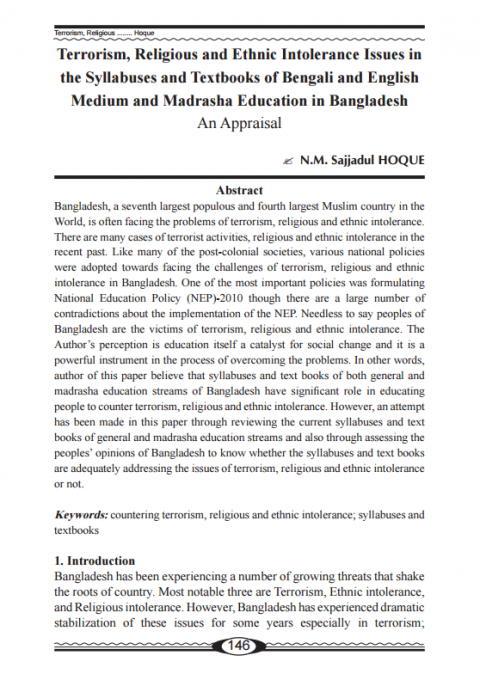 Terrorism, Religious and Ethnic Intolerance Issues in the Syllabuses and Textbooks of Bengali and English Medium and Madrasah Education in Bangladesh an Appraisal سنة النشر: 2014 المؤلف: NM Sajjadul Hoque The author argues that education is a catalyst for social change and a powerful instrument for overcoming social and security problems. In other words, the author believes that syllabuses and textbooks of both the general and madrasa education streams of Bangladesh have a significant role in educating people to counter terrorism as well as religious and ethnic intolerance. This paper attempts, however, by reviewing the current syllabuses and textbooks of general and madrasa education streams, and also by assessing peoples’ opinions in Bangladesh, to know whether the syllabuses and text books are adequately addressing, or not, the issues of terrorism and religious and ethnic intolerance. Terrorism, Religious and Ethnic Intolerance Issues in the Syllabuses and Textbooks of Bengali and English Medium and Madrasah Education in Bangladesh an Appraisal سنة النشر: 2014 المؤلف: NM Sajjadul Hoque L'auteur fait valoir que l'éducation est un catalyseur du changement social et un instrument puissant pour surmonter les problèmes sociaux liés à la sécurité. En d'autres termes, l'auteur estime que les programmes et les manuels scolaires de l’enseignement général et de la madrasa au Bangladesh ont un rôle important à jouer dans la lutte contre le terrorisme, l'intolérance religieuse et ethnique, à travers l'éducation. Ce document s’efforce, toutefois, d’examiner, si les programmes et les manuels abordent de manière adéquate, ou non, les questions du terrorisme et de l'intolérance religieuse et ethnique. L’auteur évalue les programmes actuels et les manuels en cours d’utilisation dans les établissements d’enseignement général et dans les madrasas, ainsi que les points de vue des Bangladeshis.