
الموارد
استكشف مجموعة واسعة من الموارد القيمة حول تعليم المواطنة العالمية لتعميق فهمك وتعزيز البحث والمناصرة والتعليم والتعلم.
تم العثور على 3,530 نتيجة
 Media and Information Literacy: Reinforcing Human Rights, Countering Radicalization and Extremism (The MILID Yearbook, 2016) سنة النشر: 2016 المؤلف: Jagtar Singh | Paulette Kerr | Esther Hamburger المؤلف المؤسسي: UNESCO | Alliance of Civilizations Media and Information Literacy (MIL) is a strong tool, cutting across educational, cultural and social contexts. It can help overcome disinformation, stereotypes and intolerance conveyed through some media and in online spaces. Here, stimulating critical empathy is one of the vital components and there are many stakeholders that have a role to play in this dimension of MIL.This year’s edition is focused on a highly relevant theme of “Media and Information Literacy: Reinforcing Human Rights, Countering Radicalization and Extremism”. It is a relevant reference point to initiate discussion and offer perspectives to stakeholders seeking to apply MIL as a tool to counter violent extremism. There is evident need for evidence-based research, assessment and evaluation that can provide insight into the impact of media and information literacy on societies. UNESCO trusts that this publication will contribute to ongoing scholarship and debate on these key topics.For media and other information providers to serve their purpose, we need critical minds in the public, which means to develop MIL programmes at the national, regional and international levels.
  Transforming Lives through Education سنة النشر: 2018 المؤلف: Anne Müller | Cristina Stanca-Mustea المؤلف المؤسسي: UNESCO 1945-2018: This book invites the reader on a fascinating photographic journey that highlights UNESCO’s work in promoting education across the world for more than seven decades. Above all, it testifies to the power of education to transform lives, build self-confidence, contribute to economic and social progress, and promote intercultural understanding.Through this book, the reader will discover the history of UNESCO’s work in education from its foundation to its current role as global leader for the coordination of Goal 4 of the United Nations 2030 Agenda for Sustainable Development, dedicated to education.The publication highlights the important milestones, normative advances, innovations and outstanding projects in our history, which bear witness to our humanistic vision of education. Drawing on a rich archive of photographs, some of them little known, this book illustrates the scale and diversity of UNESCO’s education programme across the globe. Transformer la vie grâce à l'éducation سنة النشر: 2018 المؤلف: Anne Müller | Cristina Stanca-Mustea المؤلف المؤسسي: Organisation des Nations Unies pour l'éducation, la science et la culture (UNESCO) 1945-2018 : cet ouvrage vous invite à un passionnant voyage photographique qui témoigne de l’action de l’UNESCO pour promouvoir l’éducation à travers le monde depuis maintenant plus de sept décennies. Il témoigne avant tout du pouvoir de l’éducation pour transformer les vies, développer la confiance en soi, contribuer au progrès économique et social, favoriser la compréhension interculturelle.En parcourant cet ouvrage, le lecteur découvrira l’histoire de l’action de l’UNESCO en matière d’éducation, depuis ses débuts jusqu’à son rôle actuel de chef de file, au niveau mondial, pour la coordination de l’Objectif de développement durable 4 dédié à l’éducation, dans le cadre de l’Agenda 2030 défini par les Nations Unies.Ce livre reflète les jalons que nous avons posés, les avancées normatives et les innovations que nous avons réalisées, les projets phares que nous avons conduits et rend compte de notre vision humaniste de l’éducation. S’appuyant sur de riches archives photographiques, don't certaines sont peu connues, ce livre illustre l’ampleur et la variété du programme d’éducation de l’UNESCO à travers le monde.
  Let's Decide How to Measure School Violence (Policy Paper 29) سنة النشر: 2017 المؤلف المؤسسي: UNESCO Violence in schools and other education settings causes serious harm to children and adolescents that can last into adulthood. As the UN World Report on Violence against Children observed, it is a global phenomenon (Pinheiro, 2006). Policies, laws and strategies to prevent school-related violence depend on accurate knowledge of its global prevalence, trends and effects, but such evidence is lacking.In schools, manifestations of violence include bullying, corporal punishment, verbal and emotional abuse, intimidation, sexual harassment and assault, gang activity and the presence of weapons. While attention usually focuses on extreme events, the more common and often unnoticed forms of violence cause the greatest harm to the education experience of children and adolescents. These tend to be under-reported, as they often involve taboos.To collect data on aspects of violence in schools, large-scale, multi-country school-based surveys are increasingly used; some countries also have well-established monitoring mechanisms. Overall, however, consistent evidence on the global prevalence and trends of school-related violence is lacking. To ensure reliable data is gathered, action is needed to bridge differences between the various monitoring methods. This paper, launched to coincide with the International Symposium on School Violence and Bullying: From Evidence to Action, in Seoul, Republic of Korea (January 17–19, 2017), aims to inform the current debate and propose options for the future.
  The King Abdullah bin Abdulaziz International Programme for a Culture of Peace and Dialogue: Key Achievements of Phase I سنة النشر: 2016 المؤلف المؤسسي: UNESCO The King Abdullah bin Abdulaziz International Programme for a Culture of Peace and Dialogue arose from the institutional framework of UNESCO’s Programme for a Culture of peace and non-violence. More than a concept, the Culture of Peace is a commitment to make peace a tangible reality for all. It denotes “a set of values, attitudes, traditions and modes of behaviour and ways of life based on respect for life, ending of violence and […] adherence to the principles of freedom, justice, democracy, tolerance, solidarity, cooperation, pluralism, cultural diversity, dialogue and understanding at all levels of society and among nations” (Article 1, Declaration and Programme of Action of a Culture of Peace, UNESCO, 1999). UNESCO continue its work to nurture a Culture of Peace, with development considerations, by joining forces with committed stakeholders in education, the sciences, culture, and communication and information.
 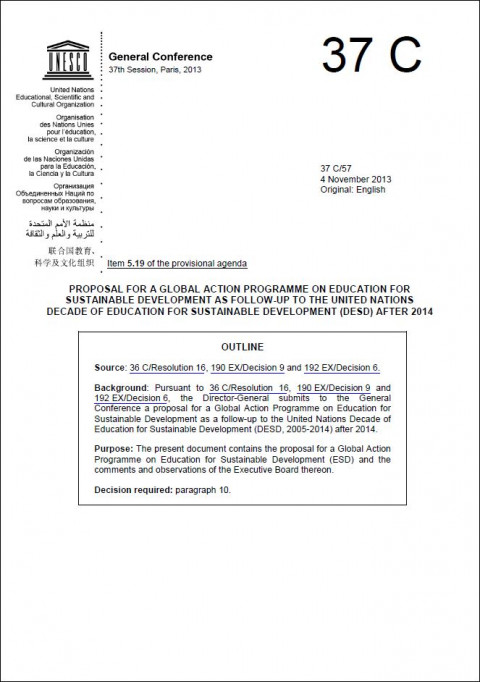 Предложение в отношении Глобальной программы действий по образованию в интересах устойчивого развития в качестве последующей деятельности по итогам Десятилетия образования в интересах устойчивого развития (ДОУР) Организации Объединенных Наций в период после 2014 г. سنة النشر: 2013 المؤلف المؤسسي: Организация Объединенных Наций по вопросам образования, науки и культуры (UNESCO) Настоящий документ содержит предложение в отношении Гло-бальной программы действий по образованию в интересах устойчивого развития (ОУР), а также комментарии и замечания Исполнительного со-вета.
  [Video] Snapshot on Education - Global & Regional Perspectives on Progress and Current Challenges سنة النشر: 2018 المؤلف المؤسسي: UNESCO The video is a snapshot of the reflection on progress and challenges for education. Taking into consideration the global and regional SDG4-Education 2030 consultations throughout 2018. More at https://en.unesco.org/themes/education/globaleducationmeeting2018 Un apercu sur l’éducation سنة النشر: 2018 المؤلف المؤسسي: Organisation des Nations Unies pour l'éducation, la science et la culture (UNESCO) La vidéo est un apercu de la réflexion sur les progrès et les défis de l'éducation. Prenant en considération les consultations mondiales et régionales de l’ODD4-Education 2030 tout au long de 2018. Pour en savoir plus https://fr.unesco.org/themes/education
 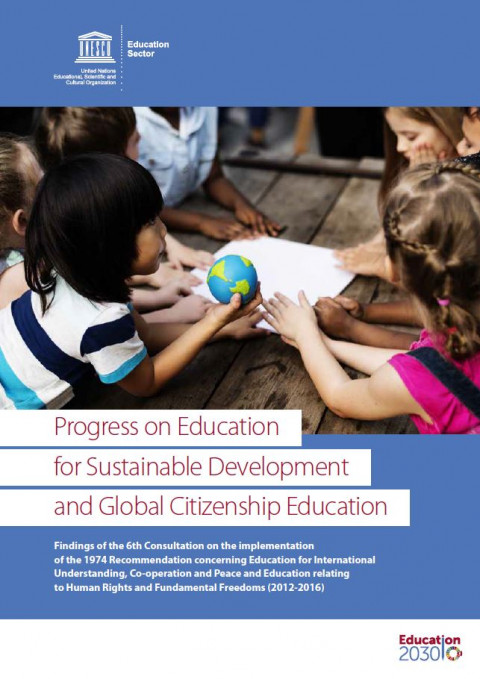 Progress on Education for Sustainable Development and Global Citizenship Education: Findings of the 6th Consultation on the Implementation of the 1974 Recommendation سنة النشر: 2018 المؤلف المؤسسي: UNESCO Findings of the 6th Consultation on the implementation of the 1974 Recommendation concerning Education for International Understanding, Co-operation and Peace and Education relating to Human Rights and Fundamental Freedoms (2012-2016) Progress on Education for Sustainable Development and Global Citizenship Education “The Recommendation concerning Education for International Understanding, Co-operation and Peace and Education relating to Human Rights and Fundamental Freedoms” was adopted by UNESCO’s General Conference at its 18th session in 1974. Every four years, Member States report to UNESCO on measures taken to implement the Recommendation in pre-primary, primary, secondary and post-secondary/tertiary education. This document summarizes and analyses the main findings of the 6th Consultation on the implementation of the 1974 Recommendation, covering the period of 2012 to 2016. The findings of the 6th Consultation provide important insight into how Member States are implementing the 1974 Recommendation as well as how they are progressing towards Target 4.7 of Sustainable Development Goal 4 on Education. Target 4.7 concerns Education for Sustainable Development and Global Citizenship Education, which are closely related to the 1974 Recommendation. Supporting Member States in implementing Target 4.7 is a UNESCO priority and essential to progress across the 2030 Agenda for Sustainable Development. Avances en la educación para el desarrollo sostenible y la educación para la ciudadanía mundial: resultados de la sexta consulta sobre la aplicación de la Recomendación sobre la Educación para la Comprensión سنة النشر: 2018 المؤلف المؤسسي: Organización de las Naciones Unidas para la Educación, la Ciencia y la Cultura (UNESCO) Hallazgos de la 6ta consulta sobre la implementación de la Recomendación de 1974 sobre Educación para la Comprensión, la Cooperación y la Paz Internacionales y la Educación relativa a los Derechos Humanos y a las Libertades Fundamentales (2012-2016). Progresos en Educación para Desarrollo Sostenible y Educación para la Ciudadanía Mundial “La Recomendación concerniente a la Educación para Comprensión, Cooperación y Paz internacional y Educación relativa a los Derechos Humanos y a las Libertades Fundamentales” fue adoptada en la Conferencia General de la UNESCO en su 18ava sesión de 1974. Cada cuatro años, los Estados Miembros reportan a la UNESCO sobre las medidas llevadas a cabo para implementar la Recomendación en los niveles preescolares, primario, secundario y post-secundario/terciario de educación. Este documento resume y analiza los hallazgos principales de la 6ta Consulta sobre la implementación de la Recomendación de 1974, cubriendo el período de 2012 a 2016. Los hallazgos de la 6ta Consulta proporcionan información importante sobre cómo los Estados Miembros están implementando la Recomendación de 1974, y de cómo están progresando hacia la Meta 4.7 del Objetivo de Desarrollo Sostenible 4 en Educación. La Meta 4.7 concierne a la Educación para el Desarrollo Sostenible y la Educación para la Ciudadanía Mundial, que están muy ligadas a la Recomendación de 1974. El apoyo a los Estados Miembros en la implementación de la Meta 4.7 es una prioridad para la UNESCO dado que es esencial para progresar hacia los objetivos de la Agenda 2030 para Desarrollo Sostenible. (Avances en la educación para el desarrollo sostenible y la educación para la ciudadanía mundial: resultados de la sexta consulta sobre la aplicación de la Recomendación sobre la Educación para la Comprensión, la Cooperación y la Paz Internacionales y la Educación relativa a los Derechos Humanos y las Libertades Fundamentales, de 1974 (2012-2016))