
الموارد
استكشف مجموعة واسعة من الموارد القيمة حول تعليم المواطنة العالمية لتعميق فهمك وتعزيز البحث والمناصرة والتعليم والتعلم.
تم العثور على 2,813 نتيجة
 Réaliser l’égalité entre les sexes, dans et par l’éducation سنة النشر: 2019 المؤلف المؤسسي: GPE Le présent document a pour objet de décrire la situation actuelle de l’égalité entre les sexes dans l’éducation et d’encourager l’examen des domaines dans lesquels le KIX pourrait investir. Il fait partie d’une série de documents de travail établis pour soutenir la consultation des pays en développement partenaires et des experts techniques, et les faire participer à la conception initiale du Mécanisme de partage de connaissances et d’innovations du PME. Les idées qu’il présente doivent servir de point de départ aux discussions et pourraient sensiblement évoluer au fil du processus de consultation.
  المواطنة العالمية وآفاقها المستقبلية في الوطن العربي سنة النشر: 2017 المؤلف: داليا الجيزاوي تتحدث الكاتبة عن مفهوم المواطنة العالمية في الدول العربية مبرزتا التطور الحاصل في المفهوم نتيجة التغييرات التي مر بها العالم العربية في الفترات الماضية. ومن ثم تبدأ الباحثة في التطرق لافاق المواطنة العالمية وعلاقته بالانتماء للوطن العربي. وقد ذكرت الباحثة نوعان من المؤشرات اللازمة لقياس المواطنة العالمية. ولتضمين المواطنة العالمية في التعليم اشارت الباحثة للغايات التعليمية المتمثلة في المهارات المعرفية والمهارات الاجتماعية العاطفية والمهارات السلوكية. في ختام المقال أكدت الباحثة على أهمية مشاركة الاطفال من خلال التنشئة لتحقيق المواطنة العالمية، وللوصول لذلك فقد وضعت الكاتبة مجموعة من التوصيات. Global Citizenship and its Future Horizons in the Arab World سنة النشر: 2017 المؤلف: Dalia Aljizawi In this article, the researcher is trying to illustrate the concept of global citizenship in the Arab nations. The researcher presented the development of the concept of global citizenship based on the changes that the Arab world faced in the past. The article then goes to state the relationship between the horizons of the global citizenship and nationality/belongings of people to the Arab world. Moreover, there were two indicators presented to evaluate global citizenship. In the last part of the paper, the author talks about implementing global citizenship in education through focusing on cognitive skills, socio-emotional skills and behavioral skills. The author recommends at the end of involving children through education to achieve global citizenship. The paper ends with some recommendations to make children participate in global citizenship education.
 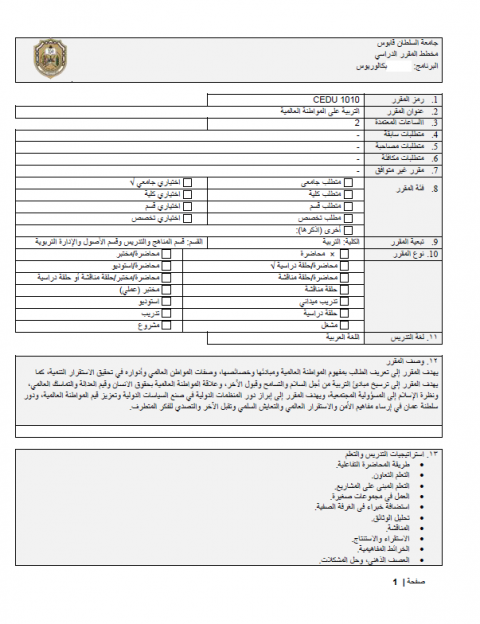 مقرر التربية على المواطنة العالمية سنة النشر: 2019 هذا المقرر قام بوضعه مجموعة من الاساتذة بكلية التربية في جامعة السلطان قابوس، وقد جاء هذا المقرر كفكرة بالتعاون بين الجامعة ومكتب اليونسكو ببيروت وأيضا مركز أسيا والمحيط الهادي للتربية من أجل التعاون الدولي. ويهدف المقرر إلى تعريف الطالب بمفهوم المواطنة العالمية ومبادئها وخصائصها، وصفات المواطن العالمي وأدواره في تحقيق الاستقرار التنمية، كما يهدف المقرر إلى ترسيخ مبادئ التربية من أجل السلام والتسامح وقبول ألآخر وعلاقة المواطنة العالمية بحقوق الانسان وقيم العدالة والتماسك العالمي، ونظرة الإسلام إلى المسؤولية المجتمعية، ويهدف المقرر إلى إبراز دور المنظمات الدولية في صنع السياسات الدولية وتعزيز قيم المواطنة العالمية، ودور سلطنة عمان في إرساء مفاهيم الأمن والاستقرار العالمي والتعايش السلمي وتقبل الآخر والتصدي للفكر المتطرف.
  FramerSpace المؤلف المؤسسي: Mahatma Gandhi Institute of Education for Peace and Sustainable Development (MGIEP) FramerSpace is an AI-powered digital platform where the curriculum’s content can be implemented in a multi-modal environment, data collected in an open and transparent manner and analysis done with ease and the highest data analytics capabilities in the pursuit of implementing personalised learning plans in a teacher driven setting. From the Content creator’s point of view, FramerSpace offers rich content creation abilities including embedding Audio, Rich Text, Video, Journaling, Games (developed using Unity/Phaser) to name a few. The platform framework design has been made extremely intuitive and powerful to help reduce the learning curve for creators significantly and make it look significantly different than any existing learning system out there. Creators are further armed with the real-time Emotion Analysis insights related to course reviews and related discussions and facilitated dialogues. These insights would help creators identify the emotion shift on pertinent topics and identify influencers by studying context-specific trends. FramerSpace has embedded analytics that helps creators always be mindful of what is working and what is not in terms of the learning outcomes of the respective courses. Predictive analytics within FramerSpace can potentially help creators take pro-active actions, especially in the case of at-risk learners who may be on the verge of dropping out. URL: https://framerspace.com/
  Blended learning for quality higher education: selected case studies on implementation from Asia-Pacific سنة النشر: 2016 المؤلف: Lim, Cher Ping | Wang Libing المؤلف المؤسسي: UNESCO Bangkok Together with The Education University of Hong Kong, UNESCO Bangkok gathered experts from higher education institutions in the Asia-Pacific region to explore the potential of blended learning, including its impact on the role of teachers, the relationship between teachers and students, and the nature of educational institutions themselves. Issues about the quality of education are at the heart of the Sustainable Development Goals, which were adopted during the United Nations Sustainable Development Summit in September 2015.
  أثر برنامج تدريبيّ في تنمية مبادئ المواطنة العالميّة لدى معلمي التاريخ في الأردن سنة النشر: 2013 المؤلف: Zaid Suleiman M. Al-Edwan | Fadyieh Mohmoud A. Bani Mustafa المؤلف المؤسسي: Deanship of Scientific Research, University of Jordan هدفت الد ا رسة إلى بناء برنامج تدريبيّ لمعلمي التاريخ في ضوء مبادئ المواطنة العالميّة واختبار أثره في مستوى معرفتهم لتلكالمبادئ في الأردن. تكونت عينة الد ا رسة من ( 26 ) معلمًا ومعلمة، تم اختيا رهم بالطريقة العشوائية من معلمي التاريخ للمرحلةالأساسيّة العليا في مديرية التربية والتعليم لمحافظة مأدبا. ولتحقيق أهداف الد ا رسة تم بناء برنامج تدريبيّ في ضوء مبادئالمواطنة العالميّة، هي: السلام العالميّ، والديمق ا رطيّة، وحقوق الإنسان، الإنسان والبيئة، والتفكير العلميّ، والتكنولوجيا،والثقافات المتعددة. وتم اعداد اختبار معرفيّ لمبادئ المواطنة العالميّة. وبعد اج ا رء التحليلات الاحصائية المناسبة أظهرتنتائج الد ا رسة أن مستوى المعرفة القبلية لمعلمي التاريخ للمرحلة الأساسيّة العليا لمبادئ المواطنة العالميّة كان أقل من المستوى0.01 ) بين مستوى المعرفة البعدية لمعلمي =α) المقبول تربويًّا ( 80 %). ووجود فروق ذات دلالة إحصائيّة عند مستوى الدلالةالتاريخ في المرحلة الأساسيّة العليا لمبادئ المواطنة العالميّة والمستوى المقبول تربويًّا ( 80 %)، ولصالح البرنامج التدريبيّ فيكلّ مجال من مبادئ المواطنة العالمية وللمجالات مجتمعة. وأوصت الد ا رسة بتضمين أبعاد مفاهيم المواطنة العالميّة ومبادئهافي الب ا رمج التدريبيّة للمعلمين لزيادة وعيهم بالقضايا العالميّة.الكلمات الدالة: المواطنة العالميّة، معلمي التاريخ، المرحلة الأساسيّة العليا.. The Effect of a Training Program on Developing the Global Citizenship Principles of the History Teachers in Jordan سنة النشر: 2013 المؤلف: Zaid Suleiman M. Al-Edwan | Fadyieh Mohmoud A. Bani Mustafa المؤلف المؤسسي: Deanship of Scientific Research, University of Jordan This study aimed at building a training program for the history teachers in the light of the global citizenship principles and testing its effect on their knowledge level of those principles in Jordan. Study sample consisted of (26) male and female teachers randomly selected from the history teachers for the high Basic stage in the Education Directorate in Ma'daba Governorate. To achieve the study goals, a training program was build in the light of the global citizenship principles, which are: the global peace, democracy, human rights, human and the environment, scientific thinking, technology, and multi-cultures.and a cognitive test of the global citizenship's principles was prepared. After performing the relevant statistical analysis the results revealed that the pre-knowledge level of the history teachers for the basic stage of the global citizenship principles was lower than the educational accepted level (80%), and the presence of differences with statistical significance (α=0.01) between the post-knowledge level of the history teachers at the higher basic stage about the global citizenship principles and the educational accepted level (80%), in favor of the training program in each domain of the global citizenship's principles and for the domains collectively. The study recommended the inclusion of the global citizenship principles and concepts in the teachers training programs to increase their awareness in the global issues.
  The Sustainable Development Goals Report 2019 سنة النشر: 2019 المؤلف المؤسسي: United Nations (UN) Four years after signing the 2030 Agenda for Sustainable Development, countries have taken action to integrate the Goals and targets into their national development plans and to align policies and institutions behind them. The Sustainable Development Goals Report 2019 uses the latest available data to track global progress on the SDGs and to take stock of how far we have come in realizing our commitments. The report shows that, while advances have been made in some areas, monumental challenges remain. The evidence and data spotlight areas that require urgent attention and more rapid progress to realize the 2030 Agenda’s far-reaching vision. Member States agree that these challenges and commitments are interrelated and call for integrated solutions. It is therefore imperative to take a holistic view of the 2030 Agenda and to identify the highest impact areas in order to target interventions. The most urgent area for action is climate change. If we do not cut record-high greenhouse gas emissions now, global warming is projected to reach 1.5°C in the coming decades. As we are already seeing, the compounded effects will be catastrophic and irreversible: increasing ocean acidification, coastal erosion, extreme weather conditions, the frequency and severity of natural disasters, continuing land degradation, loss of vital species and the collapse of ecosystems. These effects, which will render many parts of the globe uninhabitable, will affect the poor the most. They will put food production at risk, leading to widespread food shortages and hunger, and potentially displace up to 140 million people by 2050. The clock for taking decisive actions on climate change is ticking. The other defining issue of our time is increasing inequality among and within countries. Poverty, hunger and disease continue to be concentrated in the poorest and most vulnerable groups of people and countries. Over 90 per cent of maternal deaths occur in low- and middle-income countries. Three quarters of all stunted children live in Southern Asia and sub-Saharan Africa. People living in fragile States are twice as likely to lack basic sanitation, and about four times as likely to lack basic drinking water services as people in non-fragile situations. Youth are three times more likely to be unemployed than adults. Women and girls perform a disproportionate share of unpaid domestic work and lack autonomy in decision-making. Just as problems are interrelated, the solutions to poverty, inequality, climate change and other global challenges are also interlinked. Valuable opportunities exist to accelerate progress by examining interlinkages across Goals. For example, tackling climate change requires a shift to clean energy, reversing the trend in forest loss, and changing our production and consumption patterns. Promoting sustainable agriculture can help reduce both hunger and poverty, since close to 80 per cent of those who are extremely poor live in rural areas. Increasing access to safe drinking water, sanitation and hygiene can save millions of lives per year and improve school attendance. Improving proficiency in reading and mathematics of some 200 million children who are falling behind in sub-Saharan Africa will help them climb out of poverty and ultimately enable the region to better compete in the global marketplace. This report also highlights the importance of investing in data for the full implementation of the 2030 Agenda. Most countries do not regularly collect data for more than half of the global indicators. The lack of accurate and timely data on many marginalized groups and individuals makes them “invisible” and exacerbates their vulnerability. While considerable effort has been made to address these data gaps over the past four years, progress has been limited. Increased investment is urgently needed to ensure that adequate data are available to inform decision-making on all aspects of the 2030 Agenda. Towards that end, the Dubai Declaration, launched at the second World Data Forum in October 2018, outlines a demand-driven funding mechanism under Member States’ oversight that will respond quickly and efficiently to the priorities of national statistical systems.
  Social and emotional learning (The Blue Dot Issue 10, 2019) سنة النشر: 2019 المؤلف المؤسسي: Mahatma Gandhi Institute of Education for Peace and Sustainable Development (MGIEP) The tenth edition of The Blue DOT focuses on different aspects of social and emotional learning, including the neurosciences, teacher training, frameworks such as CASEL and SEE Learning and systemic SEL, amongst others. The issue includes a Foreword by Dr. Richard Davidson, William James and Vilas Professor of Psychology and Psychiatry at the University of Wisconsin–Madison and the Founder and Director of the Center for Healthy Minds, and our Cover Story that focuses on how SEL can help to achieve the United Nations Sustainable Development Goals (SDGs). Additionally, it features interviews and opinions from some of the world’s most prominent SEL experts on the importance of integrating SEL in our education systems. Amongst various experts, we hear from Kimberly Schonert-Reichl on her journey in SEL, Robert W. Roeser on “Educating the Head, the Heart and the Hand in the 21st Century” as well as Roger P. Weissberg and Joseph L. Mahoney on “What is Systemic Social and Emotional Learning and Why Does it Matter”? Further, a featured article with responses to a survey by teachers from 4 countries (Bhutan, India, South Africa and Sri Lanka), following the launch of the Institute’s SEL modules on Global Citizenship in a workshop conducted in New Delhi, India in April 2019 is presented. The modules have been rendered on MGIEP’s in house Artificial Intelligence (AI) driven digital platform now called FramerSpace (formerly CHI) and allow the student to have an interactive, instantaneous feedback and immersive experience while addressing contemporary issues such as migration, nationalism and violence.