
الموارد
استكشف مجموعة واسعة من الموارد القيمة حول تعليم المواطنة العالمية لتعميق فهمك وتعزيز البحث والمناصرة والتعليم والتعلم.
تم العثور على 2,813 نتيجة
 Global Education Monitoring Report, 2021, Central and Eastern Europe, Caucasus and Central Asia: Inclusion and Education; All Means All سنة النشر: 2021 المؤلف المؤسسي: Global Education Monitoring Report Team | European Agency for Special Needs and Inclusive Education | Network of Education Policy Centers Prepared by the Global Education Monitoring (GEM) Report, in partnership with the European Agency for Special Needs and Inclusive Education and the Network of Education Policy Centers, the regional report on inclusion and education in Central and Eastern Europe, the Caucasus and Central Asia offers a deep dive into the core challenges and key solutions. The region is working hard to overcome a legacy, whereby children with disabilities attended special schools, once wrongly regarded as an effective solution, segregated by type of disability, if not fully excluded from education.The report draws on in-depth profiles of 30 education systems in the region. It also presents the additional risks to inclusion now posed by the COVID-19 pandemic. Building on the 2020 Global Education Monitoring Report, it documents barriers facing learners, particularly where multiple disadvantages intersect. Its recommendations provide a systematic framework for identifying and dismantling these barriers, according to the principle that ‘every learner matters and matters equally’. Всемирный доклад по мониторингу образования 2021 г. : для всех означает для всех инклюзивность и образование; центральная и восточная европа,кавказ и средняя азия سنة النشر: 2021 المؤلف المؤسسي: Global Education Monitoring Report Team | European Agency for Special Needs and Inclusive Education | Network of Education Policy Centers В этом докладе описана огромная и географически разнородная территория, которую объединили в один регион схожие образовательные системыи подходы, сформированные во второй половине 20 века в рамках государственного социализма. Образование было доступно, гендерное неравенство и неравенство, связанное с местом проживания, было искоренено. Но образовательные системы подвергали дискриминации детей с особыми потребностями, которые посещали специальные школы. Это решение ошибочно считалось эффективным: ученики разделялись по типу инвалидности, а некоторые из них полностью исключались из системы образования.Начиная с 1989 года, регион старается преодолеть это тяжелое наследие и перейти к инклюзивному образованию, основанному на правах человека, подходу, который часто поддерживается международными организациями. В законодательство и образовательную политику было включено более широкое понимание инклюзии. Педагогическое образование и программы повышения квалификации учителей были пересмотрены и реструктурированы. Тем не менее, прогресс неравномерен. Многие изменения произошли на бумаге, в то время как глубинные убеждения и реальная практика практически не изменились. В то же время образовательные системы пытаются преодолеть негативные последствия политического и экономического кризисов, которые углубили неравенство и усилили социальную напряженность. Такие факторы как гендер, удаленное место проживания, бедность, этническая принадлежность, язык, миграция, принадлежность к числу перемещенных лиц, тюремное заключение, сексуальная ориентация, гендерная идентичность и религиозные и другие убеждения связаны с неравенством образовательных возможностей.Составленный группой по подготовке Всемирного доклада по мониторингу образования, в партнерстве с Европейским агентством по специальным потребностям и инклюзивному образованию и Сетью центров образовательной политики, этот доклад содержит подробные описания 30 образовательных систем региона. В докладе также представлены дополнительные риски для инклюзии, возникшие в результате пандемии COVID-19. Основываясь на Всемирном докладе ЮНЕСКО по мониторингу образования, этот документ фиксирует барьеры, с которыми сталкиваются учащиеся. Рекомендации, данные в докладе, предлагают систему для выявления и устранения этих барьеров, в основе которой лежит принцип «каждый ученик важен и важен одинаково».
  IIEP-UNESCO 12th Medium-Term Strategy: 2026–2029 سنة النشر: 2026 المؤلف المؤسسي: UNESCO International Institute for Educational Planning (IIEP) The 2026-2029 Medium-Term Strategy of the UNESCO International Institute for Educational Planning provides a vision for transforming educational planning into tangible results for education systems across the globe. Building on more than 60 years of experience, the Strategy puts the focus not only on policy and plan design, but on collective and agile implementation.
  Global Learning in Subject Teaching: Framework and Toolkit سنة النشر: 2020 المؤلف المؤسسي: Center for Citizenship Education (CCE) | Global Issues, Global Subjects (GIGS) The brochure 'Global Learning in Subject Teaching: Framework and Toolkit' has been developed as a proposal for teachers, educators and educational institutions on how to reach pupils with Global Learning. In its practical part, the brochure provides the reader with a toolkit of 20 ready-to-use lesson plans for subject lessons where the subject curriculum topics are linked with global issues such as migration, climate change and gender equality.
  Media Literacy in the Library: A Guide for Library Practitioners سنة النشر: 2020 المؤلف المؤسسي: American Library Association (ALA) | Institute of Museum and Library Services As information providers and hubs for lifelong learning, libraries have always been resources for helping communities develop media literacy skills. Now, in the midst of a global pandemic, and in an age when we increasingly rely on digital media for information and communication, these critical thinking skills are more important than ever. The American Library Association (ALA), working with talented thought leaders across the library and media literacy sectors, has created Media Literacy in the Library: A Guide for Library Practitioners to help library workers prepare for day-to-day interactions like the imagined reference desk one above.In this guide, we offer resources and ideas to plan programs and activities to teach media literacy skills to adults and also to integrate these skills into programming you already offer at your library. This guide has been created for out-of-school adult audiences, who library workers will generally meet in a public library context.
  Framework for Information Literacy for Higher Education سنة النشر: 2015 المؤلف المؤسسي: Association of College and Research Libraries (ACRL) Information literacy is the set of integrated abilities encompassing the reflective discovery of information, the understanding of how information is produced and valued, and the use of information in creating new knowledge and participating ethically in communities of learning. This Framework sets forth these information literacy concepts and describes how librarians as information professionals can facilitate the development of information literacy by postsecondary students.
  Auditing Educational Equity in Light of the COVID-19 Pandemic: A Guide for Education Unions سنة النشر: 2020 المؤلف المؤسسي: Education International (EI) The COVID-19 pandemic has led to unprecedented school closures that have affected over 1.5 billion students worldwide. However, the impact of the pandemic has not been equal, with vulnerable and disadvantaged students disproportionately affected by the resulting global crisis in teaching and learning."Auditing Educational Equity in Light of the COVID-19 Pandemic" is a guide to support education unions as they advocate for equity audits to be conducted at both education institution and systems levels.The guide stresses the importance of equity audits in enabling education institutions and systems to adapt more effectively to a COVID-19 ‘new normal’ and also address entrenched structures of inequality that have long prevented countries from realising the universal right to education.
  Access and Opportunity for All: How Libraries Contribute to the United Nations 2030 Agenda سنة النشر: 2020 المؤلف المؤسسي: International Federation of Library Associations and Institutions (IFLA) The inclusion of libraries and access to information in national and regional development plans will contribute to meeting the global United Nations 2030 Agenda for Sustainable Development.In support of this goal, IFLA has published a booklet of examples and recommendations for policymakers demonstrating the contribution of libraries to the UN Sustainable Development Goals (SDGs).The booklet includes stories from all types of libraries in many countries around the world.
  Analytical Mapping of Life Skills and Citizenship Education in the Middle East and North Africa سنة النشر: 2017 المؤلف المؤسسي: UNICEF Middle East and North Africa The Analytical Mapping of the Life Skills and Citizenship Education in MENA, published in October 2017, provides a multi-stakeholder view of the status of life skills and citizenship education in MENA and the corresponding vision for the region. It does not evaluate existing interventions, nor is it meant to generate an exhaustive list of all existing life skills programmes in MENA. It rather aims to provide an analytical overview of Life Skills and Citizenship Education (LSCE) related intervention in the region. Through analyzation, it also attempts to highlight general challenges encountered in the programming of LSCE, as well as focus on opportunities for LSCE in MENA national education systems.
 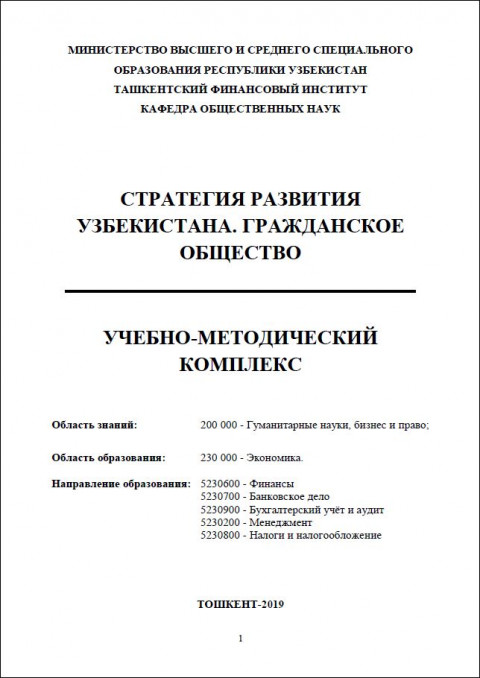 Development Strategy of Uzbekistan: Civil Society; Training and Methodology Complex سنة النشر: 2019 المؤلف: M.N. Primov | T. Norboev المؤلف المؤسسي: Uzbekistan. Ministry of Higher and Secondary-Specialized Education | Tashkent Institute of Finance The document is a collection of training materials on the conditions and prospects for the development of civil society in Uzbekistan, as well as the implementation of the main directions of the Action Strategy. The document also the role of local governments of citizens, non-governmental non-profit organizations in improving institutions civil society.A major role in this is played by new socio-political disciplines, which include the “Development Strategy of Uzbekistan. Civil society". This course reveals the basic scientific principles of the formation of civil society and the development strategy of Uzbekistan, analyzes the main stages of transformation, shows the irreversibility of the reforms carried out in the country, and helps to build the civic position of each member of the society. It is organically woven into the humanities system, forming a common logical chain with it; It helps to answer questions of modern policy of our state and to determine the place and role of each person in the grandiose transformations carried out in the country.