
الموارد
استكشف مجموعة واسعة من الموارد القيمة حول تعليم المواطنة العالمية لتعميق فهمك وتعزيز البحث والمناصرة والتعليم والتعلم.
تم العثور على 1,983 نتيجة
 CONFINTEA VI Mid-Term Review: Report of the Conference سنة النشر: 2017 المؤلف: Clinton Robinson المؤلف المؤسسي: UNESCO Institute for Lifelong Learning (UIL) The Sixth International Conference on Adult Education (CONFINTEA VI), held in Brazil in 2009, closed with the adoption of the Belem Framework for Action (BFA), which recorded the commitments of Member States and presented a strategic guide for the global development of adult learning and education. The third Global Report on Adult Learning and Education (GRALE 3), published in 2016, drew on survey data to evaluate progress made by countries in fulfilling the commitments made in Brazil.The CONFINTEA VI Mid-Term Review, held in Suwon, Republic of Korea, in October 2017, took stock of progress made by Member States in the past eight years, looking ahead to GRALE 4 in 2019 and CONFINTEA VII in 2021.This report summarizes the discussions that animated the Mid-Term Review conference and gives readers a brief survey of the key issues concerning progress against the BFA, across all world regions.
 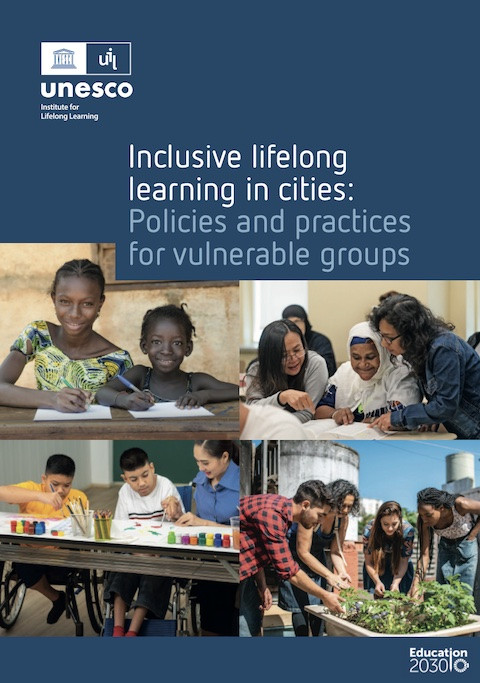 Inclusive Lifelong Learning in Cities: Policies and Practices for Vulnerable Groups سنة النشر: 2021 المؤلف المؤسسي: UNESCO Institute for Lifelong Learning (UIL) This publication features chapters on learning cities’ endeavours to promote inclusive lifelong learning for vulnerable groups. It is based on research papers prepared for the fourth International Conference on Learning Cities, which took place in 2019 in Medellín, Colombia, under the theme ‘Inclusion – A principle for lifelong learning and sustainable cities’ and hence marks a transition between the learning city conferences of 2019 and 2021.
  From Emergency to Resilience: Building Healthy and Resilient Cities Through Learning; Fifth International Conference on Learning Cities, Yeonsu, Republic of Korea, 27 to 30 October 2021 سنة النشر: 2022 المؤلف المؤسسي: UNESCO Institute for Lifelong Learning (UIL) Responding to and recovering from the COVID-19 pandemic remains an enormous challenge for cities worldwide. Lifelong learning lays the foundation for healthy and resilient cities. Hence, these municipalities are working hard to promote learning for health, and to build long-term resilience among their local populations so that they can deal both with the pandemic and with future emergencies, including those caused by climate change.The fifth International Conference on Learning Cities (ICLC 5) was hosted by UIL in collaboration with Yeonsu City, Republic of Korea, and took place from 27 to 30 October 2021. Entitled ‘From emergency to resilience: Building healthy and resilient cities through learning’, the conference attracted over 2,000 participants, who attended either online or in-person. This was an opportunity for cities to come together and share their responses to the COvID-19 pandemic.
  Lifelong Learning Opportunities for All: Medium-Term Strategy 2022–2029 سنة النشر: 2022 المؤلف المؤسسي: UNESCO Institute for Lifelong Learning (UIL) The 2021 Futures of Education report calls for a new social contract for education, with recognition of an extended right to education throughout life. It represents an important restatement of the principles of UNESCO, and particularly its historic focus on our shared humanity, the universal right to education and its rich potential in addressing social, economic and political challenges. The need for a formal recognition of a universal entitlement to lifelong learning was also highlighted in the United Nations Secretary General’s Common Agenda report (also published in 2021) and is increasingly an avowed priority of the global development agenda for education, labour, human rights and sustainability. It is in this context that the UNESCO Institute for Lifelong Learning (UIL) advances its strategy for the next eight years. With this new Medium-Term Strategy (MTS), UIL aims to strike a balance between priorities rooted in the challenges faced by the global community and this new and emerging thinking about – and interest in – lifelong learning. The world must embrace lifelong learning if we are to build fairer societies and a sustainable world.
  ESD Implementation in Learning Cities سنة النشر: 2021 المؤلف المؤسسي: UNESCO Institute for Lifelong Learning (UIL) This publication aims to share the best practice cases from nine cities on ESD implementation (policy and practice) following a lifelong learning approach. These cases showcase innovative local initiatives that have embedded ESD into lifelong learning systems through policy/ strategy development or project implementation, focusing on the following priority areas of action and local activities laid down in the ESD for 2030 roadmap: Local policy/strategy development on ESD: The development of an action plan that determines how the community as a whole can become a learning laboratory for sustainable development. Capacity-building for educators and local authorities: Lifelong learning initiatives for systematic and comprehensive ESD capacity development for educators in the formal and non-formal education sectors, and for local government officials. Efforts to foster engagement with local communities, including: • formal education institutions’ engagement with local communities for the promotion of ESD; • non-formal education institutions (e.g. community learning centres) serving as a hub for lifelong learning on ESD in their communities. Empowerment and mobilization of youth: Lifelong learning initiatives for ESD that focus on young people. Innovative use of local spaces for ESD: Designated areas or spaces that inspire learning and host projects that promote sustainability. In addition to the five priority areas listed above, the case studies share one cross-cutting theme: • Multi-stakeholder approach: How people from different walks of life or professional sectors come together to contribute to local ESD initiatives at either the policy or the project level.
  Global Inventory of Regional and National Qualifications Frameworks 2017, Vol. I: Thematic Chapters سنة النشر: 2017 المؤلف المؤسسي: European Centre for the Development of Vocational Training (CEDEFOP) | European Training Foundation (ETF) | UNESCO | UNESCO Institute for Lifelong Learning (UIL) The global inventory 2017 further strengthens the knowledge base on developments in national and regional qualifications frameworks, as implemented by countries and regions, by end of 2016. It acts as an observatory of progress in establishing NQFs, as well as the challenges and success factors in implementation. The thematic chapters (Volume I) discuss key trends and policy issues emerging from qualifications frameworks and learning outcomes reforms and developments. Volume II consists of NQF case studies of 100 countries from all continents and seven regional qualifications frameworks (RQF). The case studies look at the educational, social, economic and political context in which an NQF is embedded, main policy objectives, implementation of learning outcomes, stakeholder involvement and institutional arrangements. They also show how NQFs open for and link to validation arrangements, support recognition and learning pathways. They conclude with important lessons and future plans.The global inventory draws on inventories from four agencies: the European Centre for the Development of Vocational Training (Cedefop), the European Training Foundation (ETF), the United Nations Educational, Scientific and Cultural Organisation (UNESCO) and the UNESCO Institute for Lifelong Learning (UIL), working and communicating with country officials and experts. It also draws on extensive international research in qualifications reforms, comparability of qualifications, and use of learning outcomes.
  Global Inventory of Regional and National Qualifications Frameworks 2017, Vol. II: National and Regional Cases سنة النشر: 2017 المؤلف المؤسسي: European Centre for the Development of Vocational Training (CEDEFOP) | European Training Foundation (ETF) | UNESCO | UNESCO Institute for Lifelong Learning (UIL) The global inventory 2017 further strengthens the knowledge base on developments in national and regional qualifications frameworks, as implemented by countries and regions, by end of 2016. It acts as an observatory of progress in establishing NQFs, as well as the challenges and success factors in implementation. The thematic chapters (Volume I) discuss key trends and policy issues emerging from qualifications frameworks and learning outcomes reforms and developments. Volume II consists of NQF case studies of 100 countries from all continents and seven regional qualifications frameworks (RQF). The case studies look at the educational, social, economic and political context in which an NQF is embedded, main policy objectives, implementation of learning outcomes, stakeholder involvement and institutional arrangements. They also show how NQFs open for and link to validation arrangements, support recognition and learning pathways. They conclude with important lessons and future plans.The global inventory draws on inventories from four agencies: the European Centre for the Development of Vocational Training (Cedefop), the European Training Foundation (ETF), the United Nations Educational, Scientific and Cultural Organisation (UNESCO) and the UNESCO Institute for Lifelong Learning (UIL), working and communicating with country officials and experts. It also draws on extensive international research in qualifications reforms, comparability of qualifications, and use of learning outcomes.
 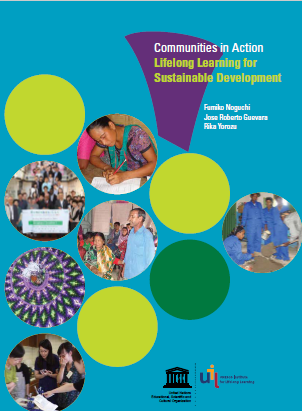 Communities in action: lifelong learning for sustainable سنة النشر: 2015 المؤلف: Fumiko Noguchi | Jose Roberto Guevara | Rika Yorozu المؤلف المؤسسي: UNESCO Institute for Lifelong Learning (UIL) This handbook identifies principles and policy mechanisms to advance community-based learning for sustainable development based on the commitments endorsed by the participants of the Kominkan-CLC International Conference on Education for Sustainable Development, which was in Okayama City, Japan, in October 2014. To inform policymakers and practitioners new to this field, the handbook clarifies the international vision and goals for sustainable development and Education for Sustainable Development, and identifies the potential contributions of community-based learning centres and organizations. It documents both policy and practice from different regions and concludes with a summary of principles and policy support mechanisms.
  Action Research to Improve Youth and Adult Literacy: Empowering Learners in a Multilingual World سنة النشر: 2015 المؤلف المؤسسي: UNESCO Institute for Lifelong Learning (UIL) | UNESCO Abuja This guidebook is about the quest for quality, which is a lifelong pursuit linked to social justice. As we move in time and space new challenges emerge, but our vision is that no one should be left behind in the quest for self- and collective realization. We have to consider all possible means for enabling the active participation of all citizens in education. We must look at both challenges and opportunities, such as those that technology offers us for making linkages and improving access to information, knowledge and skills. We must seek out possibilities for retaining positive values and acquiring new ones which foster deeper appreciation for human, linguistic, cultural and ecological diversity.
  Counting the Cost: Achieving Literacy in Countries of the Global Alliance for Literacy سنة النشر: 2021 المؤلف المؤسسي: UNESCO Institute for Lifelong Learning (UIL) This paper seeks to determine the cost of achieving Sustainable Development Goal 4 (SDG 4) Target 4.6: 'By 2030, ensure that all youth and a substantial proportion of adults, both men and women, achieve literacy and numeracy'. In an effort to answer this question, UNESCO ran simulations and identified the cost and funding gap for the 29 member countries of the Global Alliance for Literacy within the Framework of Lifelong Learning (GAL). This paper argues that 739 million youth and adults require additional literacy programmes of which 580 million are located in 9 of the 29 member countries (the E-9 countries). Based on the results of the simulation, an estimated US$ 190 billion is needed to achieve Target 4.6 by 2030 in the 29 GAL countries. The E-9 countries account for 80% of this cost as the large majority of the global population of youth and adults who lack basic literacy skills live in these territories. The estimation considers the impact of the COVID-19 crisis on GDP growth and presents several scenarios for consideration. If the 29 member countries allocate the recommended 3 per cent of their national education budget to youth and adult literacy, a funding gap of US$ 17 billion will still remain. However, this gap is greater in the 20 non-E9 countries, which account for US$ 12 billion of the funding gap. These 20 non-E9 countries already experience massive challenges for investing in their public education system due to low economic growth and low education development outcomes. A detailed description of the UNESCO GAL simulation model used to estimate the total cost and identify the financing gap for the 29 countries is presented to help interpret the results. The paper ends with a set of recommendations for governments and the international community to work together and ensure the availability of lifelong learning opportunities for all, especially those often left behind.