
الموارد
استكشف مجموعة واسعة من الموارد القيمة حول تعليم المواطنة العالمية لتعميق فهمك وتعزيز البحث والمناصرة والتعليم والتعلم.
تم العثور على 1,951 نتيجة
 Les effets de l’IA sur la vie professionnelle des femmes سنة النشر: 2022 المؤلف: Clementine Collett | Gina Neff | Livia Gouvea Gomes المؤلف المؤسسي: UNESCO | Inter-American Development Bank | Organisation for Economic Co-operation and Development (OECD) L'utilisation des technologies d'IA aura une incidence sur les opportunités de travail des femmes, ainsi que sur leur position, leur statut et leur traite,ent sur le lieu de travail. Partout dans le monde, les femmes dans la population active gagnent moins que les hommes, passent plus de temps à s'occuper des enfants et des personnes âgées sans être rémunérées, occupent moins de postes à responsabilités, sont moins présentes dans les domaines des sciences, de la technologie, de l'ingénierie et des mathématiques(STEM) et ont tendance à occuper des emplois plus précaires dans l'ensemble. En exploitant l'IA, les gouvernements, les institutions et les entreprises doivent réduire les inégalités femmes-hommes plutôt que les perpétuer ou de les exacerber. Ce rapport, rédigé par la BID, l'OCDE et l'UNESCO, présente les connaissances actuelles sur position, leur traitement et leur statut dans la population active. Pour ce faire, il explore à l'avenir. Il examine l'impact potentiel des technologies d'IA nouvelles et naissantes sur les cométences dont les employeurs auront besoin, sur la manière dont les femmes structurés grâce à un contrôle et une surveillance automatisée. Le rapport dresse la liste des opportunités et des défis que l'IA présente pour la vie professionnelle des femmes et souligne les complexités que présentent les différents contextes nationaux et régionaux pour comprendre l'impact de l'IA sur le travail des femmes. Le rapport note également que les recherches actuelles ne permettent pas de dresser un tableau complet ou précis de l'impact de l'IA sur la vie professionnelle des femmes et appelle à poursuivre les recherches et les analyses dans ce domaine.
  International Conference on Artificial Intelligence and Education, Planning Education in the AI Era: Lead the Leap; Final Report سنة النشر: 2019 المؤلف المؤسسي: UNESCO The current report is an exhaustive account of the discussion and debate at the International Conference on Artificial Intelligence and Education (hereafter referred to as ‘the conference’) held in Beijing from 16 to 18 May 2019. Under the overarching theme of ‘Planning Education in the AI Era: Lead the Leap’, the conference was structured into seven plenary sessions and 16 breakout sessions complemented by a live exhibition and study tours to facilitate forwardlooking debates, share cutting-edge knowledge and AI solutions, and deliberate on sector-wide strategies.
  Mapping Cultural Policies in Small Island Developing States: Amplifying SIDS Voices in the Global Policy Dialogue on Culture and Sustainable Development سنة النشر: 2025 المؤلف المؤسسي: UNESCO Mapping Cultural Policies in Small Island Developing StatesSpanning three sub-regions – the Atlantic, Indian Ocean and South China Sea (AIS), the Caribbean, and the Pacific – the Small Island Developing States (SIDS) represent 39 UNESCO Member States and 9 Associate Members. Countries and regional organizations have increasingly demonstrated their commitment in the context of fast-evolving policy landscape and cultural ecosystems, encompassing the different dimensions of culture through its diversity and a wide spectrum of concerned stakeholders. Today, a SIDS-specific, culture-led development vision is on the rise.Culture has a multifaceted impact on sustainable development pathways of the SIDS, from climate action, biodiversity protection and food security to economic diversification, social inclusion, gender equality or urban sustainability. The voices and aspirations of SIDS must be heard in the global policy dialogue, in acknowledgement of their priorities, opportunities and insights. International cooperation efforts by UNESCO and other organizations are also essential in identifying areas for future policy investment and adaptation at the national and regional levels.Following the UNESCO World Conference on Cultural Policies and Sustainable Development – MONDIACULT 2022, SIDS are championing culture for sustainable development towards the adoption of a new Programme of Action, the Antigua and Barbuda Agenda for SIDS 2024-2034.
  Shadow education in the Middle East: private supplementary tutoring and its policy implications سنة النشر: 2023 المؤلف: Mark Bray | Anas Hajar المؤلف المؤسسي: UNESCO An increasing number of students around the world are receiving private lessons to supplement their school education. In much academic literature, this is called shadow education; Because the content of private lessons closely mimics the content of school education, as its content changes with the change in the curriculum in schools. Private lessons can take many forms. They can be offered one-on-one, in small groups, in large classes, or online. Some private lessons are provided by the Ministry’s teachers in order to obtain additional income, and some commercial institutions also provide these lessons. As for the categoryThe third group of private lesson providers includes university students, retirees, and seasonal workers.While much research and policy has focused on the shadow education system in East Asia and some other regions of the world, there has been less interest in the topic in the Middle East. However, the topic deserves greater focus because of its far-reaching implications for prevailing social structures and education systems. This study begins with the global picture before comparing patterns within and between 12 Arabic-speaking countries in the Middle East.
  Recommendation on Education for Peace and Human Rights, International Understanding, Cooperation, Fundamental Freedoms, Global Citizenship and Sustainable Development سنة النشر: 2023 المؤلف المؤسسي: UNESCO Building more peaceful, just, and sustainable societies starts with education. It influences all aspects of our daily lives and our overall prospects while being impacted by our health and environment. In the global landscape of worsening climate change, democratic backsliding, persistent inequalities, rising discrimination, hate speech, violence and conflict, it can be a tool to address and prevent these problems in the future. And it can also be a long-term investment with increasing returns if shaped and deployed effectively. The new UNESCO Recommendation on Education for Peace and Human Rights, International Understanding, Cooperation, Fundamental Freedoms, Global Citizenship and Sustainable Development, which is commonly referred to as the Recommendation on Education for Peace, Human Rights and Sustainable Development is a landmark guidance document that defines what needs to evolve in and through education to accomplish these goals. 평화, 인권, 국제이해, 협력, 기본적 자유, 세계시민성, 지속가능발전을 위한 교육 권고 سنة النشر: 2023 المؤلف المؤسسي: 유네스코 이 권고는 ‘국제이해, 협력, 평화를 위한 교육과 인권, 기본적 자유에 관한 교육 권고(1974)’를 개정하여 2023년 제42차 유네스코 총회가 채택한 것이다.
 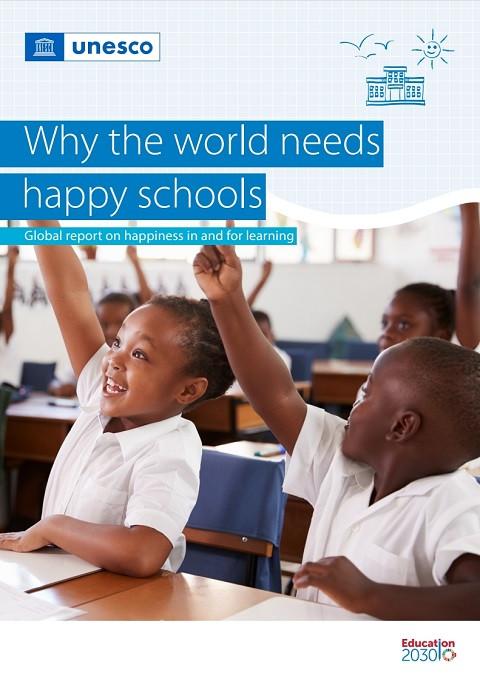 Why the World Needs Happy Schools: Global Report on Happiness In and For Learning سنة النشر: 2024 المؤلف المؤسسي: UNESCO Seeing a teacher smile. Hearing students laugh. Feeling a hug from a friend. Smelling fresh air. Tasting a nutritious school meal. These five senses can stimulate happiness at school and improve the learning experiences, outcomes and well-being of students. Through the ‘Happy Schools’ initiative, UNESCO is placing happiness at the core of the transformation of education. It encourages education systems to recognize happiness as both a means to and a goal of quality learning. The initiative is informed by a growing evidence base linking happiness with better learning, teaching, well-being and overall system resilience. This report presents the UNESCO global Happy Schools framework consisting of 4 pillars – people, process, place and principles – and 12 high-level criteria to guide the transformation of learning. It offers a holistic model for embedding happiness into education policies and cultivating it in schools through systemic changes. The report illustrates how the ‘Happy Schools’ initiative aims to create top-down and bottom-up transformation, encouraging governments to recognize happiness as a core objective of education. It supports the scaling of promising practices of joyful learning from the school to the policy level.
 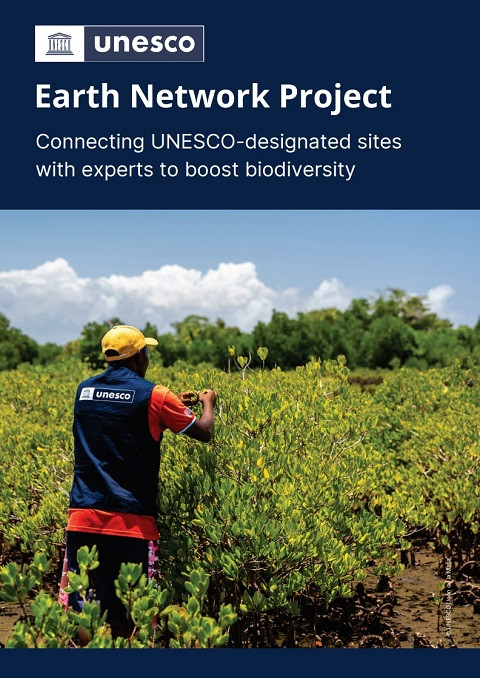 Earth Network Project: Connecting UNESCO-Designated Sites With Experts to Boost Biodiversity سنة النشر: 2024 المؤلف المؤسسي: UNESCO The Earth Network project was launched in 2021 with the support of the Government of Italy. It brings together over 380 experts from more than 60 countries, encompassing diverse biodiversity-related fields that include land restoration, environmental management and environmental law. The specialists volunteer to put their unique skillsets and knowledge at the disposal of sites designated by UNESCO which request their assistance. The Earth Network covers all scientific domains and proudly combines different forms of knowledge: scientific, practitioner, local and indigenous. On the ground, these experts provide technical advice, collect data, build partnerships, and provide training tailored to the specific needs and priorities of each UNESCO-designated site.
 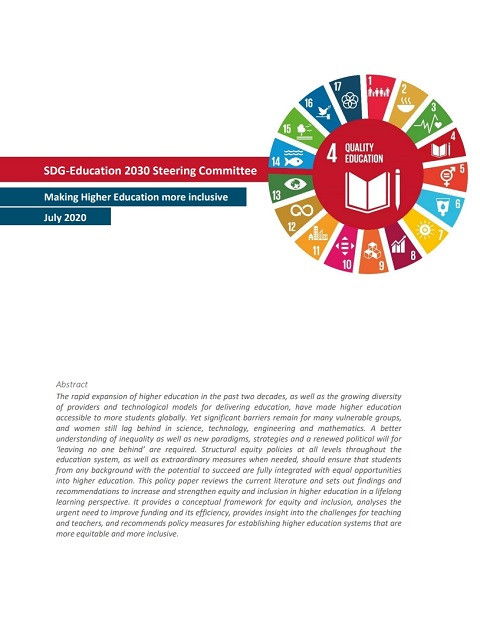 SDG-Education 2030 Steering Committee: Making Higher Education More Inclusive, July 2020 سنة النشر: 2020 المؤلف المؤسسي: UNESCO The rapid expansion of higher education in the past two decades, as well as the growing diversity of providers and technological models for delivering education, have made higher education accessible to more students globally. Yet significant barriers remain for many vulnerable groups, and women still lag behind in science, technology, engineering and mathematics. A better understanding of inequality as well as new paradigms, strategies and a renewed political will for ‘leaving no one behind’ are required. Structural equity policies at all levels throughout the education system, as well as extraordinary measures when needed, should ensure that students from any background with the potential to succeed are fully integrated with equal opportunities into higher education. This policy paper reviews the current literature and sets out findings and recommendations to increase and strengthen equity and inclusion in higher education in a lifelong learning perspective. It provides a conceptual framework for equity and inclusion, analyses the urgent need to improve funding and its efficiency, provides insight into the challenges for teaching and teachers, and recommends policy measures for establishing higher education systems that are more equitable and more inclusive.
  Chile: Artificial Intelligence Readiness Assessment Report سنة النشر: 2023 المؤلف المؤسسي: UNESCO The Readiness Assessment Methodology (RAM) is a diagnostic tool intended to assist Member States in upholding their commitment to the Recommendation by helping them understand how prepared they are to implement AI ethically and responsibly for all their citizens. The RAM questionnaire forms the basis for the first section of this readiness assessment report, providing a comprehensive but detailed overview of laws, institutions, and the cultural, social, and human capital landscape shaping AI. This is then complemented in the second section by a summary of concerns and priorities raised during a national multistakeholder consultation that was conducted in 2023. Finally, the third section presents a roadmap and recommendations for building capacities across national institutions, laws and policies, and human capital, to achieve a responsible AI ecosystem aligned with the UNESCO Recommendation. As the very first country to complete the RAM and the country report, Chile is blazing the trail not only for Latin America but the world. We applaud the initiative the Chilean government has taken to update its AI strategy putting ethics and governance front and centre, and thank them for inviting UNESCO to assist in this endeavour. The report presented here reveals a complex and rapidly-changing landscape. In the legal and regulatory dimension, the 2021 National Artificial Intelligence Policy (NAIP) represents a substantive and wide-ranging commitment to developing AI. One of the key recommendations of this report is to fully integrate the UNESCO Recommendation into the NAIP’s axis of Ethics, Regulation, and Socioeconomic Impacts. Notably, the RAM reveals the pressing need to update legislation around data protection and cybersecurity to meet the challenges of AI. It also highlights several areas the Chilean government is actively working to develop. [...] Overall, this report presents a fundamentally optimistic vision that we at UNESCO share: that ethical governance and responsible regulation of AI is entirely consistent with innovation and economic growth, and is essential for ensuring a technological ecosystem that benefits the public good. In drawing a clear line from the RAM data through to the multistakeholder consultations and the recommendations, Chile has a clear roadmap for how to get there. (This text has been extracted from the Foreword of the publication)