
الموارد
استكشف مجموعة واسعة من الموارد القيمة حول تعليم المواطنة العالمية لتعميق فهمك وتعزيز البحث والمناصرة والتعليم والتعلم.
تم العثور على 2,275 نتيجة
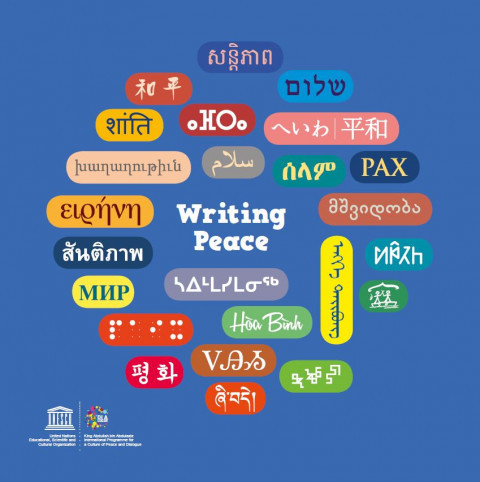 Escribir la Paz سنة النشر: 2017 المؤلف: Eric Cattelain المؤلف المؤسسي: Organización de las Naciones Unidas para la Educación, la Ciencia y la Cultura (UNESCO) Escribir la Paz es un manual que invita a un público infantil y juvenil a descubrir las escrituras contemporáneas a través de una muestra de ellas. Tiene por objeto explorar el mundo, volviéndolo más cercano y más familiar. Escribir la Paz ayuda a niños y jóvenes de 8 a 18 años a tomar conciencia de la interdependencia de las culturas, familiarizándose con los sistemas de escritura contemporáneos, su historia y sus aportes mutuos. El manual incluye 24 fichas de actividades. Cada sección presenta los caracteres de un sistema de escritura, un texto introductorio y un contexto histórico, las palabras “Paz” y “Hola”, los idiomas asociados a las distintas escrituras, y una actividad cuyas respuestas se presentan al final del manual. Seis mil años después de la aparición de la escritura, ¿qué sabemos de los demás, de sus sistemas de pensamiento y la transcripción de sus escrituras? ¿De qué manera pueden los distintos sistemas de escritura contribuir a un mejor conocimiento del mundo y del lugar que ocupamos en él? Empezando por el descubrimiento de estas escrituras y su fascinante belleza, el manual conecta a los jóvenes con la diversidad y les sensibiliza al concepto de paz y a la conciencia que de él tenemos. أكتب السلام سنة النشر: 2017 المؤلف: Eric Cattelain المؤلف المؤسسي: منظمة الأمم المتحدة للتربية والعلم والثقافة (UNESCO) يدعو كتيب "أكتب السلام" فئة القراء الصغار إلى اكتشاف الكتابات الحديثة من خلال التعريف بلغات مختلفة. كما نسعى من خلال ذلك إلى التعايش مع الاختلاف ليبدو العالم أكثر قربا وحيوية. يشجع كتيب "أكتب السلام" الأطفال الذين تتراوح أعمارهم بين 8 ـ 14 سنة على الاطلاع على مختلف أشكال الترابط والتفاعل بين الثقافات من خلال تعريفهم بأنظمة الكتابة وتاريخها والاقتباسات المتبادلة بينها.يحتوي الكتيب على 24 ورقة نشاط حيث يعرض كل جزء حروف أحد أنظمة الكتابة المدرجة في الكتيب من جهة، ومن جهة أخرى، نصَا تعريفيّا بها وبخلفيتها التاريخية، إضافة إلى كلمة "السلام" وكلمة "مرحبا" واللغة أو اللغات المرتبطة بتلك الأنظمة. كما يحتوي كل جزء على نشاط معرفي تتوفر أجوبته في آخر الدليل.بعد مرور 6000 سنة على مجيء الكتابة، ما الذي نعرفه عن الآخرين، عن أنظمتهم الفكرية وعن كيفية تناقل أنظمتهم الخطيّة؟ كيف لهذه الأنظمة المختلفة أن تساهم في تقديم معرفة أفضل عن العالم وعن موقعنا فيه؟ نسعى من خلال افتتاحنا للكتاب بآليات التعلم حول تلك الأنظمة وجمالها الأخاذ ربط إدراك الأطفال بالتنوع والانفتاح على مفهوم السلام والوعي به.
 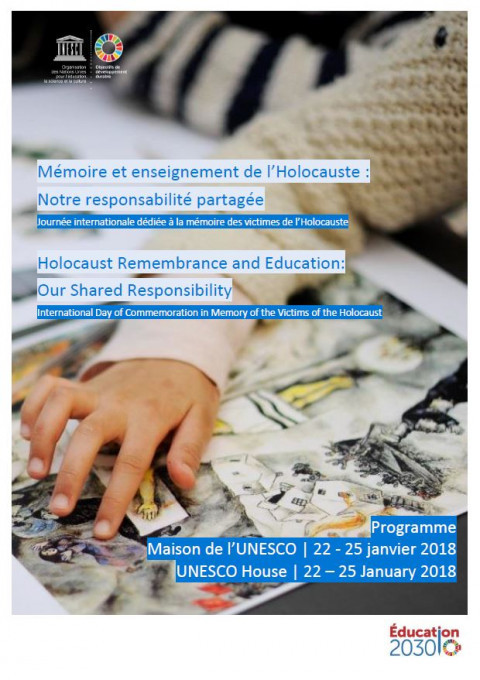 Holocaust Remembrance and Education: Our Shared Responsibility; International Day of Commemoration in Memory of the Victims of the Holocaust سنة النشر: 2018 المؤلف المؤسسي: 联合国教科文组织 (UNESCO) This brochure describes the occasion "International Day of Commemoration in Memory of the Victims of the Holocaust". For this occasion, from 22nd to 25th January, UNESCO, in partnership with the Shoah Memorial, has organised a series of events: a screening of Claude Lanzmann’s Four Sisters, a round table, an official ceremony, and exhibitions.
  Human Right and Encryption سنة النشر: 2016 المؤلف: Wolfgang Schulz | Joris van Hoboken المؤلف المؤسسي: UNESCO This publication follows UNESCO’s new approach to Internet issues, as endorsed in November 2015 on the occasion of its 38th General Conference. Our 195 Member States have adopted the CONNECTing the Dots Outcome Document, in which 38 options for future action from UNESCO are set out; and the Internet Universality principles (R.O.A.M.),which advocates for a Human-rights-based, Open and Accessible Internet, governed by Multi-stakeholder participation.Encryption is a hot topic in the current global discussion on Internet governance. This research delves into the subject, to outline a global overview of the various means of encryption, their availability and their potential applications in the media and communications landscape. The research explains how the deployment of encryption is affected by different areas of law and policy, and it offers detailed case studies of encryption in selected jurisdictions.It analyzes in-depth the role of encryption in the media and communications landscape, and the impact on different services, entities and end users. Built on this exploration and analysis, the research provides recommendations on encryption policy that are useful for various stakeholders. These include signaling the need to counter the lack of gender sensitivity in the current debate, and also highlighting ideas for enhancing “encryption literacy”. Writing Peace سنة النشر: 2017 المؤلف: Eric Cattelain المؤلف المؤسسي: UNESCO “Writing Peace” is a manual that invites young audiences to discover contemporary writings through the introduction of various languages. Its goal is to make the world appear a little closer and a little more familiar. "Writing Peace" encourages children (ages8 to 14) to become aware of the interdependence of cultures through familiarization with contemporary writing systems, their history, and their borrowings.The manual contains 24 activity sheets. Each section presents the characters of a writing system, an introductory text and historical background, the word “peace” and the word “hello,” the language(s) attached to the system(s), and an activity whose answers appear at the end of manual.Six thousand years after the advent of writing, what do we know about others, their systems of thought, and the transcriptions of their writing systems? How can different writing systems contribute to a better understanding of the world and our place within it? By beginning to learn about these writings and their fascinating beauty, the manual connects children to diversity, thus opening their eyes to the concept of peace and our awareness of it.
  Meeting on Learning to Live Sustainably in Cities in Latin America and the Caribbean, Villa María, Argentina (26-28 April 2017): Meeting Report سنة النشر: 2017 المؤلف المؤسسي: UNESCO Villa Maríia, the first Argentinian city to join the UNESCO Global Network of Learning Cities (GNLC), co-hosted the first GNLC meeting in the region, titled ‘Learning to live sustainably in cities in Latin America and the Caribbean’. This three-day event was a joint effort of the City of Villa Maríia, the UNESCO Institute for Lifelong Learning (UIL), UNESCO Headquarters, and the UNESCO Regional Bureau for Education in Latin America and the Caribbean (OREALC/UNESCO Santiago). Participants explored new ways to implement sustainable solutions at the local level, as well as increase awareness and training related to Education for Sustainable Development (ESD). More than 170 city representatives from over 40 cities and 20 countries (including mayors and deputy mayors, experts, authorities and practitioners) were welcomed by the host city. The first day of the meeting was composed of plenary sessions; the second day consisted of two parallel workshop sessions: (1) a regional workshop on the Global Action Programme (GAP) on ESD and Cities, and (2) a regional workshop on learning cities. Aprender a Vivir de Manera Sostenible en Ciudades de América Latina y el Caribe, Villa María (Argentina), 26-28 de abril de 2017: informe de la reunión سنة النشر: 2017 المؤلف المؤسسي: Organización de las Naciones Unidas para la Educación, la Ciencia y la Cultura (UNESCO) Villa Maríia, la primera ciudad argentina que entróo a formar parte de la Red Mundial de Ciudades del Aprendizaje de la UNESCO, fue una de las organizadoras de la primera reunióon de esta Red en la regióon, titulada “Aprender a vivir de manera sostenible en ciudades en Améerica Latina y el Caribe”. Este acto, de tres díias de duracióon, fue una iniciativa conjunta de la ciudad de Villa Maríia, el Instituto de la UNESCO para el Aprendizaje a lo Largo de Toda la Vida (IUAL), la Sede de la UNESCO y la Oficina Regional de Educacióon de la UNESCO para Améerica Latina y el Caribe (OREALC/UNESCO Santiago). Los participantes estudiaron nuevas formas de poner en práactica soluciones sostenibles a escala local, asíi como de fomentar una mayor sensibilizacióon y formacióon en materia de educacióon para el desarrollo sostenible (EDS). Villa Maríia acogióo a máas de 170 representantes de máas de 40 ciudades y 20 paíises, entre los que se encontraban alcaldes y tenientes de alcalde, expertos, autoridades y profesionales. Durante la primera jornada de la reunióon tuvieron lugar reuniones plenarias y la segunda jornada se dividióo en dos sesiones paralelas de talleres: 1) un taller regional sobre el Programa de Accióon Mundial de EDS y las ciudades, y 2) un taller regional sobre las ciudades del aprendizaje.
  Global Citizenship Education: Topics and Learning Objectives سنة النشر: 2015 المؤلف المؤسسي: UNESCO This publication, titled Global Citizenship Education: Topics and learning objectives, is the first pedagogical guidance from UNESCO on global citizenship education. It is the result of an extensive research and consultation process with experts from different parts of the world. This guidance draws on the UNESCO publication Global Citizenship Education: Preparing learners for the challenges of the 21st century and the outcomes of three key UNESCO events on global citizenship education: the Technical Consultation on Global Citizenship Education (September 2013), as well as the First and Second UNESCO Fora on Global Citizenship Education, organized in December 2013 and January 2015 respectively. Before it was finalized, the guidance was field-tested by education stakeholders in selected countries in all regions to ensure its relevance in different geographical and socio-cultural contexts. Following the foundational work of UNESCO to clarify the conceptual underpinnings of global citizenship education and provide policy and programmatic directions, this document has been developed in response to the needs of Member States for overall guidance on integrating global citizenship education in their education systems. It presents suggestions for translating global citizenship education concepts into practical and age-specific topics and learning objectives in a way that allows for adaptation to local contexts. It is intended as a resource for educators, curriculum developers, trainers as well as policy-makers, but it will also be useful for other education stakeholders working in non-formal and informal settings.
  Éducation à la citoyenneté mondiale: thèmes et objectifs d'apprentissage سنة النشر: 2015 المؤلف المؤسسي: Organisation des Nations Unies pour l'éducation, la science et la culture (UNESCO) Le présent ouvrage, intitulé Éducation à la citoyenneté mondiale : Thèmes et objectifs d’apprentissage, est le premier guide pédagogique de l’UNESCO sur l’éducation à la citoyenneté mondiale. Il est le fruit d’un processus approfondi de recherche et de consultation avec des spécialistes de différentes régions du monde. Ce guide s’inspire de la publication de l’UNESCO intitulée Éducation à la citoyenneté mondiale : Préparer les apprenants aux défis du XXIe siècle ainsi que des résultats de trois événements clés de l’UNESCO sur l’éducation à la citoyenneté mondiale : la Consultation technique sur l’éducation à la citoyenneté mondiale (septembre 2013) et les premier et deuxième Forums de l’UNESCO sur l’éducation à la citoyenneté mondiale, organisés en décembre 2013 et en janvier 2015. Avant sa finalisation, le guide a été expérimenté sur le terrain par des acteurs de l’éducation dans différents pays de chaque région, afin de veiller à ce qu’il soit adapté à des contextes géographiques et socioculturels divers. Inspirée des travaux de base de l’UNESCO visant à clarifier les fondements conceptuels de l’éducation à la citoyenneté mondiale, et à fournir des orientations politiques et programmatiques, cette publication a été élaborée pour répondre aux besoins des États membres, en leur donnant des indications générales sur l’intégration de l’éducation à la citoyenneté mondiale dans leurs systèmes éducatifs. Elle propose des moyens de transposer l’éducation à la citoyenneté mondiale dans des thèmes et des objectifs d’apprentissage pratiques et tenant compte de l’âge de l’apprenant, qui puissent être adaptés aux contextes locaux. Cette publication a été conçue pour servir de document de référence aux éducateurs, aux concepteurs de programmes éducatifs, aux formateurs et aux décideurs, mais elle sera également utile à d’autres acteurs de l’éducation travaillant dans des contextes non formels et informels.
  Educación para la ciudadanía mundial: temas y objetivos de aprendizaje سنة النشر: 2015 المؤلف المؤسسي: Organización de las Naciones Unidas para la Educación, la Ciencia y la Cultura (UNESCO) La educación para la ciudadanía mundial aspira a ser un factor de transformación, inculcando los conocimientos, las habilidades, los valores y las actitudes que los educandos necesitan para poder contribuir a un mundo más inclusivo, justo y pacífico.La presente publicación, titulada Educación para la ciudadanía mundial: Temas y objetivos de aprendizaje, es la primera guía de la UNESCO al respecto. Se presentan sugerencias para plasmar los conceptos de la educación para la ciudadanía mundial en temas y objetivos de aprendizaje específicos para cada grupo de edad de un modo que facilita su adaptación a las circunstancias locales. Es un recurso para los educadores, los responsables de la elaboración de programas de estudios, los instructores y los encargados de la formulación de políticas, pero también será de utilidad para otros copartícipes en la educación que trabajan en contextos no formales e informales.