
الموارد
استكشف مجموعة واسعة من الموارد القيمة حول تعليم المواطنة العالمية لتعميق فهمك وتعزيز البحث والمناصرة والتعليم والتعلم.
تم العثور على 2,255 نتيجة
 ЮНЕСКО Дорожная карта осуществления Глобальной программы действий по образованию в интересах устойчивого развития سنة النشر: 2014 المؤلف المؤسسي: UNESCO Для построения более справедливого, мирного и устойчивого мирового сообщества каждый отдельный человек и каждое общество должны быть обеспечены и вооружены знаниями, навыками и ценностными ориентирами, а также обладать четким пониманием того, как добиться подобных изменений. Сегодня мы являемся свидетелями растущего международного признания принципов образования в интересах устойчивого развития (ОУР) как неотъемлемого элемента качественного образования и ключевого фактора устойчивого развития. В Маскатском соглашении, принятом на Глобальном совещании по программе «Образование для всех» в 2014 г., а также в предложении по целям в области устойчивого развития (ЦУР), подготовленном Рабочей группой открытого состава Генеральной Ассамблеи ООН по ЦУР, образование в интересах устойчивого развития фигурирует в числе целей, предложенных к включению в повестку дня на период после 2015 г.В 2013 г. 37-я сессия Генеральной конференции ЮНЕСКО одобрила Глобальную программу действий (ГПД) по ОУР в качестве деятельности по итогам Десятилетия образования в интересах устойчивого развития Организации Объединенных Наций (2005-2014 гг.).Развивая достигнутые в рамках Десятилетия успехи, ГПД направлена на осуществление конкретной деятельности в области ОУР и расширение ее масштабов. Цель настоящей Дорожнойкарты – информировать директивные органы, заинтересованные стороны и участников о принятии государствами – членами ЮНЕСКО Глобальной программы действий и представить предложения по осуществлению ГПД, а также информацию о роли ЮНЕСКО в ее реализации.
 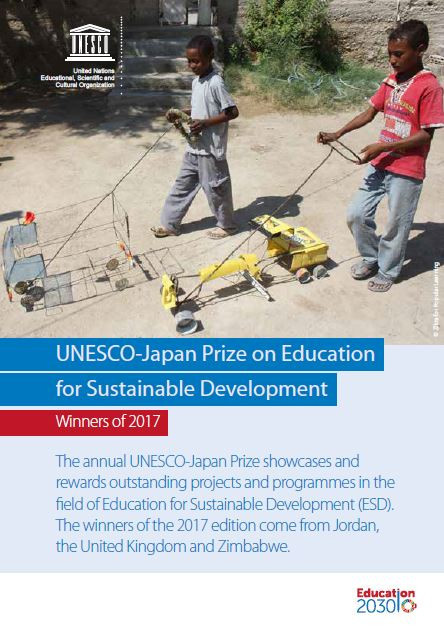 UNESCO-Japan Prize on Education for Sustainable Development: Winners of 2017 سنة النشر: 2017 المؤلف المؤسسي: UNESCO The annual UNESCO-Japan Prize showcases and rewards outstanding projects and programmes in the field of Education for Sustainable Development (ESD).The winners of the 2017 edition come from Jordan, the United Kingdom and Zimbabwe.Among this year’s winners are a school, business and a non-profit organization, promoting ESD, respectively, at the local, regional and global level: Sihlengeni Primary School from the Republic of Zimbabwe; the social enterprise Zikra from the Hashemite Kingdom of Jordan; and the Hard Rain Project from the United Kingdom of Great Britain and Northern Ireland. Each of them will receive an award of USD 50,000.The Director-General of UNESCO and the Japanese Minister of Education will award the Prize to the three laureates in a ceremony at UNESCO Headquarters in Paris on 3 November 2017, during the 39th session of the General Conference.
  Survey on Privacy in Media and Information Literacy with Youth Perspectives سنة النشر: 2017 المؤلف: Sherri Hope Culver | Alton Grizzle المؤلف المؤسسي: UNESCO Media and information literate individuals are more empowered to make informed decisions about their privacy online and offline, among other things. Accordingly, governments and policy-makers who are committed to ensuring that the privacy of citizens is respected should also be committed to media and information literacy (MIL) for all. If they are not, then their efforts will be less sustainable. Equally, private and public enterprises that genuinely want to respect the privacy of citizens should purposefully contribute to MIL awareness among users qua citizens. Two research surveys are referenced in this report. The first investigated youth attitudes towards MIL and social and democratic discourses. One of the seven themes addressed in the context of social and democratic discourses was privacy. The research was carried out by UNESCO. The second survey studied privacy in MIL courses globally and was conducted for UNESCO by the UNESCO-UNAOC University Network on Media and Information Literacy and Intercultural dialogue (MILID Network), and members of the Global Alliance for Partnerships in Media and Information Literacy (GAPMIL). The report responds to UNESCO’s efforts to stimulate global research into privacy in MIL. Ultimately, this report aims to provide conceptual, development and policy recommendations to foster privacy in MIL, while enabling the critical engagement of people, including young women and men, in an environment conducive to sustainable development and to freedom of expression online and offline. It seeks to provide clarity on the complex issue of how MIL and privacy intersect. Prix UNESCO-Japon D'éducation en vue du Développement Durable: Lauréats de 2017 سنة النشر: 2017 المؤلف المؤسسي: UNESCO L’année 2017 marque la troisième édition du Prix UNESCO-Japon. Les lauréats ont été sélectionnés parmi plus de 100 candidatures présentées par des gouvernements d’États membres de l’UNESCO et par des organisations non gouvernementales en partenariat officiel avec l'UNESCO. Les candidatures ont été évaluées par un jury indépendant composé de cinq experts internationaux de l’EDD, qui ont recommandé les trois lauréats à la Directrice générale de l’UNESCO.Parmi les lauréats de cette année figurent une école, une entreprise et une organisation à but non lucratif oeuvrant à la promotion de l’EDD, respectivement à l’échelle locale, régionale et internationale : l’école primaire Sihlengeni (République du Zimbabwe) ; l’entreprise sociale Zikra (Royaume hachémite de Jordanie) ; et le projet Hard Rain (Royaume-Uni de Grande-Bretagne et d'Irlande du Nord). Chaque lauréat recevra une récompense d’un montant de 50,000 dollars des États-Unis.La Directrice générale de l’UNESCO et le Ministre de l’éducation japonais remettront le Prix aux trois lauréats au cours d’une cérémonie qui se tiendra le 3 novembre 2017 au Siège de l’UNESCO à Paris, lors de la 39e session de la Conférence générale. Premio UNESCO-Japon de Educacion para el Desarrollo Sostenible: Galardonados de 2017 سنة النشر: 2017 المؤلف المؤسسي: UNESCO En 2017 el Premio UNESCO-Japon llegaba a su tercera edicion. Los galardonados fueron elegidos de entre las mas de 100 candidaturas presentadas por gobiernos de Estados Miembros de la UNESCO y organizaciones no gubernamentales quecolaboran oficialmente con la Organizacion. Tras examinar las candidaturas, un jurado independiente formado por cinco especialistas internacionales en EDS recomendo los tres galardonados a la Directora General de la UNESCO.Este ano se ha concedido el premio a una escuela, una empresa y una organizacion sin animo de lucro que promueven la EDS a escala local, regional y mundial respectivamente: la escuela de primaria Sihlengeni, de la Republica de Zimbabwe; Zikra por el Aprendizaje Popular, del Reino Hachemita de Jordania; y el Proyecto Hard Rain, del Reino Unido de Gran Bretana e Irlanda del Norte. Cada una de estas entidades recibira un premio en metalico de 50,000 dolares estadounidenses.La Directora General de la UNESCO y el Ministro de Educacion del Japon haran entrega del Premio a los tres galardonados en el curso de una ceremonia que tendra lugar en la Sede de la UNESCO (Paris) el 3 de noviembre de 2017, coincidiendo con la celebracion de la 39ª reunion de la Conferencia General.
 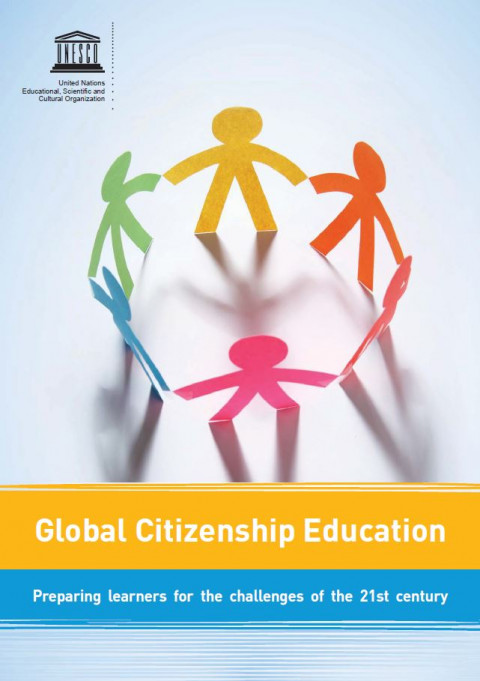 Global Citizenship Education: Preparing Learners for the Challenges of the 21st Century سنة النشر: 2014 المؤلف المؤسسي: UNESCO The United Nations Secretary-General’s Global Education First Initiative (GEFI) has established education as a means to ‘foster global citizenship’ – one of its three priority areas. To support this, UNESCO organized two landmark meetings on GCE in 2013. This publication aims to define the parameters of GCE by using the collective expertise, experience and wisdom of those participants who gathered at these landmark events, and to plan for future action in line with emerging thinking and other ongoing work. The review establishes that GCE has a critical role to play in equipping learners with competencies to deal with the dynamic and interdependent world of the twenty-first century. While GCE has been applied in different ways in different contexts, regions and communities, it has a number of common elements, which include fostering in learners. In formal settings, GCE can be delivered as an integral part of an existing subject (such as civic or citizenship education, social studies, environmental studies, geography or culture), or as an independent subject area. Integrated models appear to be more common. Some less traditional, but at least as effective, pathways for GCE have included the following: the use of information and communication technologies and social media, sport competitions and the use of art and music, and youth-led initiatives employing a wide variety of approaches. Both traditional and new horizons for GCE are profiled in this review. This publication also explores a number of enabling conditions for the promotion and implementation of GCE. These include: the existence of an open environment for universal values, the implementation of transformative pedagogy and support for youth-led initiatives.The review acknowledges that there are a number of ongoing tensions with the concepts of global citizenship and global citizenship education. While these tensions vary, they all point to the fundamental question of how to promote universality (e.g. common and collective identity, interest, participation, duty), while respecting singularity (e.g. individual rights, self-improvement). Some ways forward to resolve these tensions are suggested, whilst maintaining that challenges around theoretical elements of GCE should not undermine its practice. The processes documented in this publication have strengthened partnerships, built coalitions and contributed to improving the evidence base on the theory and practice of global citizenship education. While there are tasks that remain, this foundation bodes well for improving the enabling conditions and the practices highlighted in this review. By preparing learners to fulfil their potential in an increasingly globalized world, we are promoting transformed societies that are also better equipped to deal with the twenty-first century challenges and to seize twenty-first century opportunities. Éducation à la citoyenneté mondiale : Préparer les apprenants aux défis du XXIe siècle سنة النشر: 2014 المؤلف المؤسسي: UNESCO Qu’est-ce que l’éducation à la citoyenneté mondiale ? Est-ce que nous l’apprenons à l’école ? Quels changements peut-elle générer ? Comment peut-elle être introduite dans les programmes scolaires et devenir une pratique courante ? Cette publication cherche à répondre à ces questions, ainsi qu’à d’autres encore.Pour l’UNESCO, l’éducation à la citoyenneté mondiale (ECM) renforce les connaissances, les compétences, les valeurs et les comportements dont les apprenants ont besoin pour construire un monde plus juste, pacifique et durable, et pour prospérer en tant que citoyens du monde au XXIe siècle.Dans un monde globalisé en rapide mutation, il est fondamental que les générations actuelles et futures développent la capacité d’agir dès aujourd’hui et de trouver des solutions aux problèmes mondiaux de demain.Le point de départ de l’ECM est la reconnaissance de l’apport de l’éducation dans la compréhension et la résolution de problèmes mondiaux complexes. C’est aussi la reconnaissance du rôle qu’elle a à jouer pour aller au-delà du simple développement de capacités cognitives – par exemple, lire, écrire et compter – en inculquant aux apprenants des valeurs et des compétences sociales et émotionnelles capables de promouvoir le changement social et la coopération entre les nations.Cette publication a pour objectif : d’améliorer la compréhension de l’ECM en tant qu’approche éducative et de ses implications sur les contenus éducatifs et les méthodes d’enseignement ; d’identifier des approches novatrices et de bonnes pratiques en matière d’ECM ; et de partager les enseignements tirés et les moyens de promouvoir davantage encore l’ECM. Cette publication a été préparée à l’intention des responsables des politiques chargés de l’éducation, des praticiens, des organisations de la société civile et des leaders de la jeunesse, à partir des conclusions de deux conférences internationales consacrées à l’ECM. Educación para la Ciudadanía Mundial: Preparar a los Educandos para los Retos del Siglo XXI سنة النشر: 2014 المؤلف المؤسسي: UNESCO Esta publicación explora una serie de condiciones favorables para la promoción y la puesta en práctica de la ECM. Entre estos se incluyen: la existencia de un entorno abierto para los valores universales, la aplicación de pedagogía transformativa y el apoyo a las iniciativas dirigidas por los jóvenes. El estudio reconoce que hay una serie de tensiones vigentes para con los conceptos de ciudadanía mundial y educación para la ciudadanía mundial. Si bien estas tensiones varían, todas ellas apuntan a la cuestión fundamental de cómo promover la universalidad (p. ej. la identidad, el interés, la participación, el deber comunes y colectivos), respetando al mismo tiempo la singularidad (es decir, los derechos individuales, la superación personal). Se proponen algunas maneras de avanzar para resolver estas tensiones, a la vez que se mantiene que las dificultades que plantean los elementos teóricos de la ECM no deben socavar su práctica.
  Воспитание глобальной гражданственности: темы и цели обучения سنة النشر: 2015 المؤلف المؤسسي: UNESCO Данная публикация, озаглавленная «Воспитание глобальной гражданственности: темы и цели обучения» является первым, подготовленным ЮНЕСКО, педагогическим руководством в области воспитания глобальной гражданственности. Она является результатом обширных исследований и консультаций с участием экспертов из разных частей мира. Это руководство основывается на публикации ЮНЕСКО «Воспитание глобальной гражданственности: подготовка учащихся к проблемам XXI века» и результатах трех ключевых мероприятий ЮНЕСКО в области воспитания глобальной гражданственности: технической консультации по воспитанию глобальной гражданственности (сентябрь 2013 г.), а также первого и второго форумов ЮНЕСКО по воспитанию глобальной гражданственности, прошедших в декабре 2013 г. и январе 2015 г. До составления окончательного варианта руководства оно было протестировано заинтересованными сторонами в области образования в отдельных странах во всех регионах для обеспечения его актуальности в различных географических и социо-культурных ситуациях.
  التربية على المواطنة العالمية: مواضيع وأهداف تعلمية سنة النشر: 2015 المؤلف المؤسسي: UNESCO هذا الدليل "التربية على المواطنة العالمية: المواضيع والأهداف التعلمية" هو أول التوجيهات التربوية لليونسكو حول تعليم المواطنة العالمية. أتى هذا الدليل نتيجة لبحوث معمقة وعملية استشارية مع خبراء من مختلف أصقاع العالم. يرتكز هذا التوجيه على دليل اليونسكو» التربية على المواطنة العالمية: تحضير المتعلمين لتحديات القرن الواحد والعشرين " ومخرجات الأحداث لليونسكو حول التربية على المواطنة العالمية: المشاورة الفنية حول التربية على المواطنة العالمية (أيلول/سبتمبر 2013) وندوة اليونسكو الأولى والثانية حول التربية على المواطنة العالمية، واللتين عقدتا في كانون الأول/ديسمبر 2013 وكانون الثاني/يناير من العام 2015 على التوالي. قبل الانتهاء من العمل على هذا التوجيه، اختبره أصحاب المصلحة في المجال التعليمي اختباراً ميدانياً في عدد من الدول المنتقاة بغية الحرص على ملاءمته للسياقات الجغرافية والاجتماعية الثقافية المختلفة. تهدف التربية على المواطنة العالمية إلى أن تشكل قوة تحويلية، وبناء المعرفة والمهارات والقيم والسلوكيات التي يحتاج إليها المتعلمون ليتمكنوا من المساهمة في عالم أكثر دمجاً وعدلا وسلاماً. ويقدم هذا الدليل اقتراحات لترجمة مفاهيم التربية على المواطنة العالمية إلى مواضيع وأهداف تعلمية عملية ومراعية للأعمار بطريقة تسمح بمواءمتها مع السياقات المحلية. ويهدف الدليل إلى أن يشكل مورداً للمربين ومطوري المناهج والمدربين، بالإضافة إلى صانعي السياسات، فضلا عن كونه مهماً أيضاً لغيرهم من أصحاب المصلحة في المجال التعليمي، العاملين في أطر نظامية أو غير نظامية. يعرّف الدليل بالتربية العالمية ومقوماتها التعلمية وكيفية إدماجها في النطم التربوية وتطبيقها داخل الصف.