
الموارد
استكشف مجموعة واسعة من الموارد القيمة حول تعليم المواطنة العالمية لتعميق فهمك وتعزيز البحث والمناصرة والتعليم والتعلم.
تم العثور على 24 نتيجة
 Effects and Limits of Core Schools for Multicultural Education (The Journal of Curriculum and Evaluation; Vol. 19, No. 1) سنة النشر: 2016 المؤلف: Hyosun Kim | Wonpyo Hong المؤلف المؤسسي: Korea Institute for Curriculum and Evaluation (KICE) This study investigates curriculum programs of core schools for multicultural education and teachers’ responses to their effects and limits. To address these topics, this study analyzes curricular documents collected from 18 elementary and secondary schools selected as exemplary cases in 2014. It also conducted in-depth interviews with 14 teachers who are in charge of planing and implementing multicultural programs in core schools. Major results support that multicultural core schools expand the targets of multicultural education to mainstream students, their parents and local residents beyond minority students and their parents. It turned out, however, that multicultural core schools still tend to untouch structural biases and discriminations, while focusing on extending students’ awareness of cultural and racial diversities. This study also reveals that participating teachers face such difficulties as heavy workloads, lack of collaboration from local schools, and lack of relevant experiences and instructional materials. Based on these results, this study suggests the sharing of successful programs, enhancing teachers awareness of the significance of multicultural education, and further supports for teachers in charge of multicultural education to achieve the targeted goals of multicultural core schools. 다문화교육 중점학교 교육 프로그램 운영 현황 및 발전 방향에 대한 연구 (교육과정평가연구; Vol. 19, No. 1) سنة النشر: 2016 المؤلف: 김혜선 | 홍원표 المؤلف المؤسسي: 한국교육과정평가원 본 연구는 다문화교육 중점학교의 프로그램 운영 현황을 파악하고, 이에 대한 교사들의 인식과 운영상의 어려움을 살펴보기 위해 수행되었다. 이를 위해 2014년도 다문화교육 중점학교 가운데 우수 사례로 선정된 18개 학교의 문헌자료를 분석하였고, 그 중 14개 학교의 담당 교사와 면담을 수행하였다. 연구 결과, 모두를 위한 다문화교육을 지향하는 도입 취지에 맞게, 다문화교육 중점학교들에서는 다문화교육의 대상을 일반 학생이나 학부모들로 확대하고 있었다. 반면 다문화교육의 내용 측면에서는 여전히 문화 다양성이나 문화이해 교육이 다수를 차지하고 있는 데 비해 반편견·반차별은 주변화되어 있는 것으로 나타났다. 한편, 학교 현장의 담당 교사들은 이전의 시범학교들보다 중점학교의 접근 방식이 다문화교육의 취지와 좀 더 부합한다는 의견을 보이고 있는 반면, 업무과중, 인근 학교의 협조 부족, 관련 정보 부족 등과 같은 어려움을 지적하고 있었다. 이러한 결과를 토대로 본 연구는 다문화교육 중점학교의 발전 방안으로 다문화교육에 대한 학교 구성원들의 인식 강화, 반차별·반편견 관련 내용 요소 확대, 우수 프로그램의 확산과 공유 등을 제시하고 있다.
  A Study on Contextualization of Global Education Agenda: Focusing on Education Policies of Global Citizenship Education in South Korea (The Journal of Korean Education; Vol.46, No.3) سنة النشر: 2019 المؤلف: Insun Jeon المؤلف المؤسسي: Korean Educational Development Institute (KEDI) This study aims to provide a concrete discussion on contextualization of global education agenda with the case of Global Citizenship Education(GCED) policies in South Korea.Design/Methodology: With a theoretical approach based on neoinstitutionalism, this study investigates influential factors in determining the direction and key words of GCED policies in policy-making process. Policy documents of Ministry of Education, the local education authority of Seoul city, Kyeonggi-province, Incheon city and the Asia-Pacific Centre of Education for International Understanding of UNESCO, and the speeches of key stakeholders such as presidents, ministers and superintendents from 2014 to April 2019 are analyzed by using KHcoder for text mining and mapping. Semi-structured interviews are conducted with experts to supplement the text analysis.Findings/Result: The result shows that the influence of key stakeholders on directing GCED policies is significant. By and large, GCED is re-defined by purpose in the socio-political context of South Korea, which contributes to the expansion of GCED but also results in inconsistency and fragmentation.Value: This study shows a limit of the top-down approach to GCED policy decisions, and the necessity to allow more bottom-up proposals, transparency of the policy-making process, the participation of diverse groups and ongoing discussions focusing on the process of contextualization for future GCED. 국제교육의제의 지역적 맥락화에 대한 고찰: 한국의 세계시민교육 정책을 중심으로 (한국교육; Vol.46, No.3) سنة النشر: 2019 المؤلف: 전인선 المؤلف المؤسسي: 한국교육개발원 본 연구는 한국의 세계시민교육 정책을 통해 국제교육의제의 지역적 맥락화의 구체적인 사례와 논의의 발전가능성을 제시하고자 하였다. 신제도주의에 기반을 둔 이론적 접근방식을 통해, 세계시민교육정책의 핵심주제와 연계정책 결정에 영향을 미친 요인을 분석하였다. 연구방법으로는 KHcoder를 이용하여 2014년부터 2019년 4월까지의 서울특별시, 경기도, 인천광역시교육청의 세계시민교육 관련 정책자료와 유네스코 아시아태평양 국제이해교육원의 문서, 교육부 보도자료, 대통령, 교육부장관, 차관, 교육감 등 주요인사의 공식 발언 자료를 분석하고, 전문가 그룹과의 반구조면담을 통해 분석내용을 검증・보완하였다. 분석결과, 한국은 정책결정권자가 세계시민교육 정책의 핵심주제와 방향 설정에 미치는 영향이 매우 크며, 세계시민교육의 역할과 개념이 한국의 사회・정치적 맥락에서 목적 중심으로 재정립되는 것으로 나타났다.하향식 정책결정구조를 통해 이뤄진 ‘목적’ 중심의 세계시민교육의 맥락화는 양적팽창에는 긍정적으로 작용하였으나, 결정권자가 변경됨에 따라 생기는 정책의 비일관성과 파편화를 야기했다. 따라서 본 연구는 앞으로의 세계시민교육의 맥락화는 ‘목적’이 아닌 ‘과정’에 초점을 두어야하며, 이를 위해 정책구조의 개선을 통한 활발한 상향식 담론 생산과 정책결정과정의 투명성 보장과 다양한 그룹의 공식적인 참여, 그리고 지속적이고 공개적인 성찰이 필요하다.
  A Theoretical Discussion on Universal Core Elements and Korean Distinctiveness in Global Citizenship Education (The Journal of Korean Education; Vol. 37, No. 2) سنة النشر: 2010 المؤلف: Youlkwan Sung المؤلف المؤسسي: Korean Educational Development Institute (KEDI) Global citizenship education has been the subject of growing attention on global issues, development of ICT (Information and Communication Technology), and increasing interdependence at global level. However, the concept of global citizenship has been facing definitional ambiguity because the concept of citizenship has been tied to territorial boundaries. So there is still no overarching consensus as to what should be taught for students to become good global citizens. In facing this challenge, this paper seeks to explore (a) the definition of global citizenship education and how it has historically evolved, (b) the dilemma between national and supra-national citizenships along with another dilemma between globalization and its negative consequences, (c) universal minimum elements of global citizenship education, and (d) Korean distinctiveness in setting educational objectives. Global citizenship education is not thought of as teaching students in the same way regardless of geographical/cultural differences, but as one that may vary according to nations' culture, history, and developmental level of politics/welfare. In this regard, this paper also examines Korean political and cultural particularities as some constraints against participatory and active concept of global citizenship. The paper criticizes instrumental and ethnocentric interpretation of globalization in Korea and, instead, suggests more participatory and democratic perspectives on such global issues as poverty, hunger, inequality, injustice, sustainable development, etc. 세계시민교육 교육과정의 보편적 핵심 요소와 한국적 특수성에 대한 고찰 (한국교육; Vol.37, No. 2) سنة النشر: 2010 المؤلف: 성열관 المؤلف المؤسسي: 한국교육개발원 최근 정보통신의 발달은 물론 경제적 상호 의존성이 급격히 높아지면서 세계시민교육에 대한 관심이 부상하고 있다. 그러나 세계시민은 일국의 국경을 넘는 개념이기 때문에 세계시민 자체는 물론 세계시민교육의 개념은 정의상의 곤란에 직면하고 있다. 이 때문에 세계시민교육의 내용이 무엇이어야 하는 지가 분명하지 않은 상태에 있다. 이에 본고는 ① 일국의 시민과 세계의 시민 사이의 딜레마는 무엇인가, 그리고 세계화와 그 결과 사이의 딜레마는 무엇인가에 대해 살펴본 후, ② 의미연결망 분석과 문헌분석을 통해 세계시민교육에서 다루어야 할 핵심 요소로서 전지구적 보편성은 무엇이고, ③ 세계시민교육의 방향을 정립하는 데 있어 고려해야 할 한국적 특수성은 무엇인가에 대해 논의해 보았다. 세계시민교육은 전 세계의 모든 학생들에게 한 종류의 교육을 실시하는 것이 아니라 자국의 문화, 지정학적 위치, 정치 및 인권 발전 수준 등을 고려할 때 보다 효과적일 수 있기 때문에 보편성과 함께 특수성에 대한 논의를 수행하였다. 또한 본고는 세계시민교육을 도구주의적 관점에서 보는 것을 탈피하여 기아, 빈곤, 불평등, 인권, 환경 등 글로벌 이슈에 대해 참여적인 태도를 중시하는 변화지향적 관점의 중요성을 강조하였다.
  The Tasks for Future Education through the Analysis of Educational Innovation Cases سنة النشر: 2019 المؤلف: Eunhee Hwang | Sujin Choi | Jongheon Lim | Heejin Park | Jaeduck Lee | Sungki Kim | Giljae Lee | Hunho Kim | Ammi Jang المؤلف المؤسسي: Korean Educational Development Institute (KEDI) It is predicted that the future society will be low populated of the school-age but high populated of the elderly, intelligent information centered, and multicultural society. According to these changes of the society, it is time for education to shift to preparing for a future education system rather than growth from competition. Based on this perspectives, this study aims to explore the tasks of the future education by analyzing domestic and international cases of educational innovations. Specifically, this study suggests several practical tasks that general high schools can implement for the future education, analyzing the selected cases contributed to the educational innovation. This is because the cases of educational innovation are the stepping stones for general high school to move forward to the future education, although the cases are not perfect examples. 교육 혁신 사례 분석을 통한 미래교육 실천 과제 سنة النشر: 2019 المؤلف: 최수진 | 임종헌 | 박희진 | 이재덕 | 김성기 | 이길재 | 김훈호 | 장암미 المؤلف المؤسسي: 한국교육개발원 미래사회의 특징으로 학생 수 감소 및 고령화, 지능정보사회, 다문화 사회 등이 언급되고 있다. 이러한 미래사회의 변화에 따라 우리나라의 교육도 경쟁을 통한 성장보다는 미래를 대비하는 체제로 전환해야 할 시점에 놓여있다. 이 연구는 국내・외에서 이루어진 교육 혁신의 사례를 통해 미래교육의 실천 과제를 탐색하기 위한 것이다. 미래교육의 수준이나 내용은 미래의 범위를 어디로 설정하는가에 따라 다양할 수 있다. 이 연구에서는 일반 고등학교의 실천 가능성에 중요성을 두고 현재 완벽한 미래교육 시스템을 구축하고 있다고는 할 수 없지만 현재의 일반학교보다 한 발 앞서 미래교육을 준비하며 다양한 시행착오를 거쳐 성과를 거두고 있는 교육 혁신의 사례를 현재의 학교교육과 미래의 학교교육의 연결고리로 보고, 이들 사례에서 도출된 미래교육 실천 과제를 현재 학교들이 미래교육의 방향을 향해 나아가야할 실천 과제로 제안하였다.
 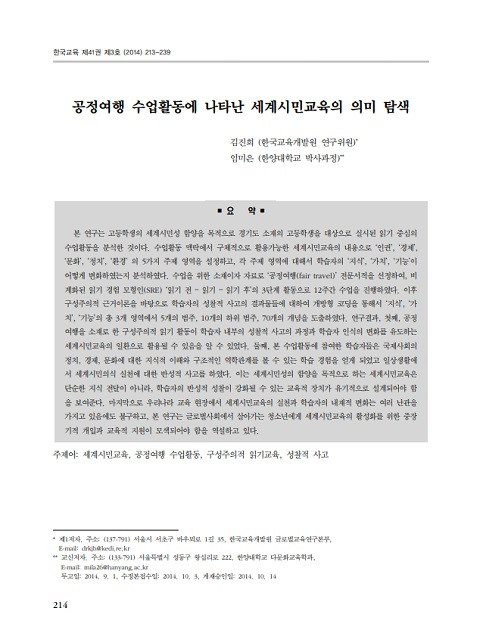 A Study on Global Citizenship Education Based on Scaffolded Reading Activities Utilizing a ‘fair travel’ Book in a High School (Journal of Korean Education; Vol. 41, No. 3) سنة النشر: 2014 المؤلف: Jinhee Kim | Mieun Lim المؤلف المؤسسي: Korean Educational Development Institute (KEDI) This study investigated the guiding principles associated with global citizenship education and their educational implications as they are engaged through scaffolded reading activities using a ‘fair travel’ book in a high school at Gyeonggi-do. The reading activities were designed to cultivate global citizenship for high school students. This study defined five major themes/subjects within global citizenship education such as ‘human rights,’ ‘economy,’ ‘culture,’ ‘politics,’ and ‘environment.’ The study sought to explore the learning domains of global citizenship education by considering the ‘knowledge,’ ‘value,’ and ‘function’ of each domain. To conduct this study, researchers selected a book with a specialized focus on ‘fair travel’ and analyzed how its contents if utilized in a 12 week program relate to the learning domains in global citizenship education. The activity stage of the program contained a ‘before reading,’ ‘on reading,’ and ‘after reading’ sections based on the Scaffolded Reading Experience Program. Embracing open-coding methodology, researchers produced 70 concepts within 10 subcategories of 5 categories in the 3 dimensions, ‘knowledge,’ ‘value,’ and ‘function.’ Major findings showed that the constructive model of scaffolded reading activities could be used as a meaningful program for global citizenship education at the high school level. This activity encouraged learners to engage in reflective thinking in a critical manner. Second, this study indicated that collective classroom activities using ‘fair travel’ contents enabled learners to acquire reshaped learning domains in the areas of global awareness, international knowledge, sense of global connectedness and local involvement. This study’s findings underscore the idea that practicing reflective critical thinking is required to enhance global citizenship education in practice. Lastly the findings support that the notion that effective educational provisioning and long-term implementation are both required to foster global citizenship education. 공정여행 수업활동에 나타난 세계시민교육의 의미 탐색 (한국교육; Vol. 41, No. 3) سنة النشر: 2014 المؤلف: 김진희 | 임미은 المؤلف المؤسسي: 한국교육개발원 본 연구는 고등학생의 세계시민성 함양을 목적으로 경기도 소재의 고등학생을 대상으로 실시된 읽기 중심의 수업활동을 분석한 것이다. 수업활동 맥락에서 구체적으로 활용가능한 세계시민교육의 내용으로 ‘인권’, ‘경제’, ‘문화’, ‘정치’, ‘환경’의 5가지 주제 영역을 설정하고, 각 주제 영역에 대해서 학습자의 ‘지식’, ‘가치’, ‘기능’이 어떻게 변화하였는지 분석하였다. 수업을 위한 소재이자 자료로 ‘공정여행(fair travel)’ 전문서적을 선정하여, 비계화된 읽기 경험 모형인(SRE) ‘읽기 전 – 읽기 – 읽기 후’의 3단계 활동으로 12주간 수업을 진행하였다. 이후 구성주의적 근거이론을 바탕으로 학습자의 성찰적 사고의 결과물들에 대하여 개방형 코딩을 통해서 ‘지식’, ‘가치’, ‘기능’의 총 3개 영역에서 5개의 범주, 10개의 하위 범주, 70개의 개념을 도출하였다. 연구결과, 첫째, 공정 여행을 소재로 한 구성주의적 읽기 활동이 학습자 내부의 성찰적 사고의 과정과 학습자 인식의 변화를 유도하는 세계시민교육의 일환으로 활용될 수 있음을 알 수 있었다. 둘째, 본 수업활동에 참여한 학습자들은 국제사회의 정치, 경제, 문화에 대한 지식적 이해와 구조적인 역학관계를 볼 수 있는 학습 경험을 얻게 되었고 일상생활에 서 세계시민의식 실천에 대한 반성적 사고를 하였다. 이는 세계시민성의 함양을 목적으로 하는 세계시민교육은 단순한 지식 전달이 아니라, 학습자의 반성적 성찰이 강화될 수 있는 교육적 장치가 유기적으로 설계되어야 함을 보여준다. 마지막으로 우리나라 교육 현장에서 세계시민교육의 실천과 학습자의 내재적 변화는 여러 난관을 가지고 있음에도 불구하고, 본 연구는 글로벌사회에서 살아가는 청소년에게 세계시민교육의 활성화를 위한 중장 기적 개입과 교육적 지원이 모색되어야 함을 역설하고 있다.