
الموارد
استكشف مجموعة واسعة من الموارد القيمة حول تعليم المواطنة العالمية لتعميق فهمك وتعزيز البحث والمناصرة والتعليم والتعلم.
تم العثور على 2,781 نتيجة
 “Our Children Are Unique, Not 'Mentally Retarded'!” سنة النشر: 2019 المؤلف: Dilmurad Yusupov The article analyzes the necessary measures in the field of inclusive education in Uzbekistan. The author spoke with parents of children with learning difficulties about the barriers to their children's development. «Наши дети уникальные, а не „умственно отсталые“!» سنة النشر: 2019 المؤلف: Dilmurad Yusupov В статье проведен анализ необходимых мер в сфере инклюзивного образования в Узбекистане. Автор побеседовал с родителями детей с трудностями в обучении о барьерах для развития их детей.
  Inclusive Higher Education: How to Ensure Access for People with Disabilities to Higher Education in Uzbekistan? سنة النشر: 2019 المؤلف: Dilmurad Yusupov The article is devoted to the analysis of changes occurring in the higher education system of Uzbekistan, as well as the measures necessary to ensure full access for people with disabilities to higher education.
  Accountability for Gender Equality سنة النشر: 2018 المؤلف: Elaine Unterhulter | Amy North | Orlanda Ward The aim of this paper is to consider approaches to understanding and evaluating accountability in education from the perspective of concerns with gender equality in education. This task has a number of facets and complexities, because ‘gender’ is not one simple set of relationships, and the notion of gender equality in education can be read in a number of different ways. Thus developing adequate conceptualizations for the key terms (accountability, and gender equality and education) needs to take account of gender as a particularly fluid, contextually located and contested idea signaling processes, which link with different formulations of policy and practice to enhance gender equality and accountability in education.In this paper we look at a range of different meanings of accountability, distilled in the main GEM Report (UNESCO, 2017) and consider their implications in relation to debates about gender and gender equality in education. The aim of the paper is to develop a ‘bespoke’ interpretation of accountability and different forms of gender equality in education through which we can assess a number of research studies and country examples of forms of accountability.This paper is also background paper prepared for the 2018 Global education monitoring report gender review: Meeting our commitments to gender equality in education.
  中国少数民族基础教育政策研究报告 سنة النشر: 2010 المؤلف المؤسسي: UNESCO Beijing 本报告是在“提高少数民族群体的受教育程度及文化上敏感的教育”的框架下是实地调查少数民族基础教育政策研究实施情况。2010年,根据对中国政府制定、实施的少数民族基础教育政策文本分析报告,确定实地调研的目标和任务,对三个项目省十二个个案点调研报告。通过田野调查和问卷调查,六个调研组完成十二个个案点调研报告。基于十二个个案调研报告内容形成本报告,并在此基础上提出改进建议和下一步的行动计划。
 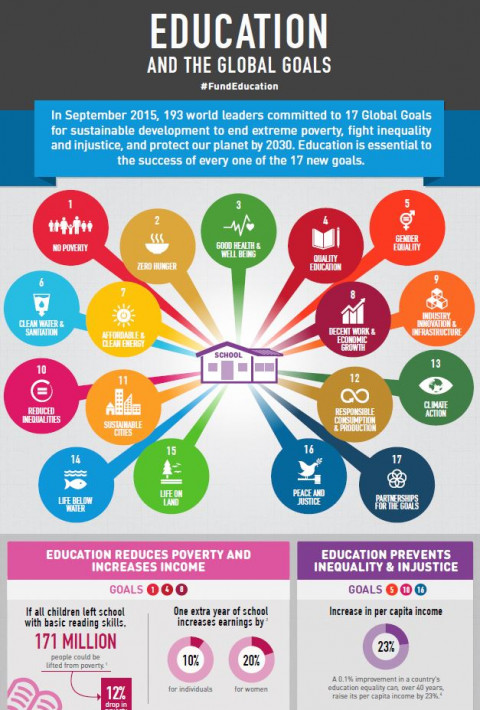 Education and the Global Goals سنة النشر: 2015 المؤلف المؤسسي: Global Partnership for Education (GPE) In September 2015, 193 world leaders committed to 17 Global Goals for sustainable development to end extreme poverty, fight inequality and injustice, and protect our planet by 2030. Education is essential to the success of every one of the 17 new goals.To learn more: https://www.globalpartnership.org/blog/17-ways-education-influences-new-17-global-goals
  UNITED NATIONS HUMAN RIGHTS MECHANISMS and the Right to Education in Insecurity and Armed Conflict المؤلف: Takhmina Karimova | Gilles Giacca | Stuart Casey-Maslen المؤلف المؤسسي: Geneva Academy of International Humanitarian Law and Human Rights This publication, United Nations Human Rights Mechanisms and the Right to Education in Insecurity and Armed Conflict, seeks to respond to the acute need to identify trends in the practice, and contribution, of United Nations human rights mechanisms to the protection of education in times of insecurity and conflict. It is the result of a one-year research project carried out by researchers at the Geneva Academy of International Humanitarian Law and Human Rights (Geneva Academy). The research was overseen by a Legal Advisory Committee and subject to multi-disciplinary peer review. Accompanying the publication is a summary policy document intended to guide future work in this area. An electronic version of each publication is available at http://www.geneva-academy.ch and at http://www.educationandconflict.org.United Nations Human Rights Mechanisms and the Right to Education in Insecurity and Armed Conflict is the second in a series of legal research documents commissioned by Protect Education in Insecurity and Conflict (PEIC) on the protection of education during insecurity and armed conflict. PEIC is a programme of the Education Above All Foundation, an independent organization chaired by Her Highness Sheikha Moza Bint Nasser of Qatar, UNESCO Special Envoy for Basic and Higher Education. A policy, research, and advocacy organization, PEIC is concerned with the protection of education during insecurity and armed conflict. PEIC’s Legal Programme contributes to such protection through the strategic use of international and national law. Its legal research papers are authored by academics and/or practicing lawyers. They are aimed at a varied audience, including international and national lawyers; non-legally trained education experts and policy-makers within governments; political, social, and cultural bodies; and civil society. The Geneva Academy aims to provide instruction of a high academic standard, conduct and promote scientific research, organize training courses and expert meetings, and provide legal expertise in the branches of international law relating to situations of armed conflict. Founded in 2007, the Academy replaces the University Centre for International Humanitarian Law created in 2002 by the Faculty of Law of the University of Geneva and the Graduate Institute of International Studies, now the Graduate Institute of International and Development Studies(IHEID).
 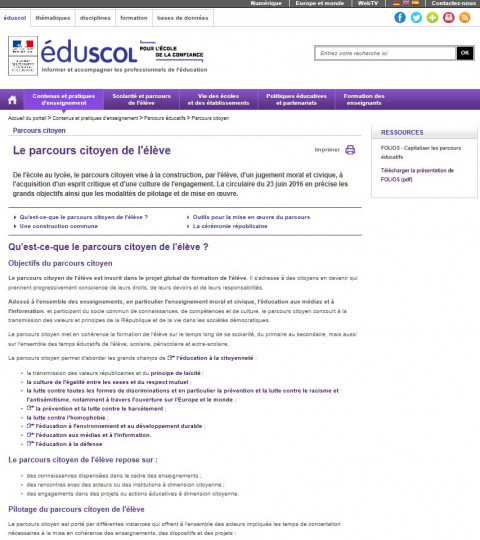 Le parcours citoyen de l'élève سنة النشر: 2016 المؤلف المؤسسي: éducscol De l'école au lycée, le parcours citoyen vise à la construction, par l'élève, d'un jugement moral et civique, à l'acquisition d'un esprit critique et d'une culture de l'engagement. La circulaire du 23 juin 2016 en précise les grands objectifs ainsi que les modalités de pilotage et de mise en œuvre. Qu'est-ce-que le parcours citoyen de l'élève ? Une construction commune Outils pour la mise en œuvre du parcours La cérémonie républicaine
  Éducation à la citoyenneté mondiale : Un guide pédagogique سنة النشر: 2010 المؤلف المؤسسي: Fondation Éducation et Déveleoppement L’«éducation à la citoyenneté» a pour but d’enseigner les interdépendances mondiales en faisant des liens globaux. Les élèves étudient les différents aspects du même thème à travers les interdé-pendances, les intérêts divergents, les différentes perceptions et valeurs. Ils doivent être capables de se situer dans un monde globalisé et de développer leurs propres valeurs et attitudes. Le Guide d’éducation à la citoyenneté mondiale propose aux enseignant-e-s une méthode d’enseignement qui permettra à leurs élèves de comprendre les interdépendances mondiales.Les bases théoriques vous présentent le concept de l’éducation à la citoyenneté mondiale. Un guide didactique vous aide à préparer votre enseignement.Des exemples vous proposent des idées de mise en œuvre et du matériel pédagogique.
 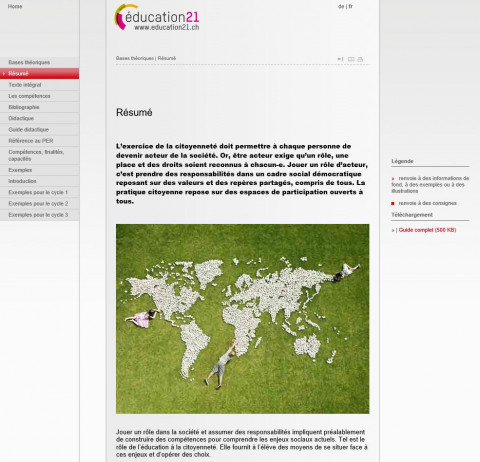 [Résumé] Éducation à la citoyenneté mondiale : Un guide pédagogique المؤلف المؤسسي: Éducation 21 L’exercice de la citoyenneté doit permettre à chaque personne de devenir acteur de la société. Or, être acteur exige qu’un rôle, une place et des droits soient reconnus à chacun-e. Jouer un rôle d’acteur, c’est prendre des responsabilités dans un cadre social démocratique reposant sur des valeurs et des repères partagés, compris de tous. La pratique citoyenne repose sur des espaces de participation ouverts à tous.