
الموارد
استكشف مجموعة واسعة من الموارد القيمة حول تعليم المواطنة العالمية لتعميق فهمك وتعزيز البحث والمناصرة والتعليم والتعلم.
تم العثور على 3,454 نتيجة
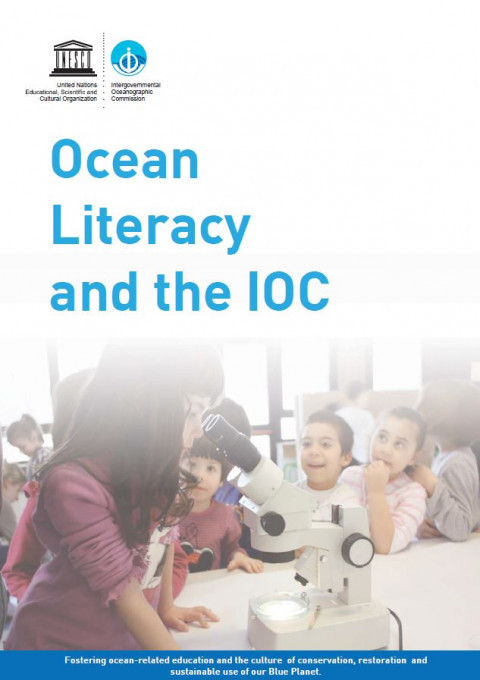 Ocean Literacy and the IOC: Fostering Ocean-related Education and the Culture of Conservation, Restoration and Sustainable Use of Our Blue Planet سنة النشر: 2017 المؤلف المؤسسي: Intergovernmental Oceanographic Commission (IOC) The general public is not aware of the full extent of the medical, economic, social, political and environmental importance of the sea.Many of us are not aware that our day-to-day actions can have a cumulative effect on the health of the ocean and seas – a necessary resource that must be protected for all life on planet earth to exist.In other words, people lack a sense of ‘Ocean Literacy’ i.e. an understanding of the ocean’s influence on us and our influence on the ocean.In more detail, ocean literacy is more than just educating or informing the public and the marine and maritime stakeholders about the importance of oceans.Ocean literacy, through the use of behavioral change methods and by adopting a system approach, aims at facilitating the creation of an ocean literate society.
 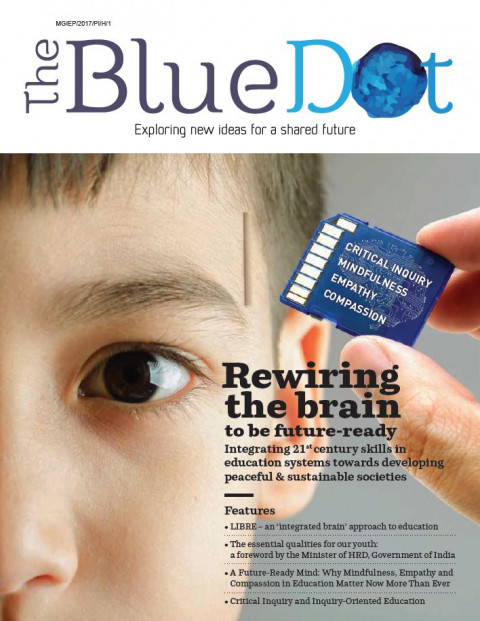 Rewiring the Brain to be Future-ready: Integrating 21st Century Skills in Education Systems Towards Developing Peaceful & Sustainable Societies (The Blue Dot Issue 6, 2017) سنة النشر: 2017 المؤلف المؤسسي: Mahatma Gandhi Institute of Education for Peace and Sustainable Development (MGIEP) In the sixth issue of the Blue Dot, we focus on the importance of these 21st century skills for the young. The issue includes a foreword by the Minister of Human Resource Development, Government of India on the importance of inculcating 21st century skills in education systems and our Cover Story, which introduces UNESCO MGIEP’s LIBRE programme that follows an ‘integrated brain’ approach to education.Additionally, we feature opinions by specialists from academia, research and the industry on the lacuna present in existing education systems and the opportunities available to address this gap by introducing socio-emotional skills and inquiry oriented learning into curricula. Amongst various experts, we hear from Ines Kudo and Joan Hartley from The World Bank on the importance of ‘Teaching empathy and compassion in schools’; Prof. K.P. Mohanan on ‘Critical Inquiry and Inquiry oriented education’ and Dr. Marilee Bresciani Ludvik on how mindfulness forms the foundation for cultivating compassion.Further, we present excerpts from a collection of ‘Ask me Anything’ sessions focused on socioemotional skills, hosted on Knowledge Commons, UNESCO MGIEP’s knowledge sharing platform.We have been honoured to have the opportunity to host and learn from experts such as Dr. Richard Davidson, recognised as one of ‘The 100 most influential people in the world’ in 2006 by the Time Magazine and Chade-Meng Tan, currently the Chairman of Search Inside Yourself Leadership Institute and Co-chair of One Billion Acts of Peace, which has been nominated eight times for the Nobel Peace Prize.
  One Voice for All: Education Pack سنة النشر: 2013 المؤلف المؤسسي: British Council One Voice for All is a set of resources designed to help teachers work on the Connecting Classrooms themes of Rights and Responsibilities and Fairness and Equality through an exploration of human rights and street children. Its focus is the UN Convention on the Rights of the Child and it aims to allow learners to develop understanding of the key concepts of global citizenship, universal rights and justice.This resource aims to give young people the opportunity to understand the complexity of the wider world in which they live by exploring inequality and steps to address it.
  Rivers of the World Education Pack سنة النشر: 2015 المؤلف: Alison Willmott المؤلف المؤسسي: British Council This education resource pack extends the project’s reach to a much greater number of schools and provides a wealth of exciting cross-curricular activities for pupils aged 7–14. It is designed to expand knowledge and understanding, help your pupils to develop core skills and encourage them to explore and reflect on local and global issues. It also contains examples of artwork from the project and illustrations of how schools around the world have used the resources with their students.
 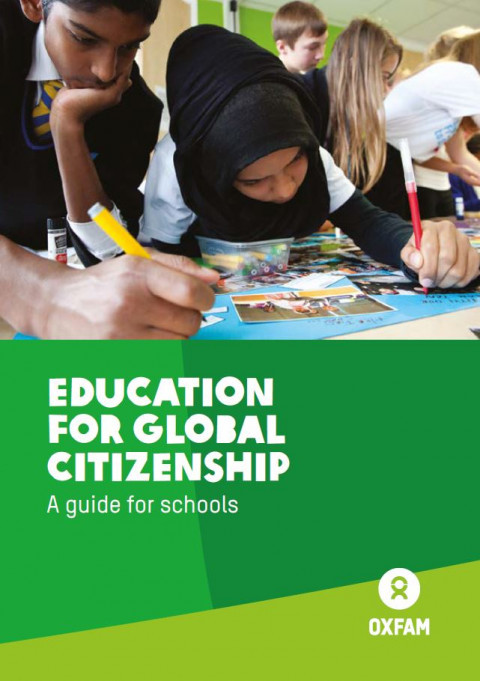 Education for Global Citizenship: A Guide for Schools سنة النشر: 2015 المؤلف المؤسسي: Oxfam GB Education for global citizenship supports young people to explore and question the world around them. It promotes critical thinking, advocates social justice and encourages learners to apply their learning to real-world issues.This guide is packed with practical information for mapping global citizenship across different subject areas and age groups. It also includes inspiring case studies from schools that take a global citizenship approach to teaching and learning.
 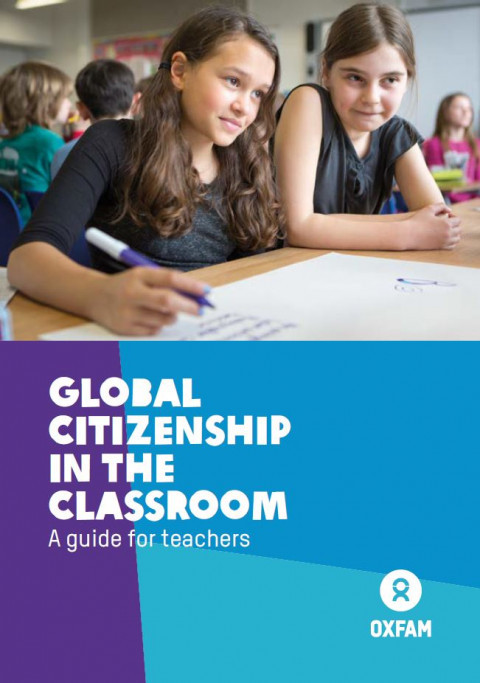 Global Citizenship in the Classroom: A Guide for Teachers سنة النشر: 2015 المؤلف المؤسسي: Oxfam GB This guide is packed with practical tools and advice for teachers wanting to embed global citizenship in their classrooms. Learn how to effectively bring a global lens into your teaching with our handy planning framework, participation methods, and tools to assess learning.Develop your teaching practice with both innovative and tried-and-tested approaches. Help your learners ask questions, make connections, and take action as active global citizens.
  Background: Using Photographs in the Classroom المؤلف المؤسسي: Oxfam GB It's a universal truth that a picture tells a thousand words. Images and artefacts can help bring your lessons to life. They can challenge stereotypes, engender empathy and increase your learners' understanding of other countries and cultures.Explore how to effectively use photographs in your lessons to foster debate and promote positive images of the countries you're learning about.
 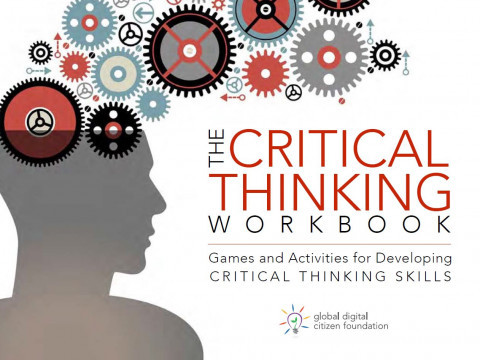 The Critical Thinking Workbook: Games and Activities for Developing Critical Thinking Skills المؤلف المؤسسي: Global Digital Citizen Foundation Critical thinking is clear, rational, logical, and independent thinking. It’s about improving thinking by analyzing, assessing, and reconstructing how we think. It also means thinking in a self-regulated and self-corrective manner. It’s thinking on purpose!The Critical Thinking Workbook helps you and your students develop mindful communication and problem-solving skills with exciting games and activities. It has activities that are adaptable to any grade level you want.The activity pages in the Critical Thinking Workbook are meant to be shared and explored. Use it as an electronic document or as worksheets.You can either print off the pages and use them as activity sheets, or you can edit them directly right in the document on your computer.There are also Answer Keys for the activities that need them provided at the back of the book.
  Beyond Access: Toolkit for Integrating Gender-based Violent Prevention and Response into Education Projects سنة النشر: 2015 المؤلف المؤسسي: United States Agency for International Development (USAID) This toolkit was developed to support implementation of the U.S. Strategy to Prevent and Respond to Gender-based Violence Globally. It provides guidance and resources for USAID technical and program officers working on education to increase understanding of GBV in the education context and strengthen integration of a gender-based violence (GBV) response into projects and activities. Because reducing school-related GBV is a high priority for USAID in all school systems globally, this toolkit includes school-related GBV, but the overall focus is GBV in the education context broadly.The Toolkit provides:The United States government definition of GBV and USAID’s definition of school-related GBVExplanation for why integrating GBV prevention and response improves education outcomes, and the evidence on the prevalence of GBV in the education sectorGuiding principles to ensure the well-being of those at risk for, and survivors of, GBVIllustrative GBV prevention and response activities by the USAID Education Strategy GoalsGuidance on how to integrate GBV prevention and response throughout theUSAID Program Cycle to be able to monitor, evaluate, learn, and adapt education projects and activities accordingly, and it includes illustrative indicators for measuringGBV prevention and response for each of the USAID Education Strategy goals.
 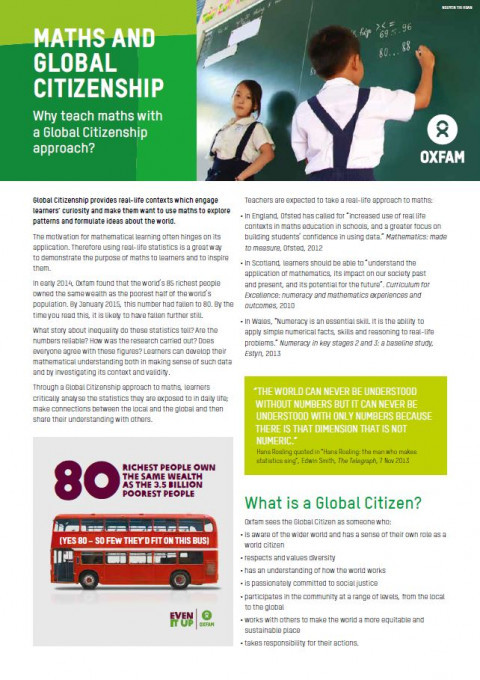 Maths and Global Citizenship المؤلف المؤسسي: Oxfam GB Maths can help your learners better understand different people, places and patterns in the world. Teaching it with a global angle can also give an insight into how maths can be applied and used to address and inform real-world issues.This guide includes creative ideas for how global citizenship can be utilised in core areas of the curriculum like ratios and fractions, probability and number. It's also filled with innovative resources for use in your classroom.