
الموارد
استكشف مجموعة واسعة من الموارد القيمة حول تعليم المواطنة العالمية لتعميق فهمك وتعزيز البحث والمناصرة والتعليم والتعلم.
تم العثور على 2,781 نتيجة
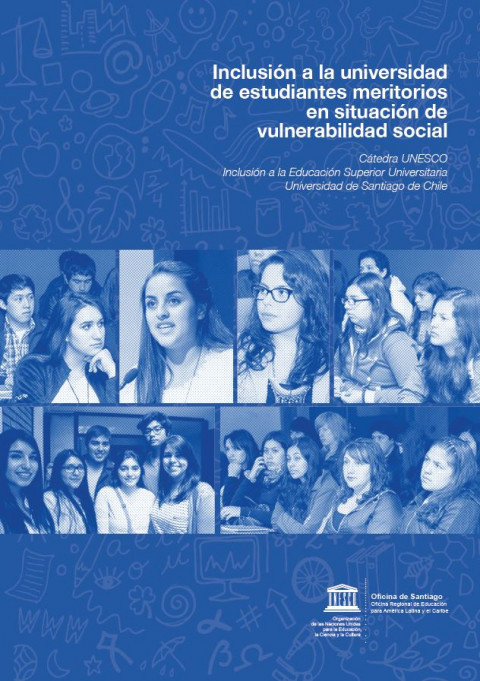 Inclusión a la universidad de estudiantes meritorios en situación de vulnerabilidad social سنة النشر: 2015 المؤلف: Marcela Orellana | Karla Moreno | Francisco Javier Gil المؤلف المؤسسي: UNESCO Santiago | UNESCO Chair on Inclusion in Higher Education La primera edición de este trabajo fue publicada por la OREALC/UNESCO Santiago para su difusión entre los asistentes a la Reunión Ministerial Educación para Todos en América Latina y el Caribe: Balance y desafíos post 2015, en el marco del Proyecto Regional de Educación para América Latina y el Caribe (PRELAC), realizada en Lima, Perú el 30 y 31 de octubre de 2014. En esta segunda edición, nos complace sumar otros mecanismos de inclusión que surgen del compromiso de la Cátedra UNESCO de Inclusión en la Educación Superior, el valioso apoyo de fundaciones privadas sin fin de lucro y el apoyo de la OREALC/UNESCO Santiago. La generación de estas alianzas constituye un aporte fundamental para el levantamiento de información relevante para el diseño de propuestas de políticas públicas tendientes a disminuir las brechas de desigualdad en la educación superior, a garantizar el derecho a una educación de calidad y a colaborar a la construcción de sociedades con mayor justicia social.
  The Time Period of the Holocaust in the Beliefs of Primary School Children – Children’s Perspectives and the Thematization of the Holocaust and National Socialism in Primary-School Instruction (in General Subjects) سنة النشر: 2012 المؤلف: Andrea Becher The original title: Die Zeit des Holocaust in Vorstellungen von Grundschulkindern – Perspektiven von Kindern und die Thematisierung von Holocaust und Nationalsozialismus im (Sach-)Unterricht der Grundschule(In I. Enzenbach, C. Klätte, & D. Pech, (Eds.). Kinder und Zeitgeschichte: Jüdische Geschichte und Gegenwart, Nationalsozialismus und Antisemitismus, Supplement, 8, pp. 101–120) This is a summary of a study of German primary school children’s beliefs about the Holocaust, based on interviews conducted in two classes in 2005. The author finds that the children almost exclusively focus on Hitler; that one can find “latent anti-Semitic fragments” in their statements; that, even without formal education, the pupils still possess knowledge about the Holocaust; and their main source of information about Nazi Germany seems to be family members. However, the family narratives mainly touch upon everyday-life and avoid the topic of the Holocaust. From these findings, the author argues that one could and should teach the Holocaust already in the German primary school. The above abstract is taken from the International Holocaust Remembrance Alliance Education Research Project. Please also consult the full list of abstracts in 15 languages and the accompanying publication Research in Teaching and Learning about the Holocaust: A Dialogue Beyond Borders. Ed: IHRA, Monique Eckmann, Doyle Stevick, Jolanta Ambrosewicz-Jacobs, 2017, Metropol Verlag.
  “Just Don’t Moralize!” Emotional Processes in the Pedagogical Engagement with National Socialism سنة النشر: 2008 المؤلف: Gudrun Brockhaus The original title: “Bloß nicht moralisieren!” Emotionale Prozesse in der pädagogischen Auseinandersetzung mit dem Nationalsozialismus(Einsichten und Perspektiven, Bayerische Zeitschrift für Politik und Geschichte, 1(8), pp. 28–33.) The article is a critical reflection on the outcomes of an empirical study (Kühner 2008; Kühner et al. 2008), based on a psychological/psychoanalytical perspective: how should we deal with emotions when dealing with the Holocaust? The author highlights the teachers’ very high expectations regarding the emotional Betroffenheit, the pressure on consensus, and the tabooisation of “political incorrectness” in the classroom, tendencies that can lead to a problematic teacher-student relationship. Thus, teachers encounter specific didactical difficulties and show a certain lack of self-assertion. Brockhaus assumes that this is based on how the teacher relates, as a person and as a pedagogue, to the heritage of National Socialism. Brockhaus concludes by insisting on the necessity to reflect openly, as students and as teachers, on the emotional processes and the reluctance caused by the topic of the Holocaust in this society. The above abstract is taken from the International Holocaust Remembrance Alliance Education Research Project. Please also consult the full list of abstracts in 15 languages and the accompanying publication Research in Teaching and Learning about the Holocaust: A Dialogue Beyond Borders. Ed: IHRA, Monique Eckmann, Doyle Stevick, Jolanta Ambrosewicz-Jacobs, 2017, Metropol Verlag at www.holocaustremembrance.com/resources/publications
  Education and Disability: Analysis of Data from 49 Countries (UIS Information Paper No. 49) سنة النشر: 2018 المؤلف المؤسسي: UNESCO Institute for Statistics (UIS) Sustainable Development Goal (SDG) 4 calls for “inclusive and quality education for all”. Persons with a disability are among the population groups most likely to suffer from exclusion from education but data that permit an analysis of the links between disability and education remain scarce.This paper examines educational disparities linked to disability based on data from 49 countries and territories for five education indicators: Proportion of 15- to 29-year-olds who ever attended school Out-of-school rate (primary school age, lower secondary school age) Completion rate (primary education, lower secondary education) Mean years of schooling of the population 25 years and older Adult literacy rate (population 15 years and older)
  The Write for Rights: A Human Rights Education Pack سنة النشر: 2015 المؤلف المؤسسي: Amnesty International This education pack contains five activities on human rights for young people. It can be used as an introduction to human rights, to global solidarity, to campaigning and activism, and to the wider work of Amnesty International. The activities provide a broad perspective on these issues and others.They are useful in opening young people’s minds to global concerns and involving them in actions which can have a real impact on people’s lives.The activities can be run at any time, but will be most effective either before or during the time of Amnesty International’s ‘Write for Rights’ campaign, which this year runs from 4 to 17 December. By working on these cases and taking part in the campaign, young people will know that they are part of a massive global movement of people. They – and you – can bring about a real improvement in the lives of the people featured in the following pages. Escribe por los derechos: Conjunto de materiales para la educacion ed derechos humanos سنة النشر: 2015 المؤلف المؤسسي: Amnesty International This education pack contains five activities on human rights for young people. It can be used as an introduction to human rights, to global solidarity, to campaigning and activism, and to the wider work of Amnesty International. The activities provide a broad perspective on these issues and others.They are useful in opening young people’s minds to global concerns and involving them in actions which can have a real impact on people’s lives.The activities can be run at any time, but will be most effective either before or during the time of Amnesty International’s ‘Write for Rights’ campaign, which this year runs from 4 to 17 December. By working on these cases and taking part in the campaign, young people will know that they are part of a massive global movement of people. They – and you – can bring about a real improvement in the lives of the people featured in the following pages. Écrire pour les droits: Dossier pour l’éducation aux droits humains سنة النشر: 2015 المؤلف المؤسسي: Amnesty International This education pack contains five activities on human rights for young people. It can be used as an introduction to human rights, to global solidarity, to campaigning and activism, and to the wider work of Amnesty International. The activities provide a broad perspective on these issues and others.They are useful in opening young people’s minds to global concerns and involving them in actions which can have a real impact on people’s lives.The activities can be run at any time, but will be most effective either before or during the time of Amnesty International’s ‘Write for Rights’ campaign, which this year runs from 4 to 17 December. By working on these cases and taking part in the campaign, young people will know that they are part of a massive global movement of people. They – and you – can bring about a real improvement in the lives of the people featured in the following pages.
  The Write for Rights: A Human Rights Education Pack سنة النشر: 2015 المؤلف المؤسسي: Amnesty International This education pack contains five activities on human rights for young people. It can be used as an introduction to human rights, to global solidarity, to campaigning and activism, and to the wider work of Amnesty International. The activities provide a broad perspective on these issues and others.They are useful in opening young people’s minds to global concerns and involving them in actions which can have a real impact on people’s lives.The activities can be run at any time, but will be most effective either before or during the time of Amnesty International’s ‘Write for Rights’ campaign, which this year runs from 4 to 17 December. By working on these cases and taking part in the campaign, young people will know that they are part of a massive global movement of people. They – and you – can bring about a real improvement in the lives of the people featured in the following pages.
  UNESCO Survey on Intercultural Dialogue, 2017: Analysis of Findings سنة النشر: 2018 المؤلف المؤسسي: UNESCO Institute for Statistics (UIS) The present report sets out the key findings of the first UNESCO survey on intercultural dialogue conducted among its Member States. The survey takes stock of the current understanding and operational mechanisms and strategies of intercultural dialogue at national level. It assesses the main issues and opportunities, current policies and legislation, available data and resources, and main stakeholders in this field. The resulting information permits an initial inventory of countryspecific intercultural dialogue policies that will function as a point of analysis for future monitoring and inform future policy-making.The questionnaire for the survey was distributed to 199 National Commissions for UNESCO in six official United Nations languages with a submission deadline of Spring 2017. There was a response rate of 21.622%. The respondents represent all geographic regions, including countries with large, middle and small populations, and over half are from developing economies.
  Address by Irina Bokova, Director-General of UNESCO, on the occasion of the Ethics in Action event, Casina Pio IV in the Vatican Gardens; Vatican, 16 October 2017 سنة النشر: 2017 المؤلف المؤسسي: UNESCO. Director-General, 2009-2017 (Bokova, I.G.) This address was delivered by Irina Bokova, Director-General of UNESCO, on the occasion of the Ethics in Action event, Casina Pio IV in the Vatican Gardens; Vatican, on 16 October 2017.