
الموارد
استكشف مجموعة واسعة من الموارد القيمة حول تعليم المواطنة العالمية لتعميق فهمك وتعزيز البحث والمناصرة والتعليم والتعلم.
تم العثور على 3,453 نتيجة
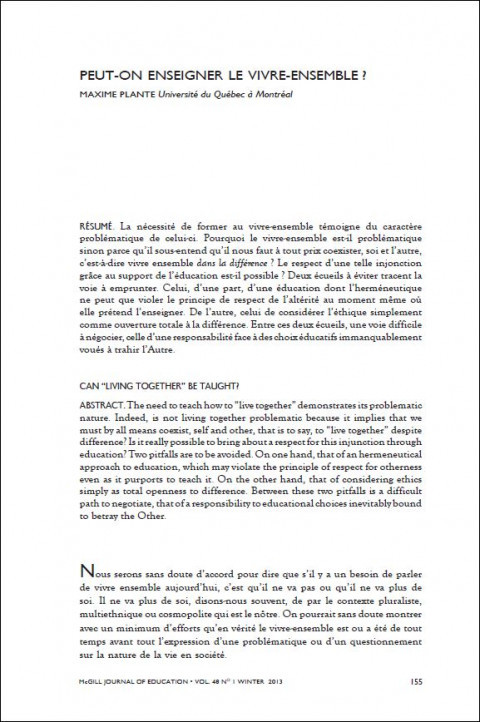 Peut-on enseigner le vivre-ensemble ? سنة النشر: 2013 المؤلف: Maxime Plante المؤلف المؤسسي: McGill University. Faculty of Education La nécessité de former au vivre-ensemble témoigne du caractère problématique de celui-ci. Pourquoi le vivre-ensemble est-il problématique sinon parce qu’il sous-entend qu’il nous faut à tout prix coexister, soi et l’autre, c’est-à-dire vivre ensemble dans la différence ? Le respect d’une telle injonction grâce au support de l’éducation est-il possible ? Deux écueils à éviter tracent la voie à emprunter. Celui, d’une part, d’une éducation dont l’herméneutique ne peut que violer le principe de respect de l’altérité au moment même où elle prétend l’enseigner. De l’autre, celui de considérer l’éthique simplement comme ouverture totale à la différence. Entre ces deux écueils, une voie difficile à négocier, celle d’une responsabilité face à des choix éducatifs immanquablement voués à trahir l’Autre.
 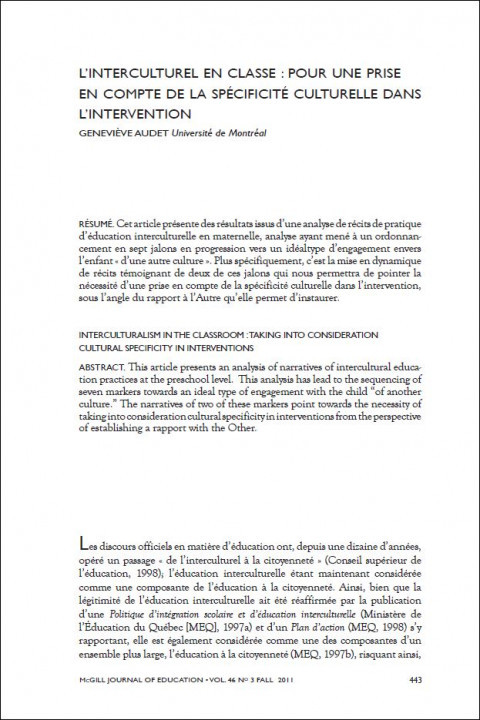 Interculturalism in the Classroom: Taking into Consideration Cultural Specificity in Interventions سنة النشر: 2011 المؤلف: Geneviève Audet المؤلف المؤسسي: McGill University. Faculty of Education This article presents an analysis of narratives of intercultural education practices at the preschool level. This analysis has lead to the sequencing of seven markers towards an ideal type of engagement with the child “of another culture.” The narratives of two of these markers point towards the necessity of taking into consideration cultural specificity in interventions from the perspective of establishing a rapport with the Other. L’interculturel en classe: pour une prise en compte de la spécificité culturelle dans l’intervention سنة النشر: 2011 المؤلف: Geneviève Audet المؤلف المؤسسي: McGill University. Faculty of Education Cet article présente des résultats issus d’une analyse de récits de pratique d’éducation interculturelle en maternelle, analyse ayant mené à un ordonnancement en sept jalons en progression vers un idéaltype d’engagement envers l’enfant « d’une autre culture ». Plus spécifiquement, c’est la mise en dynamique de récits témoignant de deux de ces jalons qui nous permettra de pointer la nécessité d’une prise en compte de la spécificité culturelle dans l’intervention, sous l’angle du rapport à l’Autre qu’elle permet d’instaurer.
 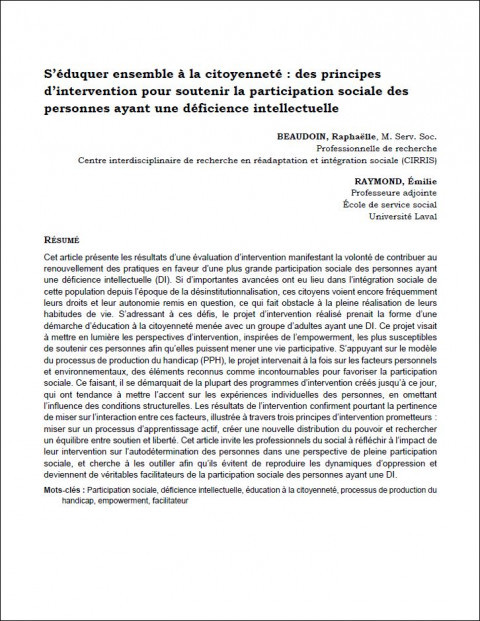 Together in Citizenship Education: Intervention Principles to Support the Social Participation of People with Intellectual Disabilities سنة النشر: 2016 المؤلف: Raphaëlle Beaudoin | Émilie Raymond المؤلف المؤسسي: Service social This article presents the outcomes of an intervention’s evaluation that was intended to contribute to the renewal of practices in favour of greater social participation of people with intellectual disabilities (ID). Although much has been achieved for the social integration of this population since deinstitutionalization, these citizens still frequently see their rights and their independence questioned, presenting obstacles to the full achievement of life habits. To address these challenges, this intervention project took the form of a citizenship education group led by adults with ID. This intervention project aimed to highlight the prospects of intervention, inspired by an empowerment approach, the most likely to support these people to lead a participatory and self-determined life. Based on the Disability Creation Process model (DCP), this project involved both personal and environmental factors, which are recognized as key elements for social participation. In doing so, it stands out from most intervention programs created to date, which tend to focus on the individual experiences of people, omitting the influence of structural conditions. Yet, the results of this intervention support the relevance of focusing on the interaction between these factors, illustrated through three promising intervention principles: to build on an active learning process, to create a new distribution of power and to seek a balance between support and freedom. This approach asks social professionals to consider the impact of their intervention on self-determination in attaining social participation. It also aims to better equip these professionals to avoid reproducing the dynamics of oppression and to become true facilitators of the social participation of people with ID.
 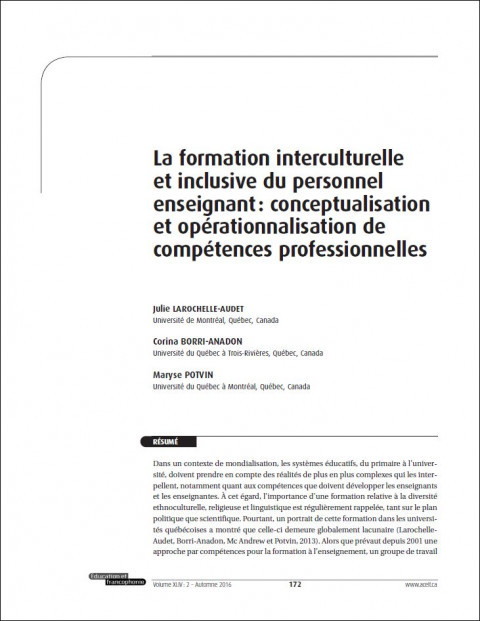 La formation interculturelle et inclusive du personnel enseignant: conceptualisation et opérationnalisation de compétences professionnelles سنة النشر: 2016 المؤلف: Julie Larochelle-Audet | Corina Borri-Anadon | Maryse Potvin المؤلف المؤسسي: Éducation et francophonie Dans un contexte de mondialisation, les systèmes éducatifs, du primaire à l’université, doivent prendre en compte des réalités de plus en plus complexes qui les interpellent, notamment quant aux compétences que doivent développer les enseignants et les enseignantes. À cet égard, l’importance d’une formation relative à la diversité ethnoculturelle, religieuse et linguistique est régulièrement rappelée, tant sur le plan politique que scientifique. Pourtant, un portrait de cette formation dans les universités québécoises a montré que celle-ci demeure globalement lacunaire (Larochelle-Audet, Borri-Anadon, Mc Andrew et Potvin, 2013). Alors que prévaut depuis 2001 une approche par compétences pour la formation à l’enseignement, un groupe de travail interuniversitaire a entrepris de pallier ce manque en enrichissant le référentiel ministériel de compétences professionnelles du personnel enseignant. Les travaux du groupe, présentés dans l’article, s’appuient sur une analyse critique du référentiel, qui révèle l’absence de considérations concrètes quant à la diversité ethnoculturelle et aux finalités d’une formation interculturelle et inclusive en enseignement. Les membres du groupe ont élaboré deux modalités visant à insérer au référentiel des compétences interculturelles et inclusives : la première propose d’intégrer 21 composantes à même les 12 compétences professionnelles existantes et la seconde privilégie l’ajout d’une nouvelle compétence dite interculturelle et inclusive. Leur opérationnalisation comporte certaines limites et certains risques, qui font ici l’objet d’une discussion.
  The Fragile Unsustainable Environmental Participation: A Problematization سنة النشر: 2009 المؤلف: Stéphane La Branche المؤلف المؤسسي: Université du Québec à Montréal (UQAM) | Éditions en environnement VertigO Sustainable development has become the way to achieve a triple objective: insure economic ands material development in a sustainable and democratic manner. Yet, the links between participatory democracy and environmental protection are not direct nor necessarily positive. This article offers, through literature reviews and case studies, to raise a few issues and paradoxes existing in the position that participation necessarily leads to better environment protection. Examples form dams, the fight against climate change and use of public transports will be given. This raises the fundamental governance question: what are the implications for governance of the refusal or resistance on the part of population at changing sufficiently their behaviours in matters of environmental protection and the fight against climate change? L’insoutenable légèreté environnementale de la participation: Une problématisation سنة النشر: 2009 المؤلف: Stéphane La Branche المؤلف المؤسسي: Université du Québec à Montréal (UQAM) | Éditions en environnement VertigO Le développement durable et participatif est devenu depuis une dizaine d’années une contrainte axiologique dont dépend en grande partie la légitimité du pouvoir politique et même économique. Au sein de cette notion est le pari à la fois théorique et pratique que la meilleure façon d’atteindre la durabilité est d’inclure les citoyens dans le processus de prise de décision. L’article présente les résultats de plusieurs études, théoriques et une revue de la littérature en profondeur (notamment sur la gouvernance climatique) et empiriques (sur les barrages, le refus de l’éolien et les transports en commun), pour problématiser le lien entre participation et protection de l’environnement. Nos études suggèrent une forte absence de problématisation de la relation entre ces deux ensembles de pratiques et de valeurs différentes et qui peuvent entrer en conflit. Nous constatons également que les instances internationales de décision promeuvent la participation comme solution aux problèmes environnementaux mais laisse le soin aux instances de décisions nationales et locales la responsabilité politique de développer les politiques publiques nécessaires aux modifications de comportements et de valeurs nécessaires pour atteindre les objectifs environnementaux. Ceci nous amène à soulever la question fondamentale en matière de gouvernance : quelles sont les implications du refus ou des réticences des populations à modifier suffisamment leurs comportements, pour la gouvernance environnementale et climatique ? S’éduquer ensemble à la citoyenneté: des principes d’intervention pour soutenir la participation sociale des personnes ayant une déficience intellectuelle سنة النشر: 2016 المؤلف: Raphaëlle Beaudoin | Émilie Raymond المؤلف المؤسسي: Service social Cet article présente les résultats d’une évaluation d’intervention manifestant la volonté de contribuer au renouvellement des pratiques en faveur d’une plus grande participation sociale des personnes ayant une déficience intellectuelle (DI). Si d’importantes avancées ont eu lieu dans l’intégration sociale de cette population depuis l’époque de la désinstitutionnalisation, ces citoyens voient encore fréquemment leurs droits et leur autonomie remis en question, ce qui fait obstacle à la pleine réalisation de leurs habitudes de vie. S’adressant à ces défis, le projet d’intervention réalisé prenait la forme d’une démarche d’éducation à la citoyenneté menée avec un groupe d’adultes ayant une DI. Ce projet visait à mettre en lumière les perspectives d’intervention, inspirées de l’empowerment, les plus susceptibles de soutenir ces personnes afin qu’elles puissent mener une vie participative. S’appuyant sur le modèle du processus de production du handicap (PPH), le projet intervenait à la fois sur les facteurs personnels et environnementaux, des éléments reconnus comme incontournables pour favoriser la participation sociale. Ce faisant, il se démarquait de la plupart des programmes d’intervention créés jusqu’à ce jour, qui ont tendance à mettre l’accent sur les expériences individuelles des personnes, en omettant l’influence des conditions structurelles. Les résultats de l’intervention confirment pourtant la pertinence de miser sur l’interaction entre ces facteurs, illustrée à travers trois principes d’intervention prometteurs : miser sur un processus d’apprentissage actif, créer une nouvelle distribution du pouvoir et rechercher un équilibre entre soutien et liberté. Cet article invite les professionnels du social à réfléchir à l’impact de leur intervention sur l’autodétermination des personnes dans une perspective de pleine participation sociale, et cherche à les outiller afin qu’ils évitent de reproduire les dynamiques d’oppression et deviennent de véritables facilitateurs de la participation sociale des personnes ayant une DI.
  Education for Sustainable Development or Sustainable Development in Teaching History and Geography: Sociopolitical Issues and School Discipline سنة النشر: 2013 المؤلف: Nicole Tutiaux-Guillon المؤلف المؤسسي: Phronesis «Sustainable development» (SD) is in France since 2004 is a transdisciplinary and binding «education to» and is also the theme structuring the fifth degree program since 2008, and is included in other programs. These requirements are unevenly convergent and are encounter to structure of already built diciplines at the same time as the lack of stabilised reference-knowledge. How is the educational dimension (attitudes, values) articulated to disciplinary content ? What about the place given to political issues of SD? Education in SD as constitutive of a discipline isn’t at the expense of educational dimensions explicit or is it modify disciplinary model of history and geography? An empirical search provides tentative answers. The forms of work chosen by the teachers ranged from classical disciplinary practice and testing of trans / multidisciplinary between incitement to questioning and reflection and transmission of factual and impartial knowledge entrecomplexité and simplification. Behavior change is always assumed result of knowledge - sometimes educational activities. The textbooks reflect the same hesitation and are situated between neutralization / disciplinarisation of SD issues and explicitation of discussion and conflicts / implicante posture. The educational dimension and especially the question of political strongly divided the teachers. Éduquer au développement durable ou enseigner le développement durable en histoire-géographie : enjeux sociopolitiques et discipline scolaire سنة النشر: 2013 المؤلف: Nicole Tutiaux-Guillon المؤلف المؤسسي: Phronesis Le « développement durable » (DD) est depuis 2004 en France l’objet d’une « éducation à » transdisciplinaire et obligatoire ; il est aussi thème structurant le programme de 5e depuis 2008, et figure dans d’autres programmes. Ces prescriptions sont inégalement convergentes et se heurtent aux structures des disciplines constituées, en même temps qu’à l’absence de savoirs de référence stabilisés. Comment la dimension éducative (comportements, valeurs) est-elle articulée sur les contenus disciplinaires ? Qu’en est-il de la place faite aux enjeux politiques du DD ? L’éducation au DD est-elle « disciplinarisée », aux dépens des dimensions éducatives explicites, ou au contraire modifie-t-elle le modèle disciplinaire de l’histoire-géographie ? Une recherche empirique apporte des réponses provisoires. Les formes de travail choisies par les enseignants oscillent entre pratique disciplinaire classique et essais de trans/pluridisciplinarité, entre incitation au questionnement et à la réflexion et transmission de savoirs factuels et impartiaux, entrecomplexité et simplification. Le changement de comportement est toujours supposé résulter des savoirs – parfois des actions pédagogiques. Les manuels reflètent les mêmes hésitations et se situent entre neutralisation/disciplinarisation des questions de DD et explicitation des débats et des conflits/posture implicante. La dimension éducative et surtout la question du politique divisent fortement les enseignants.